
The journey between San Francisco and Los Angeles is more than just a commute; it is a quintessential California experience that spans the diverse geography of the United States West Coast. Whether you are a business traveler looking for the quickest transit or a vacationer seeking the salt air of the Pacific Ocean, understanding the distance and the routes available is the first step in planning a successful trip. The distance between these two iconic cities varies significantly depending on whether you prioritize speed, scenery, or local culture. Generally, the mileage ranges from approximately 380 miles to over 450 miles, dictated entirely by your choice of asphalt.

The Most Efficient Path: Driving via Interstate 5
For those whose primary goal is to minimize time spent behind the wheel, Interstate 5 is the standard choice. Often referred to simply as “the 5” by locals, this highway cuts through the heart of the state, offering a direct, albeit less scenic, connection between Northern and Southern California.
Mileage and Estimated Travel Time
When traveling from San Francisco to Los Angeles via Interstate 5, the total distance is roughly 382 miles. Under ideal conditions, this drive takes about six to seven hours. However, travelers should always account for the notorious traffic in both the Bay Area and the Los Angeles Basin. Leaving during peak rush hour can easily add two hours to the journey. The route begins by crossing the Bay Bridge or heading south through San Jose to connect with the interstate in the Central Valley.
Landscapes of the Central Valley
The drive along Interstate 5 is characterized by the vast agricultural expanses of the San Joaquin Valley. While it lacks the dramatic cliffs of the coast, it offers a fascinating look at the “breadbasket of the world.” You will pass through endless orchards of almonds, pistachios, and citrus. Notable stops along this route for fuel and food include Kettleman City and Bakersfield. As you approach Southern California, the road climbs through the Tejon Pass, reaching an elevation of over 4,000 feet at the Tejon Summit before descending into the San Fernando Valley.
The Scenic Adventure: Highway 1 and the Pacific Coast Highway
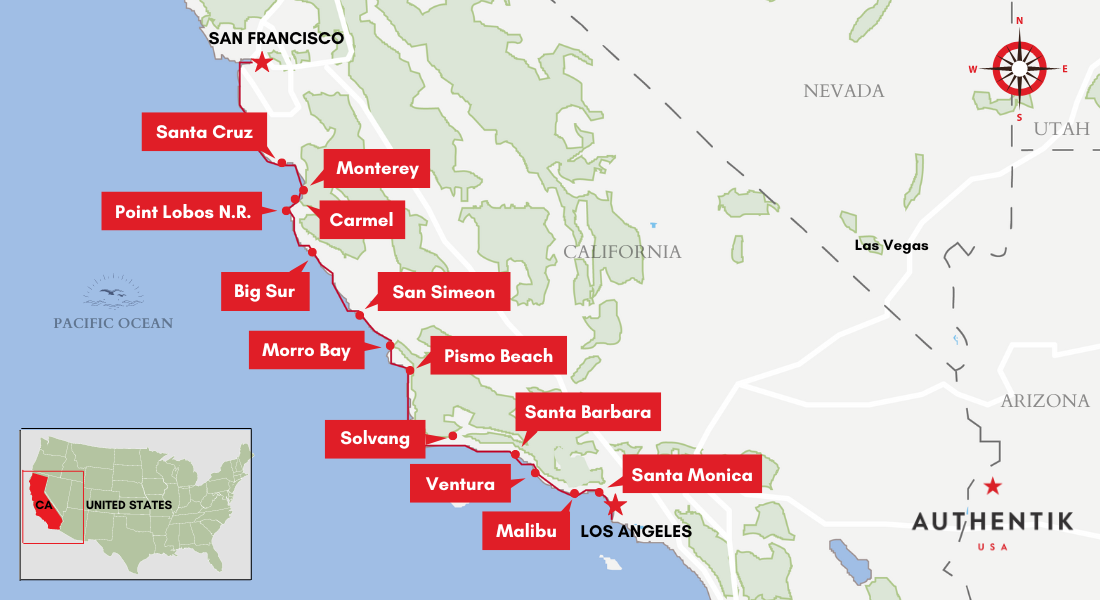
If time is not a constraint, the route along Highway 1, also known as the Pacific Coast Highway, is widely considered one of the most beautiful drives in the world. This path hugs the rugged coastline, providing breathtaking views of the Pacific Ocean.
Calculating the Coastal Distance
Taking the scenic route increases the distance to approximately 450 miles or more, depending on how many coastal detours you take. Because much of the road is two-lane and winding—particularly through the Big Sur region—this journey typically requires at least nine to ten hours of pure driving time. Most travelers choose to break this trip into two or three days to fully enjoy the attractions along the way.
Iconic Landmarks Along the Coast
The allure of this route lies in its landmarks. Starting from San Francisco, travelers often stop at Half Moon Bay and the seaside boardwalk of Santa Cruz. Further south, the Monterey Peninsula offers the world-renowned Monterey Bay Aquarium and the charming streets of Carmel-by-the-Sea.
The stretch through Big Sur is the highlight for many, featuring the architectural marvel of Bixby Creek Bridge and the ethereal McWay Falls. As the road moves into San Luis Obispo County, travelers can visit the opulent Hearst Castle in San Simeon or watch elephant seals at Piedras Blancas.
The Middle Ground: US Route 101
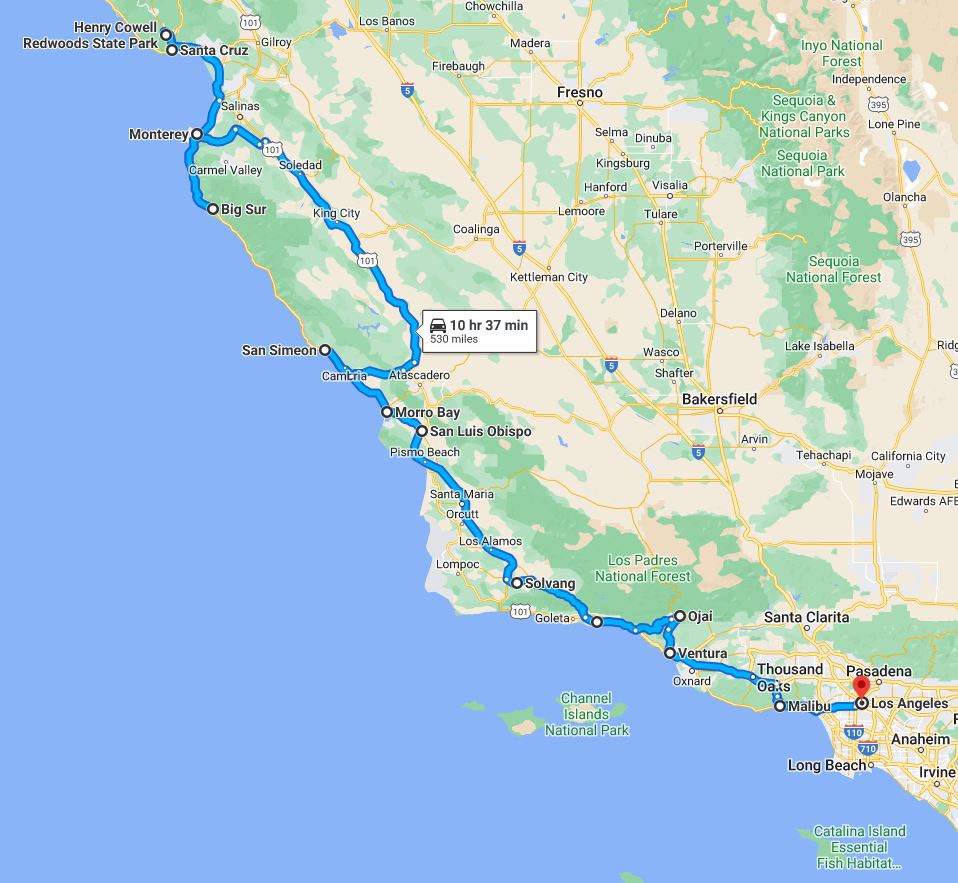
For travelers who want a balance between the efficiency of the interstate and the beauty of the coast, US Route 101 serves as an excellent compromise. This route runs inland through rolling hills and wine country before hitting the coast in the southern half of the state.
Distance and Regional Highlights
The distance via US Route 101 is about 430 miles. It takes roughly seven to eight hours to drive. This path is favored by those who enjoy visiting historic California Missions and sprawling vineyards. The road passes through San Jose and continues south into the Salinas Valley.
Wine Country and Coastal Cities
A major draw of the 101 is the access to Paso Robles, a premier wine destination. After passing through the hills, the highway joins the coast at Pismo Beach and San Luis Obispo. From there, it winds through the “American Riviera” in Santa Barbara, offering views of the Santa Ynez Mountains on one side and the ocean on the other. The final leg takes you through Ventura and Oxnard before entering the sprawl of Los Angeles.
Alternative Modes of Travel: Beyond the Car
While driving is the most common way to cover the miles between San Francisco and Los Angeles, several other transportation methods offer different perspectives on the distance.
Flying Between Major Hubs
By air, the distance is approximately 340 miles. Flights from San Francisco International Airport (SFO) to Los Angeles International Airport (LAX) take about one hour and fifteen minutes of gate-to-gate time. When you include airport security and transit, the total travel time is around four hours. Many travelers also utilize secondary airports like Oakland International Airport, San Jose Mineta International Airport, Hollywood Burbank Airport, and Long Beach Airport to avoid the congestion of the larger hubs.
The Amtrak Experience
For a truly relaxed pace, Amtrak offers the Coast Starlight service. While the train does not follow a straight line and takes approximately 12 hours to complete the trip, it offers views that are inaccessible by car. Passengers can sit in the observation car and watch the Pacific Ocean and the Santa Susana Mountains roll by. The train connects Emeryville (near San Francisco) to Union Station in downtown Los Angeles.
Essential Tips for the California Road Trip
Regardless of which route you choose, traveling hundreds of miles across California requires preparation. The state’s diverse microclimates and heavy traffic patterns can influence your experience.
Planning for Weather and Road Conditions
Weather can vary drastically between the foggy mornings of San Francisco and the dry heat of Los Angeles. Along Highway 1, landslides occasionally cause road closures, especially during the winter rainy season. It is vital to check the Caltrans website for real-time updates on road conditions before departing. If traveling via Interstate 5 during the winter, be aware that the Tejon Pass (The Grapevine) can occasionally close due to snow or high winds.
Fuel and Electric Vehicle Charging
California is well-equipped for the modern traveler. Both Interstate 5 and US Route 101 have frequent gas stations and electric vehicle (EV) charging stations. However, if you are driving through the more remote sections of Big Sur, gas stations are few and far between, and prices can be significantly higher than in the cities. It is a good rule of thumb to fuel up in Monterey or Cambria before entering the more secluded stretches of the coastline.
The journey from San Francisco to Los Angeles is a testament to the variety of the Golden State. Whether you choose the 382-mile dash through the valley or the 450-mile coastal odyssey, the distance represents a transition between two of the most influential cultural hubs in the world. By choosing the route that aligns with your travel goals—be it the history of Santa Barbara, the tech corridors of Silicon Valley, or the cinematic allure of Hollywood—you turn a simple question of “how many miles” into an unforgettable California travel story.
LifeOutOfTheBox is a participant in the Amazon Services LLC Associates Program, an affiliate advertising program designed to provide a means for sites to earn advertising fees by advertising and linking to Amazon.com. Amazon, the Amazon logo, AmazonSupply, and the AmazonSupply logo are trademarks of Amazon.com, Inc. or its affiliates. As an Amazon Associate we earn affiliate commissions from qualifying purchases.