
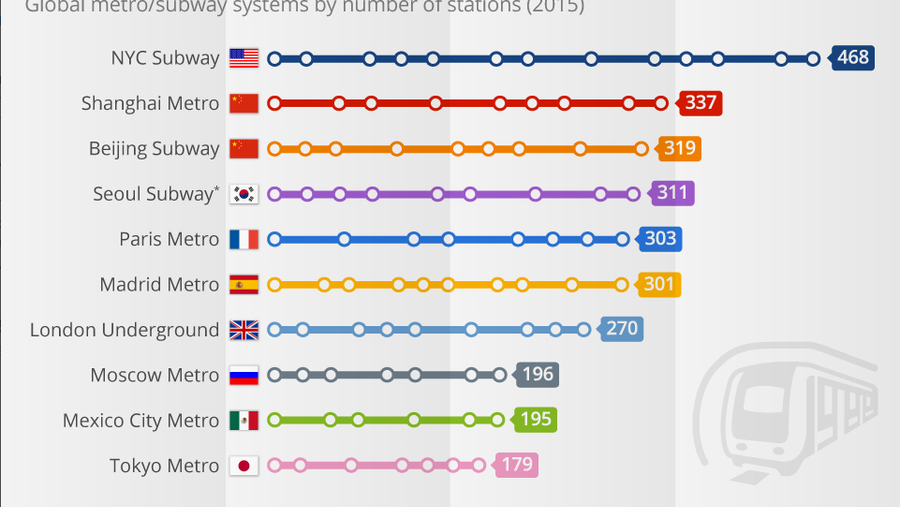
The New York City subway system is often described as the circulatory system of the city that never sleeps. Navigating its labyrinthine tunnels and historic platforms is a rite of passage for every resident and a core component of the experience for any visitor. But for those trying to grasp the sheer scale of the transit network, the question of exactly how many stations exist is deceptively complex. While the official tally stands at 472 stations, the reality of the system involves a deep history of mergers, architectural shifts, and urban development that makes the network far more fascinating than a simple digit suggests.

The Official Count and What It Includes
When the Metropolitan Transportation Authority releases its official figures, it cites 472 stations. This number represents the total count of individual stops where a passenger can board or exit a train. However, this figure is a bit of a statistical chameleon because of how the system evolved throughout the 20th century.
The Legacy of Three Systems
To understand why there are so many stations, one must look at the history of the IRT, BMT, and IND lines. In the early days of the 20th century, these three competing companies built their own networks. When the city unified these lines into a single municipal system in the 1940s, many stations that were geographically close—or even structurally connected—remained distinct entities.
Transfer Complexes vs. Individual Stops
A crucial distinction in the 472-count is the “transfer complex.” Many major hubs in Manhattan, such as the Times Square-42nd Street complex, act as massive interconnected nodes. While the MTA counts these as a singular complex for administrative and navigational purposes, they often include platforms that served different former private operators. If you were to count every individual platform and entry point separately, the number would change significantly, but for the commuter, the 472-station count remains the standard benchmark for accessibility across the five boroughs.
Geography and the Distribution of Transit
The density of stations is not spread evenly across New York. The distribution of these 472 points reflects the historic growth of the city’s commercial and residential hubs.
The Manhattan Concentration
Unsurprisingly, the highest concentration of stations is found in [Manhattan]. Because of the borough’s narrow shape and its role as the primary business district, the subway lines are packed tightly together, often with stations located just a few blocks apart. This density is a marvel of urban planning, allowing commuters to traverse the island from the Financial District to Harlem with relative ease, despite the age of the infrastructure.

Connectivity in the Outer Boroughs
The system extends far beyond the island, with significant service into Brooklyn, Queens, and The Bronx. The development of the subway was the primary driver for the expansion of these boroughs in the early 1900s. Areas that were once farmland were transformed into thriving residential neighborhoods as soon as a station opened. Today, the outer borough stations are the lifeblood of the city, connecting diverse communities to the central hubs of labor and culture. Staten Island, while part of the city, operates its own distinct Staten Island Railway and is technically not part of the primary subway count, which underscores how unique the core network truly is.
The Evolution of Station Design and History
Beyond the math, the 472 stations serve as an architectural timeline of America. Each station is a piece of living history, reflecting the design trends and industrial priorities of the decade in which it was built.
Mosaic Art and Historic Tilework
One of the most charming aspects of the system is the historic mosaic signage. Stations built in the early 1900s, such as the beautiful City Hall Station (which is now closed but visible via special tours), feature intricate terra cotta and ceramic tiles. These were not merely functional; they were designed to help illiterate or non-English-speaking immigrants navigate the system by using colors and symbols to identify their stops. Today, many of these original motifs remain, preserved by the city as historic landmarks.
Modernization and Expansion
While the city works to maintain the history of its older stations, it also embraces the new. The expansion of the Second Avenue Subway introduced some of the most modern and spacious stations in the network, featuring high ceilings, climate control, and massive public art installations. These stations represent the future of transit, proving that even a system with over a century of history can continue to evolve to meet the needs of a growing population.
Navigating the Network: Tips for Travelers
With 472 stations to choose from, navigating the system can be daunting. Whether you are headed to Central Park or the Brooklyn Bridge, understanding the system’s layout is essential.
- Mind the Express vs. Local: Many stations are “local” stops, meaning only certain trains stop there. Express trains skip these stations to save time, which is vital for long-distance travel across boroughs. Always check the platform signage to ensure your train stops at your destination.
- Understand the Neighborhoods: Some neighborhoods have multiple station entrances spread across several blocks. A quick glance at a map on your phone before exiting the turnstile can save you a long walk in the wrong direction.
- Respect the Flow: In a network this busy, station etiquette is paramount. Stay to the right, keep the stairs clear, and be prepared to move quickly once the doors open.
Ultimately, the 472 stations of the New York City Subway are more than just transit infrastructure. They are the gateways to the city’s hidden gems, from the iconic theaters of Broadway to the diverse food scenes in Queens. While the exact number of stations may occasionally change as new lines are added or old, redundant entrances are closed, the spirit of the system remains constant. It is a vast, interconnected, and essential part of life in one of the world’s most vibrant urban landscapes. Every time you descend those stairs, you are participating in a massive, daily communal effort that keeps the pulse of New York beating. Whether you are a local who knows the system by heart or a first-time traveler figuring out the Q train route, the subway is the best way to see the city as it really is: fast, deep, and endlessly complex.
LifeOutOfTheBox is a participant in the Amazon Services LLC Associates Program, an affiliate advertising program designed to provide a means for sites to earn advertising fees by advertising and linking to Amazon.com. Amazon, the Amazon logo, AmazonSupply, and the AmazonSupply logo are trademarks of Amazon.com, Inc. or its affiliates. As an Amazon Associate we earn affiliate commissions from qualifying purchases.