
Exploring the diverse landscapes of California, from its sun-drenched beaches to its majestic mountains, is an unforgettable experience for many. Whether you’re a tourist embarking on a scenic road trip or a new resident settling in, understanding the local laws is crucial. One common pitfall that can significantly impact your travel budget and overall experience is a speeding ticket. Unlike a mere slap on the wrist, a speeding ticket in California can quickly escalate into a substantial financial burden, accompanied by other inconvenient consequences. This guide aims to shed light on the true cost of a speeding ticket in the Golden State, offering insights and practical tips to help you navigate its roadways responsibly.

The Base Fine: More Than Meets The Eye
When you receive a speeding ticket in California, the amount initially listed on the citation, often referred to as the “base fine,” is merely the tip of the iceberg. This figure represents the core penalty for exceeding the speed limit, but it’s far from the total amount you’ll be expected to pay.
Understanding California’s Fine Structure
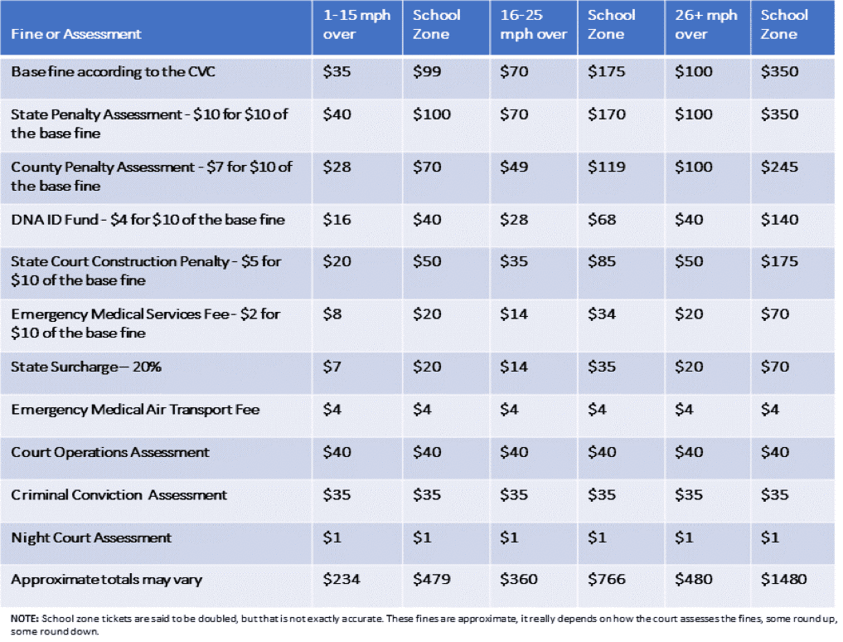
California law dictates base fines based on how much you exceeded the posted speed limit. These are typically categorized as follows:
- 1-15 mph over the limit: The base fine typically starts around $35.
- 16-25 mph over the limit: The base fine increases to approximately $70.
- 26+ mph over the limit: The base fine becomes significantly higher, often around $100 or more, and the consequences can be more severe, potentially leading to reckless driving charges depending on the circumstances.
It’s important to note that these are approximate figures and can vary slightly by county or specific circumstances. However, the crucial takeaway is that these base fines are just the starting point of your financial obligation.
The Accumulation of Additional Fees and Assessments
What transforms a relatively modest base fine into a hefty bill are the numerous “penalty assessments,” surcharges, and administrative fees that are tacked onto it. These additions are mandated by state and local laws and fund various government programs and services. They can easily multiply the base fine by four to five times, sometimes even more. These often include:
- State Penalty Assessments: Several different state-mandated surcharges.
- County Penalty Assessments: Fees specific to the county where the infraction occurred.
- Court Facility Construction Funds: Contributing to courthouse maintenance and new construction.
- Emergency Medical Services Funds: Supporting emergency services.
- Traffic Violator School Fees: If you opt for traffic school, there’s often an administrative fee to determine eligibility and process your request.
- DNA Identification Funds: A fee contributing to DNA testing programs.
For example, a ticket with a $35 base fine could easily swell to $230-$250 or more once all these assessments and surcharges are applied. A $70 base fine might result in a ticket costing well over $350. These additional fees make understanding the total cost complex, underscoring why a simple speeding ticket is never simple in California.
Factors Influencing the Final Cost
The ultimate price tag of your speeding ticket isn’t static; it’s a dynamic figure influenced by several critical factors, ranging from the specifics of your infraction to your driving history.
Speed Increment and Location
The most direct determinant of your ticket cost is how fast you were going relative to the speed limit. As discussed, exceeding the limit by a greater margin results in a higher base fine, which then multiplies the associated fees. However, the location of the offense is equally significant:
- Construction Zones: Speeding in an active construction zone carries double the normal fine. These zones are clearly marked, and enforcement is often stricter due to worker safety.
- School Zones: Similarly, exceeding the speed limit in a designated school zone, especially during school hours, incurs higher penalties.
- Safety Enhancement Zones: Certain stretches of highway are designated as “Safety Enhancement Zones” due to high accident rates. Speeding here also carries increased fines.
- Specific Jurisdictions: While state laws set the framework, individual counties or cities like Los Angeles or San Francisco might have slight variations in local fees or a reputation for particularly rigorous enforcement. For instance, tickets issued by the California Highway Patrol (CHP) or local police departments can sometimes involve different court systems, though the fines are generally consistent statewide.
Prior Driving Record and Traffic School
Your driving history plays a crucial role in the long-term impact of a speeding ticket.
- Clean Record: If you have a relatively clean driving record and meet specific eligibility criteria (e.g., the violation was not too severe, you haven’t attended traffic school in the last 18 months), you might be eligible to attend traffic school. While you still pay the full fine, successfully completing traffic school prevents the point from being added to your driving record, which can save you money on insurance premiums.
- Multiple Offenses: For drivers with a history of speeding tickets or other moving violations, the consequences for subsequent infractions become more severe. Repeat offenders might not be eligible for traffic school, leading to points on their record and potentially higher insurance rates.
- Serious Infractions: Speeding excessively (e.g., 100 mph or more) or in conjunction with other dangerous driving behaviors can elevate the charge from a simple infraction to a misdemeanor or even a felony, carrying much steeper fines, mandatory court appearances, community service, and potential license suspension.
Beyond Financial Penalties: The Wider Implications
While the immediate financial cost of a speeding ticket in California is significant, it’s essential to consider the broader, often hidden, implications that extend beyond the initial fine.
Points on Your Driving Record
California operates on a “point” system, where moving violations result in points being added to your driving record. A standard speeding ticket typically adds one point. Accumulating too many points within a certain timeframe can lead to serious consequences:
- License Suspension:
- 4 points in 12 months
- 6 points in 24 months
- 8 points in 36 months
— Any of these thresholds can result in a driver’s license suspension.
- Impact on Out-of-State/International Drivers: For those visiting California from another state or country, a speeding ticket can still have repercussions. Many states have reciprocal agreements with California, meaning points or convictions can be reported to your home state’s Department of Motor Vehicles (DMV), potentially affecting your license there. International visitors might face difficulties renting cars in California in the future or even impact their travel visa status if the offense is severe.
Insurance Premium Hikes
Perhaps the most enduring and costly consequence of a speeding ticket is the inevitable increase in your automobile insurance premiums. Insurance companies view speeding violations as an indicator of higher risk.
- Duration of Increase: Even a single point can cause your premiums to rise significantly, and this increase can last for three to five years. Over this period, the cumulative cost of increased premiums can far exceed the initial ticket fine.
- Rental Car Users: If you’re driving a rental car and receive a ticket, the rental company will typically forward the ticket to you. However, some rental agreements might include clauses allowing the company to charge administrative fees for processing the ticket, and the violation could still be reported to your driving record, affecting your personal insurance. This hidden cost is a crucial consideration for tourists.
Strategies for Addressing a Speeding Ticket
Receiving a speeding ticket can be stressful, but understanding your options for addressing it can help mitigate the impact.
Paying the Fine
The simplest and most straightforward option is to pay the fine. This means admitting guilt and accepting all associated consequences, including the points on your record (unless you’re eligible for traffic school). Payment can usually be made online, by mail, or in person at the relevant courthouse. Be mindful of the due date to avoid additional penalties or a warrant for your arrest.
Attending Traffic School
If eligible, attending traffic school is often the best option to prevent a point from appearing on your driving record. Eligibility typically requires:
- The violation being an infraction (not a misdemeanor or felony).
- Not having attended traffic school for a prior violation within the last 18 months.
- The ticket not being for excessive speed (e.g., 26+ mph over the limit or 100+ mph).
While you still pay the full ticket amount plus an administrative fee for traffic school, the benefit of avoiding increased insurance premiums often outweighs these costs. Upon successful completion, the conviction is masked, and the point is not reported to the DMV.
Contesting the Ticket
You have the right to contest your speeding ticket in court. This option is advisable if you believe:
- There was a factual error on the citation.
- You were misidentified.
- The speed measuring equipment was faulty or improperly used.
- There’s insufficient evidence to prove your guilt beyond a reasonable doubt.
Contesting a ticket involves appearing before a judge, presenting your case, and potentially cross-examining the issuing officer. While it offers the chance for dismissal, it also requires time, preparation, and potentially legal fees if you hire an attorney. There’s also the option of a “trial by declaration,” where you present your case in writing without a court appearance, and the officer does the same.
Proactive Measures for Drivers in California
The best way to deal with a speeding ticket is to avoid getting one in the first place. For both residents and visitors, adopting a proactive and mindful approach to driving in California is paramount.
Understanding Speed Limits and Road Signs
Always be aware of the posted speed limits. California uses various types of speed limits, including:
- Basic Speed Law: You must never drive faster than is safe for current conditions, regardless of the posted speed limit.
- Maximum Speed Limits: The highest legal speed you can drive on a road, typically 65 mph or 70 mph on freeways, and 55 mph on undivided two-lane highways.
- Reduced Speed Limits: Pay close attention to school zones, residential areas, and business districts where limits are often 25 mph or even 15 mph. Look out for “When Children Are Present” signs, indicating variable enforcement.
Utilizing Navigation Apps and Cruise Control
Modern technology can be a valuable ally. Many navigation apps offer real-time speed limit information and can alert you if you’re exceeding it. Using cruise control on highways is an effective way to maintain a consistent speed and avoid inadvertently creeping over the limit. Be cautious about relying solely on apps for speed trap warnings; safe driving habits are the most reliable defense.
Maintaining a Safe and Mindful Driving Approach
Beyond specific tactics, fostering a general attitude of safe and responsible driving is your best defense against tickets. This includes:
- Allowing Ample Time: Rushing often leads to speeding. Plan your journeys with extra time.
- Avoiding Distractions: Keep your focus entirely on the road and surrounding traffic.
- Being Aware of Your Surroundings: Pay attention to other drivers, road conditions, and potential enforcement presence.
In conclusion, a speeding ticket in California is more than just a minor inconvenience; it’s a multi-faceted financial and administrative burden. By understanding the true costs, potential consequences, and proactive strategies for avoidance, you can ensure your journey through California’s beautiful landscapes remains smooth, enjoyable, and free from unexpected detours. Drive safely and stay informed!
LifeOutOfTheBox is a participant in the Amazon Services LLC Associates Program, an affiliate advertising program designed to provide a means for sites to earn advertising fees by advertising and linking to Amazon.com. Amazon, the Amazon logo, AmazonSupply, and the AmazonSupply logo are trademarks of Amazon.com, Inc. or its affiliates. As an Amazon Associate we earn affiliate commissions from qualifying purchases.