
The silhouette of Las Vegas is one of the most recognizable in the United States, defined by a neon-soaked horizon of architectural wonders. Yet, standing high above the themed resorts and flashing marquees is a singular structure that serves as the ultimate sentinel of the North Strip. Known today as The STRAT Hotel, Casino & Tower, this landmark has captivated visitors since its inception. To understand the gravity of its presence, one must look toward the sky and ask the fundamental question of its scale: exactly how tall is this architectural titan?

Defining the Vertical Majesty of the Las Vegas Skyline
When discussing the physical dimensions of Nevada landmarks, few structures can compete with the sheer verticality of the Stratosphere Tower. It is not merely a tall building; it is a feat of engineering that recalibrated the possibilities of the desert landscape.
Exact Height and Record-Breaking Statistics
The Stratosphere Tower stands at a staggering height of 1,149 feet (approximately 350.2 meters). This measurement cements its position as the tallest freestanding observation tower in the United States. To put this into perspective, it surpasses the height of the Space Needle in Seattle and towers over many of the most famous skyscrapers in Los Angeles and San Francisco.
The tower is divided into several functional zones, but the most impressive is the SkyPod, the multi-level observation area located at the very top. At 1,149 feet, the tip of the spire reaches high into the flight paths of Harry Reid International Airport, requiring specialized lighting and coordination with aviation authorities. Its height is not just for show; it serves as a critical telecommunications hub for the region, utilizing its elevation to broadcast signals across the Las Vegas Valley.
Comparative Heights: Global and Local Context
While the Stratosphere Tower reigns supreme in the Western United States, it is often compared to other global giants. It is shorter than the CN Tower in Toronto, which stands at 1,815 feet, but it remains a significant entry in the list of the world’s tallest towers. Within Las Vegas, the tower dwarfs other local landmarks. For instance, the Eiffel Tower Experience at Paris Las Vegas is a half-scale replica of the original in France, standing at 540 feet—less than half the height of the Stratosphere Tower.
Even the High Roller, the massive observation wheel located near The LINQ Hotel + Experience, reaches only 550 feet. This comparison highlights why the Stratosphere Tower is the undisputed king of the Las Vegas Strip skyline, offering an unobstructed 360-degree view that extends as far as the Spring Mountains and Red Rock Canyon.
The Architectural History and Construction of a Legend
The journey from a blueprint to a 1,149-foot reality was fraught with financial hurdles, engineering obstacles, and a bold vision that many at the time thought was impossible. The tower’s history is as dramatic as its height.
The Vision of Bob Stupak
The tower was the brainchild of Bob Stupak, a legendary Las Vegas casino owner and promoter known for his eccentric ideas. Originally, the project was envisioned as a massive expansion of his Vegas World casino. Bob Stupak initially intended the tower to be even taller—some reports suggest he wanted it to exceed 1,800 feet, which would have made it the tallest structure in the world at the time. However, due to concerns from the Federal Aviation Administration regarding the proximity to the airport, the height was scaled back to its current 1,149 feet.
Construction began in the early 1990s, and the project faced immediate challenges. A massive fire broke out in 1993 during the construction of the tower’s upper levels, which could be seen from miles away. Despite this setback, the structure was completed and officially opened its doors as the Stratosphere Las Vegas in 1996.
Engineering Challenges and Structural Design
Building a 1,149-foot tower in the middle of a desert requires specialized engineering to withstand high winds and extreme temperatures. The Stratosphere Tower is constructed primarily of reinforced concrete at its base and shaft, with a steel superstructure for the SkyPod.
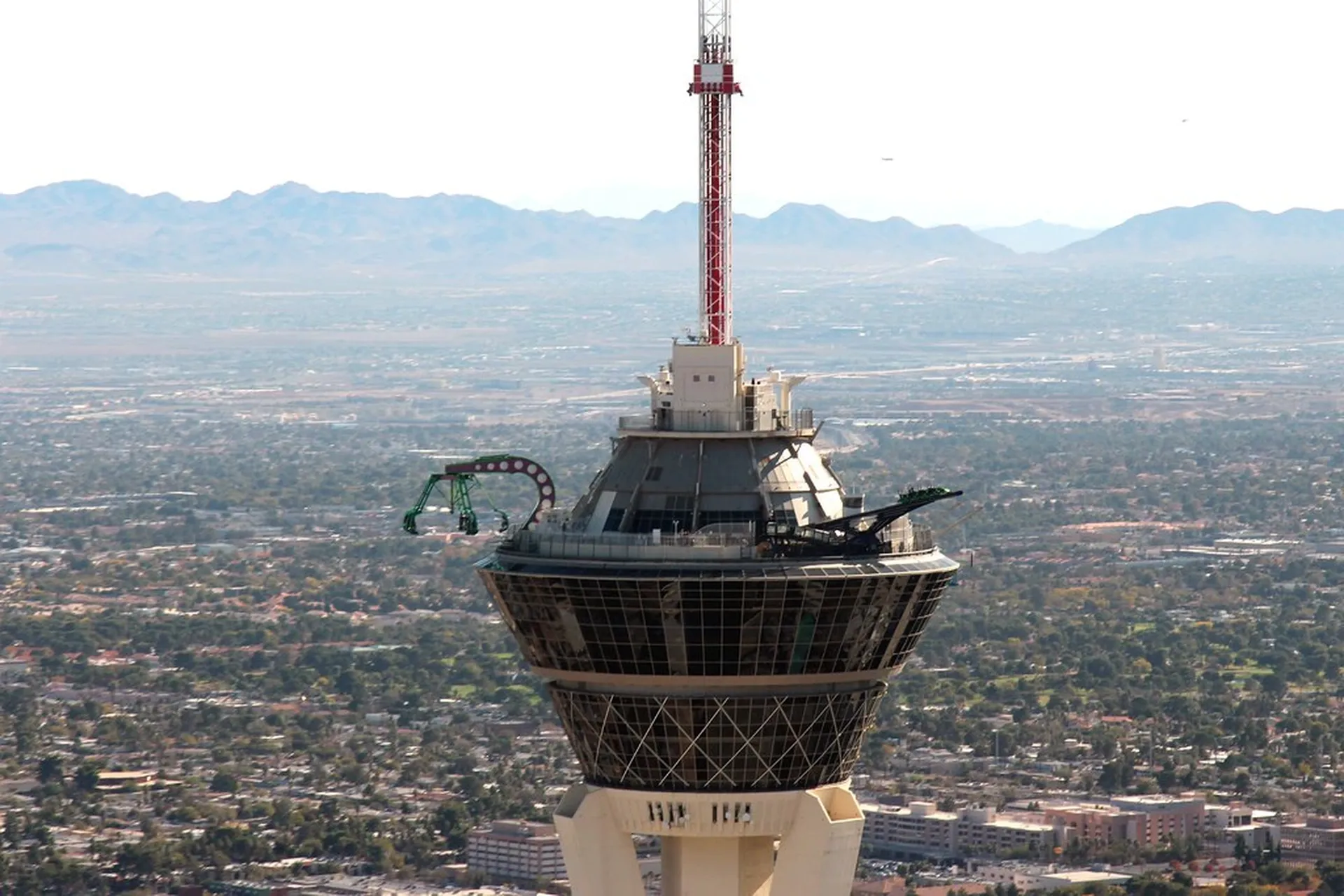
The foundation is incredibly deep, utilizing a system of “piers” that go far into the desert caliche to ensure stability. Because Las Vegas can experience significant wind gusts coming off the mountains, the tower was designed to sway slightly—a standard feature for modern skyscrapers to prevent structural snapping. The elevators are another marvel, among the fastest in the world, capable of whisking guests from the ground floor to the observation deck in approximately 37 seconds.
The STRAT Observation Experience and SkyPod Features
The height of the Stratosphere Tower is best appreciated from within the SkyPod. This section of the tower is more than just a viewing platform; it is a multi-sensory environment that utilizes its elevation to offer world-class dining and adrenaline-pumping activities.
Top of the World: Dining at Elevation
One of the most famous features located within the tower is the Top of the World restaurant. Situated more than 800 feet above the ground, this award-winning restaurant offers a unique experience: it revolves 360 degrees every 80 minutes. This allows diners to see the entirety of Las Vegas, from the glowing lights of Fremont Street Experience in Downtown Las Vegas to the southern end of the Strip near Mandalay Bay, all while enjoying a gourmet meal.
The architecture of the Top of the World level uses floor-to-ceiling slanted glass windows, designed to minimize glare and maximize the view. This design ensures that whether you are visiting during the golden hour or in the middle of the night, the city below looks like a sprawling carpet of jewels.
Extreme Engineering: The Thrill Rides
For many, the height of the tower is an invitation for adventure. The Stratosphere Tower is home to several thrill rides that are record-breaking in their own right because of their elevation.
- Big Shot: This ride shoots passengers 160 feet straight up the tower’s mast to a height of 1,081 feet before dropping them back down. At the peak, riders experience a moment of weightlessness with the entire Las Vegas Valley visible beneath their feet.
- Insanity: A massive robotic arm that extends 64 feet over the edge of the tower, spinning passengers at speeds of up to 40 miles per hour while they are tilted downward at a 70-degree angle.
- X-Scream: This ride resembles a giant seesaw that tilts over the edge of the tower, making riders feel as though they are about to plunge 866 feet to the pavement below.
- SkyJump: Perhaps the most daring of all, SkyJump is a controlled-descent power jump. It holds the Guinness World Record for the highest commercial decelerator descent, allowing guests to jump from the 108th floor and “fly” down toward the landing pad at high speeds.
Cultural and Architectural Legacy in Nevada
Over the decades, the Stratosphere Tower has evolved from a controversial project into a beloved icon of the Silver State. Its presence has influenced the development of the surrounding area and served as a beacon for tourism.
The Transition to The STRAT
In recent years, the property underwent a massive rebranding and renovation to become The STRAT. This shift was more than just a name change; it represented a modernization of the landmark to appeal to a new generation of travelers. While the height of the tower remains its primary draw, the integration of contemporary art, updated casino floors, and refined lounges like the 107 SkyLounge have reinforced its status as a premier destination.
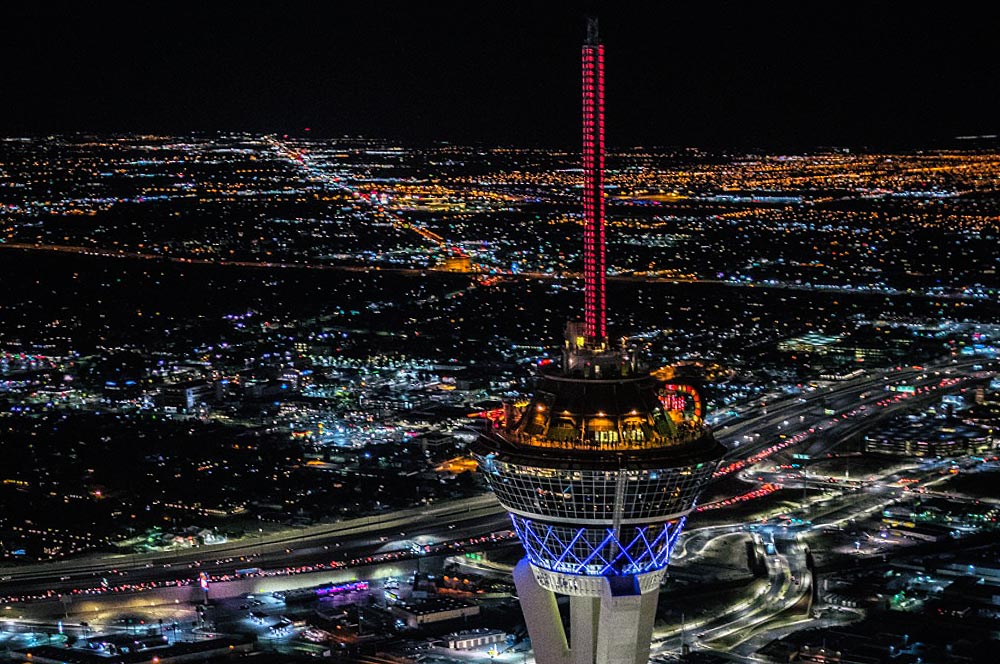
The transition also focused on the exterior lighting of the tower. A sophisticated LED system was installed, allowing the tower to change colors for various holidays, sporting events for the Vegas Golden Knights or Las Vegas Raiders, and charitable causes. This has made the 1,149-foot structure a living part of the city’s communication, reflecting the mood and spirit of Las Vegas each night.
Impact on North Strip Development
The tower’s height has long served as a North Star for the North Strip. For years, this area was less developed than the central and southern portions of the Strip. However, the permanence and success of the Stratosphere Tower helped anchor the district.
Today, with the arrival of new resorts like Resorts World Las Vegas and the Fontainebleau Las Vegas, the tower is no longer an isolated giant. It is now part of a thriving, high-density corridor. Nevertheless, despite the rise of new luxury skyscrapers and the MSG Sphere, the Stratosphere Tower remains the highest point in the city, providing a historical and physical link between the vintage charm of Downtown Las Vegas and the modern glitz of the Strip.
In conclusion, the Stratosphere Tower is much more than a statistic. At 1,149 feet, it is a monument to human ambition and engineering prowess. Whether viewed from the ground at the Golden Nugget or experienced from the terrifying height of X-Scream, it remains an essential pillar of the Las Vegas experience. Its height offers perspective—not just of the city, but of the remarkable growth of Nevada as a global center for architecture and entertainment.
LifeOutOfTheBox is a participant in the Amazon Services LLC Associates Program, an affiliate advertising program designed to provide a means for sites to earn advertising fees by advertising and linking to Amazon.com. Amazon, the Amazon logo, AmazonSupply, and the AmazonSupply logo are trademarks of Amazon.com, Inc. or its affiliates. As an Amazon Associate we earn affiliate commissions from qualifying purchases.