
The narrative of Texas joining the United States is a captivating saga of ambition, conflict, and the persistent spirit of independence that defines the Lone Star State. This transformation from a sprawling republic to a U.S. state in 1845 was not a straightforward process; it was a complex interplay of geopolitical forces, internal struggles, and the fervent desires of its people. Understanding this history offers profound insights into the very fabric of Texas and its enduring identity within the American union.
The Republic of Texas: A Decade of Independence
Before its annexation, Texas existed as an independent nation for nearly a decade. The Republic of Texas was born out of the Texas Revolution, a bloody struggle against the centralized government of Mexico. Following the pivotal victory at the Battle of San Jacinto in 1836, leaders like Sam Houston and Mirabeau B. Lamar steered the new republic.
Early Challenges and Aspirations
The nascent republic faced immense challenges. Economically, it struggled with debt and a lack of stable currency. Politically, it contended with internal divisions and the ever-present threat of renewed conflict with Mexico, which never formally recognized its independence. Despite these difficulties, a significant portion of the Texan populace, many of whom were from the United States, harbored a strong desire for annexation by their former homeland. This sentiment was fueled by cultural ties, economic opportunities, and a shared democratic ideology.
The Debate Over Annexation
The idea of Texas becoming a U.S. state was far from universally embraced. In the United States, the issue was deeply divisive, primarily due to the question of slavery. Texas was a slaveholding territory, and its admission as a state would inevitably upset the delicate balance of power between free and slave states in the U.S. Congress. Northern abolitionists vehemently opposed expansion of slavery, while Southern proponents saw annexation as crucial for the preservation of their way of life.
Furthermore, the powerful republic of Great Britain had interests in the region, including potential trade relationships and a desire to see a buffer state between the United States and Mexico. There was also a faction within Texas itself that preferred to remain an independent nation, envisioning Texas as a dominant force in North America.
The Road to Statehood: Diplomacy and Determination
The path to annexation was arduous, marked by several failed attempts and intense diplomatic maneuvering. Presidents Andrew Jackson and Martin Van Buren were hesitant to push for annexation due to the slavery issue and the potential for war with Mexico. However, by the early 1840s, the political climate began to shift.
The Tyler Administration and Annexation Efforts
President John Tyler, though a Whig in principle, found common ground with Southern Democrats on the issue of annexation. He saw it as a way to expand U.S. territory and influence, and crucially, to secure the future of slavery. In 1843, his administration began serious negotiations with the Republic of Texas government, led by President Anson Jones.
The negotiations culminated in a treaty of annexation in 1844. This treaty, however, faced significant opposition in the U.S. Senate, primarily due to concerns about its constitutionality and the renewed threat of war with Mexico. The treaty was ultimately rejected.
The Polk Presidency and the Final Push
The election of James K. Polk in 1844 proved to be a turning point. Polk, a staunch expansionist, made the annexation of Texas a central plank of his platform, alongside the acquisition of Oregon Country. His victory was widely interpreted as a mandate for territorial expansion.
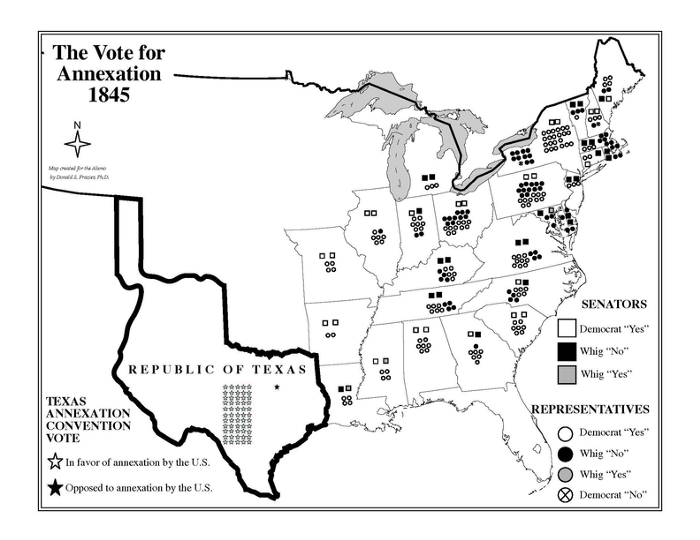
Recognizing that a treaty would likely fail again, the annexation was pursued through a joint resolution of Congress, a more politically expedient method. This approach required a simple majority in both the House of Representatives and the Senate, rather than the two-thirds majority needed for a treaty.
The Annexation Vote and Immediate Aftermath
The joint resolution for annexation was passed in early 1845. The terms offered to Texas were generous: it would be admitted as a state, allowed to retain its public lands, and could divide itself into as many as five new states. The resolution also stipulated that Texas could choose its own constitution and government, provided it was republican in form.
Texan Ratification and Statehood
The decision to accept the annexation terms rested with the people of the Republic of Texas. A convention was called in Austin in July 1845 to consider the proposal. Despite some lingering reservations and the influential voice of Anson Jones who favored independence, the overwhelming sentiment was for joining the United States. The convention drafted a new state constitution, which was subsequently ratified by the Texan voters in October 1845.
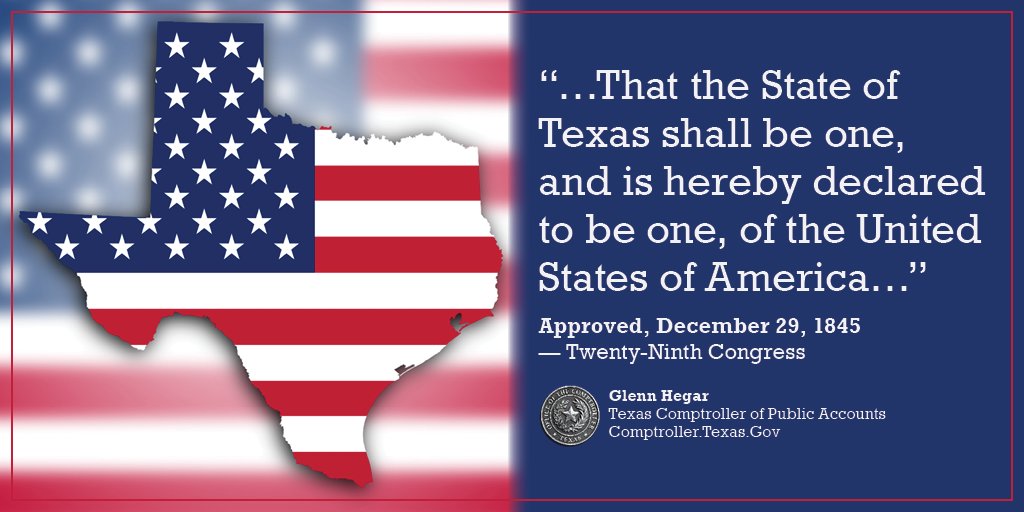
On December 29, 1845, President Polk signed the bill admitting Texas into the Union as the 28th state. However, the formal transfer of authority and the raising of the U.S. flag over Austin did not occur until February 19, 1846, during the inauguration of J. Pinckney Henderson as the first governor of Texas as a U.S. state.
The Mexican-American War
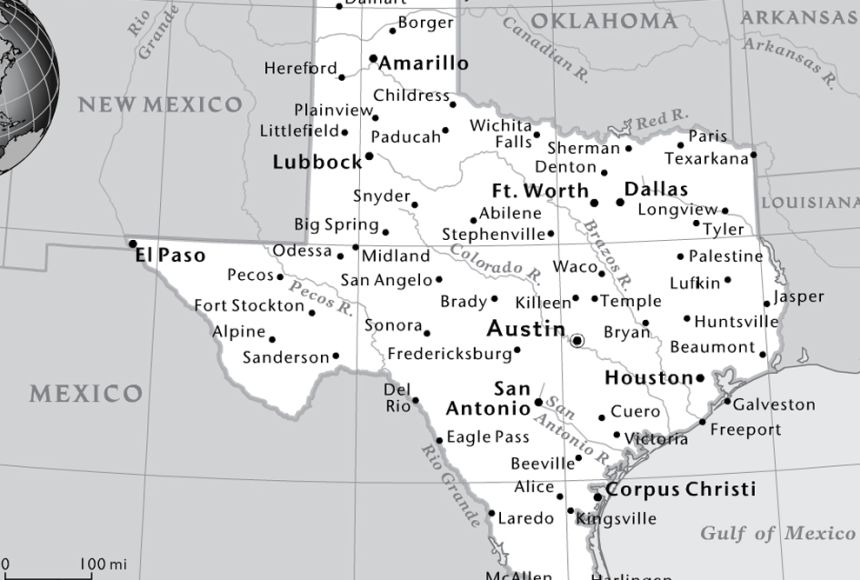
The annexation of Texas did not resolve the territorial dispute with Mexico. Mexico still claimed Texas as its own and viewed the annexation as an act of aggression. The disputed boundary between Texas and Mexico, particularly along the Rio Grande River, soon led to armed conflict. In April 1846, skirmishes between U.S. and Mexican troops in the disputed territory provided the casus belli for the Mexican-American War. The war ultimately resulted in a decisive U.S. victory and the cession of vast territories, including present-day California, Nevada, Utah, Arizona, and parts of Colorado, Wyoming, and New Mexico to the United States under the Treaty of Guadalupe Hidalgo.
Legacy and Identity: The Enduring Spirit of Texas
The journey from a republic to a state profoundly shaped Texas’s character. The experience of independence fostered a deep-seated sense of self-reliance and pride that continues to define the state’s identity. The memory of the Texas Revolution and the Republic era are not merely historical footnotes but living elements of Texan culture, evident in its symbols, its political discourse, and its independent spirit.
The Myth and Reality of Texan Exceptionalism
The narrative of Texas becoming a state is often interwoven with notions of exceptionalism. The idea that Texas is “bigger and better” than other states, a sentiment rooted in its vastness and its history of independence, is a powerful cultural force. This exceptionalism is reflected in everything from its state flag, which flies at the same height as the U.S. flag, to its unique legal and political traditions.
However, this romanticized view often overlooks the complexities and controversies surrounding its annexation, particularly the role of slavery. Understanding how Texas became a state requires acknowledging both the triumphs of its early pioneers and the darker aspects of its history that paved the way for statehood and westward expansion.
A State Forged in Conflict and Compromise
Ultimately, Texas’s path to statehood was a testament to the strategic ambitions of the United States, the resilience of its own citizens, and the volatile political landscape of the mid-19th century. It was a process born out of revolution, shaped by intense debate, and ultimately solidified through military conflict. The legacy of this formative period continues to resonate, contributing to the distinctive and enduring identity of Texas within the American mosaic.
LifeOutOfTheBox is a participant in the Amazon Services LLC Associates Program, an affiliate advertising program designed to provide a means for sites to earn advertising fees by advertising and linking to Amazon.com. Amazon, the Amazon logo, AmazonSupply, and the AmazonSupply logo are trademarks of Amazon.com, Inc. or its affiliates. As an Amazon Associate we earn affiliate commissions from qualifying purchases.