
The allure of a poker table, the strategic dance of betting, and the thrill of a well-timed bluff—these are the elements that draw millions to the game of Texas Holdem. Far from being just a game of chance, Texas Holdem is a sophisticated blend of skill, psychology, and probability. Understanding its mechanics is the first step towards mastering its nuances, whether you’re playing in a casual game at home, a lively saloon in Las Vegas, or even online. This guide will demystify the process, breaking down the game into its fundamental components.
The Objective and Basic Setup
At its core, Texas Holdem is about forming the best possible five-card poker hand from a combination of your own two private cards, known as “hole cards,” and five community cards dealt face-up on the table. The player with the strongest hand at the showdown, or the player who successfully bluffs their opponents into folding their hands, wins the pot—the accumulated sum of all bets made during the hand.

The game is typically played with a standard 52-card deck. It can accommodate anywhere from two to ten players, though it’s most commonly played with six to ten. The game proceeds clockwise around the table, with players taking turns to act.
The Deal and Hole Cards
Each player is dealt two cards face down, unseen by any other player. These are your hole cards, your private arsenal in the game. The quality of these cards significantly influences your early strategy. For instance, a pair of Aces (AA) is the strongest starting hand, while suited connectors like 7s and 8s of the same suit (e.g., 7♥ 8♥) have potential to form straights and flushes.
The Community Cards
The game progresses through several stages where community cards are dealt face-up in the center of the table. These cards are shared by all players and can be used by anyone to form their best five-card hand.
- The Flop: After the first round of betting, three community cards are dealt face-up. This is known as the flop. At this point, players begin to see the potential for hands forming with their hole cards.
- The Turn: Following another round of betting, a fourth community card, called the turn card, is dealt face-up. This card offers more possibilities for hand development.
- The River: The final community card, known as the river card, is dealt face-up after a third round of betting. This is the last card available to form hands.
Betting Rounds
Betting is an integral part of Texas Holdem, occurring at various stages of the deal. The objective is to build the pot and potentially force opponents to fold.
Pre-Flop Betting
The first betting round occurs before any community cards are dealt. The two players to the left of the dealer button (or the designated dealer in home games) are obligated to post “blinds.” The player immediately to the left of the dealer posts the “small blind,” and the player to their left posts the “big blind,” which is typically double the small blind. These forced bets seed the pot. Betting then begins with the player to the left of the big blind. Players have four options:
- Fold: Discard your hand and forfeit any chance of winning the current pot.
- Call: Match the current bet. In the pre-flop round, this means matching the big blind.
- Raise: Increase the current bet. Subsequent players must at least call the new bet or raise again.
- Check: If no bet has been made before your turn (only possible if you are the big blind and no one has raised), you can choose to “check,” passing the action to the next player without betting.
Post-Flop Betting (Flop, Turn, and River)
After the flop, turn, and river cards are dealt, additional betting rounds take place. The action in these rounds typically starts with the player closest to the left of the dealer button who is still in the hand. The options remain the same: fold, call, raise, or check. However, the minimum bet is now determined by the big blind from the previous round, and subsequent raises must be at least the size of the previous raise.
Hand Rankings in Texas Holdem
Understanding the hierarchy of poker hands is crucial for determining winners. The strength of hands is ranked as follows, from highest to lowest:
Royal Flush
The rarest and most powerful hand. It consists of the Ace, King, Queen, Jack, and 10 of the same suit. For example, A♥ K♥ Q♥ J♥ 10♥.
Straight Flush
Five cards of sequential rank, all of the same suit, but not a Royal Flush. For example, 9♠ 8♠ 7♠ 6♠ 5♠.
Four of a Kind
Four cards of the same rank, plus any other card. For example, four 7s (7♥ 7♦ 7♣ 7♠) and a King (K♦).
Full House
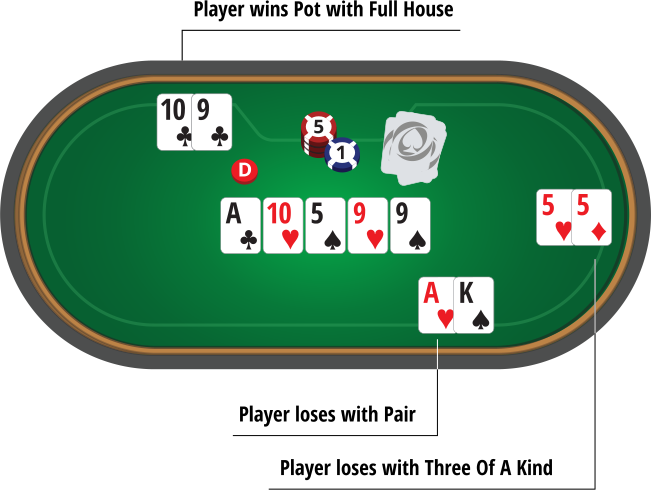
Three cards of one rank and two cards of another rank. For example, three Queens (Q♠ Q♥ Q♦) and two 8s (8♣ 8♠).
Flush
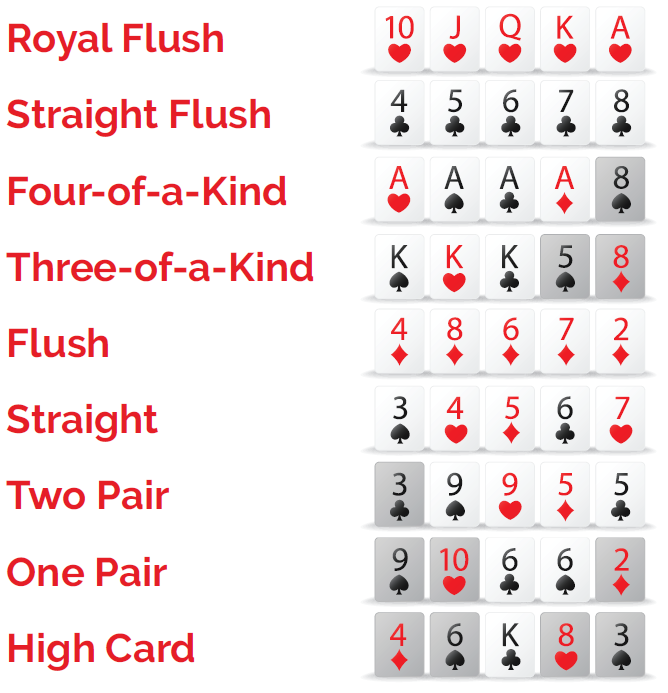
Five cards of the same suit, not in sequential order. For example, K♣ 9♣ 7♣ 4♣ 2♣.
Straight
Five cards of sequential rank, but not all of the same suit. For example, 7♥ 6♣ 5♠ 4♦ 3♥. Aces can be high (A-K-Q-J-10) or low (A-2-3-4-5).
Three of a Kind
Three cards of the same rank, and two other cards of different ranks. For example, three Jacks (J♦ J♠ J♥) and a 9 (9♣) and a 4 (4♠).
Two Pair
Two cards of one rank, two cards of another rank, and one other card. For example, two Kings (K♠ K♥), two 5s (5♦ 5♣), and a 9 (9♠).
One Pair
Two cards of the same rank, and three other cards of different ranks. For example, two Aces (A♣ A♦), a 7 (7♥), a 4 (4♠), and a 2 (2♦).
High Card
If no player has any of the above hands, the player with the highest-ranking card wins. If there’s a tie in the highest card, the next highest card is compared, and so on. For example, A-K-5-3-2 is a high card hand, with the Ace being the highest card.
The Showdown and Winning the Pot
The hand concludes when either all but one player has folded, or after the final betting round on the river, if two or more players remain. If multiple players remain after the river betting, a “showdown” occurs.
Determining the Winner
During the showdown, the remaining players reveal their hole cards. Each player uses the best possible combination of their two hole cards and the five community cards to form their best five-card poker hand. The player with the highest-ranking hand, according to the hand rankings listed above, wins the entire pot.
Splitting the Pot
In the event that two or more players have the exact same five-card hand ranking, the pot is split equally among them. For example, if two players both have a Royal Flush in the same suit, or if their best five-card hands are identical.
Key Concepts and Strategy Elements
Beyond the mechanics of dealing and betting, success in Texas Holdem hinges on understanding several key concepts:
Positional Play
Your position at the table relative to the dealer button is crucial. Acting later in a betting round (late position) gives you more information about your opponents’ actions before you have to decide. This allows for more informed decisions and is a significant advantage.
Pot Odds and Implied Odds
Pot odds refer to the ratio of the current size of the pot to the cost of a contemplated call. Understanding pot odds helps determine if a call is mathematically justified to draw to a better hand. Implied odds consider potential future bets that might be won if you complete your hand.
Bluffing and Reading Opponents
Poker is as much a game of psychology as it is of cards. Bluffing—betting or raising with a weak hand to induce opponents to fold—is a vital skill. Equally important is the ability to read your opponents’ tendencies, betting patterns, and physical tells (if playing live) to gauge the strength of their hands.
Bankroll Management
For serious players, managing your bankroll—the total amount of money you dedicate to playing poker—is paramount. This involves playing at stakes that are appropriate for your bankroll size to avoid significant losses and ensure longevity in the game.
By grasping these foundational elements, players can embark on their journey into the complex and rewarding world of Texas Holdem, a game that continues to captivate enthusiasts worldwide, from the felt tables of Monaco to the virtual arenas of online gaming.
LifeOutOfTheBox is a participant in the Amazon Services LLC Associates Program, an affiliate advertising program designed to provide a means for sites to earn advertising fees by advertising and linking to Amazon.com. Amazon, the Amazon logo, AmazonSupply, and the AmazonSupply logo are trademarks of Amazon.com, Inc. or its affiliates. As an Amazon Associate we earn affiliate commissions from qualifying purchases.