
Navigating the complexities of divorce can be one of life’s most challenging journeys, transforming individual paths and family structures. In Florida, the process is governed by specific laws and procedures designed to ensure fairness and proper resolution of all marital issues. Understanding these steps is paramount for anyone considering this significant life transition in The Sunshine State. This comprehensive guide aims to demystify the process, offering a clear roadmap from initial considerations to the final judgment, helping individuals manage expectations and make informed decisions throughout.
Divorce, officially known as “Dissolution of Marriage” in Florida, signifies the legal termination of a marriage. It’s a process that involves the division of assets and debts, the establishment of parenting plans for minor children, and potentially, spousal support. While the emotional toll can be immense, a clear understanding of the legal requirements and procedural steps can help streamline the process, allowing individuals to move forward with greater clarity and confidence. The Florida Circuit Courts handle all dissolution of marriage cases, exercising jurisdiction over these intricate family law matters.

Initial Considerations and Eligibility Requirements
Before embarking on the divorce process in Florida, it’s crucial to ascertain whether you meet the fundamental eligibility criteria. These foundational requirements dictate whether your case can proceed within the state’s legal framework and set the stage for how the process will unfold. Addressing these points upfront can save considerable time and effort, ensuring that your application is properly filed and accepted by the court.
Residency Requirements in Florida
One of the most critical prerequisites for filing for divorce in Florida is meeting the state’s residency requirement. According to Florida Statutes, at least one of the parties to the marriage must have resided in Florida for at least six months immediately preceding the filing of the petition for dissolution of marriage. This is not merely a formality; it is a jurisdictional requirement. The court must be satisfied that this residency has been established.
Proof of residency can be demonstrated through various means, such as a Florida driver’s license, voter registration, or testimony from a credible witness. For instance, if one spouse moved to Orlando six months ago with the intent to reside permanently, while the other spouse still lives in another state, the spouse in Orlando can meet the residency requirement. Without this established residency, a Florida court lacks the authority to grant a divorce. It’s important to gather documentation supporting your residency claim before initiating the process.
Grounds for Divorce: No-Fault State
Florida is a “no-fault” divorce state. This means that to obtain a divorce, you do not need to prove that one spouse was at fault for the breakdown of the marriage (e.g., adultery, abandonment, cruelty). Instead, the legal grounds for dissolution of marriage in Florida are straightforward and primarily focus on the irremediable breakdown of the marriage.
The Florida Statutes outline two primary grounds:
- Irretrievably Broken Marriage: This is the most common ground and simply means that the marriage cannot be saved. The court generally accepts the petitioner’s assertion that the marriage is irretrievably broken, particularly if there are no minor children. If minor children are involved, or if one party denies that the marriage is irretrievably broken, the court may order the parties to attend counseling, mediation, or take other steps to determine if there is a reasonable prospect of reconciliation.
- Mental Incapacity of One of the Parties: This ground is less common and requires proof that one spouse has been mentally incapacitated for at least three years, as evidenced by expert medical testimony.
The no-fault nature of Florida divorce simplifies the initial filing process, as parties do not need to engage in potentially contentious arguments about who caused the marital breakdown. This approach encourages a focus on resolving practical issues rather than assigning blame.
Types of Dissolution of Marriage in Florida
The divorce process in Florida is not monolithic; various pathways cater to different levels of agreement and complexity between the divorcing spouses. Choosing the appropriate type of dissolution can significantly impact the timeline, cost, and emotional intensity of the proceedings. Understanding these distinctions is crucial for selecting the most suitable approach for your specific circumstances.
Simplified Dissolution of Marriage
The Simplified Dissolution of Marriage is the quickest and least complex option, designed for couples who meet very specific criteria and are in complete agreement on all aspects of their divorce. This path is ideal for those seeking an amicable and efficient separation without extensive legal battles.
To qualify for a Simplified Dissolution in Florida, both parties must:
- Agree that the marriage is irretrievably broken.
- Have no minor children from the marriage (and the wife is not pregnant).
- Have filed a financial affidavit, fully disclosing all assets and liabilities.
- Agree on how to divide all assets and debts.
- Neither party is seeking alimony.
- Both parties waive their right to receive any other disclosures from each other other than the financial affidavit.
- Both parties agree to attend the final hearing together.
This option is less expensive as it often requires fewer court appearances and may not necessitate legal representation for complex negotiations. The process typically involves filing a joint petition and supporting documents with the Clerk of the Court in the appropriate county (e.g., Broward County or Orange County), followed by a final hearing where a judge reviews the agreement and issues the final judgment.
Uncontested Dissolution of Marriage
An Uncontested Dissolution of Marriage is suitable for couples who agree on all terms of their divorce, even if they have minor children or require alimony. Unlike the simplified process, this route still involves one party filing a petition and formally serving the other. However, because both parties agree on all outstanding issues—such as child custody (parenting plan), child support, alimony, and equitable distribution of assets and debts—the need for extensive litigation is eliminated.
Key characteristics of an Uncontested Divorce include:
- One spouse files the Petition for Dissolution of Marriage.
- The other spouse files an Answer, acknowledging agreement with the petition or stipulating to a settlement.
- A Marital Settlement Agreement (MSA) is drafted and signed by both parties, detailing the agreed-upon terms for all issues. This agreement is a legally binding contract that becomes part of the final judgment.
- Both parties complete and exchange financial affidavits.
- A final hearing is typically required, but it can be brief, as the judge only needs to review the settlement agreement for fairness and ensure all legal requirements have been met.
The primary benefit of an uncontested divorce is that it is generally faster, less stressful, and more cost-effective than a contested divorce, as it avoids prolonged court battles and extensive discovery processes. Many couples choose to use mediation to reach a comprehensive settlement, facilitating this type of divorce.
Contested Dissolution of Marriage
A Contested Dissolution of Marriage arises when the spouses cannot agree on one or more key issues related to their divorce. This is the most common and often the most complex, time-consuming, and expensive type of divorce. Disagreements can stem from any number of areas, including child custody, child support, alimony, or the division of marital property and debts.
The process for a contested divorce typically involves:
- Filing the Petition: One spouse files a Petition for Dissolution of Marriage, outlining their requests.
- Service of Process: The petition and summons are formally served on the other spouse.
- Response: The other spouse files an Answer and potentially a Counter-Petition, stating their positions and requests.
- Discovery: Both parties engage in a formal information-gathering process, exchanging financial documents, taking depositions, and possibly retaining experts (e.g., forensic accountants, appraisers, child psychologists).
- Mediation: Florida courts often mandate mediation for contested divorces, encouraging parties to reach a settlement outside of court. If an agreement is reached, it becomes an uncontested divorce.
- Temporary Hearings: If immediate issues arise (e.g., temporary child custody, temporary spousal support), either party may request temporary hearings to obtain court orders that remain in effect until the final judgment.
- Trial: If mediation fails and no settlement is reached, the case proceeds to trial. A judge will hear evidence, testimony, and arguments from both sides before making a final decision on all outstanding issues.
- Final Judgment: The court issues a Final Judgment of Dissolution of Marriage, legally ending the marriage and outlining all court-ordered resolutions.
Contested divorces often require the expertise of an experienced family law attorney due to the intricate legal procedures, evidentiary rules, and complex negotiations involved. The duration can range from several months to over a year, depending on the complexity of the issues and the court’s calendar in counties like Miami-Dade County or Palm Beach County.
Key Steps in the Florida Divorce Process
Regardless of whether a divorce is simplified, uncontested, or contested, there are fundamental procedural steps that must be followed in Florida. These steps ensure due process, facilitate information exchange, and lead to a legally sound final judgment.
1. Filing the Petition for Dissolution of Marriage
The divorce process officially begins when one spouse (the “Petitioner”) files a Petition for Dissolution of Marriage with the Clerk of the Circuit Court in the county where at least one spouse meets the residency requirements. The petition is a formal legal document that identifies the parties, states the grounds for divorce (irretrievably broken marriage), confirms residency, and outlines the relief sought, such as child custody, child support, alimony, and property division.
Accompanying the petition are several other forms, including:
- Civil Cover Sheet: Provides basic information about the case type.
- Uniform Child Custody Jurisdiction and Enforcement Act (UCCJEA) Affidavit: Required if there are minor children, providing details about the children’s residence history to ensure Florida has jurisdiction over child-related matters.
- Notice of Social Security Number: To be submitted confidentially.
- Summons: A document instructing the other spouse (the “Respondent”) to respond to the petition within a specific timeframe.
There is a filing fee associated with initiating a divorce case. If the Petitioner cannot afford the fee, they may apply for a “Petition for Indigent Status.”
2. Service of Process
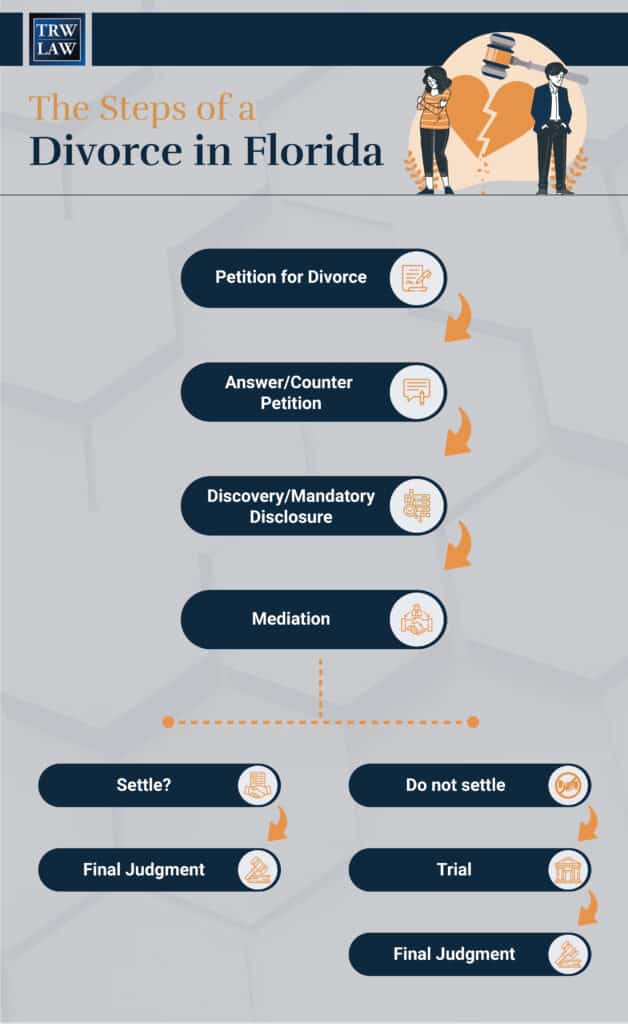
After the Petition is filed, the Respondent must be formally notified of the divorce action. This is known as “service of process.” The goal is to ensure the Respondent is legally aware of the proceedings against them and has the opportunity to respond. In Florida, service is typically accomplished by:
- Sheriff’s Deputy: A sheriff’s deputy delivers the petition and summons directly to the Respondent.
- Private Process Server: A certified private process server delivers the documents.
- Waiver of Service: In amicable cases, the Respondent may sign a “Waiver of Formal Service,” acknowledging receipt of the documents and waiving the need for official service. This is common in uncontested or simplified divorces.
Proper service is critical. If the Respondent is not properly served, the court cannot proceed with the case, as it lacks personal jurisdiction over that individual.
3. Respondent’s Answer and Financial Disclosure
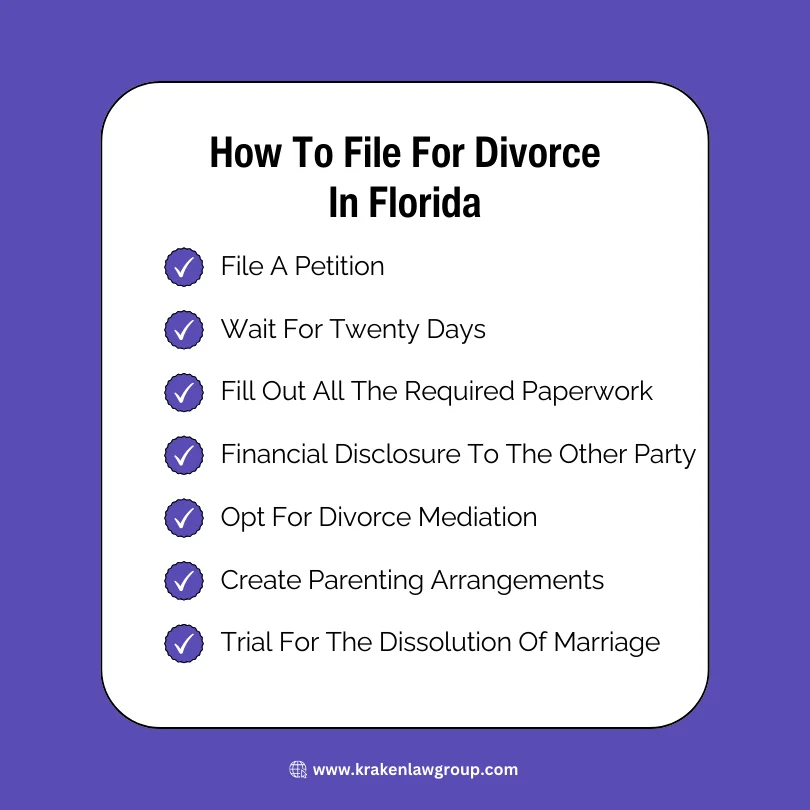
Once served, the Respondent typically has 20 days to file a formal “Answer” to the petition with the court. In their answer, the Respondent can agree with the Petitioner’s statements, deny them, or raise their own claims and requests (e.g., through a counter-petition).
A crucial step for both parties, regardless of agreement, is the financial disclosure. Both the Petitioner and Respondent are required to complete and exchange comprehensive Family Law Financial Affidavits within 45 days of service (or 20 days before any temporary hearing, whichever is sooner). These affidavits detail all income, expenses, assets, and liabilities. They must be supported by various financial documents, including:
- Pay stubs
- Bank statements
- Tax returns
- Investment account statements
- Retirement account statements
- Deeds to real estate
- Loan documents (mortgages, car loans, credit cards)
Full and honest financial disclosure is mandatory and foundational to ensuring an equitable distribution of marital property and fair determinations of child support and alimony. Failure to comply can result in sanctions from the court.
4. Negotiation, Mediation, and Litigation
After financial disclosures are exchanged, the parties typically attempt to resolve their differences through negotiation. This can occur directly between the parties, through their attorneys, or with the assistance of a neutral third party.
- Mediation: Florida courts often require divorcing couples to participate in mediation, especially if there are disputed issues. Mediation involves a neutral, trained mediator who facilitates communication and helps the parties reach mutually acceptable agreements on issues such as parenting plans, child support, alimony, and property division. If a full agreement is reached in mediation, a Marital Settlement Agreement (MSA) is drafted, signed by both parties, and submitted to the court. This transforms a potentially contested case into an uncontested one.
- Temporary Hearings: If urgent matters arise before a final settlement or trial (e.g., one spouse needs temporary financial support, or an immediate parenting schedule is needed), either party can file a motion for a temporary hearing. A judge will then issue orders that remain in effect until the final judgment.
- Discovery (for contested cases): If mediation is unsuccessful, and issues remain unresolved, the case moves into the litigation phase. This involves further “discovery,” which may include depositions (sworn testimony outside of court), interrogatories (written questions), and requests for production of documents. The goal is to gather all relevant information for trial.
- Trial: If no settlement is reached, the case will proceed to a final trial. Both parties, represented by their attorneys, will present evidence, call witnesses, and make arguments to the judge. The judge, acting as the ultimate decision-maker, will then issue a final ruling on all unresolved issues.
5. Final Judgment of Dissolution of Marriage
The culmination of the divorce process is the Final Judgment of Dissolution of Marriage. If the parties reached a full settlement (either through simplified, uncontested, or mediated processes), the judge will review the agreement to ensure it is fair and complies with Florida law. If the case proceeded to trial, the judge will issue a judgment based on the evidence presented.
The Final Judgment is a legally binding court order that:
- Legally ends the marriage.
- Approves and incorporates the Marital Settlement Agreement (if one exists).
- Establishes the Parenting Plan (if minor children are involved), detailing custody, visitation schedules, and decision-making responsibilities.
- Orders child support payments, based on Florida child support guidelines.
- Determines if alimony will be awarded, its type (e.g., temporary, rehabilitative, permanent), and amount.
- Dictates the equitable distribution of all marital assets and liabilities.
Once the Final Judgment is signed by the judge and filed with the Clerk of the Court, the marriage is officially dissolved, and the terms outlined in the judgment become legally enforceable.
Resolving Key Issues in a Florida Divorce
Beyond the procedural steps, the heart of any divorce case in Florida lies in the resolution of several critical substantive issues. These determinations significantly shape the post-divorce lives of all parties involved, especially children.
Parenting Plans and Child Custody
For divorcing couples with minor children, the court’s primary concern is always the best interests of the child. Florida law uses the term “Parenting Plan” instead of “custody” to emphasize shared parental responsibility. This plan outlines:
- Parental Responsibility: Typically, courts order “shared parental responsibility,” meaning both parents retain full parental rights and responsibilities and must confer with each other to make decisions regarding the children’s welfare (education, healthcare, religious upbringing). In rare cases, “sole parental responsibility” may be awarded if shared responsibility would be detrimental to the child.
- Time-Sharing Schedule: This details when each parent will have the children, including holidays, birthdays, and school breaks. The goal is to ensure frequent and continuing contact with both parents.
- Decision-Making: Specifies which parent makes what decisions, or how joint decisions are to be made.
- Communication: How parents will communicate with each other and with the children.
Developing a comprehensive parenting plan often requires careful negotiation and, frequently, mediation to create a schedule that works for the family while prioritizing the children’s needs.
Child Support
Child support is calculated based on Florida’s child support guidelines, which take into account:
- The income of both parents.
- The number of overnights each child spends with each parent.
- Childcare costs.
- Health insurance premiums for the children.
- Any other recurring medical expenses.
The guidelines provide a presumptive amount of child support, which courts generally adhere to unless there’s a compelling reason to deviate. The support is intended to ensure that children continue to receive adequate financial support from both parents, regardless of the marital dissolution. Payments are typically made to the custodial parent, often through the Florida Department of Revenue to ensure proper accounting and enforcement.
Alimony (Spousal Support)
Alimony, or spousal support, may be awarded from one spouse to the other to provide financial assistance after the divorce. Unlike child support, there are no strict guidelines for alimony in Florida; rather, the court considers various factors, including:
- The standard of living established during the marriage.
- The duration of the marriage (short-term, moderate-term, or long-term).
- The financial resources of each spouse.
- The earning capacities, educational levels, vocational skills, and employability of each spouse.
- The contribution of each spouse to the marriage (e.g., homemaking, childcare, career building of the other spouse).
- Any other factor necessary to do equity and justice between the parties.
Florida law recognizes several types of alimony, including:
- Temporary Alimony: Awarded during the divorce proceedings.
- Bridge-the-Gap Alimony: For short-term needs to transition from married to single life.
- Rehabilitative Alimony: To help a spouse become self-supporting through education or training.
- Durational Alimony: For a set period, not exceeding the length of the marriage, for moderate- or long-term marriages.
- Permanent Alimony: Typically reserved for long-term marriages where one spouse has a permanent inability to become self-supporting.
Alimony awards are highly fact-specific and can be a significant point of contention.
Equitable Distribution of Assets and Debts
Florida is an “equitable distribution” state, meaning that marital assets and debts are divided fairly, but not necessarily equally. “Marital assets” and “marital liabilities” are generally those acquired or incurred during the marriage. Separate assets (e.g., inherited property, gifts to one spouse, or assets owned before marriage) are typically not subject to division, unless they have been commingled with marital assets.
The court considers numerous factors when determining an equitable distribution, including:
- The contribution to the marriage by each spouse, including contributions to the care and education of the children and services as a homemaker.
- The economic circumstances of the parties.
- The duration of the marriage.
- Any desirability of retaining any asset (e.g., the marital home) free from claims by the other spouse.
- Any other factors necessary to do equity and justice.
Assets can include real estate (the marital home, vacation properties in Tampa or Jacksonville), bank accounts, investment portfolios, retirement accounts, businesses, and personal property. Debts include mortgages, car loans, credit card balances, and personal loans. The division of these often requires careful valuation and negotiation, sometimes involving experts like real estate appraisers or business valuators.
The Role of Legal Counsel and Moving Forward
While it is possible to represent oneself in a Florida divorce (pro se), particularly in simplified or truly uncontested cases, the complexities of family law often warrant the guidance of an experienced attorney. A qualified Florida Bar attorney can:
- Explain your rights and obligations under Florida law.
- Help you navigate the court system and complete necessary forms accurately.
- Negotiate on your behalf, striving for the best possible outcome.
- Represent you effectively in mediation or at trial.
- Ensure that all agreements and judgments are legally sound and enforceable.
Choosing an attorney who understands the nuances of divorce law in Florida can significantly alleviate stress and protect your interests, especially when dealing with children, substantial assets, or complex financial situations. They can provide invaluable advice on strategy, potential outcomes, and the enforceability of court orders.
Divorce in Florida marks the end of one chapter and the beginning of another. By understanding the eligibility requirements, the types of dissolution available, the procedural steps, and how key issues are resolved, individuals can approach this transition with a greater sense of control and preparedness. While challenging, navigating the legal landscape effectively can pave the way for a more stable and hopeful future.
LifeOutOfTheBox is a participant in the Amazon Services LLC Associates Program, an affiliate advertising program designed to provide a means for sites to earn advertising fees by advertising and linking to Amazon.com. Amazon, the Amazon logo, AmazonSupply, and the AmazonSupply logo are trademarks of Amazon.com, Inc. or its affiliates. As an Amazon Associate we earn affiliate commissions from qualifying purchases.