
Navigating life’s unexpected turns requires foresight and understanding the resources available to maintain your stability and chosen lifestyle. For residents of California, a critical safety net exists in the form of State Disability Insurance (SDI). This vital program offers short-term wage replacement benefits to eligible workers who are unable to work due to a non-work-related illness, injury, or pregnancy. Understanding how to apply for State Disability Insurance is an essential aspect of proactive life management, ensuring financial peace of mind when health challenges arise. This comprehensive guide will walk you through the intricacies of the California SDI program, from eligibility to managing your claim, empowering you to confidently access the benefits you’ve contributed to.
Understanding California’s State Disability Insurance (SDI) Program
California’s State Disability Insurance program is a cornerstone of the state’s social safety net, providing crucial financial relief during periods of temporary disability. It’s designed to offer short-term wage replacement for individuals who lose income because they cannot work due to a qualifying non-work-related medical condition. This includes illnesses, injuries, and pregnancy-related disabilities. The program is funded entirely through mandatory payroll deductions from California workers, meaning that those who contribute are essentially insuring themselves and their fellow workers against unforeseen health crises.
It’s important to distinguish SDI from other forms of financial assistance. Unlike Workers’ Compensation, SDI covers disabilities that are not work-related. It also differs from federal Social Security Disability benefits, which are typically for long-term or permanent disabilities. California SDI is administered by the Employment Development Department (EDD), the state agency responsible for managing unemployment and disability benefits.
The broader SDI program actually comprises two main components: Disability Insurance (DI) and Paid Family Leave (PFL). While this article focuses on DI (for one’s own disability), it’s useful to know that PFL provides benefits to individuals who need to take time off work to care for a seriously ill family member, bond with a new child, or participate in a qualifying event due to a family member’s military deployment. Both programs leverage the same contribution fund and are managed by the EDD, reflecting a comprehensive approach to supporting California families during significant life events. Understanding these distinctions is the first step toward effectively navigating the benefits system.
Eligibility Requirements for SDI Benefits
To qualify for California State Disability Insurance benefits, applicants must meet several specific criteria established by the Employment Development Department (EDD). These requirements ensure that the program serves its intended purpose of supporting workers during temporary periods of lost wages due to health issues.
First and foremost, you must be unable to do your regular work for at least eight consecutive days due to a non-work-related illness, injury, or pregnancy. This means your disability must prevent you from performing your usual job duties. You must also have been employed or actively looking for work at the time your disability began. This criterion confirms your attachment to the workforce prior to your disabling event. A crucial financial requirement is that you must have earned at least $300 in wages subject to SDI deductions during your “base period.” The base period is a 12-month timeframe the EDD uses to calculate your weekly benefit amount, typically consisting of the four calendar quarters ending 4-6 months before your claim begins.
Beyond these foundational points, you must be under the care of a licensed physician or practitioner who certifies your disability. This medical certification is paramount, as it validates the nature and expected duration of your inability to work. A key administrative requirement is that you must have lost wages as a result of your disability; SDI is a wage replacement program, not merely a medical benefit. Finally, applicants are required to serve a 7-day non-payable waiting period. Benefits begin on the eighth consecutive day of disability, provided all other eligibility requirements are met.
Certain factors can lead to ineligibility. If your injury or illness is work-related, you would typically file a Workers’ Compensation claim instead. You cannot collect SDI and Unemployment Insurance benefits concurrently, as they cover different circumstances (inability to work vs. ability to work but no work available). Failure to remain under medical care, refusing to undergo a medical examination if requested by the EDD, or not submitting required forms in a timely manner can also result in disqualification. Meeting these eligibility benchmarks is the critical first step in securing your SDI benefits.
Navigating the SDI Application Process
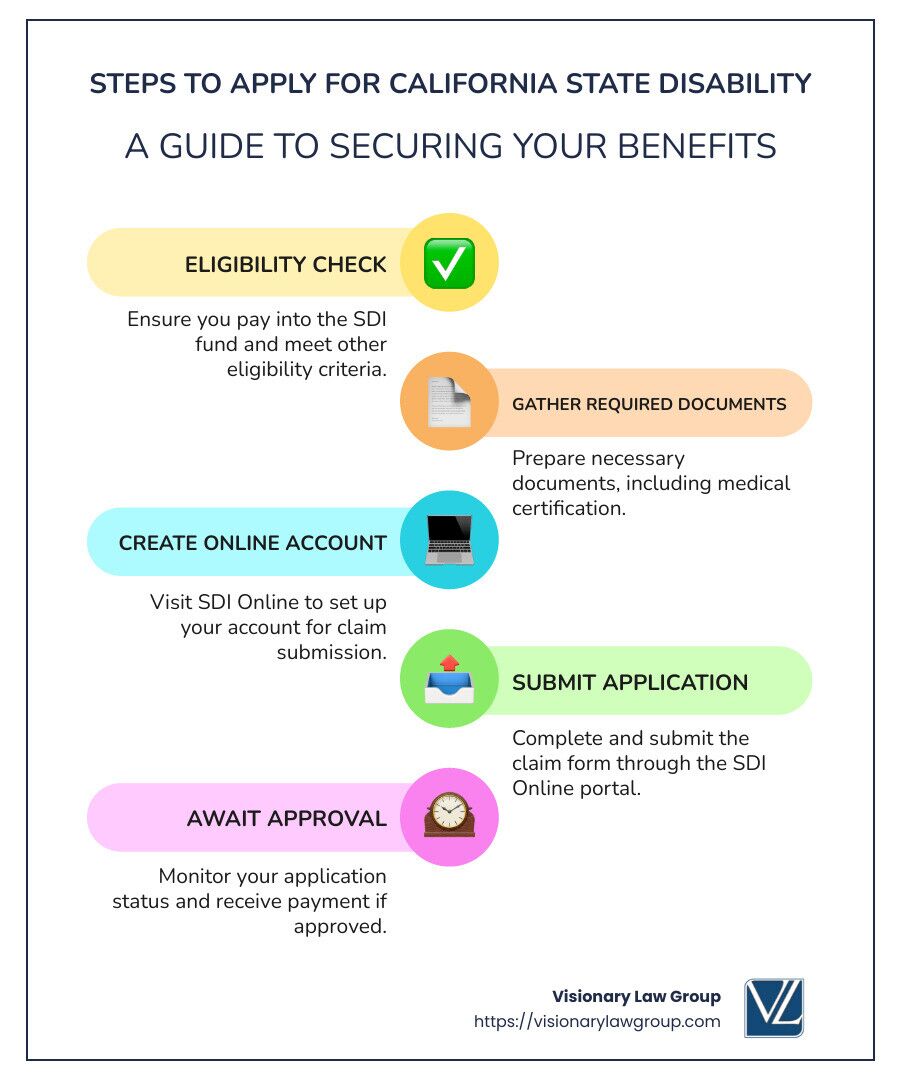
Applying for State Disability Insurance in California can seem daunting, but breaking it down into manageable steps makes the process straightforward. The Employment Development Department (EDD) strongly encourages applicants to use their online portal, SDI Online, for efficiency and faster processing.
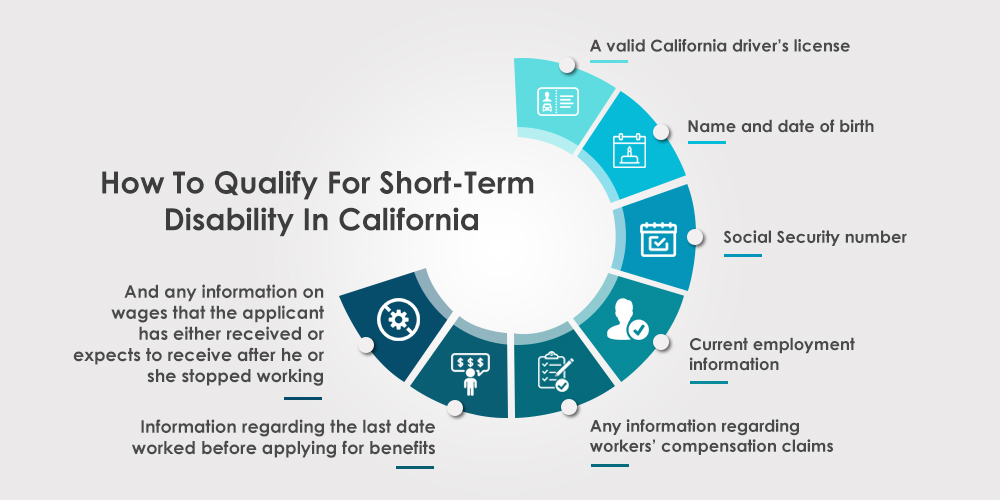
Before you begin, gather all essential information. You’ll need your Social Security Number, California Driver’s License or ID number, your last day worked, and the exact first day your disability prevented you from working. Additionally, have detailed information about your employer(s) from the last 18 months, including their business name, address, and phone number. Crucially, you’ll need the name and license number of your treating physician or practitioner, as they will be required to certify your disability.
The preferred method is to apply online through SDI Online. First, you’ll need to register for an EDD Online account if you don’t already have one. Once logged in, select “File a New Claim” for Disability Insurance. The online application is structured into several sections. You’ll start by providing your personal claimant information, followed by details about your employment history and your employer(s). The third critical section focuses on your disability itself, where you’ll input the nature of your illness or injury, the date your disability began, and the expected duration. Accuracy in these details is vital for a smooth process.
The most critical step in the application process involves your medical provider. After you submit your portion of the claim, SDI Online will provide you with a claim receipt number. You must provide this number to your physician or practitioner. They are responsible for completing the “Physician/Practitioner’s Certificate” (form DE 2501). Your medical provider can submit this certification directly through SDI Online using your claim receipt number, which is the fastest and most recommended method. It is absolutely essential that your medical provider submits their portion of the claim promptly, ideally within 49 days from your first day of disability, to avoid any delays or potential denial of benefits. Follow up with your doctor’s office to ensure their part is completed in a timely manner.
Required Documentation and Information
Successfully applying for State Disability Insurance in California hinges on providing accurate and complete documentation. Both the claimant and their medical provider have distinct responsibilities in supplying the necessary information to the Employment Development Department (EDD).
As the claimant, your primary responsibility is to complete your portion of the application form (DE 2501F, if applying by mail, or the online equivalent) with precise personal and employment details. This includes:
- Personal Identification: Your full legal name, Social Security number, date of birth, current mailing address, and phone number.
- Employment Details: The official business name, address, and phone number of your last employer(s). You’ll also need your last day of work due to the disability.
- Medical Information: The full name, license number, and contact information of your primary treating physician or practitioner. While your doctor provides the detailed medical certification, you initiate this connection by identifying them.
- Wage Information: Although the EDD typically accesses your wage history through payroll records, be prepared to provide pay stubs or W-2 forms if there are any discrepancies or if additional information is requested to verify your base period wages.
The role of your employer, while less active in the initial application, is to cooperate with the EDD if contacted. They may be asked to verify your employment dates, wages, and the circumstances surrounding your leave of absence. While employers generally do not complete a specific form for SDI claims, their responsiveness to EDD inquiries can help expedite your claim.
Crucially, your medical provider is responsible for completing the “Physician/Practitioner’s Certificate” (also part of the DE 2501 form, or submitted digitally via SDI Online). This certificate is the medical substantiation of your disability claim and must accurately detail:
- Diagnosis and Prognosis: A clear description of your medical condition.
- Dates of Disability: The exact date your disability began and the estimated date you are expected to recover and return to work.
- Medical Justification: An explanation of why your condition prevents you from performing your usual work.
- Provider Information: Their full name, medical license number, and contact details.
Timely and accurate submission of all these components is paramount. Missing information or delays in submission, particularly from your medical provider, can significantly prolong the processing of your claim or lead to its denial. It’s advisable to maintain open communication with your doctor’s office and regularly check your claim status to ensure all required documentation has been received by the EDD.

After Applying: What to Expect and How to Manage Your Claim
Once you’ve submitted your State Disability Insurance claim and your physician has provided their certification, the next phase involves the Employment Development Department (EDD) processing your application. This period can sometimes feel uncertain, but understanding what to expect can alleviate stress and help you manage your claim effectively.
Upon receipt of both your and your medical provider’s portions of the claim, the EDD will begin its review. They will verify your eligibility, including your wage history in the base period and the medical certification. You can track the status of your claim online through your SDI Online account, which is the most efficient way to stay informed. The EDD may also mail you notices or request additional information if clarification is needed. It’s crucial to respond promptly to any such requests to avoid delays. Processing times can vary, but generally, the EDD aims to process claims within 14 days of receiving all necessary information.
If your claim is approved, you will receive notification of your weekly benefit amount and the period for which you are eligible to receive benefits. Benefits are typically paid via an EDD Debit Card issued by Bank of America, or you can opt for direct deposit into your personal bank account. Your benefit amount is calculated based on your earnings in your highest-earning quarter during the base period. California SDI benefits generally cover up to 52 weeks of payments, although the specific duration depends on your medical condition and the dates certified by your physician.
Managing your claim involves several responsibilities. If your disability extends beyond the initial period certified by your doctor, you’ll need to submit a “Continuation Claim for Disability Benefits” (DE 2500EE) and have your physician complete an “Attending Physician’s Supplementary Certificate” (DE 2525XX). It’s also vital to report any changes in your status, such as returning to work, even if only part-time, as this could affect your benefits. The EDD takes fraud seriously, so ensure all information you provide is accurate and truthful.
Should your claim be denied, you have the right to file an appeal. The denial notice will include instructions on how to appeal the decision. You typically have 30 days from the mailing date of the denial notice to submit your appeal. The appeals process involves a hearing before an Administrative Law Judge, where you can present your case and provide additional evidence. While the process can be challenging, understanding your rights and the steps involved is key to navigating an appeal. Being proactive and informed throughout the entire claim lifecycle is the best way to ensure you receive the SDI benefits you are entitled to during a period of temporary disability.
Securing State Disability Insurance benefits in California is a critical component of personal financial planning and lifestyle stability. By meticulously following the application steps, understanding the eligibility requirements, and proactively managing your claim, you can confidently navigate periods of temporary disability. The SDI program is a testament to California’s commitment to supporting its workforce, providing a vital safety net that allows individuals to focus on recovery without the added burden of immediate financial distress. Remember, timely submission and clear communication with the EDD and your medical provider are your best tools for a successful claim.
LifeOutOfTheBox is a participant in the Amazon Services LLC Associates Program, an affiliate advertising program designed to provide a means for sites to earn advertising fees by advertising and linking to Amazon.com. Amazon, the Amazon logo, AmazonSupply, and the AmazonSupply logo are trademarks of Amazon.com, Inc. or its affiliates. As an Amazon Associate we earn affiliate commissions from qualifying purchases.