
Creating an S corporation in California offers a unique tax advantage for eligible small businesses. Unlike a traditional C corporation, an S corp allows profits and losses to be passed through directly to the owners’ personal income without being subject to corporate tax rates. This can significantly reduce the overall tax burden, making it an attractive structure for many entrepreneurs. However, the process involves several specific steps, compliance requirements, and ongoing obligations. Understanding these nuances is crucial for successfully establishing and maintaining an S corp status in the Golden State.
Understanding the S Corporation Structure
An S corporation, or S corp, is not a type of business entity in itself but rather a federal tax election made by an eligible corporation or Limited Liability Company (LLC) that meets specific IRS criteria. The core benefit lies in its pass-through taxation. Instead of the corporation paying taxes on its profits and then the shareholders paying taxes again on dividends (a “double taxation” scenario common with C corporations), the S corp’s income, deductions, and credits are passed through to the shareholders’ personal tax returns. This eliminates the corporate-level income tax.
Eligibility Requirements for S Corp Status
To qualify for S corp status, a business must meet several key criteria set by the Internal Revenue Service (IRS) and the State of California. These include:
- Domestic Entity: The business must be a domestic entity, meaning it was formed in the United States.
- Shareholder Restrictions:
- It cannot have more than 100 shareholders.
- Shareholders must be individuals, certain trusts, or estates. Corporations and partnerships are generally not allowed as shareholders.
- Shareholders must be U.S. citizens or resident aliens. Nonresident alien shareholders are not permitted.
- Stock Classes: The corporation can only have one class of stock. However, differences in voting rights among common stock are permissible.
- Business Type: Certain types of businesses are ineligible to be S corps, such as specific financial institutions and insurance companies.
Advantages of an S Corporation
The primary advantage of an S corp is its tax treatment. By avoiding corporate income tax, it can lead to substantial savings for profitable businesses. Another significant benefit relates to self-employment taxes. For shareholder-employees, only the salary paid as reasonable compensation is subject to Social Security and Medicare taxes. Any remaining profits distributed as dividends are not subject to self-employment tax. This can result in considerable savings compared to operating as a sole proprietorship or partnership where all profits are typically subject to self-employment tax. Additionally, S corps can offer more flexibility in terms of profit and loss allocations among shareholders compared to partnerships.
Disadvantages of an S Corporation
Despite the advantages, S corps also come with their own set of challenges. The “reasonable salary” requirement is a critical point of contention. The IRS scrutinizes shareholder-employee compensation to ensure it’s in line with what similar services would command in the marketplace. Failure to establish a reasonable salary can lead to penalties and back taxes. S corps also face more stringent operational requirements than LLCs or sole proprietorships, including mandatory board meetings, shareholder meetings, and detailed record-keeping. The administrative complexity and compliance burden can be higher. Furthermore, the pass-through nature means that if the business incurs losses, these losses are passed through to shareholders, which can be beneficial but also means the business itself doesn’t retain earnings to reinvest or cover operating expenses without the owners’ personal funds.
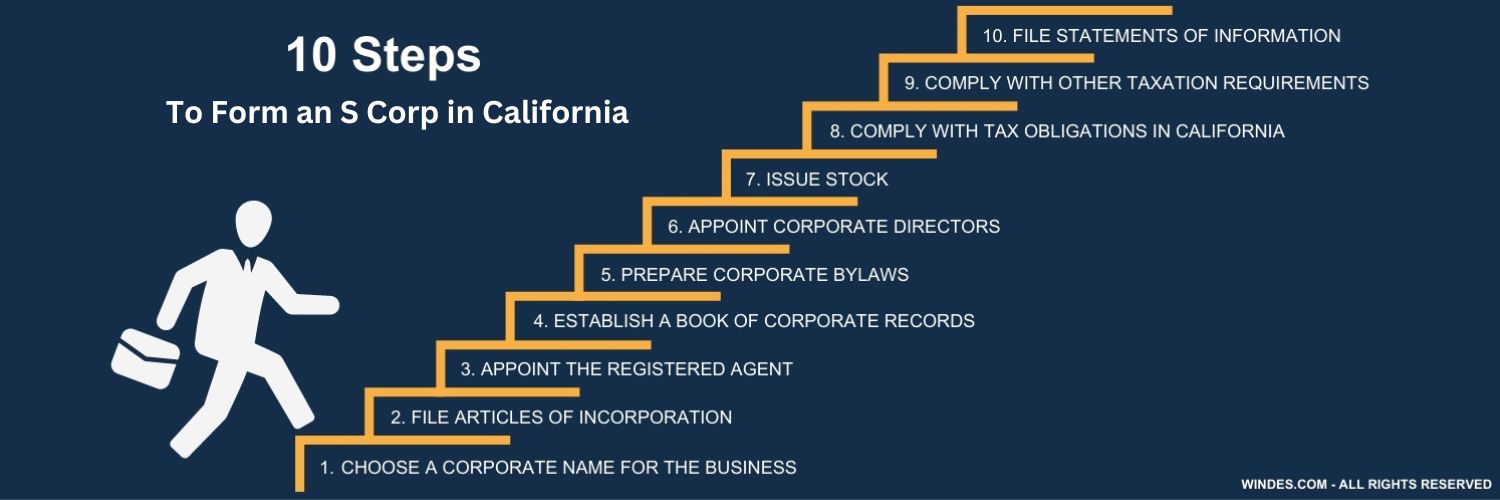
Steps to Create an S Corporation in California
Establishing an S corporation in California involves a multi-step process. It begins with forming the underlying business entity (either a corporation or an LLC) and then making the S corp election with both the IRS and the State of California.
Step 1: Form Your Business Entity
Before you can elect S corp status, you must first establish your business as either a corporation or an LLC in California.
- Forming a Corporation: This involves filing Articles of Incorporation with the California Secretary of State. The Articles of Incorporation must include the business name, the purpose of the corporation, the number of shares authorized, and the name and address of the registered agent for service of process. After filing, you’ll need to adopt corporate bylaws, appoint directors, issue stock, and hold an organizational meeting.
- Forming an LLC: To form an LLC, you file Articles of Organization with the California Secretary of State. This document requires the LLC’s name, its principal office, and the name and address of the registered agent. An operating agreement, though not filed with the state, is a crucial internal document that outlines ownership, management, and operational procedures.
Step 2: Obtain an Employer Identification Number (EIN)
Regardless of whether you formed a corporation or an LLC, you will need to obtain an Employer Identification Number (EIN) from the IRS. An EIN is a unique nine-digit number assigned to business entities operating in the United States for identification purposes by the IRS. You can apply for an EIN online through the IRS website.
Step 3: File the S Corporation Election with the IRS
Once your business entity is formed and you have your EIN, you can elect S corporation status by filing Form 2553, “Election by a Small Business Corporation,” with the IRS. This form must be signed by all shareholders of the corporation and dated. There are specific deadlines for filing Form 2553 to have the S corp election take effect for the current tax year. Generally, the election must be made within two months and 15 days after the beginning of the tax year the election is to take effect, or at any time during the tax year preceding the tax year it is to take effect.
Step 4: File the S Corporation Election with the State of California

California does not have a separate state-level S corporation tax election form like the federal Form 2553. Instead, businesses that have elected S corporation status with the IRS must notify the Franchise Tax Board (FTB). This is typically done by including a statement on the first tax return filed after making the federal election, indicating that the corporation has elected to be taxed as an S corporation under federal law. The FTB will then treat the corporation as an S corporation for state tax purposes, subject to California’s own specific rules and potential conformity issues. It’s crucial to check the latest FTB guidelines for the most accurate procedure.
Maintaining S Corporation Status in California
Once you have successfully elected S corporation status, there are ongoing requirements to maintain this designation. Failure to comply can lead to the revocation of your S corp status, forcing your business to be taxed as a C corporation.
Reasonable Compensation for Shareholder-Employees
As mentioned, one of the most critical ongoing obligations is paying yourself and any other shareholder-employees a reasonable salary. This salary should reflect the value of the services you provide to the business. Determining what constitutes “reasonable” compensation can be complex and depends on various factors, including industry standards, your responsibilities, and your experience. It’s highly advisable to consult with a tax professional or accountant to establish and document a reasonable salary structure. This documentation is crucial if the IRS ever audits your business.
Annual Filings and Compliance
S corporations in California have several annual filing requirements:
- Federal Tax Return: You must file IRS Form 1120-S, “U.S. Income Tax Return for an S Corporation,” annually. This form reports the corporation’s income, deductions, gains, and losses, and details how these items are allocated to shareholders via Schedule K-1.
- State Tax Return: California requires S corps to file FTB Form 100S, “California S Corporation Franchise or Income Tax Return.” This return is used to report income and calculate any state-specific tax liabilities.
- Statement of Information: Both corporations and LLCs registered in California must file a Statement of Information with the Secretary of State within 90 days of filing their initial formation documents and then biennially (every two years) thereafter. This ensures the state has up-to-date contact and management information.
- Corporate Formalities: Even if you started as an LLC and elected S corp status, you must adhere to corporate formalities. This includes holding regular board and shareholder meetings, keeping minutes, and maintaining detailed financial records. This helps to maintain the legal separation between the business and its owners, protecting their personal assets.
Maintaining Shareholder and Ownership Requirements
It’s essential to continuously monitor your shareholder structure to ensure you remain compliant with the S corp eligibility rules. If your business plans to bring in new investors, you must ensure they meet the criteria (e.g., not being a nonresident alien or a non-qualifying entity) and that the total number of shareholders does not exceed 100. Any change in ownership structure must be carefully managed to avoid jeopardizing your S corp status.
Navigating S Corporation Tax Implications in California
The tax landscape for S corporations in California involves both federal and state considerations. While the pass-through nature is the core benefit, understanding the specifics is vital.
Pass-Through Taxation Explained
As noted, S corps avoid the corporate income tax. Instead, profits and losses are allocated to shareholders based on their percentage of ownership. Each shareholder then reports their share of the income or loss on their personal federal income tax return (Form 1040, Schedule E) and their California state tax return. This means that even if the S corp doesn’t distribute all its profits to the shareholders, the shareholders are still taxed on those undistributed profits. This can lead to a situation where a shareholder owes taxes on income they haven’t actually received.
California’s Minimum Franchise Tax
A significant factor for S corporations operating in California is the state’s minimum franchise tax. Unlike other states where an S corp election might exempt the entity from state-level corporate taxes, California imposes an annual minimum franchise tax of $800 on all corporations, including S corporations, regardless of their income or profit. This tax is due each year by the 15th day of the 4th month after the beginning of the tax year. This means even a business that incurs a loss or has minimal profits will still owe this $800 minimum tax to the state.
Self-Employment Tax Savings
One of the most compelling reasons to elect S corp status is the potential for savings on self-employment taxes. For shareholder-employees, only the salary paid as reasonable compensation is subject to Social Security and Medicare taxes. Any remaining profits distributed as dividends are not considered wages and thus are not subject to self-employment taxes. This can create substantial tax savings over time, especially for highly profitable businesses. However, the IRS scrutinizes this to ensure that salaries are reasonable and not artificially low to avoid these taxes.

Tax Planning and Professional Advice
The complexities of S corp taxation, especially with California’s specific rules, necessitate careful tax planning. Working with a qualified tax advisor or CPA is highly recommended. They can help you:
- Determine a reasonable salary for yourself and other shareholder-employees.
- Understand the implications of profit and loss allocations.
- Ensure all federal and state tax filings are accurate and timely.
- Advise on strategies to optimize tax efficiency while remaining compliant.
- Navigate the $800 minimum franchise tax and other state-specific requirements.
By diligently following the steps for formation, adhering to ongoing compliance obligations, and engaging in smart tax planning, you can effectively leverage the benefits of an S corporation in California to grow your business and manage your tax liabilities.
LifeOutOfTheBox is a participant in the Amazon Services LLC Associates Program, an affiliate advertising program designed to provide a means for sites to earn advertising fees by advertising and linking to Amazon.com. Amazon, the Amazon logo, AmazonSupply, and the AmazonSupply logo are trademarks of Amazon.com, Inc. or its affiliates. As an Amazon Associate we earn affiliate commissions from qualifying purchases.