
Navigating a divorce can be one of life’s most challenging transitions, both emotionally and financially. While legal representation offers invaluable expertise, it’s not always feasible or necessary for every situation. For individuals seeking to dissolve their marriage in Alabama without the assistance of an attorney, understanding the intricate legal landscape is paramount. This guide provides a comprehensive overview of the process, empowering individuals to manage their divorce proceedings independently while adhering to the state’s specific requirements. Embracing this self-reliant approach requires diligence, attention to detail, and a thorough understanding of procedural steps and legal nuances.

Understanding Alabama’s Divorce Laws and Requirements
Embarking on a self-filed divorce in Alabama begins with a foundational understanding of the state’s specific laws. These regulations dictate who can file, why they can file, and the fundamental structure of the legal separation process. Knowing these prerequisites is the first step toward a successful self-representation.
Residency and Grounds for Divorce
Before initiating a divorce, one of the parties must satisfy Alabama’s residency requirements. At least one spouse must have been a bona fide resident of the state for a minimum of six months immediately preceding the filing of the complaint. The divorce must be filed in the Circuit Court of the county where the defendant resides, or in the county where the parties resided at the time of separation, or in the county where the plaintiff resides if the defendant is a non-resident.
Alabama is both a “fault” and “no-fault” divorce state. This means you can file for divorce based on specific fault grounds or on a “no-fault” basis.
No-fault grounds include:
- Incompatibility of Temperament: This is the most common no-fault ground, signifying that the marriage has broken down irrevocably and there is no reasonable expectation of reconciliation.
- Irretrievable Breakdown of the Marriage: Similar to incompatibility, this implies the marriage is beyond repair.
- Voluntary Abandonment: If one spouse voluntarily leaves the other for at least one year with no intention of returning.
Fault-based grounds are numerous and include adultery, habitual drunkenness or drug addiction, institutionalization for incurable insanity for five years, imprisonment for two years, crimes against nature (sexual perversion), and domestic violence or cruelty. For self-filers, using no-fault grounds like incompatibility often simplifies the process considerably, as it avoids the need to present evidence and testimony regarding marital misconduct.
Types of Divorce: Contested vs. Uncontested
The success of a self-filed divorce largely hinges on whether the divorce is contested or uncontested.
- Uncontested Divorce: This is the ideal scenario for filing without a lawyer. An uncontested divorce occurs when both spouses agree on all key issues, including property division, debt allocation, spousal support (alimony), and, if applicable, child custody, visitation, and child support. When all terms are mutually agreed upon, a settlement agreement is drafted and signed by both parties, which is then submitted to the court for approval. This path is significantly faster, less expensive, and less emotionally taxing.
- Contested Divorce: In a contested divorce, spouses cannot agree on one or more significant issues. This typically involves extensive negotiation, mediation, discovery (exchanging financial and other relevant information), and potentially court hearings or a trial. Navigating a contested divorce without legal representation is exceedingly difficult and generally not advisable, as the complexities of litigation, evidence rules, and court procedures are challenging for laypersons. If your divorce is likely to be contested, even partially, consulting an attorney is highly recommended.
For the purpose of this guide, we will focus primarily on the process for an uncontested divorce, as it is the most viable option for self-representation.
Preparing Your Divorce Paperwork
Once you’ve confirmed your eligibility and determined your divorce will be uncontested, the next crucial step is gathering and completing the necessary legal documents. Precision and thoroughness in this phase are critical to avoid delays or rejection by the court.
Essential Forms and Where to Find Them
The Alabama Unified Judicial System provides many of the standard forms required for an uncontested divorce. These forms are often available on the administrative office of courts’ website or can be obtained from the clerk of the Circuit Court in your county (e.g., Jefferson County, Montgomery County, Madison County). Key documents typically include:
- Complaint for Divorce: This is the initial pleading that formally requests the court to dissolve the marriage. It outlines the parties, the grounds for divorce, and the relief sought.
- Summons: A legal notice informing the defendant (the other spouse) that a lawsuit has been filed against them and they must respond.
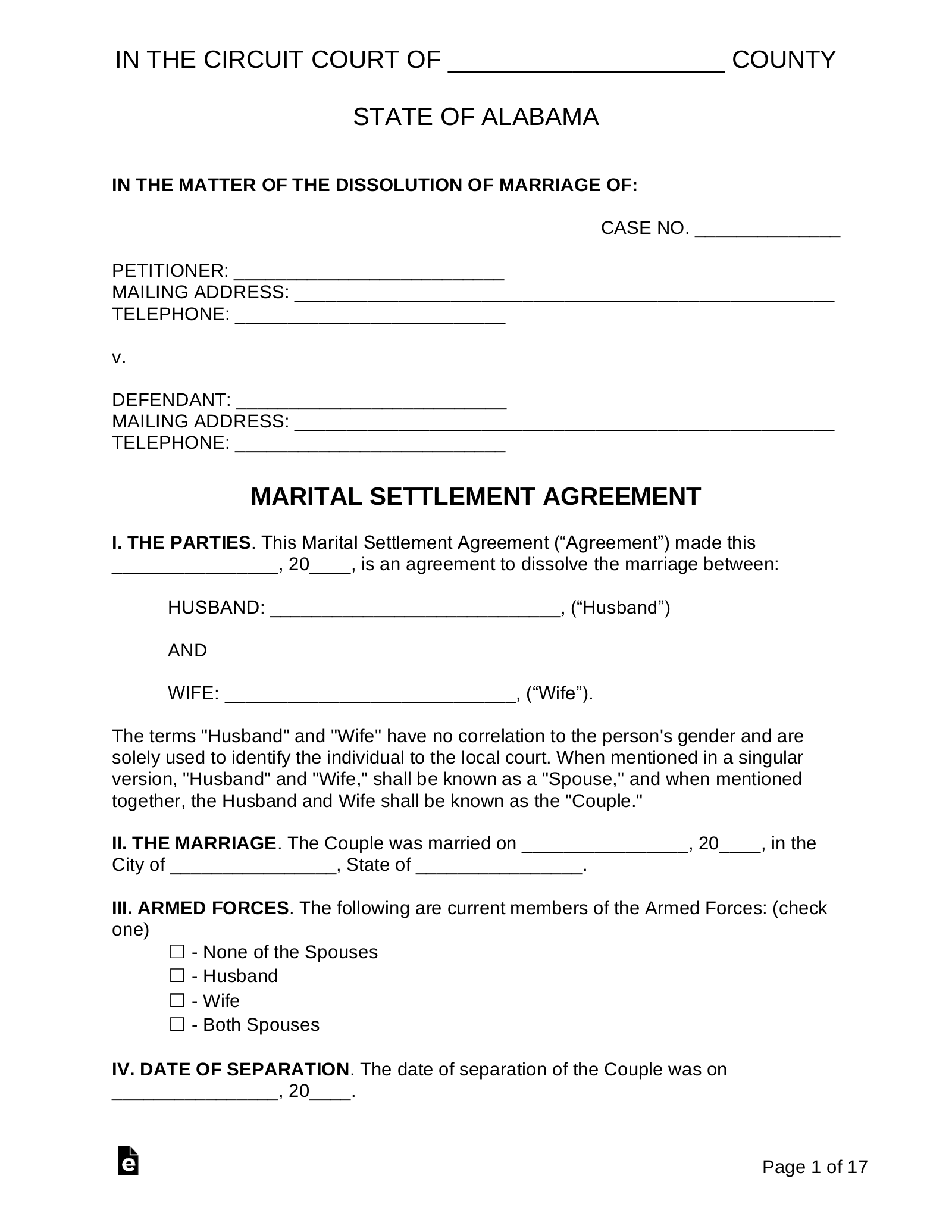
- Marital Settlement Agreement (or Separation Agreement): This is the cornerstone of an uncontested divorce. It details how all marital issues—assets, debts, alimony, and child-related matters—have been mutually resolved. Both parties must sign this document.
- Parenting Plan (if minor children are involved): This detailed plan outlines custody arrangements, visitation schedules, holidays, and decision-making responsibilities for children.
- Child Support Information Sheet and Order (if minor children are involved): This form provides information necessary to calculate child support according to Alabama guidelines.
- Affidavit of Residency: A sworn statement confirming that one party meets Alabama’s residency requirements.
- Waiver of Service: If the defendant agrees to accept the divorce papers without formal service by a sheriff or process server, they can sign this waiver.
- Testimony of Plaintiff: A sworn statement from the plaintiff supporting the claims made in the complaint.
It is highly recommended to obtain the most current versions of these forms directly from official sources, as legal forms can be updated. Read all instructions carefully.
Completing the Petition for Divorce
The “Complaint for Divorce” (sometimes called a Petition) is the primary document you will file with the court. It must be filled out accurately and completely. You will need to provide:
- Your Personal Information: Full legal names, addresses, dates of birth, and social security numbers for both spouses.
- Marriage Details: Date and place of marriage.
- Residency Confirmation: A statement confirming Alabama residency requirements are met.
- Grounds for Divorce: Clearly state the no-fault (e.g., incompatibility) or fault-based grounds you are asserting.
- Children’s Information: Names and dates of birth of any minor children of the marriage.
- Requested Relief: Specify what you are asking the court to do, such as dissolve the marriage, approve the marital settlement agreement, determine child custody and support, and divide property.

Every blank space must be addressed. If a section does not apply, write “N/A” (not applicable) to avoid ambiguity. The document often needs to be notarized, meaning you will sign it in front of a notary public.
Navigating the Court Process
With your paperwork meticulously prepared, the next phase involves formally submitting your case to the court and adhering to procedural requirements. This stage demands careful attention to deadlines and specific court protocols.
Filing Your Documents and Service of Process
After completing all forms, make several copies. You will typically need to provide the original set to the court, one copy for yourself, and one copy for your spouse (the defendant).
- Filing: Take the original Complaint for Divorce and other initial filings to the Clerk of the Circuit Court in the appropriate county. You will be required to pay a filing fee. If you cannot afford the fee, you may be able to file a “Petition to Proceed In Forma Pauperis” to ask the court to waive the fees.
- Service of Process: The defendant must be legally informed that a divorce action has been filed. This is known as “service of process.” For an uncontested divorce where cooperation exists, the simplest method is for the defendant to sign a “Waiver of Service” form. By signing this, they acknowledge receipt of the complaint and waive their right to formal service by a sheriff or process server. If the defendant refuses to sign a waiver, you will need to arrange for formal service through the sheriff’s office or a private process server, which incurs additional fees and may complicate the process.
Once the documents are filed and service is completed (or waived), the court officially has jurisdiction over the case.
The Waiting Period and Finalizing Your Divorce
Alabama law typically imposes a mandatory 30-day waiting period from the date the Complaint for Divorce is filed (or served) before a divorce can be finalized. This period allows for a cooling-off period and an opportunity for reconciliation.
During or after this 30-day period, if all issues are resolved and you have an executed Marital Settlement Agreement (and Parenting Plan, if applicable), you will then submit these to the court. Often, the court will require a brief hearing, even in an uncontested divorce, where the plaintiff testifies under oath that the marriage is irretrievably broken or that the grounds for divorce exist, and that the settlement agreement is fair and equitable. Some courts may accept an Affidavit of Testimony in lieu of a personal appearance, but this varies by circuit and judge.
After reviewing all documents and any required testimony, if the judge is satisfied that all legal requirements have been met and the settlement is fair, they will sign the “Final Judgment of Divorce” (also known as a Divorce Decree). This document officially dissolves the marriage and makes the terms of your settlement agreement legally binding. Ensure you obtain certified copies of the final judgment for your records, especially if you need to update legal documents, change your name, or transfer property.
Key Considerations for Self-Represented Filers
While filing for divorce without a lawyer is possible, several complex issues require careful attention, even in an uncontested situation. Overlooking these aspects can lead to significant future problems.
Property Division and Spousal Support
Alabama is an “equitable distribution” state, meaning marital property and debts are divided fairly, but not necessarily equally. In an uncontested divorce, you and your spouse must agree on how to divide all assets (real estate, bank accounts, retirement funds, vehicles) and debts (mortgages, credit card debt, loans) acquired during the marriage. The Marital Settlement Agreement must clearly delineate who receives what and who is responsible for which debts. Be meticulous in listing all assets and liabilities to avoid inadvertently omitting something.
Spousal support, or alimony, is another critical consideration. Alimony may be awarded for a limited period (rehabilitative alimony) or indefinitely (periodic alimony), depending on various factors like the length of the marriage, the financial needs of one spouse, and the ability of the other spouse to pay. In an uncontested divorce, you must mutually decide if alimony will be paid, the amount, and the duration. If you agree that no alimony will be paid, your agreement should explicitly state this. Without clear terms, this issue could resurface later.
Child Custody and Support
If you have minor children, the stakes are even higher. Alabama courts always prioritize the “best interests of the child” when making decisions about custody and support.
- Custody: Alabama recognizes both sole and joint custody. Joint custody can be physical (children spend significant time with both parents) and/or legal (parents share decision-making authority). Your Parenting Plan must detail the residential schedule, holiday arrangements, transportation, and how major decisions regarding education, healthcare, and religious upbringing will be made. The plan should be comprehensive and address potential future disagreements.
- Child Support: Child support is calculated using Alabama’s child support guidelines, which consider both parents’ incomes, childcare costs, and health insurance premiums. Even if you agree on an amount, the court will review it to ensure it aligns with the guidelines. Any significant deviation from the guidelines must be justified and explicitly approved by the court. The Child Support Information Sheet must be accurately completed to provide the necessary data for calculation.
Self-filing for divorce in Alabama is a viable option for many, particularly those with an uncontested case and a cooperative spouse. However, it requires a significant investment of time, attention to detail, and a commitment to understanding the legal process. While this guide provides a solid framework, remember that it is not a substitute for legal advice. When in doubt, or if any aspect of your divorce becomes contested, seeking counsel from a qualified attorney is always the wisest course of action to protect your rights and ensure a legally sound outcome.
LifeOutOfTheBox is a participant in the Amazon Services LLC Associates Program, an affiliate advertising program designed to provide a means for sites to earn advertising fees by advertising and linking to Amazon.com. Amazon, the Amazon logo, AmazonSupply, and the AmazonSupply logo are trademarks of Amazon.com, Inc. or its affiliates. As an Amazon Associate we earn affiliate commissions from qualifying purchases.