
Forming an S Corporation in California can be a strategic move for business owners seeking to enhance their tax efficiency and operational flexibility. While the legal framework for an S Corporation is established at the federal level by the Internal Revenue Service (IRS), California has its own specific requirements and considerations that must be navigated. This guide will walk you through the essential steps and nuances of establishing an S Corporation within the Golden State, ensuring compliance and maximizing potential benefits.
Understanding the S Corporation Election
Before delving into the formation process, it’s crucial to grasp what an S Corporation is and why a business owner might choose this structure. An S Corporation, or “S Corp,” is not a business entity type in itself but rather a tax election that a qualifying domestic corporation or LLC can make with the IRS. This election allows profits and losses to be passed through directly to the owners’ personal income without being subject to corporate tax rates. This avoids the “double taxation” often associated with traditional C Corporations, where profits are taxed at the corporate level and again when distributed to shareholders as dividends.
Key Advantages of an S Corp Election
- Pass-Through Taxation: This is the primary benefit. Business income and losses are reported on the owners’ individual tax returns, simplifying tax filings and potentially reducing overall tax liability.
- Deductible Expenses: Owners who work for the S Corp can be paid a “reasonable salary” as employees. This salary is subject to payroll taxes. However, any remaining profits distributed to the owners are not subject to self-employment taxes. This can lead to significant savings compared to being taxed as a sole proprietor or partner.
- Credibility and Professionalism: Operating as a corporation, even with the S Corp tax election, can lend an air of greater legitimacy and professionalism to your business, which can be beneficial when seeking loans or attracting investors.
- Limited Liability: Like a traditional corporation or LLC, an S Corp offers liability protection to its owners, separating personal assets from business debts and liabilities.
Considerations Before Electing S Corp Status
While advantageous, an S Corp election isn’t suitable for every business. Several factors warrant careful consideration:
- Ownership Restrictions: S Corps can only have up to 100 shareholders. These shareholders must be U.S. citizens or resident aliens, certain trusts, or estates. Partnerships and other corporations generally cannot be shareholders.
- One Class of Stock: S Corps can only have one class of stock, although differences in voting rights are permissible.
- Complexity and Administrative Burden: While simpler than a C Corp in some tax aspects, S Corps still have more stringent reporting and compliance requirements than sole proprietorships or partnerships, including payroll and separate tax filings.
- California Franchise Tax: California imposes a minimum annual franchise tax on all corporations, including S Corps, which is currently $800. This tax is levied regardless of profitability.
Steps to Forming an S Corporation in California
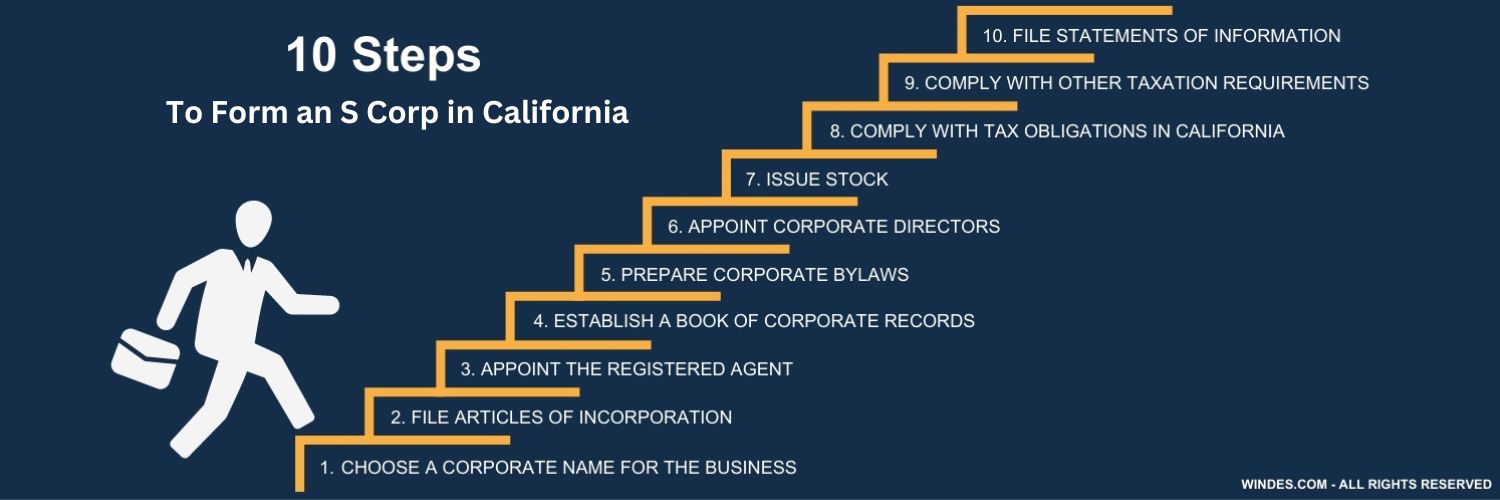
The process of forming an S Corporation in California involves two main stages: first, establishing a legal business entity (typically a corporation or LLC) at the state level, and second, making the S Corporation tax election with the IRS and the Franchise Tax Board (FTB).
Step 1: Establish Your Business Entity in California
You cannot directly form an S Corporation. Instead, you must first form a traditional corporation or a Limited Liability Company (LLC) in California.
Option A: Forming a California Corporation
- Choose a Business Name: Select a unique name for your corporation that is not already in use by another registered business in California. You can check name availability on the California Secretary of State website.
- Appoint a Registered Agent: You must designate a registered agent located in California to receive official legal and tax documents on behalf of your corporation. This can be an individual residing in California or a business entity authorized to do business in the state.
- File Articles of Incorporation: This is the foundational document for your corporation. It must be filed with the California Secretary of State. The Articles of Incorporation typically include:
- The corporation’s name.
- The name and address of the registered agent.
- The total number of shares the corporation is authorized to issue.
- The name and address of the incorporator(s).
- Create Corporate Bylaws: While not filed with the state, bylaws are essential internal documents that govern the corporation’s operations, including rules for shareholder meetings, director elections, and officer duties.
- Hold an Organizational Meeting: At this meeting, initial directors are appointed, bylaws are adopted, officers are elected, and shares are issued.
- Obtain an Employer Identification Number (EIN): Even if you don’t plan to hire employees immediately, you will need an EIN from the IRS for tax purposes. This is a unique nine-digit number assigned to business entities operating in the United States. You can apply for an EIN online for free on the IRS website.
Option B: Forming a California LLC
- Choose a Business Name: Similar to a corporation, your LLC name must be unique in California.
- Appoint a Registered Agent: An LLC also requires a registered agent in California.
- File Articles of Organization: This document is filed with the California Secretary of State and establishes your LLC. It includes:
- The LLC’s name.
- The name and address of the registered agent.
- Whether the LLC is a member-managed or manager-managed entity.
- Create an Operating Agreement: An operating agreement is an internal document that outlines the ownership structure, management, and operating procedures of the LLC. It’s highly recommended for clarity and to avoid future disputes.
- Obtain an EIN: As with a corporation, an LLC needs an EIN from the IRS.
Step 2: Make the S Corporation Tax Election

Once your corporation or LLC is legally established in California, you can proceed with the S Corporation tax election.
Federal Election (IRS Form 2553)
- Eligibility Check: Ensure your entity meets the federal eligibility requirements for an S Corporation (as outlined above).
- File Form 2553, Election by a Small Business Corporation: This is the crucial form for electing S Corp status with the IRS. It must be completed accurately and signed by all shareholders. The form requires information such as:
- The corporation’s name, address, and EIN.
- The date and state of incorporation.
- The names and addresses of all shareholders.
- The number of shares each shareholder owns.
- The tax year for which the election is to take effect.
- A statement that the corporation meets the eligibility requirements.
- Filing Deadline: Form 2553 must generally be filed within two months and 15 days after the beginning of the tax year the election is to take effect, or at any time during the tax year preceding the year the election is to take effect. Late elections can sometimes be permitted with reasonable cause.
California State Election (FTB Form 3522)
- File Form 3522, S Corporation Election or Termination: In addition to the federal election, California requires a separate election with the Franchise Tax Board (FTB). This form is used to elect S Corporation status or to terminate a previously made S Corp election.
- Submission: Form 3522 should be filed with the FTB. It’s important to note that California follows the federal S Corp election. If your federal election is approved, California generally recognizes it. However, filing Form 3522 ensures proper tracking and taxation within the state.
- California S Corporation Tax: While S Corps benefit from pass-through taxation federally, California has specific provisions. S Corporations in California are subject to a 1.5% franchise tax on their net income, with a minimum annual tax of $800. This is in addition to the federal tax treatment.
Ongoing Compliance and Considerations
Operating as an S Corporation in California involves ongoing responsibilities to maintain compliance and fully leverage the benefits of this structure.
Reasonable Salary and Distributions
A critical aspect of S Corp operation is the distinction between owner salaries and distributions. Owners who actively work for the business must be paid a “reasonable salary.” This salary is subject to payroll taxes (Social Security and Medicare) and must be processed through the company’s payroll system.
- Determining Reasonableness: What constitutes a “reasonable salary” depends on various factors, including industry standards, the owner’s qualifications and duties, and the company’s profitability. The IRS scrutinizes this to prevent owners from taking excessively low salaries to avoid payroll taxes.
- Distributions: Profits remaining after all expenses, including reasonable salaries, can be distributed to shareholders as dividends or distributions. These distributions are generally not subject to self-employment taxes, offering a significant tax advantage.
Tax Filings
S Corps have distinct tax filing obligations:
- Federal: File IRS Form 1120-S, U.S. Income Tax Return for an S Corporation. This form reports the corporation’s income, deductions, gains, and losses, and it includes Schedule K-1, which details each shareholder’s share of these items.
- California: File FTB Form 100S, California S Corporation Franchise or Income Tax Return. This return reports income and calculates the state’s 1.5% franchise tax.
Annual Reporting and Fees
- Statement of Information: California corporations must file a Statement of Information with the California Secretary of State within 90 days of filing their Articles of Incorporation and then biennially thereafter. This update ensures that the state has current information about the corporation’s directors, officers, and registered agent.
- Franchise Tax: As mentioned, the $800 minimum annual franchise tax is a mandatory payment to the state of California for all corporations and LLCs, including those electing S Corp status. This tax is due annually.

Legal and Operational Best Practices
To maintain the integrity of your S Corporation and the protection it offers:
- Maintain Corporate Formalities: Even though an LLC can elect S Corp status, it’s often advisable to operate it with some corporate formalities to reinforce the separation between business and personal affairs. For true corporations, strictly adhering to corporate formalities (e.g., holding regular board and shareholder meetings, keeping accurate minutes) is essential for preserving limited liability.
- Separate Finances: Always keep business and personal finances strictly separate. Use dedicated business bank accounts and credit cards.
- Consult Professionals: Navigating the intricacies of S Corp formation and ongoing compliance can be complex. Engaging with a qualified tax advisor, accountant, or business attorney in California is highly recommended. They can provide tailored advice, ensure proper filing, and help you optimize your S Corp strategy.
Forming an S Corporation in California requires a methodical approach, starting with establishing the underlying business entity and then making the appropriate tax elections. By understanding the benefits, requirements, and ongoing responsibilities, business owners can harness the advantages of S Corp status to achieve greater financial efficiency and strategic growth within the Golden State.
LifeOutOfTheBox is a participant in the Amazon Services LLC Associates Program, an affiliate advertising program designed to provide a means for sites to earn advertising fees by advertising and linking to Amazon.com. Amazon, the Amazon logo, AmazonSupply, and the AmazonSupply logo are trademarks of Amazon.com, Inc. or its affiliates. As an Amazon Associate we earn affiliate commissions from qualifying purchases.