
Navigating the intricacies of employment law is crucial for anyone looking to work legally in the state of California. While the term “workers’ permit” often brings to mind permits for minors, the broader context of employment authorization is essential for a diverse range of individuals, particularly those who are not U.S. citizens or legal residents. Understanding the correct terminology and the relevant agencies involved is the first step towards ensuring compliance and securing legitimate employment opportunities across the Golden State.
Understanding Employment Authorization in California
The concept of a “workers’ permit” in California, especially for adults, directly relates to the authorization to work in the United States. This authorization is primarily governed by federal law, specifically through the U.S. Citizenship and Immigration Services (USCIS). In essence, individuals who are not U.S. citizens or lawful permanent residents typically need to demonstrate their legal right to work in the country. This is commonly achieved through various forms of immigration status that grant employment authorization.
Who Needs Employment Authorization?
The need for explicit employment authorization extends to several groups:
- Non-Citizens with Specific Visas: Many non-immigrant visa categories in the United States permit or require specific authorization for employment. Examples include:
- F-1 Students: While primarily in the U.S. for educational purposes, F-1 students may be eligible for Optional Practical Training (OPT) or on-campus employment under specific conditions.
- J-1 Exchange Visitors: Certain J-1 visa holders, particularly those participating in work-based exchange programs, may have employment authorization tied to their program.
- H-1B Specialty Occupations: This visa category allows U.S. employers to temporarily employ foreign workers in specialty occupations requiring theoretical or technical expertise.
- L-1 Intracompany Transferees: Allows employees of an international company to transfer to a related company in the U.S..
- Asylum Applicants and Refugees: Individuals who have applied for asylum or have been granted refugee status may be eligible for employment authorization.
- Temporary Protected Status (TPS) Holders: Those granted TPS due to conditions in their home country may also be authorized to work.
- Lawful Permanent Residents (Green Card Holders): While not requiring a separate “permit,” lawful permanent residents are authorized to work in the U.S. without restriction.
- U.S. Citizens: U.S. citizens are inherently authorized to work in the U.S..
Forms of Employment Authorization
The documentation proving employment authorization can take several forms, most notably:
- Form I-766, Employment Authorization Document (EAD): Often referred to as an “EAD card,” this is a plastic card issued by USCIS that serves as proof of authorization to work in the U.S. for a specific period. This is what most people would colloquially refer to when asking about a “workers’ permit” for non-citizens.
- Green Card: For lawful permanent residents, their Green Card (Form I-551) serves as proof of their authorization to work.
- Other USCIS Notices or Documents: In some cases, specific USCIS notices or approval documents may serve as temporary proof of employment authorization.
The Process of Obtaining an Employment Authorization Document (EAD)
For many individuals, obtaining an EAD is the primary route to legal employment in California if they do not fall into categories with inherent work authorization. The process is initiated by filing specific forms with USCIS. The most common application for an EAD is Form I-765, Application for Employment Authorization.
Eligibility for Form I-765
Eligibility to file Form I-765 is contingent upon one’s immigration status or pending application. Common categories that allow an individual to apply for an EAD include:
- Asylum Applicants: Those with a pending asylum application may be eligible to apply for an EAD 150 days after filing their asylum claim.
- F-1 Students: Eligible for OPT or STEM OPT extensions.
- J-2 Dependents: Spouses of J-1 exchange visitors may be eligible if the J-1’s program is in effect and they can demonstrate that the income is not needed to support the J-1.
- Lawful Permanent Resident Applicants: Individuals with a pending application for adjustment of status to lawful permanent resident.
- Temporary Protected Status (TPS) Holders: Individuals granted TPS.
- Certain Visa Holders: Such as those in the U.S. under specific categories that allow for employment authorization.
Steps to File Form I-765
- Determine Eligibility: Carefully review the instructions for Form I-765 and the eligibility categories on the USCIS website to confirm you meet the requirements for your specific situation.
- Gather Required Documentation: This is a critical step. You will need to provide evidence of your current immigration status, such as visa stamps, I-94 records, or approval notices. You will also need to provide passport-style photographs and potentially other supporting documents relevant to your eligibility category.
- Complete Form I-765: Fill out the application accurately and completely. Any errors or omissions can lead to delays or a denial.
- Pay the Filing Fee: There is a filing fee associated with Form I-765. Fee waivers may be available for individuals experiencing severe financial hardship, but this requires filing Form I-912, Request for Fee Waiver.
- Submit the Application: Mail the completed Form I-765, supporting documents, photographs, and the filing fee (or a request for a fee waiver) to the correct USCIS lockbox facility. The USCIS website provides detailed instructions on where to mail your application based on your eligibility category.
- Biometrics Appointment: After submitting your application, USCIS may schedule you for a biometrics appointment at a local Application Support Center (ASC). This appointment is for collecting your fingerprints, photograph, and signature, which are used for background checks.
- Receive Decision: USCIS will review your application and supporting documents. If approved, you will receive your Employment Authorization Document (EAD) in the mail. Processing times can vary significantly.
Employer Responsibilities: The I-9 Form
Once an individual has obtained their EAD or other acceptable proof of employment authorization, the next step in the employment process involves the employer. In the United States, employers are legally required to verify the identity and employment authorization of all individuals they hire. This is done through the completion of Form I-9, Employment Eligibility Verification.
The Role of Form I-9

Form I-9 is a U.S. government form that employers must complete for every new employee, whether they are U.S. citizens or non-citizens. The purpose is to establish that the employee is authorized to work in the U.S..
Key Responsibilities of the Employer:
- Section 1: The employee must complete Section 1 of the Form I-9 on their first day of employment. In this section, the employee attests to their citizenship or immigration status and provides information about their employment authorization. They will indicate if they are a U.S. citizen, lawful permanent resident, or an alien authorized to work. If they are not a U.S. citizen or lawful permanent resident, they must provide their document numbers and expiration dates for their employment authorization.
- Section 2: Within three business days of the employee’s first day of employment, the employer must physically examine original documents presented by the employee from the Lists of Acceptable Documents. These documents are divided into two lists:
- List A: Documents that establish both identity and employment authorization (e.g., a U.S. Passport, Permanent Resident Card).
- List B: Documents that establish identity only (e.g., a Driver’s License, State ID Card).
- List C: Documents that establish employment authorization only (e.g., an Employment Authorization Document (EAD) issued by USCIS).
The employee must present either one document from List A, OR one document from List B AND one document from List C. The employer then records the document information in Section 2 of the Form I-9.
- Section 3: This section is used for re-verification when employment authorization expires or when rehiring an employee.
Key Responsibilities of the Employee:
- Present Valid Documentation: The employee must present original, unexpired documents from the Lists of Acceptable Documents that prove their identity and employment authorization.
- Complete Section 1: Accurately complete and sign Section 1 of the Form I-9.
It is important to note that employers cannot specify which documents an employee may present; they must accept any valid combination from the Lists of Acceptable Documents. Furthermore, employers are prohibited from discriminating against individuals based on their national origin or immigration status.
Special Considerations for Minors Working in California
The term “workers’ permit” is most directly applicable to minors under the age of 18 seeking employment in California. These permits are designed to protect children and ensure that their work does not interfere with their education or pose a risk to their health and safety.
California Minor Labor Laws
California’s child labor laws are enforced by the California Labor Commissioner’s Office, part of the Department of Industrial Relations. These laws set restrictions on the types of work minors can do, the hours they can work, and the necessary documentation.
Obtaining a Work Permit for Minors
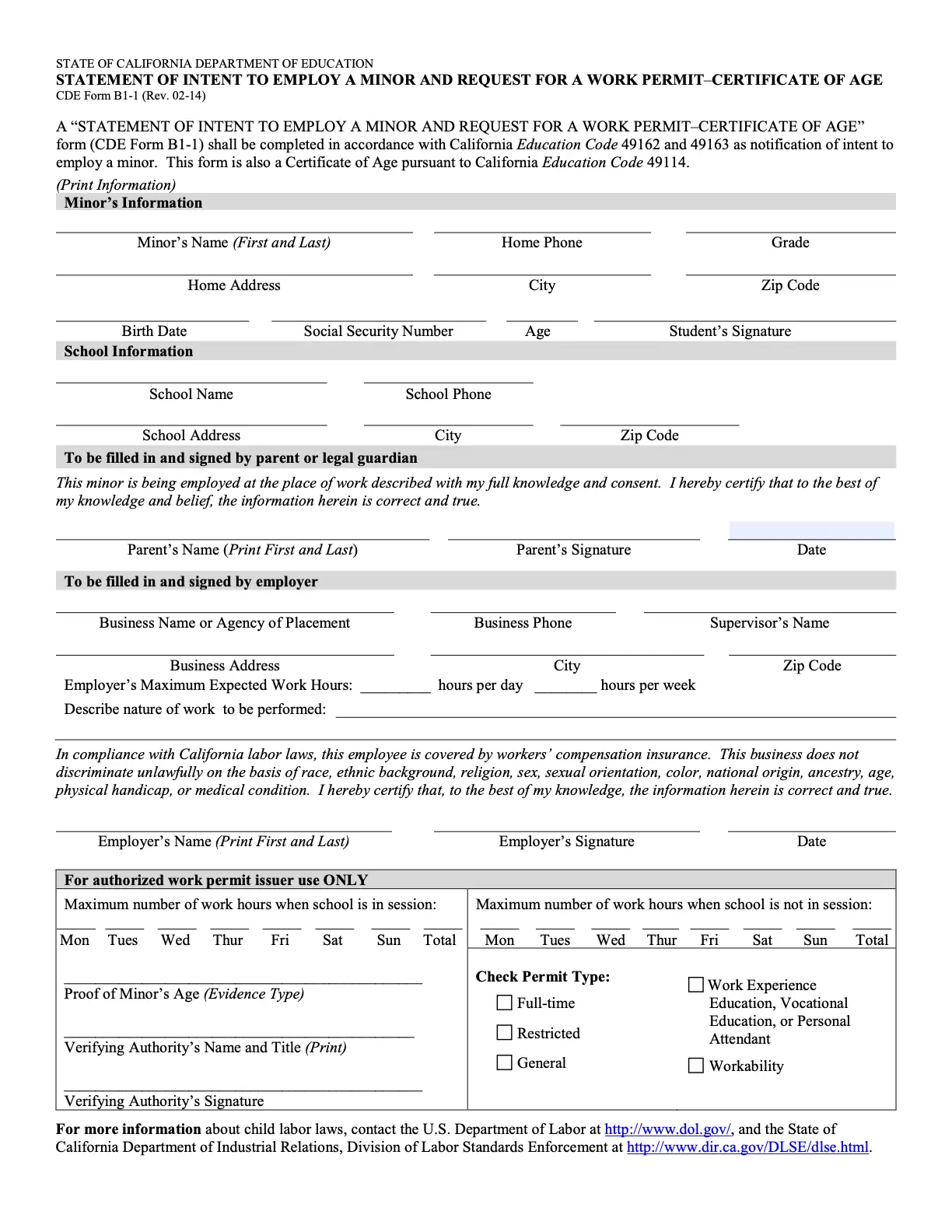
To work legally in California, minors under 18 generally need a Permit To Employ and Work (often called a “work permit” or “work permit card”).
Who Issues Work Permits?
Work permits are typically issued by the public school district or the private school the minor attends. If a minor is home-schooled or does not attend a school, they may be able to obtain a permit from the county office of education or the California Department of Education.
Steps to Obtain a Work Permit for a Minor:
- Obtain the Application Form: The minor (or their parent/guardian) will need to obtain a Permit To Employ and Work application form from their school or the issuing authority.
- Employer Information: The employer must complete a portion of the form, specifying the minor’s job title, duties, and the hours and days of employment. This section is crucial for the school to determine if the proposed work is suitable and does not violate labor laws.
- Parent/Guardian Consent: The parent or legal guardian of the minor must sign the application form, giving their consent for the minor to work.
- Minor’s Signature: The minor must also sign the application.
- School Approval: The completed application, including employer and parental signatures, is then submitted to the school’s work permit officer. The officer reviews the application to ensure it complies with all state and federal child labor laws. They will consider the minor’s age, the proposed hours, and the nature of the work.
- Issuance of the Permit: If approved, the school will issue the Permit To Employ and Work to the minor. This permit must be presented to the employer.
Important Notes for Minors:
- Age Restrictions: Specific rules apply based on the minor’s age. For example, minors under 16 have more stringent limitations on the types of work and hours.
- School Attendance: A minor must be enrolled in and attending school to be eligible for a work permit. If a minor is not attending school or is performing poorly, the school may revoke their work permit.
- Hours of Work: Strict limits are placed on the number of hours minors can work, especially during school days and school weeks. These limits vary by age and whether school is in session.
- Prohibited Occupations: Certain occupations are deemed too dangerous for minors and are strictly prohibited.

Staying Compliant in California’s Employment Landscape
For both employers and employees in California, understanding and adhering to employment authorization requirements is paramount. This ensures a legal and fair working environment, protecting the rights and well-being of all individuals involved. Whether you are a U.S. citizen, a lawful permanent resident, or a foreign national seeking employment, clarity on work authorization is the first step towards a successful career in the Golden State.
For employers, rigorous adherence to Form I-9 procedures and awareness of discrimination laws are essential. For individuals seeking to work, understanding the different pathways to employment authorization, whether through federal immigration processes or state-specific minor work permits, is critical. Consulting official resources from USCIS, the California Labor Commissioner’s Office, and seeking legal counsel when necessary can provide invaluable guidance in navigating these complex requirements. Ensuring you have the correct documentation and follow the proper procedures is not just a legal obligation but a fundamental aspect of professional integrity.
LifeOutOfTheBox is a participant in the Amazon Services LLC Associates Program, an affiliate advertising program designed to provide a means for sites to earn advertising fees by advertising and linking to Amazon.com. Amazon, the Amazon logo, AmazonSupply, and the AmazonSupply logo are trademarks of Amazon.com, Inc. or its affiliates. As an Amazon Associate we earn affiliate commissions from qualifying purchases.