
Learning to play an iconic song on the acoustic guitar can be one of the most rewarding experiences for anyone looking to enrich their lifestyle through music. Few songs capture the spirit of classic rock and the joy of a sing-along quite like Sweet Home Alabama. Penned by the legendary Lynyrd Skynyrd, this track isn’t just a hit; it’s a cultural touchstone that has inspired countless guitarists to pick up their instruments. Mastering this tune offers more than just a new skill; it provides a pathway to personal expression, social engagement, and a deeper appreciation for musical heritage. This guide will walk you through the essential steps to make this classic part of your repertoire, focusing on the techniques and practice strategies that transform a learner into a confident performer.
The Enduring Appeal of a Southern Rock Anthem
Embracing music as a hobby offers profound benefits to one’s lifestyle, from stress relief to enhanced cognitive function. Diving into a song like “Sweet Home Alabama” is an excellent way to tap into these advantages. Its widespread recognition and relatively straightforward structure make it an ideal target for acoustic guitarists of all levels.
A Brief History of a Classic
Released in 1974 on their album Second Helping, “Sweet Home Alabama” quickly became one of Lynyrd Skynyrd’s signature songs. It was famously written in response to Neil Young’s songs “Southern Man” and “Alabama,” which criticized the South. Lynyrd Skynyrd crafted a response that championed the state of Alabama and its people, creating an anthem that transcended its initial political context to become a beloved rock staple. The song’s origins are deeply rooted in the Southern Rock movement, reflecting a distinctive sound that combines blues, country, and rock influences. Its simple yet powerful message and unforgettable riffs have cemented its place in music history, making it a perennial favorite for musicians and listeners alike.
Why “Sweet Home Alabama” Resonates
Beyond its catchy melody, “Sweet Home Alabama” holds a special place in the hearts of many due to its accessible nature and feel-good vibe. For acoustic guitarists, it presents an achievable challenge that yields immense satisfaction. The chord progression is foundational, the main riff is iconic, and the strumming pattern is intuitive once understood. Learning this song is not merely about hitting the right notes; it’s about connecting with a piece of cultural history and developing a skill that can bring joy to gatherings, campfire sessions, or simply quiet moments of personal reflection. It’s a song that almost everyone knows, making it a fantastic addition to any musician’s personal playlist for impromptu performances.
Essential Preparations for Aspiring Guitarists
Before diving into the specific chords and riffs, ensuring you have the right setup and a foundational understanding of guitar basics will significantly smooth your learning curve. This preparation is a crucial aspect of personal development in any new hobby, setting the stage for success.
Gear Up: Your Acoustic Guitar and Accessories
To play “Sweet Home Alabama,” you’ll primarily need an acoustic guitar. While any acoustic will do, a dreadnought-style guitar often provides the full, resonant sound characteristic of the song. Beyond the instrument itself, a few accessories are highly recommended:
- Picks: Medium-gauge picks are versatile for both strumming and picking the main riff. Experiment with different thicknesses to find what feels best for your playing style.
- Capo: Although the original recording is in G major, many live versions and tutorials might suggest using a capo on the second fret to play in a more accessible key like A major (using G major chord shapes). For this guide, we will focus on playing in G major without a capo, to directly match the original key.
- Tuner: Essential for ensuring your guitar is in standard tuning (E-A-D-G-B-E), which is crucial for the chords to sound correct.
- Strap: If you plan to play standing up, a comfortable strap is a must.
- Patience: Perhaps the most important accessory, patience, is key to learning any musical instrument. Embrace the process, celebrate small victories, and don’t get discouraged by initial difficulties.
Foundational Skills: Chords and Rhythm
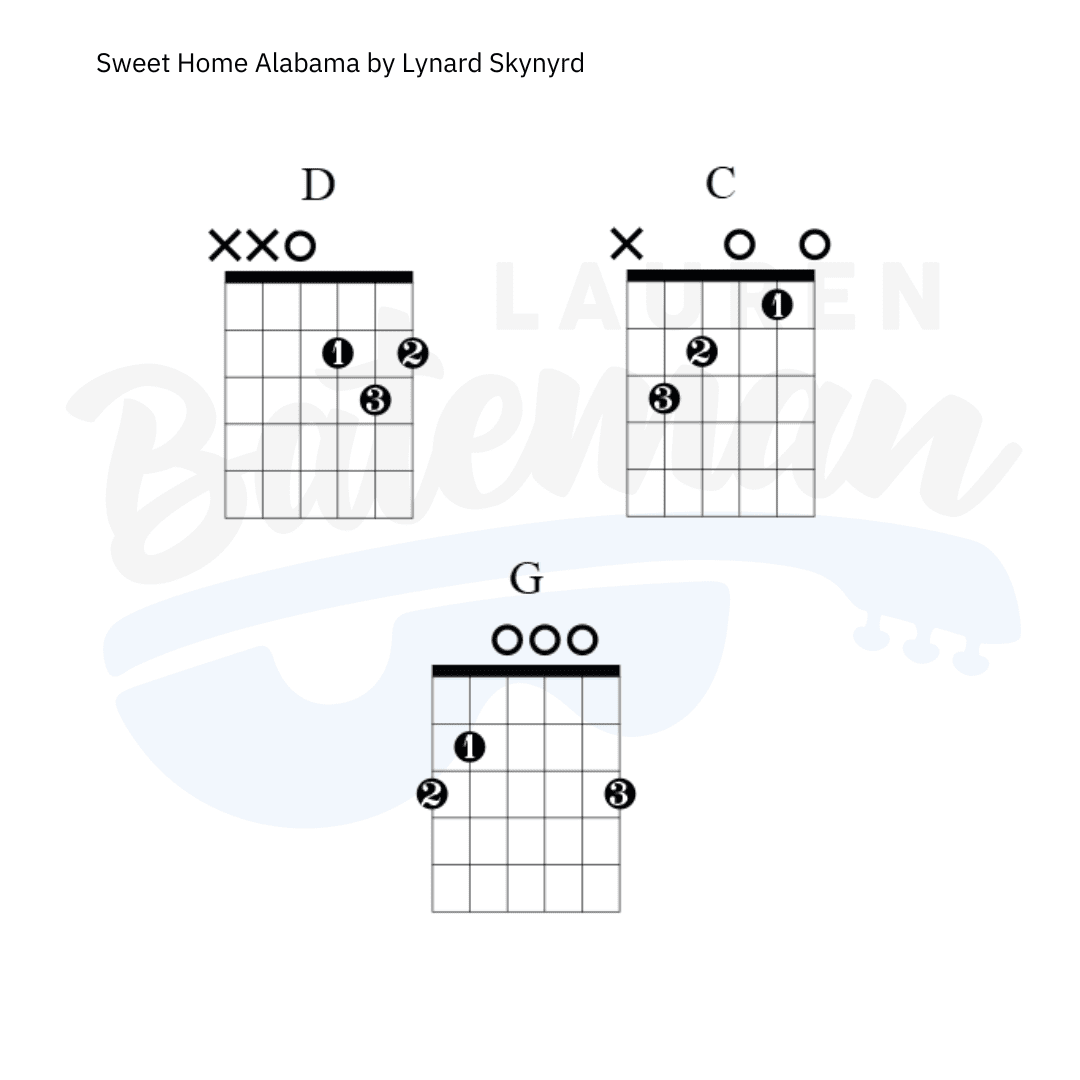
Before tackling “Sweet Home Alabama,” a basic familiarity with open chords and rhythm is beneficial. If you’re completely new to the guitar, start by practicing the following open chords until you can switch between them relatively smoothly:
- G Major: This is a fundamental chord and appears prominently in the song.
- C Major: Another core chord used frequently.
- D Major: Essential for the song’s progression.
- E Minor: Not directly in the main progression but good for overall chord vocabulary.
Additionally, developing a sense of rhythm is paramount. Practice simple down-up strumming patterns, ensuring each strum is even and consistent. Using a metronome can be incredibly helpful for developing precise timing and keeping a steady beat, which are vital for a song with such a strong rhythmic backbone.
Deconstructing “Sweet Home Alabama”: Chords and Riffs
This section breaks down the song into its core components, offering a detailed guide to the main riff, chord progressions, and strumming patterns. This structured approach is akin to mastering any complex skill: breaking it into manageable pieces.
The Iconic Intro Riff
The most recognizable element of “Sweet Home Alabama” is its opening riff. Played by two guitars on the original recording, it translates beautifully to a single acoustic guitar. The riff is played over a D-C-G progression, although the notes of the riff itself often imply these chords without needing to fully strum them.
Here’s a simplified version of the main riff:
(Assuming standard tuning, no capo)
Part 1 (D string):
e|—————–|
B|—————–|
G|–2–0———–|
D|——–2–0—–|
A|—————2-|
E|—————–|

Part 2 (C string – played over a C chord shape, but not fully strummed):
e|—————–|
B|—————–|
G|–0————–|
D|—–2–0——–|
A|———–3–2–|
E|—————–|
Part 3 (G string – played over a G chord shape):
e|—————–|
B|—————–|
G|—————–|
D|–0————–|
A|—–2–0——–|
E|———–3–0–|
Repeat these three parts, focusing on clarity and even timing. The tempo is brisk, so start slowly and gradually increase your speed. Pay attention to the alternating bass notes implied by the riff, which are crucial to its feel.
Mastering the Verse and Chorus Chords
The chord progression for the verse and chorus is remarkably simple and cyclical, making it easy to memorize and play repeatedly. It primarily revolves around three open chords: D Major, C Major, and G Major.
The progression is:
D Major – C Major – G Major
This sequence repeats throughout the verses and choruses. For the C Major chord, many guitarists, including those in Lynyrd Skynyrd, often use a Cadd9 (C add 9) chord, which sounds fuller and has a more open, ringing quality.
Cadd9 (C add 9) Chord Shape:
e|-3-|
B|-3-|
G|-0-|
D|-2-|
A|-3-|
E|—| (Mute with your thumb or don’t strum)
Practice switching between D, Cadd9 (or C), and G smoothly. Focus on clean transitions where each chord rings out clearly without buzzing. The trick is to anticipate the next chord and move your fingers efficiently.
Crafting the Strumming Pattern
The strumming pattern for “Sweet Home Alabama” is energetic and propulsive, driving the song forward. A common and effective pattern is:
Down – Down-Up – Up – Down-Up
Let’s break it down:
- DOWN: A strong downstroke.
- DOWN-UP: Two quick strums.
- UP: A single upstroke.
- DOWN-UP: Two quick strums.
The emphasis often falls on the first downstroke of each chord. Try counting along to the beat, perhaps “1 & 2 & 3 & 4 &” where the downstrokes align with the numbers and upstrokes with the “ands.” Once comfortable, try to feel the groove and let the rhythm flow naturally. Consistency is more important than speed initially. The song is in 4/4 time, so aim for four beats per measure, with the strumming pattern fitting within that.
Elevating Your Performance and Practice Routine
Integrating music into your lifestyle means more than just learning a few chords; it involves consistent practice, continuous improvement, and finding joy in the musical journey. This dedication not only sharpens your guitar skills but also enhances your discipline and creative expression.
Practicing with Purpose
Effective practice is intentional and structured. Instead of aimlessly strumming, focus on specific areas:
- Slow and Steady: Always start slow. Use a metronome to ensure your timing is precise, gradually increasing the tempo as you gain confidence.
- Isolate Sections: If you’re struggling with the riff, practice only the riff. If chord changes are difficult, practice only the chord changes in sequence.
- Listen Actively: Play along with the original Lynyrd Skynyrd recording of “Sweet Home Alabama.” This helps you internalize the timing, feel, and nuances of the song. Many apps and online tools allow you to slow down songs without changing pitch.
- Record Yourself: Listening back to your playing can highlight areas for improvement that you might not notice while playing.
- Consistency over Duration: Short, regular practice sessions (e.g., 15-30 minutes daily) are often more effective than infrequent, long ones.
Adding Your Personal Touch
Once you’re comfortable with the basic structure of “Sweet Home Alabama,” don’t be afraid to experiment and add your personal flair. This is where your unique musical lifestyle truly begins to shine.
- Dynamics: Play with the volume and intensity of your strumming. A softer verse contrasting with a powerful chorus can add significant emotional depth.
- Strumming Variations: While the basic pattern is effective, try subtle variations in your strumming. Maybe a muted strum here, or a heavier accent there.
- Sing Along: Even if you don’t consider yourself a singer, trying to sing along while playing helps with timing and overall musicality. It also makes the experience more engaging and enjoyable.
- Improvise: During instrumental breaks, try simple improvisations using the G major pentatonic scale. This can be a great way to develop your soloing skills.

The Joy of Playing for Yourself and Others
Ultimately, learning to play “Sweet Home Alabama” on acoustic guitar is about enriching your life. Whether you’re playing for personal enjoyment, performing for friends around a campfire, or simply using it as a stepping stone to learn more complex pieces, the journey is rewarding. Music offers a unique form of self-expression and connection. The pride of mastering a challenging piece, the camaraderie of a sing-along, and the simple pleasure of creating sound are all profound benefits of integrating guitar playing into your lifestyle. It’s a skill that transcends geographical boundaries, allowing you to connect with people and cultures through a universal language, much like the band did from their humble beginnings in Jacksonville to their induction into the Rock and Roll Hall of Fame. Embrace the journey, and let the music play!
LifeOutOfTheBox is a participant in the Amazon Services LLC Associates Program, an affiliate advertising program designed to provide a means for sites to earn advertising fees by advertising and linking to Amazon.com. Amazon, the Amazon logo, AmazonSupply, and the AmazonSupply logo are trademarks of Amazon.com, Inc. or its affiliates. As an Amazon Associate we earn affiliate commissions from qualifying purchases.