
Navigating the complexities of healthcare can be a daunting task, especially when it involves understanding state-specific programs like Medicaid in Texas. For residents of the Lone Star State, understanding eligibility for this crucial safety net is vital for accessing necessary medical care. Whether you’re planning a long-term stay, considering relocation, or are already a resident, knowing the ins and outs of Texas Medicaid can significantly impact your lifestyle and financial planning. This comprehensive guide aims to demystify the qualification process, offering clarity on who is eligible, how to apply, and what programs are available.
Understanding Medicaid in the Lone Star State
Medicaid is a joint federal and state program that helps cover medical costs for people with limited income and resources. In the United States, each state administers its own Medicaid program, leading to variations in eligibility criteria and benefits. Texas has a specific set of rules and programs designed to meet the needs of its diverse population.
What is Texas Medicaid?
Texas Medicaid is designed to provide comprehensive health coverage to eligible low-income individuals and families. This can include doctor visits, hospital stays, prescription drugs, mental health services, and long-term care, among other benefits. The primary goal is to ensure that vulnerable populations, who might otherwise go without essential medical services, can access the care they need to maintain their health and well-being. Unlike some other states, Texas has not expanded its Medicaid program under the Affordable Care Act to cover all low-income adults without specific qualifying conditions. This means that income thresholds are often stricter and eligibility is tied to specific categories of need.
Who Administers Medicaid in Texas?
The administration of Medicaid in Texas falls under the purview of the Texas Health and Human Services Commission (HHSC). This state agency is responsible for determining eligibility, managing the various Medicaid programs, and overseeing the delivery of services. HHSC works with Managed Care Organizations (MCOs) across different regions of Texas to provide healthcare services to Medicaid recipients. Understanding the role of HHSC is crucial because they are the primary point of contact for applications, questions, and appeals related to Medicaid benefits.
Key Eligibility Requirements for Texas Medicaid
Qualifying for Medicaid in Texas hinges on meeting specific criteria related to residency, citizenship, income, and often, a qualifying category of need. It’s not a one-size-fits-all program, so understanding the nuances of each requirement is essential.
Residency and Citizenship Status
To be eligible for Texas Medicaid, applicants must first establish that they are residents of the state of Texas. This generally means living in Texas with the intent to remain, and not just for temporary purposes. Documentation such as a Texas driver’s license, utility bills, or a lease agreement can help prove residency.
In addition to residency, applicants must be either a U.S. citizen or a qualified non-citizen. Qualified non-citizens include permanent legal residents, asylees, refugees, parolees, or those granted withholding of deportation. There are specific rules regarding how long a qualified non-citizen must reside in the United States before becoming eligible for full Medicaid benefits, often requiring a five-year waiting period, though some exceptions exist for certain groups like refugees.
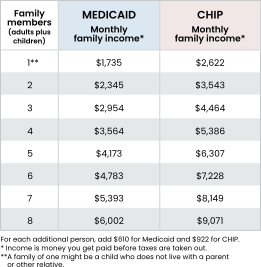
Income and Household Size Limits
Income is a primary determinant of Medicaid eligibility. Texas utilizes the Modified Adjusted Gross Income (MAGI) methodology for most family-based Medicaid programs, which considers taxable income and household composition. However, for certain groups like the elderly and individuals with disabilities, different income and asset tests may apply.
Since Texas has not expanded Medicaid, the income thresholds are typically tied to percentages of the Federal Poverty Level (FPL) and vary significantly depending on the applicant’s category. For instance:
- Pregnant Women: Often eligible if their household income is at or below 198% of the FPL. This program, known as Medicaid for Pregnant Women (MPW), provides comprehensive care throughout pregnancy and for a period postpartum.
- Children: Eligibility for children up to age 18 can extend up to 133% of the FPL for Medicaid, and up to 201% of the FPL for the Children’s Health Insurance Program (CHIP). CHIP is a separate program for children whose families earn too much for Medicaid but cannot afford private insurance.
- Parents/Caretaker Relatives: In Texas, parents or caretaker relatives are typically eligible for Medicaid only if their income is extremely low, often around 17-18% of the FPL. This is a stark difference compared to states that have expanded Medicaid coverage to all adults up to 138% of the FPL.
- Adults with Disabilities and the Elderly: For individuals aged 65 and over, or those with disabilities, income and asset limits are generally higher and are not solely based on MAGI. These individuals may qualify for Medicaid if their monthly income is at or below 79% of the FPL for an individual (for example, around $965 per month for an individual, though these numbers change annually), and their countable assets (excluding their primary home and one car) are below a certain limit, typically $2,000 for an individual and $3,000 for a couple. These individuals may also access home and community-based services or nursing home care through Medicaid waiver programs.
It’s crucial to note that the exact FPL percentages and corresponding dollar amounts are updated annually by the federal government. Applicants should always refer to the most current guidelines on the HHSC website or YourTexasBenefits.com for precise figures.
Specific Coverage Groups and Programs
Beyond the general income and residency requirements, Texas Medicaid offers a variety of specialized programs catering to particular populations. These programs often have their own specific eligibility criteria:
- STAR (State of Texas Access Reform): This is the main Medicaid managed care program for families and children. It provides healthcare services, including doctor visits, prescription drugs, hospital stays, and more, through health plans selected by the enrollee.
- STAR Kids: Tailored for children and young adults with disabilities, up to age 20, who receive Medicaid. This program offers service coordination and additional benefits designed to meet the complex needs of this population.
- STAR Health: Specifically for children in foster care who receive Medicaid. It provides a comprehensive approach to their healthcare needs, ensuring continuity of care.
- Medicaid for the Elderly and People with Disabilities (MEPD): This program covers individuals aged 65 or older, or those with disabilities, who meet the income and asset limits. It can help with medical costs, long-term care services in nursing facilities, or home and community-based services through waiver programs.
- Medicaid Buy-In Program: This program allows working adults with disabilities to “buy into” Medicaid by paying a monthly premium, even if their income is slightly above traditional Medicaid limits. It encourages employment by allowing individuals to maintain their health coverage despite earning more. There’s also a Medicaid Buy-In for Children program for children with disabilities whose families have higher incomes.
- Medicare Savings Programs (MSPs): For individuals who are eligible for both Medicare and Medicaid (often referred to as “dual eligibles”), MSPs can help with Medicare premiums, deductibles, and co-payments. These programs have their own income and asset limits, usually slightly higher than full Medicaid.
- Emergency Medicaid: In specific urgent situations, even undocumented immigrants or non-qualified non-citizens may be eligible for limited Medicaid coverage for emergency medical conditions that threaten life or limb, but this does not cover routine care.
Navigating the Application Process
Applying for Medicaid in Texas requires attention to detail and thorough documentation. The process is designed to verify eligibility across all the relevant criteria.
Gathering Necessary Documentation
Before starting your application, it’s highly recommended to gather all required documents. This will streamline the process and prevent delays. Typically, you will need:
- Proof of Identity: State ID, driver’s license, passport.
- Proof of Texas Residency: Utility bills, lease agreement, mail with your current address.
- Proof of U.S. Citizenship or Qualified Non-Citizen Status: Birth certificate, U.S. passport, Green Card, visa, or other immigration documents.
- Proof of Income: Pay stubs, tax returns, employer statements, Social Security Administration (SSA) award letters, pension statements, unemployment benefits statements. You’ll need consistent documentation covering at least the past 30 days.
- Proof of Resources/Assets (for certain programs, e.g., MEPD): Bank statements, property deeds, life insurance policies, retirement accounts.
- Household Information: Social Security numbers and dates of birth for all household members, even those not applying.
- Proof of Pregnancy (if applicable): Doctor’s note or medical records.
- Proof of Disability (if applicable): SSA disability award letter, medical records, or a doctor’s statement.
Ways to Apply
Texas offers several convenient ways to apply for Medicaid:
- Online: The easiest and often fastest way is to apply through YourTexasBenefits.com. This online portal allows you to create an account, complete your application, upload documents, and check the status of your application.
- By Phone: You can call 2-1-1 (select language, then Option 2) to apply over the phone. A trained specialist can assist you with the application process.
- By Mail: You can download a paper application from the HHSC website, fill it out, and mail it to the address provided on the form.
- In Person: Visit a local HHSC office. You can find the nearest office on the HHSC website. This option is beneficial if you need in-person assistance or have complex questions.
It’s crucial to submit a complete and accurate application. Any missing information or discrepancies can lead to delays or denials.
What Happens After You Apply?
Once your application is submitted, HHSC will review it. This review process typically involves:
- Verification: HHSC will verify the information you provided through various databases and may request additional documentation or clarification if needed.
- Interview (Optional): In some cases, an interview may be required, either by phone or in person, to clarify details of your application.
- Determination: HHSC will make an eligibility determination. You will receive a written notice informing you whether your application has been approved or denied. This notice will explain the reasons for the decision and outline your rights.
- Enrollment: If approved, you will be enrolled in a Medicaid health plan (often a STAR plan for families and children). You will receive information on how to choose a health plan and how to access your benefits.
- Appeals: If your application is denied, and you believe the decision was incorrect, you have the right to request an appeal process. The denial letter will provide instructions on how to file an appeal. During an appeal, your case will be reviewed by an impartial hearing officer.
Important Considerations and Tips
Understanding the core requirements is just the beginning. A few additional tips can help ensure a smoother application and ongoing eligibility for Medicaid in Texas.
The Importance of Accurate Information
Always provide truthful and accurate information on your application. Providing false information can lead to severe penalties, including repayment of benefits and even criminal charges. If your circumstances change after you apply or are approved – such as a change in income, household size, or residency – it is your responsibility to report these changes to HHSC promptly. Failure to do so could result in losing your benefits or being required to repay amounts received while ineligible.
Special Programs and Waivers
For individuals with significant medical needs, especially those with disabilities or chronic conditions, Texas offers various waiver programs under Medicaid. These waivers allow individuals to receive long-term care services in their homes or communities rather than in institutions. Examples include programs for individuals with intellectual and developmental disabilities (IDD), those with physical disabilities, and programs for the elderly. Waiver programs often have waiting lists, but they are critical for quality of life and access to essential support services. Exploring these options with HHSC or a local Area Agency on Aging can be immensely beneficial. For individuals receiving Supplemental Security Income (SSI), Medicaid eligibility is often automatic in Texas, simplifying the process significantly.
Staying Informed About Policy Changes
Medicaid policies and income limits are subject to change, both at the federal and state levels. The FPL thresholds are updated annually, and the Texas legislature may introduce new rules or modify existing programs. It’s wise to periodically check the official HHSC website or YourTexasBenefits.com for the most current information. Advocacy groups and local community health centers can also be valuable resources for staying informed and assisting with the application process.
Qualifying for Medicaid in Texas is a structured process designed to provide essential healthcare coverage to those who need it most. While the specific criteria, particularly income limits and eligible groups, can be complex due to Texas’ non-expansion status, a clear understanding of the requirements and a diligent approach to the application process can significantly increase your chances of success. By gathering the right documents, utilizing the available application methods, and staying informed, individuals and families in the Lone Star State can secure the healthcare support they deserve. If in doubt, remember that the Texas Health and Human Services Commission and local assistance programs are there to help guide you through every step.
LifeOutOfTheBox is a participant in the Amazon Services LLC Associates Program, an affiliate advertising program designed to provide a means for sites to earn advertising fees by advertising and linking to Amazon.com. Amazon, the Amazon logo, AmazonSupply, and the AmazonSupply logo are trademarks of Amazon.com, Inc. or its affiliates. As an Amazon Associate we earn affiliate commissions from qualifying purchases.