
Understanding Kansas Rental Laws and Tenancy Basics
Navigating the legalities of long-term stays, residential leases, and property management can be complex, particularly when tenancy agreements turn sour. For landlords and tenants residing in the state of Kansas, understanding the precise mechanics of ending a lease is essential. When questions arise regarding lease terminations, many individuals immediately wonder whether a standard 30-day notice is legally required to evict a tenant or vacate a property. The reality of Kansas property law depends heavily on the specific nature of the rental agreement, the payment frequency, and whether a lease violation has occurred.
Types of Tenancy Agreements in the Sunflower State
To determine the exact notice period required, one must first classify the tenancy type. Rental arrangements generally fall into two primary categories: fixed-term leases and periodic tenancies.
- Fixed-Term Leases: These agreements have a specific end date, such as a standard 12-month lease. In Kansas, a fixed-term lease expires automatically on the date specified in the contract. Therefore, a separate notice to quit or vacate is typically not required unless the lease agreement itself explicitly mandates it.
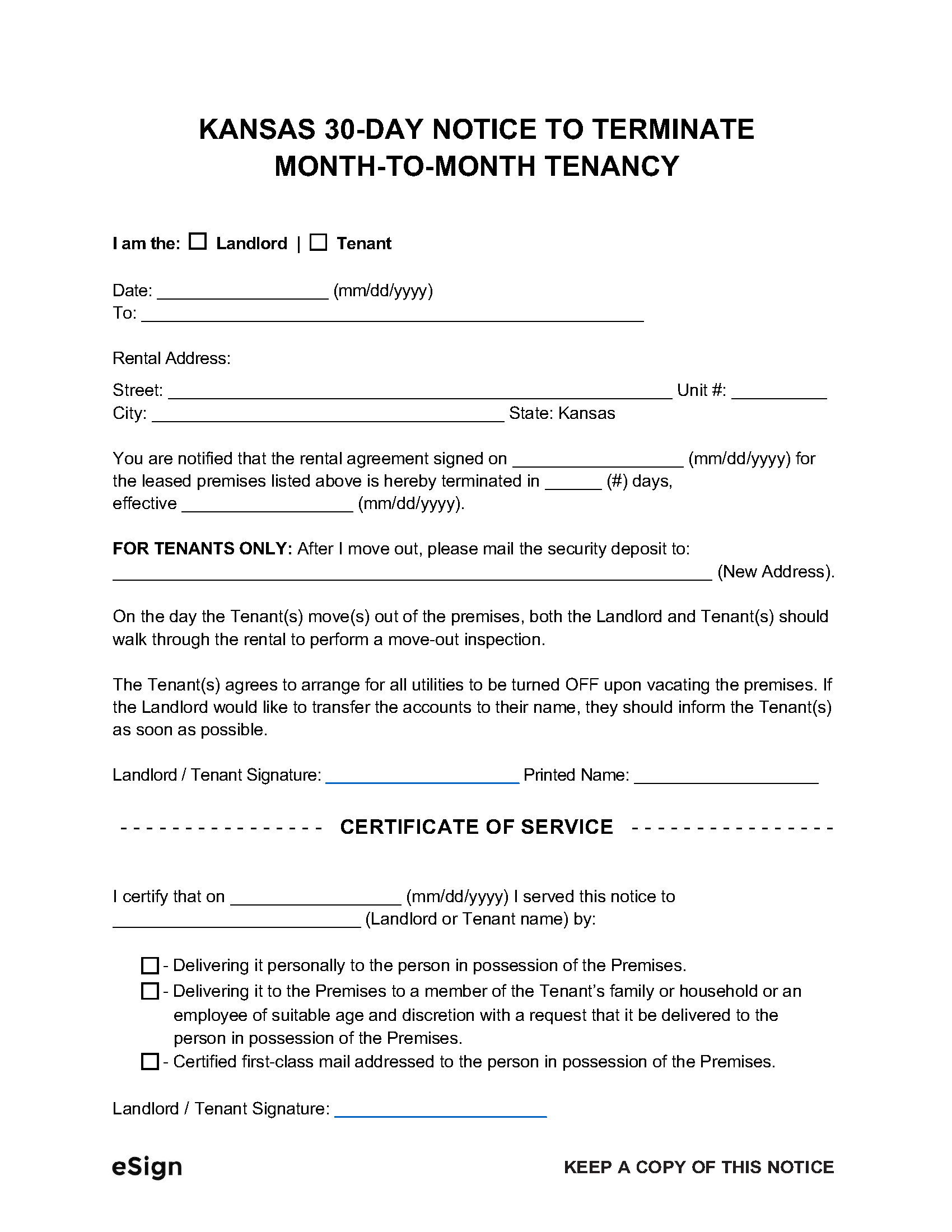
- Periodic Tenancies: These are rolling agreements without a fixed end date, most commonly structured as month-to-month tenancies. Because these agreements renew automatically with each rental period, either party must provide formal, written notice to terminate the arrangement.
The Myth Versus Reality of the 30-Day Notice
Many people assume that a 30-day notice is a universal legal standard across the United States. However, Kansas law handles month-to-month tenancy terminations a bit differently depending on the timeline established by state statute.
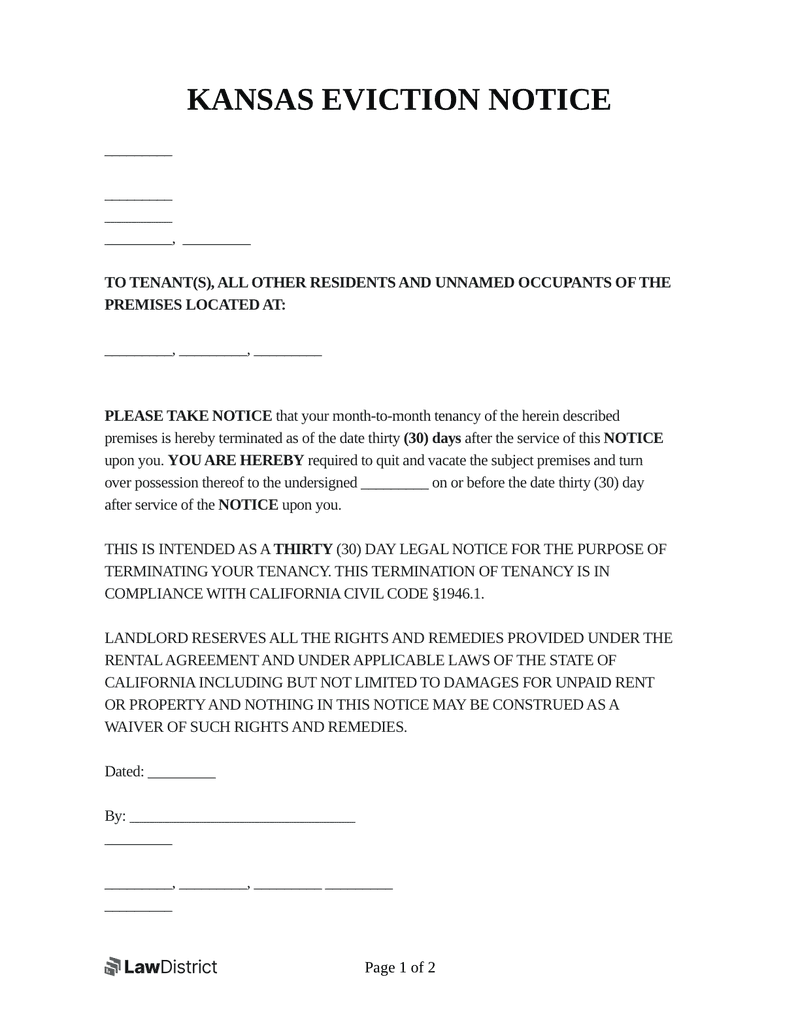
Under Kansas Residential Landlord and Tenant Act, terminating a month-to-month tenancy requires at least a 30-day written notice prior to the next rental-due date. Interestingly, while 30 days is the standard for month-to-month terminations initiated by the tenant, the statutory notice period required from a landlord for a month-to-month termination is actually at least 30 days as well, aligning the responsibilities for both parties in most standard residential contexts. However, shorter tenancies, such as week-to-week arrangements, require only a 7-day notice.
Notice Requirements for Lease Violations and Nonpayment
The rules shift dramatically when an eviction is initiated due to a lease violation or failure to pay rent rather than a simple desire to end a periodic tenancy. In these scenarios, Kansas law outlines strict timelines that are often much shorter than 30 days.
Nonpayment of Rent
When a tenant fails to pay rent on time, the landlord cannot immediately file for eviction in court. Instead, the landlord must issue a formal notice to remedy the situation.
- For tenancies lasting 3.5 months or longer, the landlord must provide a 3-day written notice to pay rent or quit.
- For tenancies lasting less than 3.5 months, a 3-day notice is similarly standard under specific statutory guidelines, though lease terms and local municipal ordinances in major hubs like Wichita or Overland Park may impose slight procedural variations.
If the tenant pays the overdue balance within the specified 3-day window, the eviction process must halt. If the tenant fails to pay, the landlord is legally permitted to proceed with filing an eviction lawsuit, formally known as a forcible detainer action, through the local court system, such as the district court in Kansas City.
Material Noncompliance with the Lease Agreement
Apart from unpaid rent, tenants may violate other terms of the lease agreement, such as unauthorized pets, property damage, or disturbing neighbors. Under Kansas law, handling these situations requires a specific procedure:
- The landlord must serve a 14/30 day notice for material noncompliance.
- The notice must outline the specific violation and state that the rental agreement will terminate in 30 days if the tenant does not remedy the issue within 14 days.
- If the tenant fixes the problem within the 14-day window, the lease continues. If they fail to fix it, the lease terminates at the end of the 30-day period.
Should the tenant commit the exact same violation within a six-month period, the landlord can issue an unconditional notice to quit, bypassing the cure period entirely and moving straight toward eviction proceedings.
Step-by-Step Legal Process for Eviction in Kansas
Assuming proper notice has been served and the recipient has failed to comply or vacate, the legal eviction process moves into the formal judicial arena. Landlords in Kansas are strictly prohibited from engaging in “self-help” evictions. This means changing the locks, shutting off utilities, or removing a tenant’s personal property without a court order is entirely illegal and exposes the landlord to significant civil liabilities and lawsuits.
Filing the Petition and Summons
The formal legal procedure requires specific documentation:
- Filing: The landlord files a petition for forcible detainer with the local county court.
- Service of Process: A court-appointed process server or sheriff formally delivers the summons and petition to the tenant, notifying them of the court date and the allegations against them.
- The Hearing: Both parties appear before a judge to present evidence, lease agreements, copies of the written notices, and proof of service.

The Court Ruling and Writ of Restitution
If the judge rules in favor of the landlord, the court will issue a judgment for possession. If the tenant still refuses to leave voluntarily, the landlord can request a Writ of Restitution. This document commands local law enforcement officers to physically remove the tenant and their belongings from the property, ensuring the landlord regains lawful possession safely and legally.
Throughout this entire process, adherence to statutory notice periods—whether 3-day, 14-day, or 30-day—is the foundational element that determines whether a court will grant an eviction order. Both landlords and tenants are strongly encouraged to keep meticulous written records of all communications, notices, and payment receipts to protect their respective rights.
LifeOutOfTheBox is a participant in the Amazon Services LLC Associates Program, an affiliate advertising program designed to provide a means for sites to earn advertising fees by advertising and linking to Amazon.com. Amazon, the Amazon logo, AmazonSupply, and the AmazonSupply logo are trademarks of Amazon.com, Inc. or its affiliates. As an Amazon Associate we earn affiliate commissions from qualifying purchases.