
For travelers planning an adventure to the Lone Star State, understanding its geographical expanse and the resulting time zones is crucial. The simple answer to “Is Texas Eastern Standard Time?” is no, not primarily. While the United States spans multiple time zones, Texas predominantly observes Central Standard Time (CST), with a small, but significant, western portion adhering to Mountain Standard Time (MST). This distinction is vital for anyone coordinating flights, booking accommodations, or planning activities across this vast and diverse state.
From the bustling metropolises of Houston and Dallas to the vibrant culture of Austin and the historic charm of San Antonio, the majority of Texas operates on CST. This time zone, which is UTC-6 during standard time and UTC-5 during Daylight Saving Time (CDT), governs the daily rhythms of millions of Texans and impacts everything from business schedules to sunset views. However, as you journey westward towards the rugged beauty of the desert, particularly in the El Paso area, the clock shifts. This fascinating duality adds an interesting layer of complexity for tourists and business travelers alike, demanding careful attention to detail to ensure a seamless and enjoyable experience. Let’s delve deeper into the specifics of Texas’s time zones and how they can influence your travel plans.
Unraveling Texas’s Time Zones: A Comprehensive Guide
Texas’s sheer size, being the second-largest state in the United States, necessitates a division into different time zones to accurately reflect solar time across its longitude. This geographical reality is key to understanding why not all of Texas adheres to a single time.
The Predominance of Central Standard Time (CST)
The vast majority of Texas, stretching from its eastern border with Louisiana and Arkansas all the way to its western plains, falls squarely within the Central Time Zone. This encompasses virtually every major city and popular tourist destination that comes to mind when one thinks of Texas. Cities like Houston, known for its space exploration history and vibrant arts scene; Dallas, a hub for business, fashion, and culture; Austin, the live music capital and political center; and San Antonio, rich in colonial history with landmarks like The Alamo, all observe CST.
For travelers, this means that flight arrival and departure times for George Bush Intercontinental Airport (IAH) in Houston, Dallas/Fort Worth International Airport (DFW) serving the Dallas and Fort Worth metroplex, and Austin-Bergstrom International Airport (AUS) in Austin, will all be listed in CST. Similarly, booking hotel check-ins, reserving tables at renowned Texan steakhouses, or scheduling tours of historic sites like the Sixth Floor Museum in Dallas or Space Center Houston, should always be planned with CST in mind. The consistent observance of CST across these key areas simplifies itinerary planning for the majority of visitors, allowing for smooth transitions between destinations along the Gulf Coast, the Texas Hill Country, and the major inland cities.

The Mountain Standard Time Exception in Far West Texas
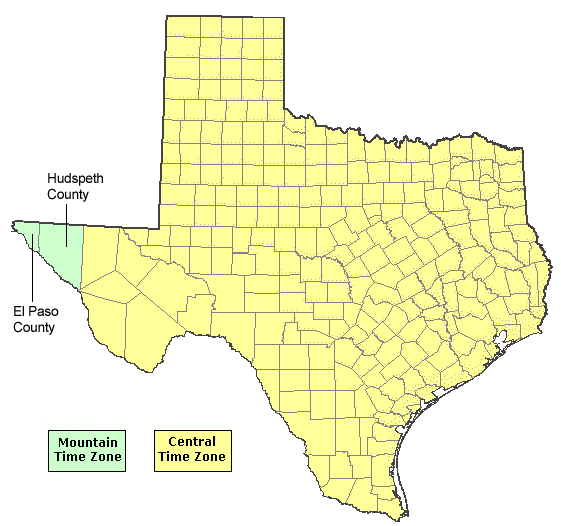
While CST dominates, a distinct exception exists in the far western reaches of Texas. The city of El Paso and the western part of Hudspeth County observe Mountain Standard Time (MST). This places them one hour behind the rest of Texas. MST is UTC-7 during standard time and UTC-6 during Daylight Saving Time (MDT).
This time zone alignment is primarily due to El Paso’s geographical proximity and economic ties to New Mexico and Arizona, both of which largely adhere to the Mountain Time Zone. The city also shares a border with Ciudad Juárez, Mexico, and its time zone often aligns with its cross-border partners for seamless operations. For travelers venturing to explore the breathtaking landscapes of Big Bend National Park or Guadalupe Mountains National Park, or those crossing the border from El Paso into New Mexico, it’s imperative to adjust your clocks. The shift is most noticeable when traveling eastward from El Paso into the main body of Texas — you will gain an hour. Conversely, traveling west from, say, San Antonio to El Paso, you will lose an hour. This small but significant detail can impact everything from making a connecting flight to arriving on time for a scheduled activity or meeting.

Navigating Time Zones for Travelers in Texas
Understanding Texas’s time zone configuration is not just a matter of trivia; it’s a practical necessity for any traveler seeking a smooth journey. Whether you’re on a leisure trip exploring the diverse landscapes or a business traveler attending meetings, time zone awareness can make all the difference.
Planning Your Itinerary: Flights, Check-ins, and Activities
For most visitors flying into major airports like Dallas/Fort Worth International (DFW) or Houston George Bush Intercontinental (IAH), timing will generally be straightforward as these cities are in the Central Time Zone. However, if your itinerary includes destinations in far west Texas, particularly El Paso, meticulous planning is essential.
Imagine flying from Austin (CST) to El Paso (MST). A flight scheduled to depart at 10:00 AM CST and arrive two hours later will land at 11:00 AM MST, not 12:00 PM MST. You gain an hour. Conversely, if you fly from El Paso to Dallas, a two-hour flight departing at 10:00 AM MST will land at 1:00 PM CST, meaning you “lose” an hour from your internal clock. Always double-check flight confirmations and hotel booking details, which typically state times in the local time zone of the destination.
Booking tours, restaurant reservations, or tickets for attractions also requires awareness. A guided tour of Big Bend National Park, which is close to the Mountain Time Zone boundary, might be scheduled in MST. Missing a sunrise hike because your watch was an hour ahead or behind could be a regrettable oversight. Many modern smartphones automatically adjust time zones, but it’s always wise to verify manually, especially if you’re driving long distances across the state. Remember, when driving from central Texas to El Paso along I-10, you’ll cross a time zone boundary. Look for signs indicating the change, usually around the Hudspeth County line.
Business Travel and Meeting Schedules
For business travelers, time zone differences in Texas can be particularly critical. Attending a conference in Houston and needing to coordinate a virtual meeting with colleagues in El Paso requires precise scheduling. If a meeting is set for 2:00 PM CST in Houston, it will be 1:00 PM MST for those participating from El Paso. Miscalculating this hour can lead to missed connections, delays, and an unprofessional impression.
When scheduling calls or virtual meetings that involve participants from different parts of Texas, always specify the time zone (e.g., “2:00 PM CST” or “1:00 PM MST”). This clarity prevents confusion and ensures everyone is on the same page. For those traveling between the two time zones for in-person meetings, factor in the time adjustment when calculating travel duration and arrival times. Arriving an hour late or an hour early due to a time zone oversight can disrupt carefully planned agendas and impact productivity. Always verify the time zone of your destination, especially when working across multiple offices or with diverse clients spread across the state.
Time Zones and the Texan Experience
Beyond the logistical challenges, the time zones in Texas also subtly shape the local lifestyle and daily rhythms, offering unique perspectives for visitors immersing themselves in the culture.
Lifestyle and Daily Rhythms Across the State
In the vast majority of Texas, observing Central Standard Time means that sunrise and sunset times align with the typical schedules of major cities in the central United States. This influences everything from when businesses open and close, to school schedules, and even social events. In cities like Dallas and Houston, the mornings start relatively early, and evenings offer ample daylight for after-work activities or enjoying the city’s nightlife during Daylight Saving Time. Dining customs, for example, tend to follow a similar pattern to other central states, with dinner often served starting around 6:00 PM or 7:00 PM.
However, in El Paso and western Hudspeth County, which are on Mountain Standard Time, the daily rhythm shifts. As they are one hour behind the rest of the state, sunrises and sunsets occur later by the clock. This can mean enjoying longer daylight evenings in the summer, perfect for exploring the desert landscapes or enjoying outdoor patios. It also influences cross-border activities with Mexico, particularly Ciudad Juárez and the state of Chihuahua, where time zones are often synchronized for economic and social convenience. For travelers, experiencing this subtle difference can be part of the adventure, offering a slightly different pace of life that aligns more with the mountain west than the deep south or central plains.
Embracing Daylight Saving Time
Like most of the United States and Canada, Texas observes Daylight Saving Time (DST). This means that on the second Sunday in March, clocks “spring forward” one hour, and on the first Sunday in November, they “fall back” one hour. During DST, the Central Time Zone becomes Central Daylight Time (CDT), operating at UTC-5, while the Mountain Time Zone becomes Mountain Daylight Time (MDT), operating at UTC-6.
For tourists, DST generally means more daylight hours in the evening, which is ideal for sightseeing, outdoor activities, and enjoying the vibrant street life of Texan cities. Imagine an extra hour of daylight to stroll along the San Antonio Riverwalk or explore the eclectic shops of Austin’s South Congress Avenue. However, it also means that the hour difference between the two Texas time zones remains consistent (one hour), so the need for careful planning when crossing between CST/CDT and MST/MDT persists. Travelers should always be mindful of the transition dates for DST, as they can sometimes cause confusion, especially if traveling during the weekend when the change occurs. Setting your smartphone to automatic time updates is generally the most reliable method to ensure your device reflects the correct local time.
Key Destinations and Their Respective Time Zones
To further clarify, let’s pinpoint some of Texas’s most visited destinations and confirm their time zone affiliations. This can serve as a quick reference for planning your next Texas getaway.
Central Time Zone Hubs: Houston, Dallas, Austin, and San Antonio
These four metropolitan giants represent the heart of Texas in many ways, and all operate on the Central Time Zone (CST/CDT).
- Houston: As the largest city in Texas and the fourth largest in the United States, Houston is a global hub for energy, space exploration, and medicine. All activities, from visiting the Space Center Houston to enjoying its diverse culinary scene, will be on CST/CDT.
- Dallas: A major center for commerce, fashion, and culture in North Texas, Dallas follows CST/CDT. This includes nearby cities like Fort Worth and Plano, which are part of the expansive Dallas-Fort Worth Metroplex.
- Austin: The state capital and a city renowned for its live music, tech industry, and outdoor lifestyle, Austin observes CST/CDT. Plan your South by Southwest events or Barton Springs Pool visits accordingly.
- San Antonio: Steeped in history and home to iconic landmarks such as The Alamo and the Riverwalk, San Antonio also operates on CST/CDT.
- Other significant cities in CST/CDT: This includes popular coastal destinations like Galveston and Corpus Christi, as well as the bustling resort area of South Padre Island in the state’s southern tip. All these vibrant locales keep time with the central part of the continent.
Mountain Time Zone Outposts: El Paso and Hudspeth County
These unique western regions stand apart, offering a different time perspective for travelers.
- El Paso: This major border city, nestled along the Rio Grande and adjacent to New Mexico and Mexico, is firmly in the Mountain Time Zone (MST/MDT). When planning travel to El Paso, whether for its unique blend of cultures, its proximity to stunning national parks, or its role as a key border crossing, remember to adjust your clock back one hour from CST.
- Hudspeth County: While a portion of Hudspeth County observes CST, the vast majority of its western half, including settlements like Dell City and areas bordering New Mexico, adheres to MST/MDT. This is where the time zone line subtly cuts through, so if you’re traveling through this expansive, sparsely populated region, be aware of the shift, especially if you have precise plans.
Beyond the Clock: Maximizing Your Texas Adventure
While knowing the time zones in Texas is fundamentally important for logistical reasons, it’s also a part of the adventure of exploring such a diverse state. From the sprawling urban centers to the rugged western deserts, Texas offers a kaleidoscope of experiences. Don’t let a simple time zone oversight dampen your spirits or derail your plans.
Embrace the subtle differences that come with a state spanning two time zones. Think of it as an extra layer of planning that ultimately enhances your travel savvy. Always cross-reference your travel documents, set your devices to automatically update their time, and when in doubt, confirm local times with hotels, tour operators, or business contacts. This diligence will ensure that you make every flight, catch every tour, arrive on time for every meeting, and enjoy every sunset, whether it’s setting over the Gulf Coast in Corpus Christi or casting long shadows over the Franklin Mountains in El Paso.
So, while Texas is not Eastern Standard Time, its dual adherence to Central Standard Time and Mountain Standard Time adds a unique characteristic to its identity. By being prepared, you can fully immerse yourself in all the rich culture, history, and natural beauty the Lone Star State has to offer, making your trip truly unforgettable.
LifeOutOfTheBox is a participant in the Amazon Services LLC Associates Program, an affiliate advertising program designed to provide a means for sites to earn advertising fees by advertising and linking to Amazon.com. Amazon, the Amazon logo, AmazonSupply, and the AmazonSupply logo are trademarks of Amazon.com, Inc. or its affiliates. As an Amazon Associate we earn affiliate commissions from qualifying purchases.