
When horror cinema ventures into the wilderness, it often taps into our primal fears of isolation, disorientation, and the unknown lurking just beyond the tree line. In the 2017 film The Ritual, directed by David Bruckner, a group of friends finds themselves hopelessly lost in the dense, suffocating forests of Sweden. While fans often debate the nature of the antagonist—the ancient, Norse-inspired entity known as the Moder—the creature’s visual design and the setting’s oppressive nature spark curiosity about the folklore and real-world wildlife that might have inspired such a terrifying vision.

The Mythology of the Scandinavian Wilderness
The forests of Northern Europe have long been the birthplace of folklore that bridges the gap between the natural and the supernatural. In The Ritual, the characters stumble upon a woodland that feels alive with ancient malice. To understand the creature, one must first look at the landscape of Sarek National Park. While the film was actually shot largely in the Carpathian Mountains of Romania, the fictional narrative places the protagonists deep within the Swedish backcountry.
Ancient Entities and Woodland Spirits
In Scandinavian mythology, the forest is rarely just a collection of trees; it is a sentient entity. The creature stalking the hikers is described as a “Jötunn,” a child of Loki, which serves as a powerful manifestation of the untamed wilderness. Unlike common cryptids like Bigfoot, which are often theorized to be biological anomalies, the entity in The Ritual functions as a deity. It demands worship and sacrifice, tethered to the ancient groves rather than roaming the globe.
Biological Inspiration or Supernatural Design?
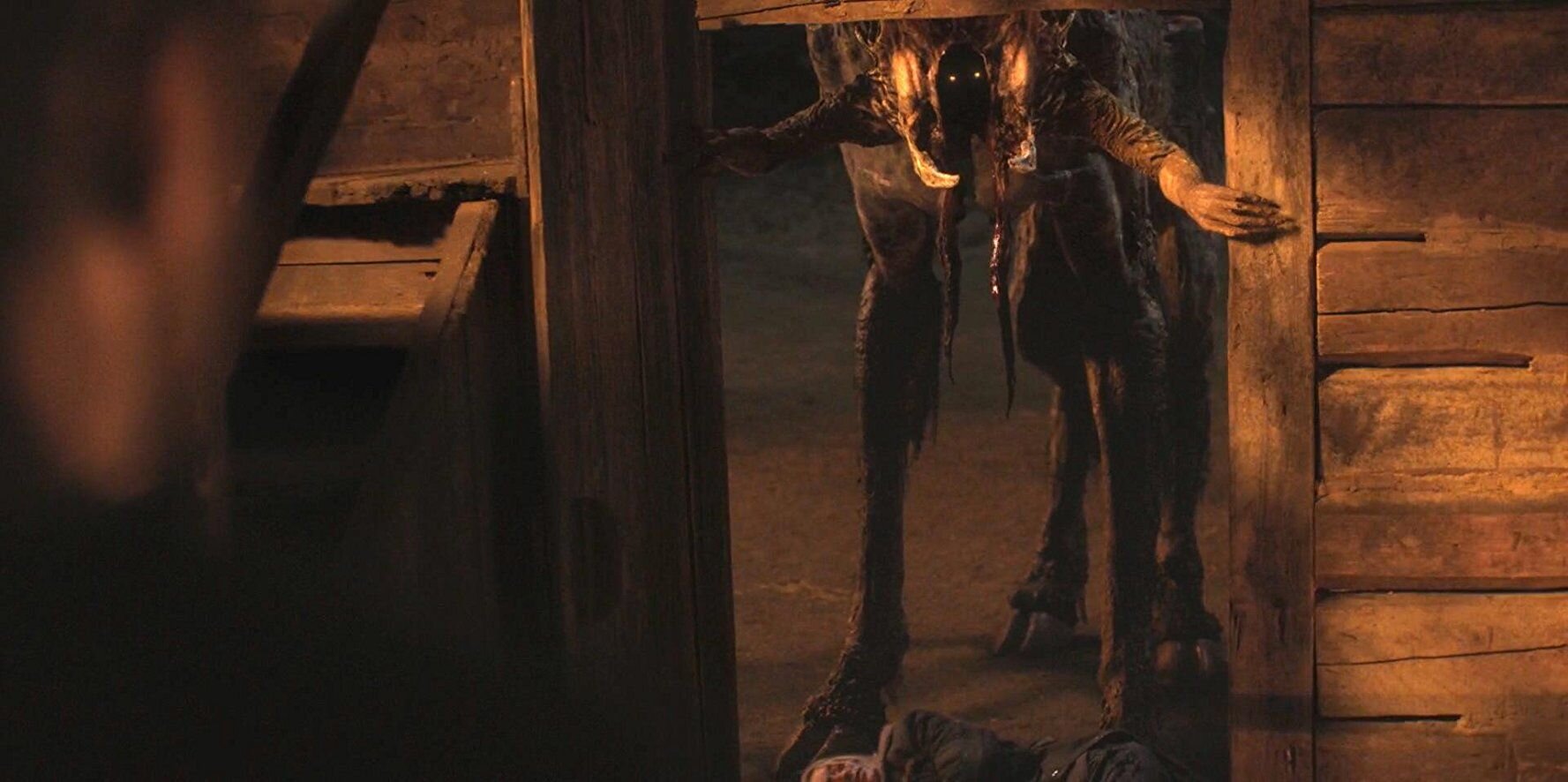
When viewers ask if the creature is a “Wilderbe”—a term often conflated with various beasts of burden or mythical ungulates—they are usually reacting to the creature’s distinct, deer-like head and sprawling, asymmetrical limbs. In reality, the creature is a masterful synthesis of humanoid structure and skeletal animal features. It possesses a cervine skull, likely inspired by the Moose or the Reindeer, which are staples of the Lapland region.
Analyzing the Creature’s Physicality
The creature in The Ritual is a masterclass in creature design, avoiding the tropes of standard monsters to create something genuinely unsettling. By utilizing elongated limbs and a head that bears a striking resemblance to the majestic but eerie Red Deer, the designers tapped into a specific type of visceral horror: the perversion of something familiar.
The Cervine Influence
The head of the beast, which features haunting human-like eyes and human hands protruding from its body, challenges the audience’s perception of nature. In European folklore, the deer is often a symbol of nobility or protection, but when distorted—as seen in the creature’s jagged antlers and hollowed-out expression—it becomes a symbol of encroaching death. This design choice mirrors the feeling of being hunted by the wilderness itself. The idea that a “Wilderbe”—if we define it as a beast of the wild—could be a protector of a forgotten cult, transforms the hiker’s journey into a theological nightmare.
Why “Wilderbe” Doesn’t Quite Fit
The term “Wilderbe” is not a standard taxonomic or mythological classification. However, if we interpret it as a “beast of the wild,” the creature fits the archetype perfectly. It is the personification of the forest’s defense mechanism. In the deep reaches of the Arctic Circle, where silence and isolation can drive a human to the brink of insanity, the appearance of such a creature feels like the logical conclusion to a psychological break. The creature is not merely a predator; it is the environment taking a physical, vengeful form.
The Psychological Toll of the Swedish Wilderness
The horror of The Ritual is compounded by the mental states of the main characters. They are dealing with grief, guilt, and the breakdown of their social dynamic long before they encounter the supernatural. The setting—a vast, unmapped woodland—serves as a pressure cooker.
Isolation as a Catalyst
For travelers, Sweden offers some of the most serene and untouched wilderness in the world. However, that serenity is a double-edged sword. When one strays from the marked trails in areas like Kungsleden, the realization of how small a human is compared to the vastness of the Scandinavian Peninsula can be overwhelming. The film captures this perfectly. The hikers’ trek through the trees becomes a descent into a world where their modern worries are replaced by the raw, base necessity of survival.
The Landscape as the Real Villain
If the creature is the face of the forest, the forest is the architect of the trauma. Whether you are trekking through Norway or the remote regions of Finland, the experience of total silence is profound. In the film, the silence is punctuated only by the crack of branches and the strange, booming calls of the entity. The “Wilderbe” label, while inaccurate in a biological sense, captures the essence of a traveler’s fear: that there is something in the woods that knows exactly what you have done and is waiting for you to stumble.

Conclusion: Nature’s Unforgiving Grace
Ultimately, the creature in The Ritual is a reflection of our complicated relationship with the natural world. We admire the beauty of the Boreal Forest, but we ignore the fact that it is a place governed by indifference. The entity does not hate the hikers; it simply operates on a scale of time and morality that they cannot comprehend.
Whether or not one chooses to define the beast as a “Wilderbe,” the film succeeds in making the audience look at the treeline with a newfound sense of caution. It reminds us that travel, while enriching and beautiful, involves venturing into spaces where human rules do not apply. As the Scandinavian light fades and the long shadows of the pines grow, the line between a majestic animal and a nightmare beast becomes dangerously thin.
For those who find themselves exploring the remote trails of the North, The Ritual serves as a grim cautionary tale: respect the land, stay on the path, and understand that in the deepest parts of the wild, you are never truly alone.
LifeOutOfTheBox is a participant in the Amazon Services LLC Associates Program, an affiliate advertising program designed to provide a means for sites to earn advertising fees by advertising and linking to Amazon.com. Amazon, the Amazon logo, AmazonSupply, and the AmazonSupply logo are trademarks of Amazon.com, Inc. or its affiliates. As an Amazon Associate we earn affiliate commissions from qualifying purchases.