
While the financial heart of the global economy, the New York Stock Exchange (NYSE), might seem like a place operating at the frantic pace of Wall Street trading, its daily rhythm is actually governed by a structured schedule. Understanding these operational hours is not just a matter of financial curiosity; for investors, traders, and anyone interested in the dynamics of global markets, it’s fundamental. This schedule dictates when buying and selling can occur, influencing price discovery and market sentiment.
The Daily Trading Schedule
The NYSE observes a consistent daily trading schedule designed to maximize market participation and provide a predictable framework for financial transactions.
Standard Trading Hours
The regular trading session at the NYSE commences with the opening bell at 9:30 AM Eastern Time (ET) and concludes with the closing bell at 4:00 PM ET. This seven-hour window is when the vast majority of stock trading activity takes place. This timeframe is crucial for domestic investors and institutions operating within the United States.
Pre-Market Trading
Before the official opening bell, the NYSE offers pre-market trading hours. These sessions typically begin as early as 4:00 AM ET and conclude at the start of the regular trading session at 9:30 AM ET. Pre-market trading allows for the incorporation of overnight news and events that may have occurred after the previous day’s close. However, liquidity in the pre-market can be significantly lower than during regular hours, potentially leading to wider bid-ask spreads and greater price volatility. This makes it a space primarily for sophisticated investors and institutions who can navigate its unique characteristics.
After-Hours Trading
Similarly, the NYSE provides after-hours trading sessions that extend beyond the regular closing time. The primary after-hours session typically runs from 4:00 PM ET to 8:00 PM ET. Like pre-market trading, after-hours trading offers participants the opportunity to react to news and events that unfold after the market has officially closed. However, it also shares the characteristic of lower liquidity and higher volatility compared to the regular trading session. Many retail investors find after-hours trading too risky due to these factors.
Extended Trading Hours Considerations
It is important to note that the exact timings and availability of pre-market and after-hours trading can vary slightly depending on the brokerage firm and specific trading platforms used. While the NYSE sets the general framework, the execution of trades during these extended hours is facilitated by individual member firms. Participants should always verify the specific trading hours offered by their broker.
Market Holidays and Special Sessions
Beyond the daily rhythm, the NYSE observes specific holidays and occasionally schedules special trading sessions. These interruptions and deviations from the norm are important to track for any market participant.
Official NYSE Holidays
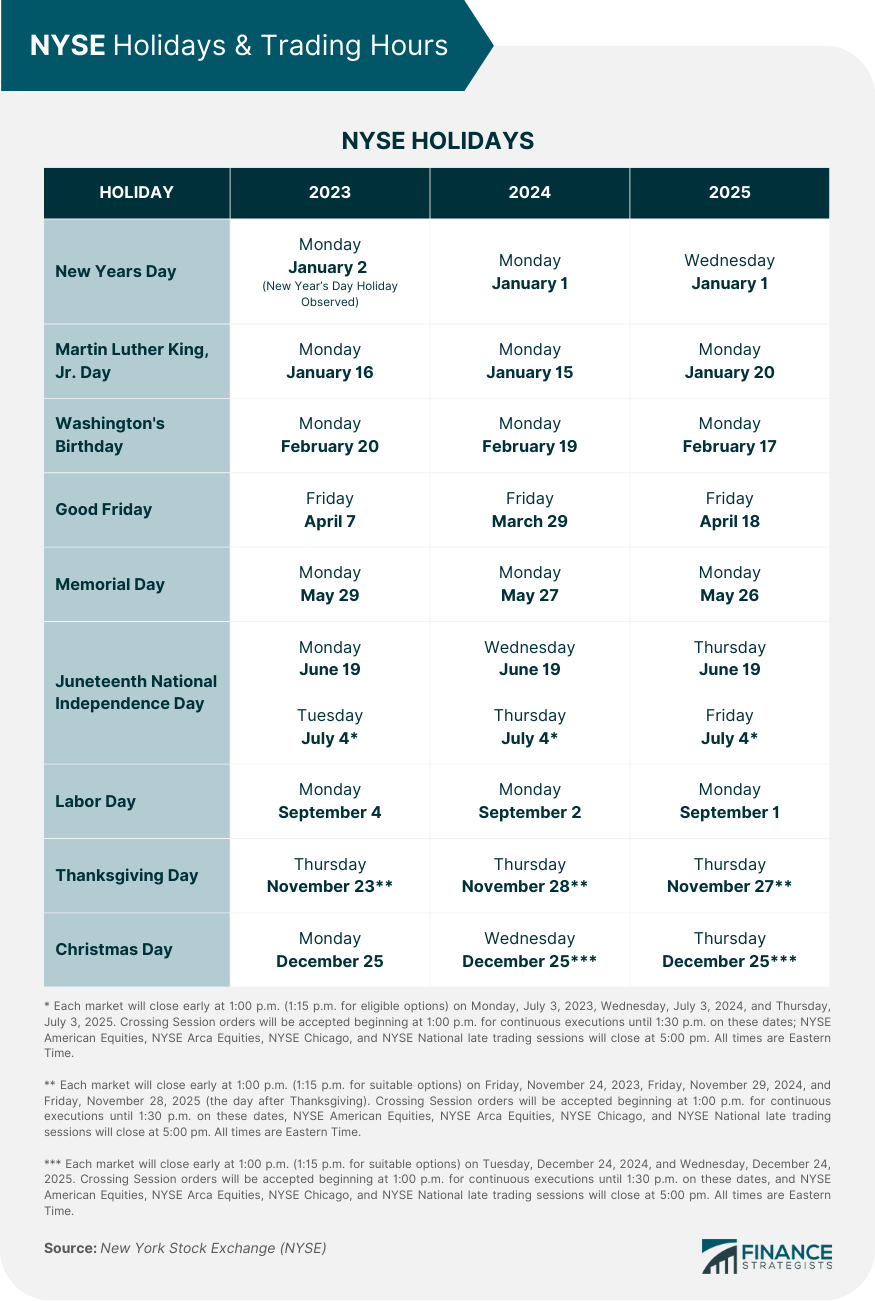
The NYSE closes for a set of recognized holidays throughout the year. These closures are typically aligned with federal holidays observed in the United States. Some of the most prominent NYSE holidays include:
- New Year’s Day: January 1st
- Martin Luther King, Jr. Day: Third Monday in January
- Presidents’ Day: Third Monday in February
- Good Friday: The Friday before Easter Sunday
- Memorial Day: Last Monday in May
- Juneteenth National Independence Day: June 19th
- Independence Day: July 4th
- Labor Day: First Monday in September
- Thanksgiving Day: Fourth Thursday in November
- Christmas Day: December 25th

When a holiday falls on a weekend, the NYSE will typically observe the holiday on the preceding Friday or the following Monday.
Early Closings
On certain days, the NYSE may schedule an early closing. This is most commonly observed on the day after Thanksgiving (often referred to as “Black Friday”), with the market closing at 1:00 PM ET. There might also be early closings on days preceding holidays, though this is less common and typically announced well in advance. These early closings are a long-standing tradition, often reflecting a desire for a longer holiday weekend for market participants.
Special Trading Sessions
In rare circumstances, the NYSE may convene for special trading sessions. These are typically held for significant historical events, such as the opening of the market after major national tragedies or other momentous occasions. These sessions are not part of the regular schedule and are announced by the exchange with considerable forewarning. For example, the NYSE has held special sessions to commemorate the anniversary of the September 11th attacks or to mark significant economic milestones.
Impact on Investors and Market Dynamics
The structured hours of the New York Stock Exchange have profound implications for how investors operate and how markets function.
Global Market Interdependence
While the NYSE has defined hours, the global financial markets operate on a 24/5 schedule (excluding weekends). Major exchanges in Tokyo, London, and Hong Kong, among others, have their own trading hours that overlap and precede or follow the NYSE’s schedule. This global interdependence means that events occurring in one market can influence another, even when the latter is closed. For instance, a significant downturn in the Asian markets overnight could lead to a bearish opening on the NYSE. Understanding the trading hours of these other major exchanges, such as the London Stock Exchange or the Tokyo Stock Exchange, is crucial for a comprehensive view of global market sentiment.
Liquidity and Volatility
Liquidity, the ease with which an asset can be bought or sold without affecting its price, is highest during the core hours of the NYSE’s regular trading session. This is when the largest number of buyers and sellers are active, leading to tighter bid-ask spreads and smoother price movements. During pre-market and after-hours trading, liquidity is significantly reduced. This can lead to increased volatility, where even small trades can cause substantial price swings. This is a key factor for investors to consider when deciding whether to execute trades outside of the standard hours.
Information Flow and Reaction Time
The NYSE’s schedule dictates when market participants can react to new information. Earnings reports, economic data releases, geopolitical events, and breaking news all impact stock prices. Investors must be aware of the timing of these releases relative to the NYSE’s open and closed periods. For example, a major earnings announcement released after the market closes at 4:00 PM ET will not be fully priced into stocks until the pre-market opens the next day, or more significantly, when the regular session begins. This creates opportunities for those who can analyze information and position themselves strategically before the market reopens.
The Role of Algorithmic Trading
Modern markets are heavily influenced by algorithmic trading, where computers execute trades based on pre-programmed instructions. These algorithms often operate across pre-market, regular, and after-hours sessions, seeking to capitalize on price discrepancies and market inefficiencies. Understanding the NYSE’s hours is essential for comprehending the environment in which these algorithms operate and how they contribute to market dynamics, including price discovery and execution speed.
Conclusion: Navigating the NYSE Clock
The operating hours of the New York Stock Exchange are more than just a timetable; they are the pulse of a critical global financial engine. From the opening bell that signals the start of intense activity to the closing bell that marks a pause, and through the quieter periods of pre-market and after-hours trading, each phase presents unique opportunities and challenges. For anyone involved in the financial markets, whether as an individual investor, a professional trader, or an observer of economic trends, a firm grasp of the NYSE’s daily schedule, holiday observances, and the nuances of extended trading hours is indispensable for informed decision-making and strategic planning in the dynamic world of finance. Understanding these rhythms allows for better navigation of market volatility, more effective reaction to global news, and a deeper appreciation of how the wheels of Wall Street truly turn.
LifeOutOfTheBox is a participant in the Amazon Services LLC Associates Program, an affiliate advertising program designed to provide a means for sites to earn advertising fees by advertising and linking to Amazon.com. Amazon, the Amazon logo, AmazonSupply, and the AmazonSupply logo are trademarks of Amazon.com, Inc. or its affiliates. As an Amazon Associate we earn affiliate commissions from qualifying purchases.