
The Chicago flag is an iconic symbol of the city, instantly recognizable by its bold horizontal bands of blue and white, bisected by a vertical red stripe. Yet, its most striking features are the four six-pointed stars adorning the white band. These are not mere decorative elements; each star is a deliberate inclusion, imbued with historical significance and representing pivotal moments or aspects of Chicago’s journey. Understanding these celestial emblems unlocks a deeper appreciation for the city’s rich tapestry of history and triumphs.
The Birth of a Symbol: A Competition and a Vision
The story of the Chicago flag begins in the early 20th century. In 1915, the Municipal Art League of Chicago launched a competition to design a new city flag. The existing flag, adopted in 1893, was a simple white rectangle with a red seal in the center, and it was considered by many to be uninspiring and difficult to reproduce. The competition aimed to create a flag that was distinctive, representative, and easily reproducible.

The Winning Design and Its Architect
The winning design was submitted by Wallace Rice, a graphic designer and advertising executive. Rice’s proposal was a departure from the previous iteration, featuring a simplified aesthetic with clear symbolic meaning. His design incorporated the now-famous blue and white bands and the pivotal four stars. The competition was fierce, with over 1,000 entries, but Rice’s vision resonated with the judges for its clarity and potent symbolism. The flag was officially adopted by the City Council on April 4, 1917, though the stars themselves were not officially assigned their meanings until 1939. This later clarification speaks to the evolutionary nature of how symbols can be interpreted and formally codified.
Decoding the Celestial Emblems: Four Pillars of Chicago
Each of the four stars on the Chicago flag represents a significant event or theme that has shaped the city’s identity. These are not random selections but rather carefully chosen milestones that narrate the narrative of Chicago’s resilience, growth, and cultural impact.
The First Star: The Great Chicago Fire of 1871
The uppermost star, positioned slightly to the left, commemorates the Great Chicago Fire of 1871. This devastating event, which ravaged much of the city, could have been its end. However, instead of succumbing to despair, Chicago rose from the ashes with remarkable speed and determination. The fire, while catastrophic, also cleared the way for a monumental rebuilding effort, ushering in an era of unprecedented growth and innovation in architecture and urban planning. The inclusion of this star is a powerful testament to the city’s indomitable spirit and its capacity for rebirth and renewal. It signifies the destruction and the subsequent rebirth, a narrative of resilience that has become synonymous with Chicago.
The Second Star: The Chicago Plan of 1909
The second star, positioned to the right of the first, honors the Chicago Plan of 1909. Developed by urban planner Daniel Burnham and his associate Edward Bennett, this ambitious plan was a comprehensive vision for the city’s future development. It aimed to create a more beautiful, functional, and livable metropolis by emphasizing wide boulevards, extensive park systems along Lake Michigan, and a more organized street grid. While not all aspects of the plan were fully realized, it profoundly influenced Chicago’s urban landscape and continues to serve as a guiding principle for the city’s development. This star represents foresight, ambition, and a commitment to strategic urban growth.
The Third Star: The Century of Progress Exposition of 1933-1934
The third star, situated below the first two and slightly to the left, marks the Century of Progress Exposition, a world’s fair held in Chicago from 1933 to 1934. This exposition celebrated the city’s centennial anniversary and showcased advancements in science, industry, and culture. It was a pivotal event that not only boosted the city’s economy during the Great Depression but also projected an image of Chicago as a forward-thinking and dynamic hub of innovation. The fair’s theme of progress and the future is encapsulated in this star, symbolizing Chicago’s role as a leader in technological and societal advancements.
The Fourth Star: The 1893 World’s Columbian Exposition
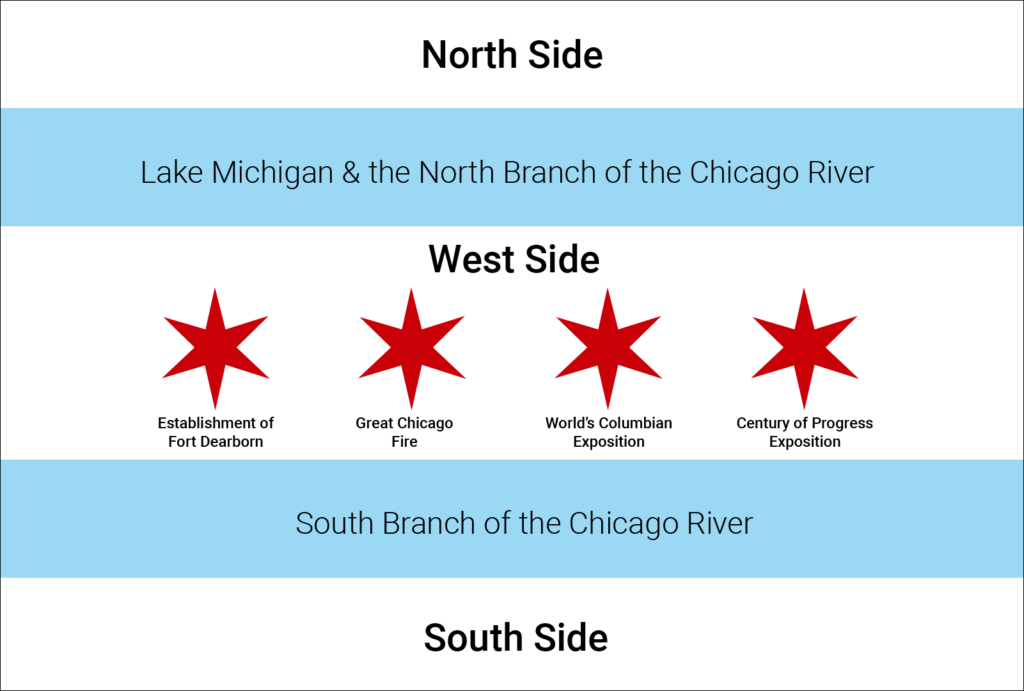
The bottommost star, positioned to the right of the third, commemorates the 1893 World’s Columbian Exposition, also known as the World’s Fair. This monumental event celebrated the 400th anniversary of Christopher Columbus’s arrival in the New World and was held in Chicago. The exposition was a spectacular display of architecture, art, and technology, featuring the iconic “White City.” It had a profound impact on urban planning and design worldwide and firmly established Chicago on the international stage as a city of ambition and cultural significance. This star represents Chicago’s international recognition and its contribution to global progress and cultural exchange.
The Colors of Chicago: Symbolism Beyond the Stars
While the stars command attention, the colors of the Chicago flag also carry symbolic weight. The flag’s design, as conceived by Wallace Rice, was intended to be simple yet profound.
The Blue Bands: Water and Natural Resources
The two horizontal blue bands represent the two major bodies of water that are integral to Chicago’s identity and historical development: the Chicago River and the waters of Lake Michigan. The river, in particular, played a crucial role in the city’s early growth as a transportation artery and in the revolutionary feat of reversing its flow. Lake Michigan provides the city with its drinking water and serves as a vital recreational and economic resource. These blue bands are a constant reminder of the city’s relationship with its waterways and the essential role they have played in its prosperity.
The White Band: Hope and Purity
The central white band symbolizes purity, hope, and the positive aspirations of the city and its people. It serves as a clean canvas upon which the significant historical events, represented by the stars, are emblazoned. This band suggests a forward-looking perspective, a belief in the city’s potential for continued progress and a bright future, even in the face of adversity.
The Red Vertical Stripe: Fortitude and Achievement
The vertical red stripe, which cuts through the white band and separates the stars, represents fortitude, courage, and the spirit of achievement. It can be interpreted as symbolizing Chicago’s resilience in overcoming challenges, its bold initiatives, and its enduring strength. This bold stroke of red underscores the dynamism and tenacity that have characterized the city throughout its history.
A Living Emblem: The Chicago Flag Today
More than just a piece of cloth, the Chicago flag is a dynamic emblem that continues to resonate with residents and visitors alike. Its simple yet profound design, with its carefully chosen colors and four significant stars, tells the story of a city forged in fire, shaped by visionary planning, and propelled by a relentless spirit of progress.
Inspiring Civic Pride and Identity
The flag serves as a powerful unifier, fostering a strong sense of civic pride and collective identity among the diverse population of Chicago. Whether flown from flagpoles atop towering skyscrapers like the Willis Tower or displayed on the lapels of its citizens, the flag is a constant visual reminder of the shared history and common aspirations that bind the city together. It’s a symbol of the city’s past achievements and its ongoing commitment to innovation and betterment.

A Beacon for Visitors and Tourists
For those visiting Chicago, the flag offers a visual introduction to the city’s historical narrative and its enduring spirit. It invites exploration, encouraging visitors to delve deeper into the stories behind each star, to walk the boulevards envisioned by the Chicago Plan, and to appreciate the architectural marvels that rose from the ashes of the Great Fire. The flag is a gateway to understanding the unique character of this vibrant metropolis. The next time you see the Chicago flag, take a moment to appreciate the rich history and the powerful symbolism embedded within its design. Each star tells a story, contributing to the captivating narrative of one of America’s most iconic cities.
LifeOutOfTheBox is a participant in the Amazon Services LLC Associates Program, an affiliate advertising program designed to provide a means for sites to earn advertising fees by advertising and linking to Amazon.com. Amazon, the Amazon logo, AmazonSupply, and the AmazonSupply logo are trademarks of Amazon.com, Inc. or its affiliates. As an Amazon Associate we earn affiliate commissions from qualifying purchases.