
The Hawaii State Capitol is more than just a seat of government; it is a profound architectural statement that embodies the natural beauty, cultural heritage, and political evolution of the Hawaiian Islands. Located in the heart of Honolulu on the island of Oahu, this landmark serves as the official home of the Hawaii State Legislature and the office of the Governor of Hawaii. Completed in 1969, it replaced the historic Iolani Palace, which had housed the government since the days of the Kingdom of Hawaii.
Unlike most state capitols in the United States, which often mimic the neoclassical style of the United States Capitol in Washington D.C., the Hawaii State Capitol is a masterpiece of modern architecture. It was designed to be “open” to the elements, reflecting the democratic ideals of transparency and the island’s connection to the environment. From its volcanic-inspired chambers to the towering pillars that resemble palm trees, every inch of this landmark is steeped in symbolism.
Architectural Symbolism and Modernist Design
The design of the Hawaii State Capitol was a collaborative effort led by the renowned architect John Carl Warnecke and the firm Belt Lemmon and Lo. The building is a prime example of the Hawaiian Modern style, which integrates mid-century modernism with regional environmental factors.
The Influence of Nature
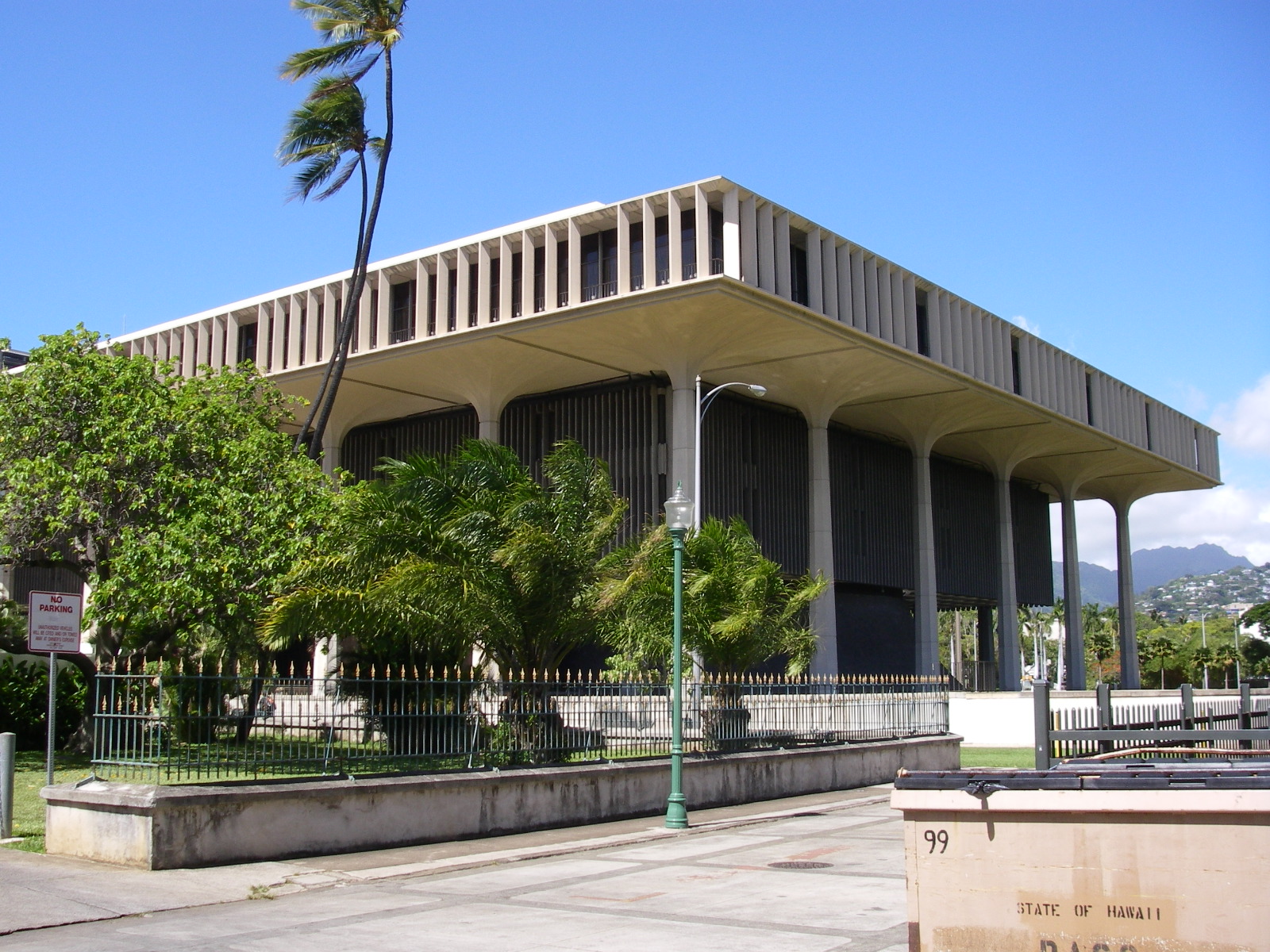
The building’s architecture is intentionally metaphorical. The most striking feature is the central courtyard, which is open to the sky. This design allows rain, sunlight, and the Pacific trade winds to pass through the building, symbolizing a government that is open to the people and the natural world.
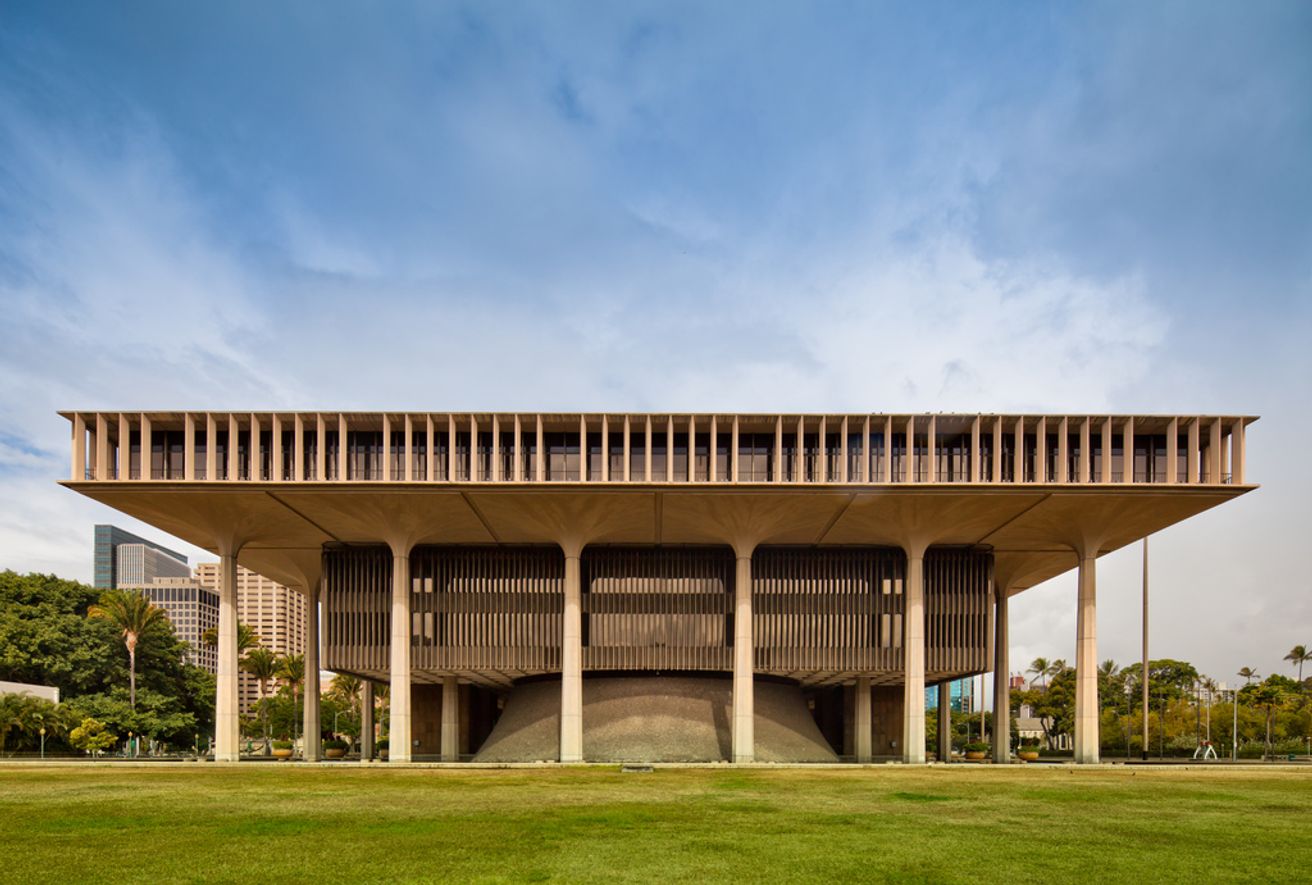
The two legislative chambers—the House of Representatives and the Senate—are cone-shaped. This is a direct reference to the volcanoes that formed the Hawaiian Islands. When viewed from the outside, these sloping walls rise out of a reflecting pool, which represents the Pacific Ocean surrounding the islands.
The Columns and the Canopy
Supporting the massive structure are 40 concrete columns. These columns are designed with flared tops to resemble Coconut Palm trees. There are eight columns on each of the four sides of the building, plus additional supports, totaling 40. These pillars hold up the roof, which acts as a “canopy,” providing shade while maintaining the open-air feel. The number of columns also holds significance, as the eight main columns on each face represent the eight main islands of Hawaii: Niihau, Kauai, Oahu, Molokai, Lanai, Kahoolawe, Maui, and the Big Island.
Materials and Aesthetics
The materials used in the construction were selected to endure the tropical climate of Honolulu. The exterior is finished with a mixture of crushed volcanic stone and cement, giving it a texture that feels native to the landscape. Inside, the use of Koa wood—a rare and precious hardwood native to Hawaii—is prevalent in the furniture and paneling, adding a layer of local warmth to the otherwise stark concrete structure.
Historical Context and Political Significance
To understand the Hawaii State Capitol, one must understand the transition of Hawaii from a kingdom to a territory, and finally to the 50th state of the United States.
Transition from Iolani Palace
For decades, the government operated out of Iolani Palace, the former residence of the Hawaiian Monarchy. By the mid-20th century, as Hawaii moved toward statehood in 1959, it became clear that the palace was too small and delicate to handle the administrative needs of a modern state. The decision to build a new capitol was both practical and symbolic. It allowed the Iolani Palace to be restored as a historical museum while providing the new state government with a dedicated, modern space.
A Monument to Statehood
The construction began in 1965 and was completed in 1969. At the time, the Hawaii State Capitol was seen as a bold step forward. It signaled that Hawaii was not just a tropical outpost but a sophisticated and forward-thinking member of the United States. The inauguration of the building was a major event in Honolulu, attended by dignitaries from across the Pacific region.
Interior Features and Artistic Elements
The interior of the Hawaii State Capitol is as much an art gallery as it is a government office. The building houses several significant works of art that tell the story of the islands.
The Legislative Chambers
The Senate and House of Representatives chambers are located on the second floor.
- The Senate Chamber: Known for its warm tones, it features a massive tapestry created by Ruthadell Anderson. The colors and patterns represent the earth and the volcanic origins of the land.
- The House Chamber: This chamber features cooler tones, with a focus on the sky and the sea. The large mural and tapestry work here evoke the sense of the Pacific Ocean and the horizon.
Both chambers are visible from the public galleries, reinforcing the theme of government transparency. The lack of traditional doors in the central courtyard area means that citizens can literally walk through the center of their government on their way to the surrounding streets.
Iconic Statues
The grounds of the Hawaii State Capitol feature two of the most important statues in the state.
- Statue of Father Damien: Located at the Beretania Street entrance, this bronze statue honors Father Damien, a Belgian priest who dedicated his life to caring for people with leprosy on the island of Molokai. The statue, designed by Marisol Escobar, is known for its contemporary, blocky style, which initially sparked controversy but has since become a beloved landmark.
- Statue of Queen Liliuokalani: Situated between the capitol and Iolani Palace, this statue pays tribute to the last reigning monarch of Hawaii. Queen Liliuokalani is depicted holding the Hawaii State Constitution and the musical score for “Aloha Oe,” a song she composed.
The Liberty Bell
On the grounds, you will also find a replica of the Liberty Bell. This was gifted to the Territory of Hawaii by the United States government in 1950, part of a program where replicas were sent to all states and territories to encourage the purchase of savings bonds.
Visiting the Capitol and the Surrounding District
The Hawaii State Capitol is the centerpiece of the Hawaii Capital Historic District. For visitors and locals alike, the area offers a dense concentration of history and architecture.
Location and Accessibility
The capitol is bordered by Beretania Street, Richards Street, and Punchbowl Street. It is easily accessible from Waikiki via public transit or a short drive. Because the main level is an open courtyard, the building is generally accessible to the public during daylight hours, even when the legislature is not in session.
Neighboring Landmarks
A visit to the Hawaii State Capitol is often paired with a tour of the nearby landmarks:
- Washington Place: Located just across Beretania Street, this historic mansion was the home of Queen Liliuokalani and later served as the official residence of the Governor of Hawaii.
- Hawaii State Library: A beautiful example of Italian Renaissance architecture, located adjacent to the capitol grounds.
- The Eternal Flame: This memorial honors those who served in the armed forces from Hawaii. It is located directly across from the capitol and remains lit at all times.
- Korea and Vietnam Memorial: Located on the capitol grounds, these memorials consist of two black granite walls inscribed with the names of service members from Hawaii who lost their lives in these conflicts.

The Experience of the Space
Walking through the Hawaii State Capitol is a unique sensory experience. Unlike the hushed, enclosed corridors of the Texas State Capitol or the New York State Capitol, the Honolulu landmark is filled with the sound of splashing water from the reflecting pools and the rustle of wind through the open center. It is a building that breathes.
On the executive level, the Governor of Hawaii maintains offices that are elegantly decorated with local art and historical artifacts. While these areas are not always open for casual walkthroughs, the public is often invited for special events or scheduled tours.
The Hawaii State Capitol stands as a bold testament to the identity of the islands. It bridges the gap between the ancient volcanic origins of the land and the modern democratic systems of the United States. For anyone interested in architecture, history, or the unique culture of Hawaii, this building is an essential destination. It captures the “Spirit of Aloha” in concrete and steel, inviting the world to witness the governance of a state that is truly like no other.
LifeOutOfTheBox is a participant in the Amazon Services LLC Associates Program, an affiliate advertising program designed to provide a means for sites to earn advertising fees by advertising and linking to Amazon.com. Amazon, the Amazon logo, AmazonSupply, and the AmazonSupply logo are trademarks of Amazon.com, Inc. or its affiliates. As an Amazon Associate we earn affiliate commissions from qualifying purchases.