
Since its release in 1976, “Hotel California” by the Eagles has captivated audiences worldwide, cementing its status as one of the most iconic and enigmatic songs in rock history. More than just a catchy tune with a legendary guitar solo, the track delves into a complex tapestry of themes, leaving listeners to ponder its true, often elusive, meaning. Is it a literal story of a haunted hotel, a cautionary tale about excess, or a deeper critique of the American Dream? For decades, the lyrics have sparked endless debate and speculation, evolving into a cultural touchstone that speaks to disillusionment, the pursuit of fleeting pleasures, and the dark side of paradise. This deep dive aims to unravel the layers of interpretation behind the Eagles’ magnum opus, exploring its lyrical journey, the band’s own insights, popular fan theories, and its enduring legacy in popular culture and the realm of travel and lifestyle.

The Lyrical Journey: A Surface-Level Interpretation of a Mysterious Stay
At its core, “Hotel California” presents a vivid, albeit unsettling, narrative that unfolds like a surreal dream or a traveler’s nightmare. The song invites us into a mysterious setting, painting a picture with evocative imagery that is both alluring and deeply disturbing.
Arriving at the Mysterious Hotel California
The journey begins on a “dark desert highway,” where a weary traveler, presumably the narrator, pulls into a seemingly inviting roadside accommodation. The “warm smell of colitas, rising up through the air” instantly transports the listener to a specific, almost tangible, atmosphere – one that is exotic, perhaps illicit, and certainly intoxicating. This initial sensory detail sets a tone of ambiguous enchantment. The sight of the hotel, with its “light a mile away,” promises respite and luxury after a long drive.
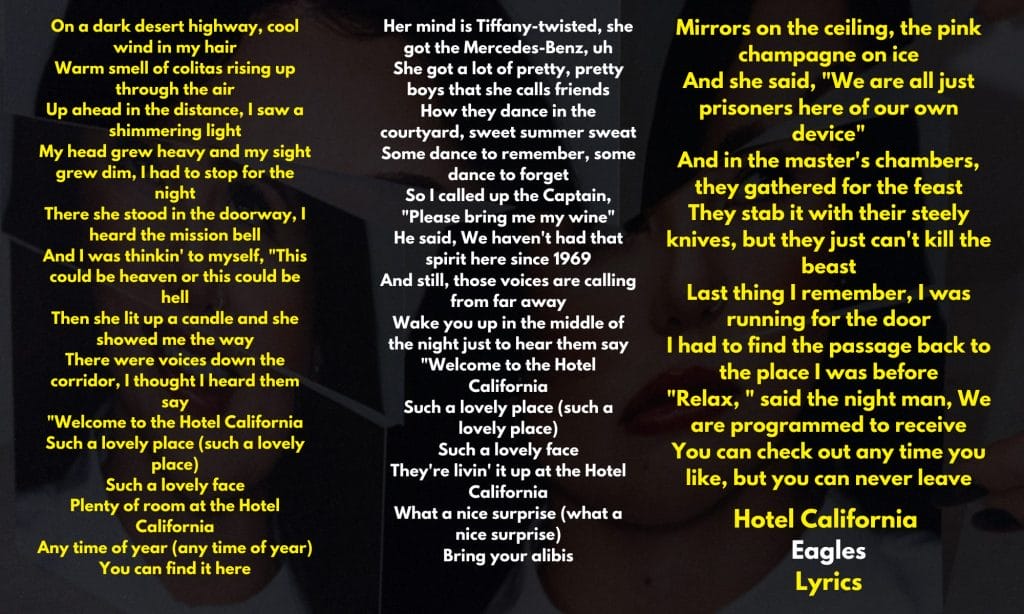
Upon arrival, the narrator is greeted by a woman who proclaims, “Welcome to the Hotel California / Such a lovely place (Such a lovely place) / Such a lovely face.” This welcome is outwardly warm, yet tinged with an underlying eeriness that hints at something more sinister than standard hospitality. The immediate impression is one of opulence and comfort, a perfect escape for any weary globetrotter seeking a lavish retreat. The bell-boy, with his “Mercedes Benz,” further underscores the establishment’s high-end appeal, an epitome of luxury travel. Yet, the sense of unease persists, a subtle dissonance that prevents the listener from fully relaxing into this seemingly perfect destination. The “voices in the corridor” whispering “sweet summer sweat” add to this disquiet, suggesting a hidden world beneath the polished surface. This isn’t just a typical stop on a road trip; it’s a destination with its own rules and a palpable, almost sentient, presence.
The Allure and the Trap: An Unforgettable (and Unescapable) Accommodation
As the narrative progresses, the hotel reveals its true, complex nature. The opulent amenities, like “mirrors on the ceiling, the pink champagne on ice,” paint a picture of lavish indulgence. These details cater to a lifestyle of excess, often associated with the most exclusive resorts and high-end accommodations. The imagery evokes a sense of hedonism and unbridled pleasure, a lifestyle that promises ultimate freedom and gratification. However, this paradise quickly morphs into a gilded cage. The “pretty, pretty boys” and “pretty, pretty girls” dancing “in the courtyard” under the stars create an atmosphere of perpetual party, yet it’s a party from which one cannot leave.
The chilling revelation comes with the line, “We haven’t had that spirit here since 1969,” a cryptic statement that implies a significant loss or change within the hotel’s essence. This historical marker is key, suggesting a bygone era of innocence or a turning point into a darker period. The hotel’s service takes an even more bizarre turn when the narrator attempts to order wine, only to be told, “We are programmed to receive / You can check out any time you like, but you can never leave.” This iconic couplet is the song’s emotional and thematic crescendo, transforming the luxurious accommodation into a psychological prison. It’s a profound statement on entrapment, where the illusion of choice masks an inescapable reality. This isn’t just a metaphor for a bad vacation; it’s a profound commentary on the nature of being caught in a cycle, whether it be addiction, fame, or the pursuit of a dream that has soured. The “beast” the narrator attempts to “kill” with his “steel knives” but “just can’t seem to kill” further solidifies the idea of an insurmountable internal or external struggle, a monster of one’s own making or a pervasive evil within the system itself.
The Eagles’ Perspective: Don Henley’s Vision of California
While the enigmatic lyrics fuel myriad interpretations, the Eagles themselves, particularly chief lyricist Don Henley, have offered significant insights into the song’s intended meaning. Their explanations consistently point away from a literal haunted hotel and towards a profound social and cultural critique of 1970s California.
A Metaphor for the California Dream
Don Henley and Glenn Frey, the primary songwriters for the track, consistently described “Hotel California” as their interpretation of the high life in Los Angeles, particularly the seductive yet destructive nature of the music industry and the broader California lifestyle. For the band, the “hotel” serves as a powerful metaphor for the allure and subsequent disillusionment associated with the pursuit of success and fame in the Golden State.
In interviews, Henley explained that the song was “a song about a journey from innocence to experience,” specifically referencing the band’s own experiences moving from the relative simplicity of their beginnings to the glittering, yet often superficial, world of Hollywood. The California Dream, once a symbol of opportunity and liberation, had by the mid-1970s, begun to show its cracks. The song captures this shift, portraying California as a place that promises paradise but delivers a gilded cage, where the price of admission is often one’s soul. It’s a commentary on the fleeting nature of luxury and the emptiness that can accompany material success, themes that resonate strongly with the “Lifestyle” aspect of many travel experiences – particularly those focused on exclusivity and opulence. The irony is that this dream, once a magnet for travelers and aspiring artists alike, became a source of spiritual exhaustion.
The Dark Side of American Excess
Beyond the music industry, “Hotel California” also functions as a broader critique of American hedonism and the excesses of the 1970s. The reference to “1969” is particularly poignant, often interpreted as the year that marked the end of the idealized hippie era and the counterculture movement, ushering in a period of self-indulgence and materialism. The hotel, in this context, becomes a symbol of the societal shift from communal ideals to individualistic pursuits, a decline from spiritual awakening to superficial gratification.
The characters within the hotel — the “Tiffany-twisted” women, the “pretty, pretty boys” — represent the archetypes of this decadent lifestyle. They are trapped in a cycle of endless partying and superficial interactions, unable to find genuine connection or meaning. This reflects a disillusionment with the post-1960s landscape of the United States, where the promise of a better world seemed to dissolve into consumerism and spiritual emptiness. The song encapsulates the band’s feelings about the price of fame, the loss of innocence, and the insidious nature of addiction — be it to drugs, money, or the intoxicating illusion of perpetual youth and pleasure. It’s a powerful narrative about how appealing destinations and lifestyles can become prisons when driven by unchecked desires and a disregard for deeper values, a potent message for anyone contemplating the ultimate goals of their travel or life pursuits.
Popular Theories and Enduring Interpretations
While the band’s explanation provides a definitive foundation, the beauty and power of “Hotel California” lie in its ability to transcend a single meaning. Its rich lyrical tapestry has inspired countless fan theories and interpretations, each adding another layer to its enigmatic charm.
The Asylum, Addiction, or Spiritual Prison Allegory
One of the most persistent and compelling theories views the Hotel California as an allegory for a mental institution, a drug rehabilitation center, or even a spiritual prison. The unsettling atmosphere, the feeling of being trapped, and the ambiguous “voices” and “beast” align well with themes of mental illness or the struggle with addiction. The line “You can check out any time you like, but you can never leave” perfectly encapsulates the cyclical nature of addiction or the profound difficulty of escaping certain psychological states. The “colitas” reference, while sometimes attributed to marijuana, has also been interpreted as a metaphor for more insidious substances that lull one into a false sense of security and belonging, ultimately leading to entrapment.
This interpretation resonates deeply because it taps into universal fears of losing control, being confined, or struggling with internal demons. It’s a chilling reminder that even in the most seemingly luxurious settings, one can be battling personal struggles that offer no easy escape. For travelers, this can symbolize the dangers of becoming lost in unfamiliar surroundings, or the internal conflicts that can arise even when pursuing outwardly glamorous experiences. It highlights how a place, even a beautiful one, can feel like a cage if one is not at peace internally.
Specific Landmarks and Urban Legends
Over the years, numerous urban legends have attempted to pinpoint a literal location for the Hotel California. The most famous of these is the Hotel California in Todos Santos, Baja California Sur, Mexico. This charming boutique hotel, originally built in 1948, has capitalized on the legend, despite the Eagles vehemently denying any connection. The band has even filed lawsuits against the hotel for attempting to associate itself too closely with the song. This illustrates how popular culture can create its own “landmarks” and narratives, independent of the artists’ original intent.
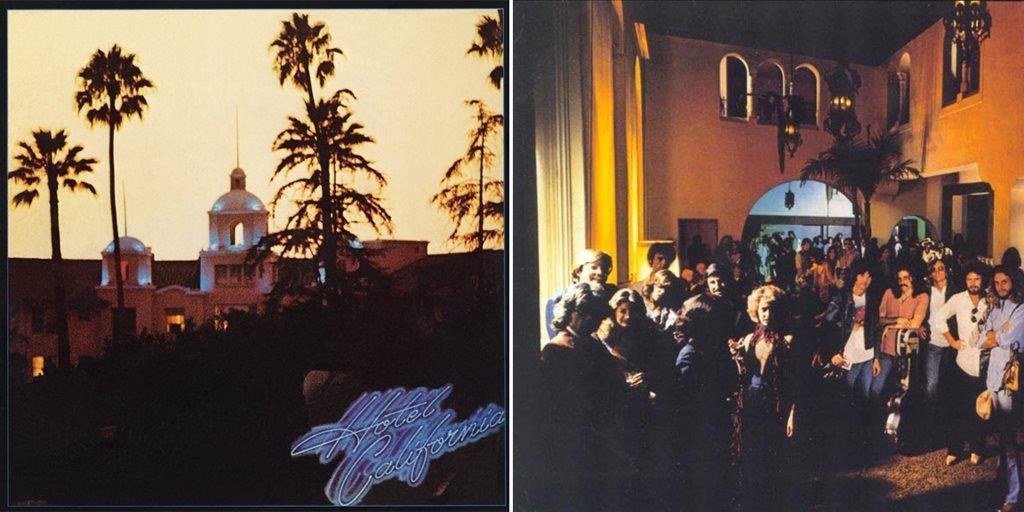
The actual inspiration for the album cover artwork, however, is widely known to be the Beverly Hills Hotel, often dubbed the “Pink Palace,” on Sunset Boulevard in Beverly Hills. The opulent and iconic facade of this famous landmark perfectly captures the superficial glamour and hidden decadence that the song critiques. While not the literal hotel of the lyrics, its visual representation became synonymous with the song’s themes of alluring luxury and hidden depths. This connection between the album art and a real, famous hotel adds another layer to the song’s dialogue with themes of hotels, accommodation, and iconic landmarks. It highlights how even real, tangible places can embody metaphorical concepts, becoming more than just structures but symbols of an era or a lifestyle.
A Travel Warning?
Connecting to the very essence of a website dedicated to Travel, Hotels, Tourism, and Accommodation, “Hotel California” can also be interpreted as a profound travel warning. It’s a cautionary tale for those who seek out superficial luxury, endless pleasure, or the promise of an idealized lifestyle without considering the potential costs. The song subtly advises travelers and those pursuing new experiences to look beyond the glittering facade of a destination.
It suggests that sometimes, the most alluring places—be it a resort in Miami, a vibrant city like New York or Las Vegas, or an exotic escape in Paris, London, Rome, or Tokyo—can become traps if one loses sight of oneself or becomes consumed by the pursuit of external validation. The song’s message encourages a more mindful approach to travel and lifestyle choices, reminding us that genuine freedom and happiness come from within, not from the most luxurious suite or the most vibrant party. It’s a reminder to remain grounded and aware, even when immersed in the most breathtaking and enticing destinations around the globe. This perspective adds a timeless dimension to the song, making its themes relevant to every generation of explorers and dreamers.
The Song’s Legacy and Cultural Impact
Decades after its release, “Hotel California” remains a monumental achievement, not only for the Eagles but for music history itself. Its profound impact extends far beyond its lyrical ambiguity, influencing popular culture and shaping perceptions of various destinations and lifestyles.
A Timeless Narrative and Musical Masterpiece
“Hotel California” is undeniably a timeless narrative because its central themes—the pursuit of paradise, disillusionment, the price of ambition, and the struggle between good and evil—are universal. These concepts transcend specific eras or locations, resonating with anyone who has ever chased a dream, experienced success, or faced personal demons. The song’s ability to be interpreted on multiple levels ensures its continued relevance, allowing each new listener to find a personal connection within its haunting verses. Its intricate structure, captivating melody, and, most notably, the legendary dual guitar solo by Don Felder and Joe Walsh, solidify its status as a musical masterpiece. This solo is often cited as one of the greatest of all time, a testament to the band’s musical prowess and collaborative genius, cementing its place in the pantheon of rock and roll.
The song’s critical acclaim is equally impressive. It won the Grammy Award for Record of the Year in 1978 and its parent album sold millions of copies, topping charts worldwide. Its induction into the Rock and Roll Hall of Fame as one of the “500 Songs That Shaped Rock and Roll” further underscores its monumental importance. It stands as a testament to the power of storytelling through music, a sonic journey that continues to intrigue, provoke thought, and inspire generations of musicians and listeners. Even today, its haunting melody and complex lyrics remain instantly recognizable and deeply impactful.
Its Influence on Popular Culture and the Travel Psyche
Beyond its musical accolades, “Hotel California” has woven itself deeply into the fabric of popular culture. The phrase itself has become shorthand for a place that is beautiful but deceptively dangerous, or a situation from which there is no easy escape. It has been referenced in countless films, TV shows, books, and other songs, demonstrating its pervasive influence. This widespread cultural osmosis has, in turn, shaped perceptions of California, Hollywood, and the allure of the glamorous lifestyle. For many, the song defines a certain era and attitude towards success and excess, forever linking the Golden State with a sense of bittersweet enchantment.
For the travel psyche, “Hotel California” serves as a powerful archetype for the alluring, yet potentially treacherous, destination. It reminds us that behind every glossy travel brochure or curated Instagram feed, there might be a more complex reality. It encourages a critical perspective on the places we choose to visit and the experiences we seek. It subtly advises that while luxury hotels, exotic destinations, and unique accommodations offer unparalleled experiences, the true essence of travel lies in genuine connection and self-awareness, rather than succumbing to the illusions of a manufactured paradise. The song, therefore, remains not just a classic rock anthem, but a profound cultural commentary that continues to influence how we view the pursuit of dreams, the nature of places, and the choices we make in our lives and travels. It is a cautionary tale, a work of art, and a timeless mystery all rolled into one.
In conclusion, “Hotel California” is far more than just a song; it’s a lyrical labyrinth that invites introspection and challenges our perceptions of paradise. Whether one interprets it as a critique of the music industry, a metaphor for addiction, a spiritual warning, or simply a chilling tale of a haunted hotel, its power lies in its ambiguity and its profound resonance with the human condition. It reminds us that sometimes, the most beautiful destinations can hold the darkest secrets, and that the allure of luxury and excess can come at an unbearable cost. Its legacy endures, forever prompting us to question what truly lies beneath the surface of the dreams we chase and the places we yearn to explore.
LifeOutOfTheBox is a participant in the Amazon Services LLC Associates Program, an affiliate advertising program designed to provide a means for sites to earn advertising fees by advertising and linking to Amazon.com. Amazon, the Amazon logo, AmazonSupply, and the AmazonSupply logo are trademarks of Amazon.com, Inc. or its affiliates. As an Amazon Associate we earn affiliate commissions from qualifying purchases.