
Navigating the intricate road networks of California can be a rewarding experience, offering breathtaking vistas from the Pacific Coast Highway to the vibrant cityscapes of Los Angeles and San Francisco. However, understanding the nuances of road signage is paramount for safe and efficient travel. While most drivers are familiar with directional signs, a less commonly discussed yet crucial aspect of California’s traffic management involves signs that explicitly prohibit turns. These “no turn” signs are not merely suggestions; they are legal directives designed to enhance traffic flow, prevent accidents, and protect pedestrians. Recognizing and adhering to these signs ensures a smoother journey and avoids potential citations.

Understanding California’s “No Turn” Signage
California’s Department of Transportation (Caltrans) employs a standardized system for traffic signs, ensuring consistency across the state. “No turn” signs are typically presented in a clear, universally recognizable format. Their primary purpose is to direct drivers to follow a specific path, often to manage complex intersections, protect sensitive areas, or reroute traffic during construction or special events. Ignoring these signs can lead to traffic violations, fines, and, more importantly, dangerous situations for all road users.
Types of “No Turn” Prohibitions
California utilizes several distinct types of signs to indicate prohibited turns. Each type conveys specific instructions and is often placed strategically to optimize traffic movement.
1. “No Left Turn” Signs
The “No Left Turn” sign is perhaps the most frequently encountered prohibition. It is typically a white rectangular sign with a black border, displaying a black arrow making a left turn with a red circle and a diagonal red line (the universal “do not” symbol) superimposed over it. These signs are commonly found at intersections where a left turn would create traffic congestion, conflict with oncoming traffic, or pose a safety hazard to pedestrians crossing the street. In some instances, the prohibition might be time-restricted, indicated by additional text below the main sign, such as “No Left Turn 7 AM – 7 PM.” This is particularly common in busy urban areas or near schools during peak hours.
2. “No Right Turn” Signs
Similar in design to the “No Left Turn” sign, the “No Right Turn” sign features a right-pointing arrow within the red prohibitory circle. These are less common than “No Left Turn” signs but are deployed in specific scenarios. They might be used at intersections with opposing one-way streets, where a right turn would lead the driver in the wrong direction. They can also be found in areas with heavy pedestrian traffic, such as near crosswalks or in pedestrian-heavy zones like Old Town San Diego. In some jurisdictions, a right turn on red might be prohibited by a separate sign, often a red circle with a red right arrow and a diagonal line, sometimes accompanied by the text “No Turn On Red.” However, the dedicated “No Right Turn” sign clearly prohibits the turn at all times unless otherwise specified.
3. “No U-Turn” Signs
The “No U-Turn” sign depicts a U-shaped arrow within the red prohibitory circle. U-turns can be particularly dangerous on busy roadways due to the need to cross multiple lanes of traffic and the potential for drivers to misjudge oncoming speeds. These signs are frequently found on freeways, expressways, and major arterial roads where the speed limit is high or visibility is limited. They are also often posted in areas with medians that are not designed to accommodate U-turns or where such a maneuver would obstruct traffic flow significantly. It is important to note that in California, U-turns are generally prohibited by law on any curve or near the crest of a grade where visibility is obstructed, even without a specific sign. The “No U-Turn” sign serves as a clear directive in such situations and often in others where it’s deemed necessary for safety.
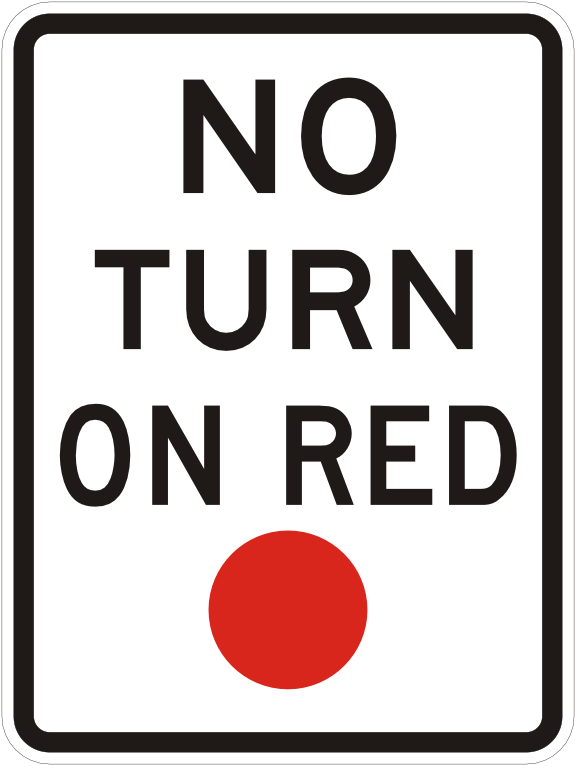
4. “No Turn On Red” Signs
While not a prohibition of a turn itself, a “No Turn On Red” sign specifically restricts the common practice of making a right turn on a red light after stopping. This sign typically features a right-pointing arrow with a red circle and a diagonal line, often accompanied by the text “No Turn On Red.” These signs are primarily implemented to enhance pedestrian safety, especially in urban environments with significant foot traffic, or in intersections with complex signal phasing that could make a right turn on red hazardous. It is crucial to remember that even without a specific sign, drivers must always yield to pedestrians and oncoming traffic when making a right turn on red.
Strategic Placement and Interpretation
The placement of “no turn” signs in California is deliberate and based on traffic engineering principles. Understanding the context in which these signs appear is key to proper interpretation.
Intersection Design and Traffic Flow
Many “no turn” signs are a direct consequence of intersection design. A left turn from a busy street onto another busy street can create a bottleneck, especially if there isn’t adequate time for the turning vehicle to complete the maneuver without impeding through traffic or oncoming vehicles. Similarly, right turns can be problematic at intersections with complex pedestrian signals or where there are multiple lanes of traffic to cross.
Managing Congestion
In densely populated urban centers like San Jose or the San Fernando Valley, “no turn” signs are crucial for managing traffic congestion. By prohibiting certain turns during peak hours, traffic engineers can create smoother traffic flow along major arteries, reducing travel times and the likelihood of gridlock. For example, a major intersection leading into a popular commercial district might prohibit left turns during morning rush hour to keep the main thoroughfare clear.
Pedestrian and Cyclist Safety
California, particularly cities like San Diego and Sacramento, places a strong emphasis on pedestrian and cyclist safety. “No turn” signs are often implemented in areas with high pedestrian volumes, such as downtown districts, near schools, or adjacent to parks and public spaces. A “No Right Turn on Red” sign, for instance, is a direct measure to prevent collisions between turning vehicles and pedestrians crossing the street.
Road Characteristics and Hazards
Beyond intersection design, the specific characteristics of the road itself can dictate the need for “no turn” signage.
High-Speed Roads and Freeways
On high-speed roads and freeways, U-turns are almost universally prohibited and often implicitly illegal due to the nature of these roadways. Dedicated “No U-Turn” signs are prevalent at interchanges or where median openings might otherwise tempt drivers to attempt this maneuver. Left and right turns are also generally not permitted directly onto or off of freeways, with designated on- and off-ramps serving these functions.
Restricted Access Areas
In certain areas, such as military bases, private compounds, or areas with sensitive environmental considerations, “no turn” signs might be used to restrict access or direct traffic along designated routes. These signs are part of broader access control strategies.
Beyond the Sign: Legal Implications and Best Practices
Understanding the visual cues of “no turn” signs is only the first step. Drivers must also be aware of the legal ramifications of non-compliance and adopt best practices to ensure their journeys are safe and lawful.
Legal Consequences of Non-Compliance
Violating “no turn” signs in California can result in traffic tickets, fines, and points assessed against your driving record. These violations are enforced by law enforcement officers, and in some urban areas, automated enforcement cameras may also be in use for certain turn restrictions. Accumulating too many points can lead to increased insurance premiums and even license suspension.
Best Practices for Drivers
- Always Scan Ahead: Pay close attention to all traffic signs as you approach an intersection or roadway. Look for signs indicating prohibited turns, especially if you are unfamiliar with the area.
- Understand the Context: Consider the environment. Are you on a busy freeway? A narrow residential street? Near a school or a busy crosswalk? This context can help you anticipate potential turn restrictions.
- Consult GPS and Navigation Apps Wisely: While navigation apps are incredibly useful, they are not always updated with the latest temporary or time-sensitive traffic restrictions. Always defer to official signage when it conflicts with your GPS.
- Be Aware of Adjacent Signage: Sometimes, a “No Turn” sign might be supplemented by other signs that provide additional context or exceptions. For example, a “No Left Turn” sign might have a smaller sign below it stating “Except Sundays.”
- When in Doubt, Don’t Turn: If you are unsure whether a turn is permitted, it is always safer to proceed straight or find a designated turn lane or intersection. You can always re-route if you miss a desired turn.
- Observe Other Drivers (with Caution): While observing what other drivers do can sometimes provide clues, it is not a reliable method for determining legality. Some drivers may also be unaware of or disregarding restrictions.
By diligently observing and respecting “no turn” signs, drivers contribute to a safer and more efficient traffic environment throughout the diverse landscapes of California. These signs are not arbitrary obstacles but vital components of a sophisticated system designed to protect all road users.
LifeOutOfTheBox is a participant in the Amazon Services LLC Associates Program, an affiliate advertising program designed to provide a means for sites to earn advertising fees by advertising and linking to Amazon.com. Amazon, the Amazon logo, AmazonSupply, and the AmazonSupply logo are trademarks of Amazon.com, Inc. or its affiliates. As an Amazon Associate we earn affiliate commissions from qualifying purchases.