
Introduction to a Turning Point in American History
The year 1854 marked a critical juncture in the territorial expansion and political evolution of the United States. As the nation pushed further westward, the question of whether new territories would permit slavery became an explosive issue that threatened to tear the Union apart. At the center of this legislative firestorm was the Kansas-Nebraska Act, a controversial measure that reshaped the geopolitical landscape and served as a major catalyst for the American Civil War.
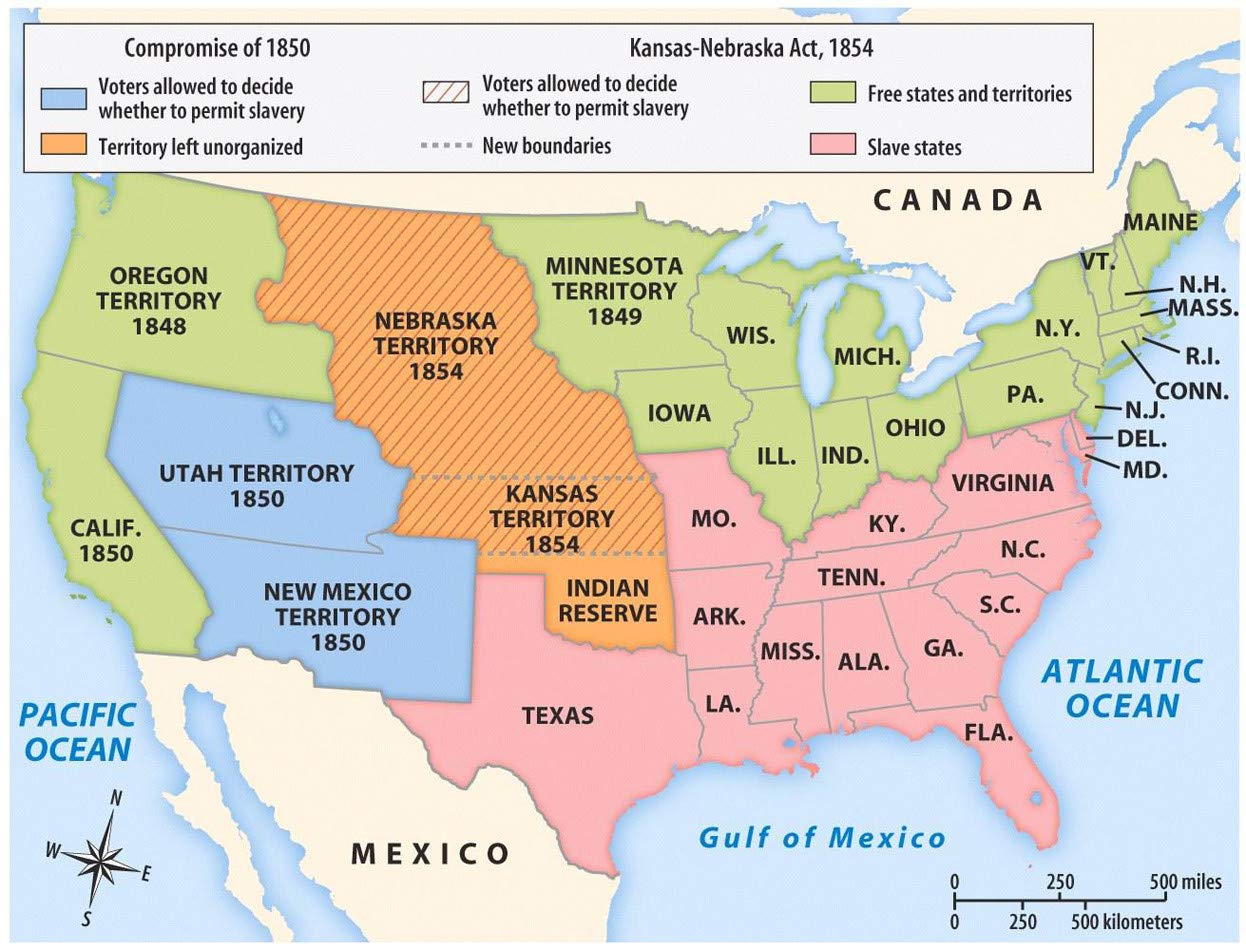
Passed by the United States Congress and signed into law by President Franklin Pierce, the act organized two vast new territories: Kansas Territory and Nebraska Territory. However, its true significance lay not in simple land organization, but in its reckless dismantling of long-standing political compromises. By reopening the debate over slavery in the western territories, the legislation directly challenged the delicate balance of power between Northern free states and Southern slave states, setting the stage for profound national turmoil.
The Legislative Origins and the Missouri Compromise
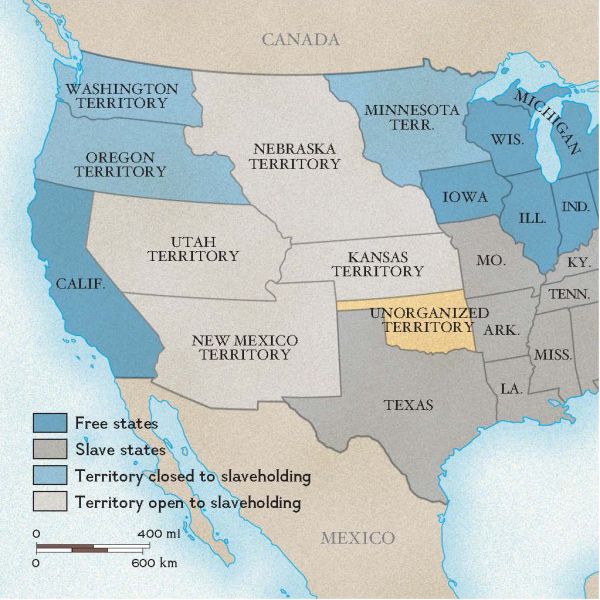
To understand the profound impact of the Kansas-Nebraska Act, one must examine the legal and political framework that preceded it. For decades, the Missouri Compromise of 1820 had maintained a fragile peace across the continent. Under this agreement, slavery was strictly prohibited in the unorganized territories north of the 36°30′ parallel, except within the boundaries of the state of Missouri. This boundary provided a clear geographic dividing line for the future expansion of the country.
However, the acquisition of vast new lands following the Mexican-American War and the rapid push for a transcontinental railroad forced the slavery debate back to the forefront. Stephen A. Douglas, an ambitious senator from Illinois, envisioned a transcontinental railroad that would connect the Midwest to the Pacific Ocean, with a major eastern terminus in Chicago. To build this grand infrastructure through the northern plains, the region needed to be officially organized into territories under federal law.
Senator Douglas faced a severe political dilemma. Southern politicians, led by figures like Jefferson Davis, strongly opposed organizing the northern territories as free soil, as it would tip the balance of congressional power further in favor of the North. To win Southern support for his railroad project and territorial organization, Douglas crafted a legislative maneuver that repealed the Missouri Compromise of 1820. In its place, he introduced the doctrine of popular sovereignty.
Popular Sovereignty and the Principle of Self-Determination
At the core of the Kansas-Nebraska Act was the concept of popular sovereignty. Instead of Congress determining whether slavery would be permitted in a new territory, Douglas proposed that the actual settlers living within those territories should decide the question for themselves through democratic voting.
The Appeal of Popular Sovereignty
To many mid-19th-century Americans, popular sovereignty sounded like the ultimate expression of democratic self-government. It aligned with the foundational American ideals of local autonomy and grassroots decision-making. Senator Douglas and his supporters argued that the federal government had no constitutional business dictating social institutions to the hardy pioneers carving out new lives in the West.
The Flaws in Practice
Despite its democratic facade, popular sovereignty contained a fatal flaw: it failed to specify when the territorial inhabitants could vote on slavery. Did they decide during the territorial phase, or only when drafting a state constitution to apply for official statehood? This ambiguity transformed the Western frontier into a high-stakes ideological battleground. Pro-slavery and anti-slavery factions realized that whoever could populate the territories fastest would control the vote and dictate the future of the region.
Bleeding Kansas: The Prelude to Civil War
The passage of the Kansas-Nebraska Act immediately triggered a rush of migration into the newly created lands, particularly into Kansas. The peaceful settlement of the frontier quickly descended into violent political conflict, earning the territory the grim moniker of “Bleeding Kansas.”
The Clash of Ideologies
New England abolitionist organizations, such as the New England Emigrant Aid Company, funded and equipped anti-slavery settlers—often referred to as Free-Staters—to relocate to Kansas and vote against slavery. Meanwhile, pro-slavery advocates, particularly from neighboring Missouri, crossed the border in droves to influence elections, establish fraudulent governments, and intimidate their opponents. These aggressive pro-slavery interlopers became known across the nation as Border Ruffians.
Escalating Violence and Radicalization
The political friction soon erupted into open warfare. Armed bands roamed the countryside, burning settlements, stuffing ballot boxes, and committing assassinations.
- The Sack of Lawrence, in which pro-slavery forces attacked and looted the free-state stronghold, shocked the nation.
- In retaliation, the radical abolitionist John Brown led a murderous raid at Pottawatomie Creek, hacking five pro-slavery settlers to death with broadswords.
The violence in Kansas was not merely local thuggery; it was a microscopic preview of the national catastrophe to come. The federal government proved utterly incapable of restoring law and order, further alienating citizens on both sides of the slavery debate and eroding trust in national institutions like the Supreme Court.
The Collapse of the Party System and Political Realignment
Beyond the bloodshed on the frontier, the Kansas-Nebraska Act fundamentally shattered the established American political party system. For decades, the Democratic Party and the Whig Party had served as the two major national institutions holding the country together across sectional lines. Both parties contained members from both the North and the South, forcing political leaders to compromise.
The Demise of the Whigs
The Whig Party was utterly destroyed by the controversy over the act. Northern Whigs, outraged by the repeal of the Missouri Compromise, split entirely from their Southern counterparts. Unable to find common ground on the expansion of slavery, the party disintegrated, leaving a massive vacuum in American politics.
The Rise of the Republican Party
Out of the ashes of the Whig Party and disaffected factions of Democrats and Free-Soilers emerged a powerful new political entity: the Republican Party. Founded in the mid-1850s, the Republicans united under a clear anti-slavery platform, specifically dedicated to stopping the further spread of slavery into the Western territories. The polarization caused by the Kansas-Nebraska Act ensured that the new Republican Party would quickly become a dominant political force in the North.
The Polarized Nation
The national debate transformed the political vocabulary of the country. Sectional identities—Northern versus Southern—began to eclipse national identity. When Abraham Lincoln delivered his famous “House Divided” speech a few years later, he was speaking to a nation whose political fabric had already been shredded by the legislative battles ignited in 1854.
Legacy and Historical Significance
The Kansas-Nebraska Act stands as one of the most disastrous pieces of legislation in the history of the United States. Conceived as a practical compromise to advance railway development and smooth over sectional differences, it achieved the exact opposite. By unnecessarily reopening the volatile question of slavery expansion, it inflamed regional tensions past the point of no return.
The law transformed the American West from a symbol of national hope and economic opportunity into an arena of violent ideological warfare. It exposed the moral bankruptcy of popular sovereignty when applied to fundamental human rights, alienated millions of moderates, and accelerated the march toward national disunion. Ultimately, the Kansas-Nebraska Act proved that legislative maneuvering could no longer contain the moral and political crisis of slavery, setting the inevitable stage for the bloodshed of the Civil War.
LifeOutOfTheBox is a participant in the Amazon Services LLC Associates Program, an affiliate advertising program designed to provide a means for sites to earn advertising fees by advertising and linking to Amazon.com. Amazon, the Amazon logo, AmazonSupply, and the AmazonSupply logo are trademarks of Amazon.com, Inc. or its affiliates. As an Amazon Associate we earn affiliate commissions from qualifying purchases.