
Alaska, often dubbed “The Last Frontier,” officially joined the United States as its 49th state on January 3, 1959. This monumental event marked the culmination of a long and complex journey, transforming a vast, remote territory from a Russian outpost into an integral part of the American fabric. The story of Alaska’s statehood is a captivating narrative woven with threads of exploration, strategic foresight, economic potential, and the persistent efforts of its resilient residents. From its initial discovery by European explorers to its pivotal role in global geopolitics, Alaska’s path to statehood is a testament to its unique character and enduring significance.
The Vast Expanse: Early History and Russian Ownership
Before its transition to American hands, Alaska existed for centuries as a land shaped by its indigenous inhabitants and, later, by the ambitions of the Russian Empire. Understanding this foundational period is crucial to appreciating the subsequent developments that led to its eventual incorporation into the United States.
Indigenous Peoples and European Exploration
For thousands of years, Alaska was home to diverse indigenous groups, including the Inupiat, Yup’ik, Aleut, Tlingit, and Athabascan peoples, among others. These communities developed rich cultures, sophisticated survival strategies, and intricate spiritual beliefs adapted to the challenging Arctic and sub-Arctic environments. Their connection to the land was profound, and their history predates any European contact by millennia.
The first documented European sighting of Alaska occurred in 1741, when the Russian explorer Vitus Bering led an expedition across the Bering Strait. His voyage, commissioned by Tsar Peter the Great, aimed to determine if Asia and North America were connected. Although Bering himself died during the return journey, his crew brought back valuable sea otter pelts, sparking a lucrative fur trade that drew Russian adventurers and traders to the region.
The Russian-American Company and Colonial Footprint
Following Bering’s discoveries, Russian fur trappers, known as “promyshlenniki,” rapidly expanded their operations throughout the Aleutian Islands and mainland Alaska. This unregulated exploitation led to devastating impacts on the indigenous populations, who were often coerced into labor and suffered from disease. To bring order to the chaotic fur trade and solidify Russian claims, Tsar Paul I chartered the Russian-American Company in 1799.
This powerful, state-sponsored monopoly established permanent settlements, most notably Sitka (originally New Archangel), which became the capital of Russian America. For nearly seven decades, the Russian-American Company managed the vast territory, engaging in fur trading, whaling, and limited mining. However, despite their extensive presence, Russian colonization remained relatively shallow, primarily focused on coastal areas and resource extraction rather than extensive settlement or agricultural development. The economic viability of their Alaskan venture began to wane as the fur seal and sea otter populations dwindled, exacerbated by the logistical challenges of governing such a remote and harsh environment.
Seward’s Folly: The Purchase of Alaska
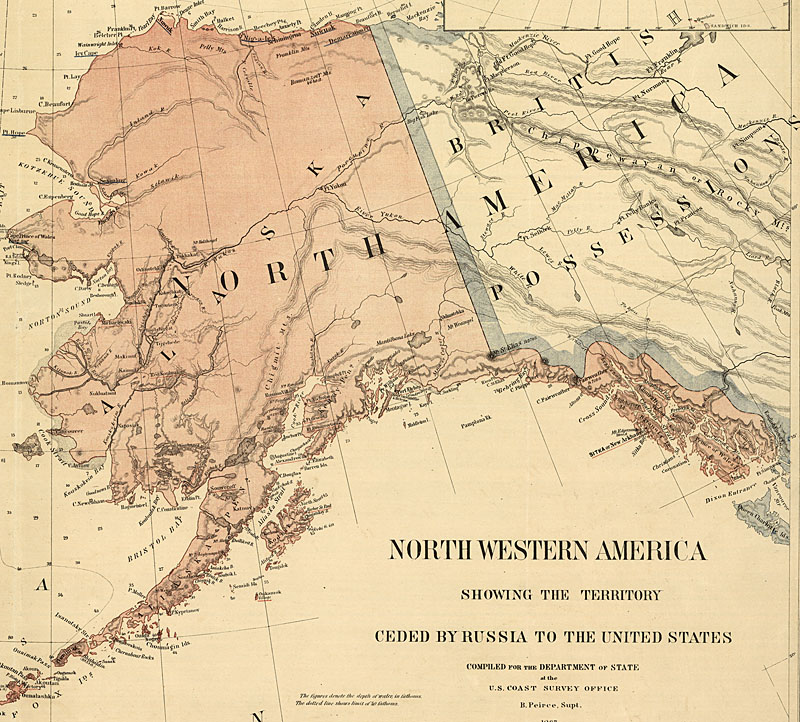
The mid-19th century brought about a significant shift in Russia’s view of Alaska. Facing financial difficulties, primarily stemming from the costly Crimean War, and recognizing the territory’s diminishing economic returns and vulnerability to British takeover from neighboring Canada, Russia began to consider selling Alaska. This confluence of factors set the stage for one of history’s most extraordinary real estate deals.
The Diplomatic Deal of 1867
The opportunity to acquire Alaska was seized upon by U.S. Secretary of State William H. Seward, a visionary politician under President Andrew Johnson. Seward was a staunch expansionist who believed in the strategic importance of American control over North America. He saw Alaska as a gateway to Asia and a potential source of immense natural resources.
Negotiations between Seward and the Russian Minister to the United States, Eduard de Stoeckl, proceeded swiftly and secretly. On March 30, 1867, a treaty was signed in Washington D.C. agreeing to the sale of Alaska for $7.2 million, an astonishingly low price for such a vast territory (approximately 2 cents an acre). The formal transfer of sovereignty took place in Sitka on October 18, 1867, with the lowering of the Russian flag and the raising of the American flag.
Public Perception and Initial Skepticism
Initially, the purchase was met with widespread skepticism and ridicule in the United States press and by many politicians. Critics derided the acquisition as “Seward’s Folly,” “Seward’s Icebox,” or “President Johnson’s Polar Bear Garden,” questioning the wisdom of spending such a sum on a seemingly barren and frozen wasteland. The country was still recovering from the Civil War, and many felt the money could be better spent elsewhere.
However, Seward and his supporters argued passionately for the purchase, emphasizing Alaska’s strategic importance, potential for natural resources (though largely unknown at the time), and the removal of a major European power from the North American continent. Over time, as the territory’s vast resources, particularly gold, fish, and timber, began to be discovered, public opinion gradually shifted, and the wisdom of “Seward’s Folly” became increasingly apparent.
A Territory in Transition: The Path to Statehood
For decades after the purchase, Alaska remained a neglected and largely unorganized territory. Its immense size, harsh climate, and sparse population presented unique challenges for governance and development. Yet, through periods of hardship and boom, the seeds of statehood were slowly sown.
Early Governance and Resource Exploitation
Immediately following the purchase, Alaska was administered by the U.S. Army, then the Treasury Department, and finally the Navy. It was essentially treated as a military district, with minimal civilian oversight or legal framework. This lack of proper governance stifled development and often led to injustice for both settlers and indigenous peoples. It wasn’t until 1884 that the Organic Act provided Alaska with its first civil government, establishing a governor and a district court, but still no legislative body or voting representation.
Despite the limited federal attention, economic activities began to pick up. Commercial fishing, particularly for salmon, became a significant industry. Whaling fleets also frequented Alaskan waters. These industries, while profitable, were often exploitative, with many resources shipped out of Alaska without much benefit to the local population or territorial development.
The Gold Rush and Population Boom

The discovery of gold in the late 19th and early 20th centuries proved to be a transformative moment for Alaska. The famous Klondike Gold Rush of 1896, though primarily centered in neighboring Canada’s Yukon Territory, brought a massive influx of prospectors and adventurers through Alaskan ports like Skagway and Juneau. Subsequent major gold discoveries within Alaska itself, particularly in Nome and Fairbanks, led to significant population growth and the establishment of new towns and infrastructure.
This population boom brought with it a demand for better governance and representation. Settlers, often hardy and independent-minded, resented the “colonial” status of Alaska and the fact that decisions affecting their lives were made thousands of miles away in Washington D.C.. The gold rush era solidified the belief among many Alaskans that they deserved the same rights and self-determination as citizens in other U.S. territories.
Growing Calls for Self-Governance
The sustained population growth and economic development fueled a nascent statehood movement. In 1912, the Second Organic Act granted Alaska its own territorial legislature, allowing Alaskans to elect representatives and enact local laws, albeit with federal oversight. Juneau was designated the capital. This was a crucial step, giving Alaskans a taste of self-governance and empowering them to advocate more effectively for full statehood.
Throughout the 1920s and 1930s, the statehood movement gained momentum, though it faced considerable opposition from vested interests who benefited from the territorial status, particularly powerful fishing and mining corporations that preferred minimal regulation from a distant federal government. The outbreak of World War II further highlighted Alaska’s strategic importance. The Japanese invasion of the Aleutian Islands demonstrated the territory’s vulnerability and its critical role in national defense, leading to massive federal investment in infrastructure, airfields, and military bases. This wartime development dramatically increased Alaska’s population and its economic integration with the rest of the United States, strengthening the argument for statehood.
Achieving the Dream: Alaska’s Statehood
The post-WWII era saw the statehood movement reach its zenith. Alaskans, having contributed significantly to the war effort and now boasting a more diverse and substantial population, felt it was time for full equality with other states.
The Statehood Movement Gains Momentum
Following World War II, the arguments for Alaska’s statehood became compelling. Proponents argued that taxation without representation was undemocratic, and that federal control stifled economic development and local autonomy. Key figures like Governor Ernest Gruening tirelessly campaigned for statehood, advocating in Washington D.C. and organizing support within the territory.
A major challenge was to draft a state constitution that would be acceptable to the U.S. Congress and the people of Alaska. In 1955, a constitutional convention was held at the University of Alaska Fairbanks, producing a progressive document that drew praise nationally. This demonstrated Alaska’s readiness for self-governance and its commitment to democratic principles. Another innovative strategy was the “Tennessee Plan,” where Alaskans elected a full congressional delegation, even before statehood was granted, to lobby forcefully in Washington D.C..
Congressional Approval and Presidential Proclamation
Despite persistent lobbying, the path through Congress was fraught with obstacles. Concerns about Alaska’s small population, its vast distance from the contiguous United States, and its potential political leanings led to delays. Southern states, in particular, feared that new states might upset the delicate balance of power in Congress. However, the tireless efforts of Alaskans and their advocates eventually swayed opinion.
In 1958, both the House of Representatives and the Senate passed the Alaska Statehood Act. On July 7, 1958, President Dwight D. Eisenhower signed the act into law, paving the way for the final steps. Alaskans then voted overwhelmingly to accept the terms of the statehood act and ratify their constitution.
The 49th State Enters the Union
With the formal requirements met, President Eisenhower issued Proclamation 3269 on January 3, 1959, officially declaring Alaska the 49th state of the United States. Celebrations erupted across the territory, now a state, marking the dawn of a new era. The addition of Alaska brought with it not only a massive landmass but also incredible natural resources, strategic military importance, and a unique cultural heritage. The new 49-star flag was unveiled, a symbol of the expanded union.
The Enduring Legacy: Alaska’s Importance Today
The statehood of Alaska was not just a historical footnote; it profoundly reshaped the political, economic, and cultural landscape of the United States and continues to hold immense significance today.
Economic Contributions and Strategic Significance
Since becoming a state, Alaska has proven to be an economic powerhouse, primarily due to its vast natural resources. The discovery of massive oil reserves at Prudhoe Bay in 1968, and the subsequent construction of the Trans-Alaska Pipeline System, transformed the state’s economy. Oil revenues have funded state services, provided a permanent fund dividend to residents, and diversified the economy beyond fishing and timber. Alaska remains a major producer of oil, natural gas, and minerals, and its fishing industry continues to be one of the largest and most valuable in the world.
Strategically, Alaska’s location is unparalleled. Positioned at the crossroads of North America and Asia, and bordering Russia across the Bering Strait, it serves as a critical geopolitical outpost. Its numerous military bases are vital for national defense, Arctic research, and global projection of power. In an era of increasing focus on the Arctic Circle, Alaska’s importance is only set to grow.
A Land of Unrivaled Natural Beauty and Cultural Heritage
Beyond its economic and strategic value, Alaska is celebrated for its unparalleled natural beauty. Home to Mount Denali, North America’s highest peak, vast national parks like Denali National Park and Glacier Bay National Park, and millions of acres of wilderness, it offers breathtaking landscapes of glaciers, fjords, forests, and tundra. This makes it a prime destination for adventure tourism, wildlife viewing, and outdoor recreation.
The state also actively preserves and celebrates its rich cultural heritage, including the vibrant traditions of its indigenous peoples, the legacy of its Russian past, and the rugged spirit of its pioneers. Cities like Anchorage and Juneau serve as hubs for exploring this diverse heritage. The journey to statehood fundamentally transformed Alaska, allowing it to develop its unique identity while integrating fully into the American experiment.
The story of “When Did Alaska Become A State In The United States?” is more than just a date on a calendar; it’s an epic tale of geopolitical maneuvering, determined self-advocacy, and the eventual recognition of a vast, resource-rich, and strategically vital land. On January 3, 1959, Alaska shed its territorial status, taking its rightful place as the 49th star on the American flag and forever changing the national landscape. Its journey from “Seward’s Folly” to a cornerstone of the United States is a powerful reminder of vision, perseverance, and the enduring allure of “The Last Frontier.”
LifeOutOfTheBox is a participant in the Amazon Services LLC Associates Program, an affiliate advertising program designed to provide a means for sites to earn advertising fees by advertising and linking to Amazon.com. Amazon, the Amazon logo, AmazonSupply, and the AmazonSupply logo are trademarks of Amazon.com, Inc. or its affiliates. As an Amazon Associate we earn affiliate commissions from qualifying purchases.