
The story of Texas’s annexation to the United States is a complex tapestry woven with threads of independence, national ambition, and international intrigue. While often presented as a straightforward acquisition, the path to statehood for the Republic of Texas was a protracted and often contentious affair, marked by political maneuvering, ideological divides, and the ever-present specter of slavery. Understanding this pivotal moment in American history requires delving into the unique circumstances that led the Lone Star Republic to seek union with its powerful northern neighbor, and the significant hurdles it had to overcome to achieve that goal.
The Genesis of a Republic: Texas’s Fight for Independence
The journey of Texas to annexation began not with a desire to join the United States, but with a fervent struggle for its own sovereignty. In the early 19th century, Mexico, having recently gained its independence from Spain, encouraged settlement in the vast, sparsely populated territory of Texas. American immigrants, drawn by promises of cheap land and economic opportunity, began to pour into the region. These settlers, however, brought with them their own cultural norms and, crucially, their enslaved laborers, which clashed with Mexico’s abolitionist policies.
Tensions escalated as Mexican President Antonio López de Santa Anna consolidated power and began to centralize authority, eroding the federalist system that had been in place. This led to growing resentment among the Texan colonists. The breaking point came in 1835, igniting the Texas Revolution. Key battles like the Alamo and Goliad became iconic symbols of Texan resolve, though they also represented devastating defeats. However, the tide turned at the Battle of San Jacinto on April 21, 1836, where Sam Houston’s Texan army decisively defeated Santa Anna’s forces, securing Texas’s independence.
The Birth of the Lone Star Republic
Following the victory at San Jacinto, Texas declared itself an independent nation, the Republic of Texas. For nearly a decade, Texas existed as a sovereign entity, grappling with the challenges of nation-building. The new republic faced immense difficulties: a fragile economy, a small population, and constant threats from Mexico, which refused to recognize its independence. Despite these struggles, Texas developed its own distinct identity, forging a path independent of the United States.
During this period, overtures were made to the United States for annexation. However, the issue of slavery loomed large. Texas, like many Southern states in the U.S., was a slaveholding society. The prospect of adding another slave state to the Union was deeply divisive, particularly in the Northern states, where abolitionist sentiment was growing. This ideological chasm created a significant political obstacle to annexation, preventing any serious consideration by the U.S. government for several years.
The Road to Annexation: Political Intrigue and Shifting Tides
The desire for annexation, however, remained strong among many Texans. The republic’s financial woes and security concerns made union with the United States an attractive proposition. Yet, the U.S. government, led by President Andrew Jackson, was hesitant. Jackson, a strong advocate for expansion, also recognized the political peril associated with bringing the slavery issue to a head. He famously kept Texas’s annexation request pending for much of his presidency, effectively delaying a decision.
The subsequent administration of President Martin Van Buren also shied away from the issue, prioritizing domestic concerns and avoiding the explosive slavery debate. For a time, it seemed as though Texas might forge a future on its own, or perhaps even seek alliances with European powers like Great Britain.
The Rise of Manifest Destiny and the Election of 1844
The political landscape began to shift dramatically with the growing fervor of “Manifest Destiny” in the United States. This powerful ideology championed the belief that the U.S. was divinely ordained to expand its dominion and spread democracy across the North American continent. The idea of acquiring vast territories, including the strategically important Texas, gained considerable traction.
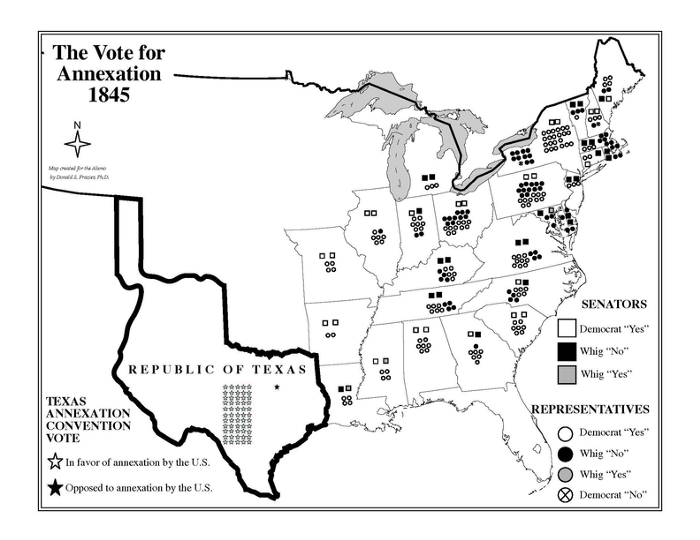
The presidential election of 1844 proved to be a watershed moment. The Whig Party candidate, Henry Clay, was cautious on the issue of annexation, fearing it would ignite sectional conflict. The Democratic candidate, James K. Polk, however, ran on an explicitly expansionist platform, promising to annex Texas and even to acquire Oregon Country from Great Britain. Polk’s victory signaled a clear mandate for expansion, and the path to Texas’s annexation was suddenly much clearer.

The Annexation Process: A Joint Resolution and a Declaratory Act
Following President Polk’s inauguration in March 1845, the wheels of annexation began to turn with unprecedented speed. The U.S. Congress, galvanized by the election results and the growing nationalistic sentiment, moved to formally bring Texas into the Union.
The Joint Resolution for Annexing Texas
Instead of a traditional treaty, which would have required a two-thirds majority in the Senate and faced significant opposition, the U.S. Congress opted for a joint resolution. This legislative maneuver, requiring only a simple majority in both the House of Representatives and the Senate, was a more politically feasible route.
On February 28, 1845, the U.S. House of Representatives passed the joint resolution to annex Texas. The Senate followed suit on March 1, 1845. President John Tyler, in his final days in office, signed the resolution into law on March 1, 1845. This act effectively offered Texas the opportunity to join the United States.
Texas’s Acceptance and Statehood
The joint resolution stipulated that Texas would be admitted as a state with its existing boundaries, but without the right to divide itself into multiple states without the consent of Congress. It also stipulated that Texas would cede all its public lands to the U.S. government, but would retain its public debts.
The Republic of Texas, eager to finalize its incorporation into the United States, convened a constitutional convention. On July 4, 1845, the Texan convention formally accepted the terms of the annexation resolution. A new state constitution was drafted, which was overwhelmingly ratified by the Texan people in a popular vote on October 13, 1845.
Finally, on December 29, 1845, President Polk signed the bill admitting Texas as the 28th state of the Union. While the annexation resolution was passed in March 1845, the official date of statehood is December 29, 1845. This marked the culmination of a long and complex process, transforming the independent Lone Star Republic into an integral part of the United States.
The Aftermath: The Mexican-American War and Lingering Tensions
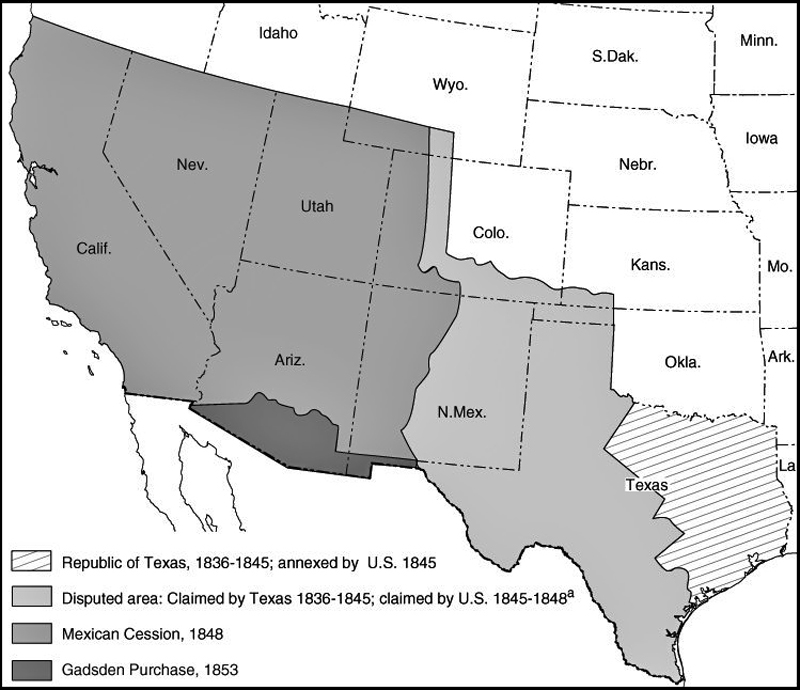
The annexation of Texas, however, was far from universally accepted. Mexico, which still considered Texas a rebellious province, viewed the annexation as an act of aggression. Diplomatic relations between the United States and Mexico deteriorated rapidly. The disputed border between Texas and Mexico—with the U.S. claiming the Rio Grande and Mexico asserting the Nueces River—became a flashpoint.
In 1846, disputes over this border led to armed conflict, igniting the Mexican-American War. The war, which lasted for two years, resulted in a decisive American victory. The Treaty of Guadalupe Hidalgo, signed in 1848, ceded vast territories to the United States, including present-day California, Nevada, Utah, Arizona, and parts of New Mexico, Colorado, and Wyoming.
Legacy and Significance
The annexation of Texas remains a significant event in American history, profoundly shaping the nation’s territorial expansion and its relationship with its southern neighbor. It was a testament to the powerful currents of Manifest Destiny and the political will to overcome significant sectional divisions, albeit temporarily. The inclusion of Texas as a slave state further intensified the growing tensions between the North and the South, contributing to the eventual outbreak of the Civil War. The legacy of this annexation is multifaceted, encompassing themes of national ambition, territorial growth, and the enduring complexities of slavery in the American narrative. For historians and enthusiasts of American history, understanding the intricate journey of Texas from an independent republic to a U.S. state offers invaluable insights into the forces that shaped the modern United States.
LifeOutOfTheBox is a participant in the Amazon Services LLC Associates Program, an affiliate advertising program designed to provide a means for sites to earn advertising fees by advertising and linking to Amazon.com. Amazon, the Amazon logo, AmazonSupply, and the AmazonSupply logo are trademarks of Amazon.com, Inc. or its affiliates. As an Amazon Associate we earn affiliate commissions from qualifying purchases.