
For cinema enthusiasts and lovers of historical architecture, few structures command as much presence and dread as the Overlook Hotel. Since its cinematic debut in the 1980 psychological horror masterpiece The Shining, the hotel has become an architectural icon, synonymous with isolation, grandeur, and the supernatural. However, for those looking to visit the actual location, the answer is far more complex than a single pin on a map. The Overlook Hotel as portrayed by Stanley Kubrick is a composite creation, a phantom landmark built from the exteriors of one famous lodge, the interiors of another, and the imaginative spark ignited by a third.

To understand where the hotel from the movie is located, one must look toward the rugged peaks of Oregon, the high-altitude landscapes of Colorado, and the sprawling soundstages of the United Kingdom. Each of these locations contributes a piece to the puzzle, creating a landmark that exists more in the collective consciousness of film history than in a physical geographical coordinate.
The Exterior Face: Timberline Lodge and the Oregon Wilderness
When viewers witness the sweeping aerial shots of the snow-caked mountains that open the film, they are looking at the majestic Mount Hood. Perched on the southern flank of this dormant volcano is Timberline Lodge, the building used for the exterior shots of the Overlook Hotel. Constructed during the Great Depression as a project of the Works Progress Administration, the lodge is a triumph of “Cascadian” style architecture, utilizing local stone and massive timber beams to create a structure that feels as though it grew directly out of the mountainside.
High Altitude Architecture at Mount Hood
Timberline Lodge was dedicated by President Franklin D Roosevelt in 1937 and stands today as a National Historic Landmark. Its heavy, rustic aesthetic provided the perfect visual weight for the Overlook. Interestingly, while the lodge is famous for its association with horror, the reality of the site is far more welcoming. Located just a short drive from Portland, it serves as a premier destination for skiing and mountaineering.
During the filming of The Shining, the management of Timberline Lodge grew concerned that the film’s depiction of a haunted room would discourage future guests from staying in that specific suite. In the original Stephen King novel, the cursed room was Room 217. At the request of the hotel management, Stanley Kubrick changed the room number to the non-existent Room 237. Ironically, Room 217 remains the most requested room at Timberline Lodge today, proving that the allure of a landmark’s history often outweighs the fear of its fictional ghosts.
The Landscape of the Pacific Northwest
The isolation of the Overlook was effectively captured by the surrounding vistas of Mount Hood National Forest. The winding roads seen in the beginning of the movie, where the Volkswagen Beetle appears as a tiny speck against the vast wilderness, were filmed along Going To The Sun Road in Glacier National Park, Montana. However, the psychological weight of the “exterior” Overlook remains firmly anchored to the stone and timber facade of the lodge in Oregon.
The Spiritual Origin: The Stanley Hotel and Stephen King’s Vision
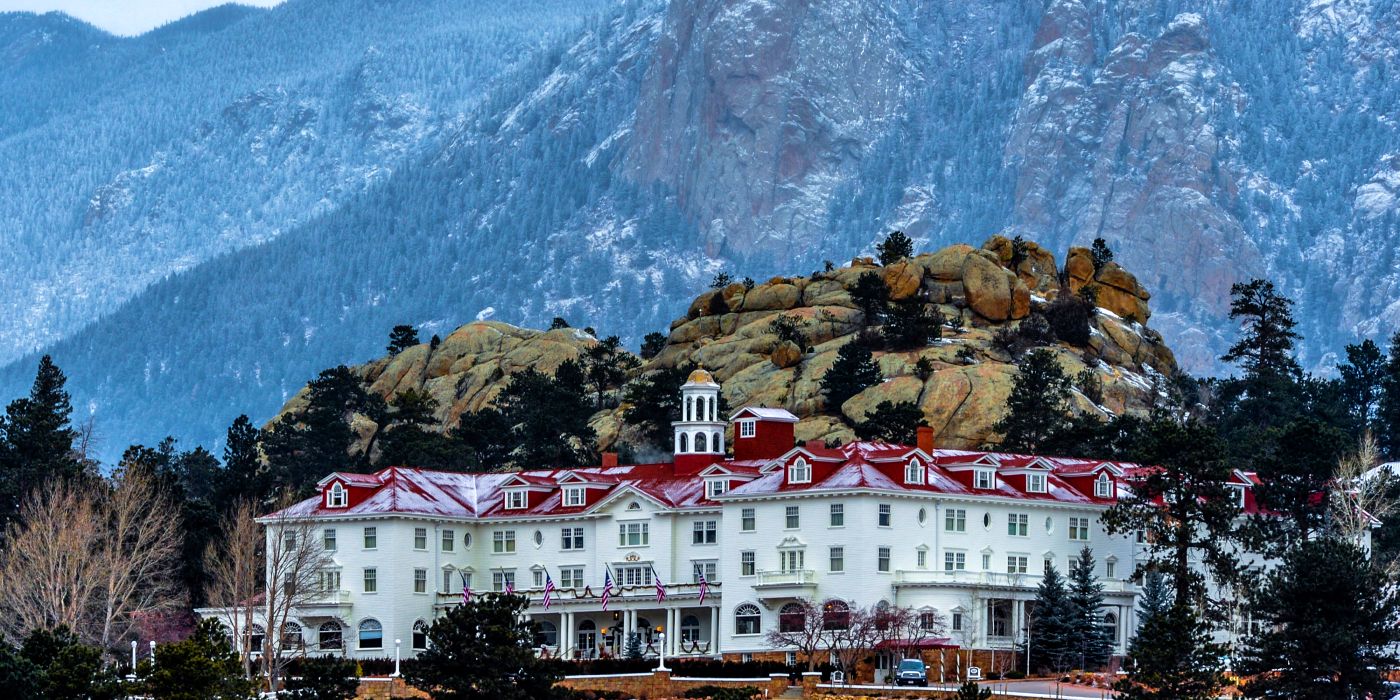
While Timberline Lodge provided the face, the soul of the Overlook Hotel was born in Estes Park, Colorado. In 1974, author Stephen King and his wife Tabitha King stayed at The Stanley Hotel. As the season was ending, they were the only guests in the massive, Colonial Revival building. This eerie experience of wandering empty corridors and dining in a silent ballroom inspired the narrative that would become one of the most famous horror stories of all time.
The Colonial Revival Elegance of Estes Park
The Stanley Hotel opened in 1909 and was the brainchild of Freelan Oscar Stanley, the inventor of the Stanley Steamer automobile. Unlike the rustic, dark wood of Timberline Lodge, The Stanley Hotel is bright, white, and classical. It sits near the entrance to Rocky Mountain National Park, offering stunning views of Longs Peak.
Though Stanley Kubrick chose not to film at The Stanley Hotel, preferring the more “menacing” look of the Oregon lodge, the Colorado landmark has embraced its legacy. It has since become a major tourist attraction for paranormal investigators and film buffs. Visitors today can take “ghost tours” and even view a hedge maze that was added to the property in 2015—a direct nod to the film’s climax, as the original hotel never actually possessed one.

The 1997 Miniseries and the Return to Colorado
Because Stephen King was famously dissatisfied with the Stanley Kubrick adaptation, he later produced a television miniseries of The Shining in 1997. For this version, the production filmed entirely on-site at The Stanley Hotel. For fans of the book’s specific atmosphere, this Colorado landmark is the “true” Overlook, representing the architectural elegance that contrasts so sharply with the protagonist’s mental decline.
The Interior Blueprint: The Ahwahnee Hotel and Studio Sets
Perhaps the most jarring realization for visitors to Timberline Lodge is that the interiors look nothing like the movie. The vast, echoing halls, the patterned carpets, and the Gold Room ballroom were all constructed on soundstages at Elstree Studios in Borehamwood, Hertfordshire, just north of London. However, these sets were not entirely fictional; they were heavily modeled after The Ahwahnee Hotel in Yosemite National Park.
Yosemite’s Architectural Influence
The Ahwahnee Hotel in California is a masterpiece of “National Park Service Rustic” architecture. Designers at Elstree Studios meticulously studied the hotel’s Great Lounge, its Native American motifs, and its massive fireplaces. When Jack Nicholson walks through the lobby of the Overlook, he is essentially walking through a heightened, cinematic recreation of The Ahwahnee Hotel.
The use of red, black, and orange patterns—inspired by Yosemite and the indigenous cultures of the American West—was intentional. Stanley Kubrick wanted to create a space that felt “impossible.” The set was designed with architectural inconsistencies—doors that lead nowhere and hallways that loop back on themselves—to subtly disorient the audience. This psychological manipulation of a landmark’s interior is part of what makes the movie so enduringly terrifying.
Studio Craftsmanship in the United Kingdom
The sets at Elstree Studios were some of the largest ever built at the time. The production was so immersive that a fire actually broke out toward the end of filming, destroying several of the stages. For historians of film, the “location” of the hotel is as much the soil of Borehamwood as it is the mountains of North America. The meticulous attention to detail, from the Colorado Lounge to the industrial kitchen where Shelley Duvall fought for survival, remains a benchmark in set design and architectural world-building.
The Cultural Legacy of the Overlook Landmarks
The Overlook Hotel is more than just a setting; it is a landmark of the American gothic tradition. Its physical existence is spread across three distinct locations: the rugged exterior of Timberline Lodge in Oregon, the spiritual home of The Stanley Hotel in Colorado, and the aesthetic blueprint of The Ahwahnee Hotel in California.
A Pilgrimage for Cinema and Architecture Lovers
For those planning a trip to see the “Shining hotel,” the journey usually begins in Denver, followed by a scenic drive to Estes Park. There, one can experience the mountain air and the Victorian-era grandeur that spooked Stephen King. While the interiors may not match the film, the atmosphere of The Stanley Hotel is undeniably potent.
Alternatively, a trip to the Pacific Northwest allows visitors to stand in the shadow of Mount Hood and gaze up at the stone walls of Timberline Lodge. Standing on the patio where the fictional Torrance family first arrived provides a surreal bridge between reality and the silver screen. Finally, visiting The Ahwahnee Hotel in Yosemite National Park offers the most “cinematic” interior experience, where the grand windows and high ceilings evoke the haunting presence of the Overlook’s lobby.
Why the Overlook Persists
The enduring fascination with these landmarks lies in their ability to evoke a sense of “place” that is both beautiful and terrifying. The architecture of these grand hotels—built in an era of expansion and luxury—represents a uniquely American intersection of nature and civilization. By choosing such prominent, historically significant buildings, the creators of The Shining ensured that the Overlook would remain a permanent fixture in the landscape of our nightmares.
Whether you find yourself in the Rocky Mountains or the Sierra Nevada, the shadow of the Overlook is never far away. These hotels are not just places to stay; they are monuments to the power of storytelling and the architectural majesty of the United States. To visit them is to walk through the doors of history and into the corridors of one of the greatest films ever made.
LifeOutOfTheBox is a participant in the Amazon Services LLC Associates Program, an affiliate advertising program designed to provide a means for sites to earn advertising fees by advertising and linking to Amazon.com. Amazon, the Amazon logo, AmazonSupply, and the AmazonSupply logo are trademarks of Amazon.com, Inc. or its affiliates. As an Amazon Associate we earn affiliate commissions from qualifying purchases.