
For sports enthusiasts and travelers alike, few structures in the United States carry as much cultural weight and architectural prestige as the home of the Kansas City Chiefs. Often referred to as the “Sea of Red,” this iconic landmark is more than just a venue for professional football; it is a pilgrimage site for fans of the NFL and a testament to mid-century engineering. Understanding exactly where this stadium is located requires a look into the unique geography of Kansas City and the massive sports complex that defines the eastern edge of the city.

The Heart of the Truman Sports Complex
When people ask for the location of the Kansas City Chiefs stadium, the answer lies within the expansive Truman Sports Complex. This sports hub is situated in the southeastern part of Kansas City, Missouri. One of the most common points of confusion for visitors is whether the stadium sits in Kansas or Missouri. While the metropolitan area straddles the state line, the stadium itself is firmly rooted in Missouri.
Geographical Coordinates and Accessibility
The stadium is officially located at 1 Arrowhead Drive, Kansas City, MO 64129. Geographically, it is positioned near the intersection of Interstate 70 and Interstate 435. This location was chosen specifically for its accessibility to fans traveling from various parts of the Midwest. The Blue Ridge Cutoff serves as the primary artery for those entering the complex, providing a direct route into the massive parking lots that are legendary for their tailgating culture.
For those traveling from Downtown Kansas City, the stadium is approximately an eight-mile drive to the east. The proximity to major highways ensures that whether you are coming from Independence, Overland Park, or Lee’s Summit, the landmark is easily reachable. However, its slightly isolated position away from the city center means that the stadium serves as a self-contained destination, where the surrounding asphalt becomes a temporary city every game day.
The Layout of the Truman Sports Complex
The Truman Sports Complex is unique because it houses two major professional sports venues side-by-side: GEHA Field at Arrowhead Stadium and Kauffman Stadium, the home of the Kansas City Royals. This dual-stadium layout was a revolutionary concept when it was built in the early 1970s. Unlike other cities that opted for “cookie-cutter” multipurpose stadiums, Kansas City decided to build two separate venues specifically designed for football and baseball, respectively.
This arrangement means that the Kansas City Chiefs stadium shares its parking infrastructure and surrounding amenities with the MLB venue. For visitors, this creates a massive landmark footprint that is visible from miles away. The shared space allows for some of the most organized and high-capacity sporting events in the North America, making it a gold standard for urban sports planning.
Architectural Significance and Design of Arrowhead Stadium
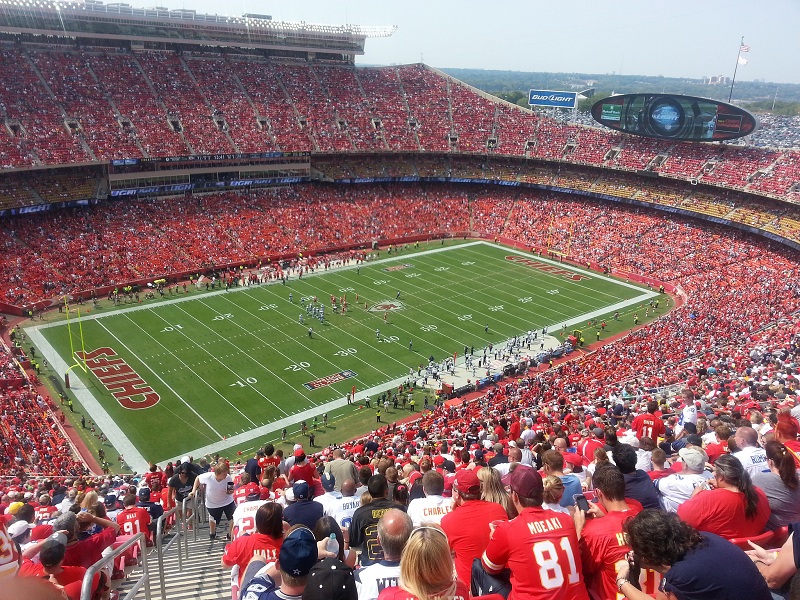
While its location is a point of logistical interest, the physical structure of GEHA Field at Arrowhead Stadium is what makes it a world-renowned landmark. Completed in 1972, the stadium was designed to provide every spectator with an unobstructed view of the field. This was achieved through a groundbreaking “bowl” design that has influenced countless other stadiums across the globe.
Lamar Hunt’s Vision for Modern Stadiums
The stadium exists because of the vision of Lamar Hunt, the founder of the Kansas City Chiefs and a pioneer in professional football. Lamar Hunt wanted a venue that felt intimate despite its massive capacity. He worked closely with architect Charles Deaton and the firm Kivett & Myers to create a design that emphasized sightlines and fan experience.
The architecture is characterized by its curving, sweeping lines and the lack of traditional supporting pillars that often blocked views in older venues like Soldier Field or Lambeau Field. This focus on the fan’s perspective has helped the stadium remain relevant and beloved for over five decades. It is widely considered one of the most beautiful examples of mid-century modern sports architecture in the United States.
Renovations and Modern Amenities
In 2010, the stadium underwent a massive $375 million renovation to modernize the facility while preserving its historic bowl shape. This renovation added the Horizon Level seating, expanded the concourses, and introduced high-tech scoreboards. Despite these updates, the landmark has maintained its classic feel. The naming rights were later updated to GEHA Field at Arrowhead Stadium, reflecting a partnership with Government Employees Health Association, though fans still affectionately call it Arrowhead Stadium.
The architectural integrity of the site is further enhanced by the Hall of Honor, a museum-like space within the stadium that showcases the history of the AFL and the NFL. This makes the stadium a landmark not just for sports, but for the history of American popular culture.

The Historical Evolution of a Football Landmark
The history of where the Kansas City Chiefs play is intertwined with the evolution of the city itself. Before moving to the Truman Sports Complex, the team played at Municipal Stadium in Kansas City. The transition to the current location marked a new era of professional sports in Missouri.
Iconic Moments in Stadium History
Since its opening, the stadium has been the site of legendary games, including numerous AFC Championship matches. Its location has become synonymous with the “home-field advantage,” a reputation built over decades of loud, passionate crowds. The stadium has also hosted international events, including FIFA World Cup qualifying matches and major concerts featuring artists like The Rolling Stones and Taylor Swift.
In 2026, the landmark will reach a new level of global recognition as it serves as a host venue for the FIFA World Cup 2026. This selection by FIFA highlights the stadium’s world-class status and the efficiency of the Kansas City infrastructure. Being chosen as a site for the world’s biggest sporting event solidifies its place as a premier landmark of the United States.
The Loudest Stadium Record
One of the most defining characteristics of this landmark is the noise level generated by its fans. In 2014, the stadium officially broke the Guinness World Record for the loudest crowd roar at an outdoor sports stadium, reaching a staggering 142.2 decibels. This acoustic phenomenon is partially attributed to the stadium’s design, which reflects sound back toward the field, and the unwavering energy of the Chiefs Kingdom. This record is a point of pride for the local community and adds a layer of intangible value to the physical location.
Exploring the Surrounding Area and Nearby Landmarks
While the Kansas City Chiefs stadium is the primary draw in the eastern part of the city, its location offers easy access to other significant Missouri attractions. Visitors often combine a trip to the stadium with other local cultural experiences.
Proximity to Kauffman Stadium
As mentioned, the stadium is just a short walk across the parking lot from Kauffman Stadium. This makes the area a rare double-landmark destination. Known for its iconic water fountains and outward-facing scoreboards, Kauffman Stadium is often cited as one of the most beautiful ballparks in Major League Baseball. Seeing these two massive structures side-by-side provides a unique perspective on the scale of American sports architecture.
Cultural Impact on the Kansas City Community
The stadium’s location has sparked development and cultural identity in Kansas City. Beyond the games, the area is known for its world-class barbecue, with famous spots like Arthur Bryant’s Barbeque and Gates Bar-B-Q located just a few miles away. The stadium is not just a place to watch football; it is the center of a cultural ecosystem that celebrates the traditions of the Midwest.
For those looking to explore more of the city, a short drive west takes you to the Power and Light District, a vibrant entertainment hub, or the Country Club Plaza, an outdoor shopping district known for its Spanish architecture and beautiful fountains. The stadium acts as an anchor for the region, drawing people into the rich tapestry of Missouri life.
Planning a Visit to This American Sports Icon
If you are planning to visit GEHA Field at Arrowhead Stadium, there are several things to keep in mind regarding its location and logistics. Because the stadium is situated within a dedicated sports complex, it is surrounded by vast parking lots rather than a walkable downtown neighborhood.
Visitors should plan for transportation accordingly. While there are some shuttle services and rideshare options, the majority of fans arrive by car to participate in the legendary tailgating. If you are staying in Downtown Kansas City or near the Kansas City International Airport, it is wise to allow extra travel time on game days, as the traffic along I-70 can become quite heavy.
For those interested in the architecture and history without the game-day crowds, the stadium offers guided tours. These tours provide behind-the-scenes access to the locker rooms, the press box, and the field itself. It is a fantastic way to appreciate the landmark’s design and learn more about its 50-year history in Kansas City.
In conclusion, the Kansas City Chiefs stadium is located at the Truman Sports Complex in Kansas City, Missouri. Its strategic placement at the crossroads of major interstates, its revolutionary architectural design, and its deep-seated historical significance make it a premier landmark of the United States. Whether you are there to hear the record-breaking roar of the crowd or to admire the mid-century engineering, a visit to this iconic venue is an essential experience for any traveler exploring the Midwest.
LifeOutOfTheBox is a participant in the Amazon Services LLC Associates Program, an affiliate advertising program designed to provide a means for sites to earn advertising fees by advertising and linking to Amazon.com. Amazon, the Amazon logo, AmazonSupply, and the AmazonSupply logo are trademarks of Amazon.com, Inc. or its affiliates. As an Amazon Associate we earn affiliate commissions from qualifying purchases.