
Navigating the gateway to the bustling metropolis of New York City can be a crucial first step for any traveler. Understanding which of the major airports serving the region is geographically closest, and therefore potentially most convenient, is a common point of inquiry. While several airports are associated with New York City, the primary contenders for this title are LaGuardia Airport (LGA), John F. Kennedy International Airport (JFK), and Newark Liberty International Airport (EWR), which, despite being in New Jersey, is an integral part of the New York City metropolitan area. This exploration delves into the proximity, accessibility, and practical considerations of each, guiding travelers towards the most efficient entry point for their New York City adventures.

Understanding Proximity: Defining “Closest”
The concept of “closest” to New York City can be interpreted in several ways, primarily concerning geographical distance and travel time to key areas within the city, such as Midtown Manhattan. While LaGuardia Airport might appear closest on a map to parts of Queens and Upper Manhattan, actual travel time can be heavily influenced by traffic, the mode of transport, and the specific destination within the city.
Geographical Distance vs. Travel Time
Geographically, LaGuardia Airport, located in the borough of Queens, is often considered the closest to Midtown Manhattan. It’s situated on the north shore of Long Island, a mere stone’s throw from parts of Queens and a relatively short distance across the East River to Manhattan.
However, in the context of air travel, “closest” often translates to the quickest journey into the heart of the city. This is where the nuances of traffic congestion, public transportation networks, and the infrastructure connecting each airport become paramount. A geographically closer airport might not always be the fastest to reach due to its lack of efficient public transit links or its susceptibility to severe road delays.
Key Areas of New York City
When discussing proximity, it’s essential to consider the primary points of interest for travelers. For most international and domestic visitors, Midtown Manhattan, with its iconic landmarks like Times Square, Central Park, and numerous hotels and business districts, serves as a central reference point. Other important areas include Downtown Manhattan, with its financial centers and historic sites, and Brooklyn and Queens themselves, which are increasingly popular destinations.
The Contenders: LaGuardia Airport, JFK Airport, and Newark Liberty Airport
Each of the three major airports offers a unique set of advantages and disadvantages regarding proximity and accessibility to New York City.
LaGuardia Airport (LGA): The Urban Neighbor
LaGuardia Airport, nestled within Queens, boasts the shortest geographical distance to Midtown Manhattan. This proximity makes it an attractive option for domestic travelers, particularly those on short trips or business travelers seeking to minimize transit time.
Accessibility and Transit Options
- By Taxi/Rideshare: In ideal traffic conditions, a taxi or rideshare service from LaGuardia Airport to Midtown Manhattan can take as little as 20-30 minutes. However, during peak hours, this journey can easily extend to an hour or more, negating the initial proximity advantage. The cost of this option can also be significant.
- By Public Transportation: LaGuardia Airport has historically been less connected to the subway system compared to JFK Airport. However, recent improvements, including the LaGuardia Gateway Project, have enhanced its connectivity. Travelers can utilize the Q70 LaGuardia Link bus, which is free and connects directly to the Jackson Heights-Roosevelt Avenue subway station, providing access to the E, F, M, and R trains. This is often the most cost-effective way to reach Manhattan, though it involves a transfer and can take 45-60 minutes depending on the final destination. AirTrain service connecting to the subway is also planned as part of ongoing renovations.
- Shuttle Services: Various private shuttle services operate between LaGuardia Airport and hotels in Manhattan, offering a middle ground in terms of cost and convenience.
Advantages
- Closest geographically to Midtown Manhattan.
- Often preferred for domestic flights due to its location.
- Ongoing modernization efforts are improving passenger experience and transit links.
Disadvantages
- Historically, it has had the weakest direct subway connectivity among the three.
- Highly susceptible to traffic delays, especially during rush hours.
- Primarily serves domestic flights, limiting options for international travelers.
John F. Kennedy International Airport (JFK): The Global Gateway
John F. Kennedy International Airport, also located in Queens, is the largest and busiest international airport in the New York City metropolitan area. While slightly further from Midtown Manhattan than LaGuardia Airport, its superior public transportation infrastructure often makes it a more reliable and faster option for reaching the city center.
Accessibility and Transit Options
- By Taxi/Rideshare: The drive from JFK Airport to Midtown Manhattan typically takes 30-60 minutes in light traffic. Similar to LGA, this time can significantly increase during periods of heavy congestion. The taxi fare is a flat rate to Manhattan.
- By Public Transportation (The Most Recommended Option): The AirTrain JFK is the cornerstone of JFK’s public transit system. It provides a seamless connection to the New York City Subway system at Jamaica Station (for the E, J, and Z trains) and Howard Beach Station (for the A train). The AirTrain journey itself takes about 10-15 minutes to connect to the subway. From Jamaica Station, the E train offers a direct and relatively quick route to Midtown Manhattan, typically taking around 30-40 minutes. This combined AirTrain-subway journey is often the most efficient and cost-effective way to reach Manhattan, especially during peak traffic hours.
- Long Island Rail Road (LIRR): For those heading to Penn Station or Grand Central Terminal, the AirTrain also connects to the Long Island Rail Road at Jamaica Station. This offers a faster, albeit more expensive, route to these major transit hubs.
Advantages
- Excellent public transportation connectivity via the AirTrain JFK and the New York City Subway.
- The most reliable option for reaching Manhattan quickly, especially during peak traffic.
- Serves as the primary hub for international travel to New York City.
- A wide array of dining and retail options across its terminals.
Disadvantages
- Geographically slightly further from Midtown Manhattan than LGA.
- Can be more expensive than LGA for certain ground transportation options.
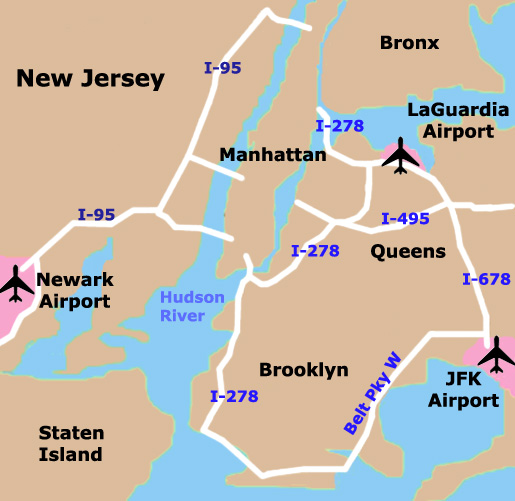
Newark Liberty International Airport (EWR): The New Jersey Neighbor
Newark Liberty International Airport (EWR), located in Newark, New Jersey, is the third major airport serving the New York City area. While not physically within New York City limits, its extensive transit links make it a viable option for many travelers heading to Manhattan.
Accessibility and Transit Options
- By Taxi/Rideshare: Travel time from EWR to Midtown Manhattan can range from 45 minutes to over an hour, heavily dependent on traffic conditions and the specific route taken. This option is generally more expensive than from LGA or JFK.
- By Public Transportation (The Most Recommended Option): The AirTrain Newark system connects passengers to the New Jersey Transit (NJ Transit) and Amtrak rail lines at Newark Liberty International Airport Station. From this station, NJ Transit provides frequent service to New York Penn Station in Midtown Manhattan. This train journey typically takes about 30-40 minutes and is often the most efficient and reliable way to reach the city, especially compared to driving. Amtrak offers a slightly faster but more expensive service to Penn Station.
Advantages
- Offers a viable public transportation alternative to Manhattan via NJ Transit.
- Often has competitive airfares, making it an attractive option for budget-conscious travelers.
- A significant number of airlines operate from EWR, offering diverse flight choices.
Disadvantages
- Geographically the furthest from the core of New York City.
- Requires a transfer to the AirTrain and then a train to reach Manhattan.
- The perception of being outside New York City can deter some travelers.
The Verdict: Which Airport is Truly Closest?
When evaluating “closest” based on a combination of geographical distance and, more importantly, efficient travel time to Midtown Manhattan, the answer becomes nuanced.
For Speed and Reliability (Public Transit Focused):
John F. Kennedy International Airport often emerges as the most practical choice for many travelers aiming for Midtown Manhattan. The well-established AirTrain JFK-subway network provides a consistent and relatively swift journey, largely unaffected by road traffic.
For Direct Proximity (Under Ideal Conditions):
LaGuardia Airport is geographically the closest. If your destination is in Upper Manhattan or parts of Queens very close to the airport, and you are traveling during off-peak hours, a taxi or rideshare might be the quickest. However, the unpredictable nature of New York City traffic makes this a less reliable strategy for many.
For Alternative Connectivity and Potential Savings:
Newark Liberty International Airport offers a solid public transit connection to Midtown via NJ Transit, making it a competitive option, particularly if flight prices are more favorable.
Practical Considerations for Travelers
Beyond sheer proximity, several other factors should influence your choice of airport when traveling to or from New York City:
Flight Availability and Airlines
Your airline of choice and the specific routes you need to take will often dictate which airport you fly into or out of. JFK Airport is the primary hub for international carriers, while LGA is heavily used by domestic airlines like American Airlines, Delta Air Lines, and United Airlines for their shuttle services and short-haul flights. EWR also hosts a wide range of domestic and international airlines.
Cost of Transportation
The price of taxis, rideshares, and public transport tickets can vary significantly between airports and your final destination. While LGA might offer a slightly cheaper taxi ride in theory, the potential for extended travel times due to traffic can make the AirTrain-subway combination from JFK or the AirTrain-NJ Transit route from EWR more predictable and often more economical when time is factored in.
Terminal Amenities and Passenger Experience
Each airport and its terminals offer different amenities, including restaurants, shops, lounges, and Wi-Fi services. Modernized terminals at JFK and ongoing renovations at LGA aim to enhance the passenger experience. EWR’s terminals also provide a range of services, though some may feel less updated than others.

Type of Travel
- International Travelers: JFK Airport is almost always the primary gateway.
- Domestic Travelers: LGA is often preferred for its proximity, especially for flights within the US. However, the efficiency of JFK’s public transit makes it a strong contender even for domestic trips.
- Budget Travelers: Comparing airfares and ground transportation costs across all three airports is crucial. EWR can sometimes offer significant savings on flights.
- Business Travelers: Time is often of the essence. For those heading to Midtown, the reliable public transit from JFK or EWR might outweigh the marginal geographical advantage of LGA given the traffic uncertainties.
In conclusion, while LaGuardia Airport holds the title for closest geographical proximity to Midtown Manhattan, the practical realities of New York City travel, particularly traffic and public transportation efficiency, often make John F. Kennedy International Airport and Newark Liberty International Airport equally, if not more, convenient for many travelers. The “closest” airport is ultimately the one that best suits your individual travel needs, priorities, and specific destination within the vast and dynamic landscape of New York City.
LifeOutOfTheBox is a participant in the Amazon Services LLC Associates Program, an affiliate advertising program designed to provide a means for sites to earn advertising fees by advertising and linking to Amazon.com. Amazon, the Amazon logo, AmazonSupply, and the AmazonSupply logo are trademarks of Amazon.com, Inc. or its affiliates. As an Amazon Associate we earn affiliate commissions from qualifying purchases.