
The question of “Who bets first in Texas Hold’em?” is fundamental to understanding the dynamics of the game, influencing strategy, and ultimately, a player’s success. While seemingly straightforward, the answer involves a clear protocol dictated by position at the table. This protocol is not arbitrary; it’s a carefully constructed system designed to ensure fairness and create a strategic landscape where players must adapt their decisions based on their proximity to the button. Understanding this betting order is the bedrock upon which all Texas Hold’em play is built, from casual home games to the high-stakes arenas of professional tournaments.
The Mechanics of Betting Order
In Texas Hold’em, the act of betting is sequential, moving clockwise around the table. This systematic progression ensures that each player has an opportunity to act and that no player is at a perpetual disadvantage due to information. The critical factor determining who acts first is the player’s position relative to the dealer button.
The Dealer Button and its Significance
The dealer button, a disc placed in front of one player each hand, signifies the theoretical dealer for that round. While a designated dealer might be present, the button rotates clockwise after each hand, ensuring that every player gets a turn to be in the “dealer” position. The importance of the button cannot be overstated, as it dictates the end of the betting round. All players to the left of the button must act before the button player. This “in position” advantage is a cornerstone of Texas Hold’em strategy.
Blinds: The Forced Bets
Before any cards are dealt, two players are compelled to make forced bets known as “blinds.” These initial bets serve to create a pot and incentivize action. The player immediately to the left of the dealer button posts the “small blind” (SB), and the player to the left of the small blind posts the “big blind” (BB). The big blind is typically twice the size of the small blind. These blinds are the first “bets” of the hand, establishing a starting point for the pot before any voluntary betting occurs.
The Small Blind and Big Blind: First Act of Betting
Therefore, in terms of actual forced action at the very beginning of a hand, the player in the small blind is the first to contribute chips to the pot. Following them, the player in the big blind is the next to commit chips. These positions are crucial because they are the first players to act in the pre-flop betting round. Their decisions are made with the least information, as they are acting before any other players have had a chance to declare their intentions.
Pre-Flop Betting: Beyond the Blinds
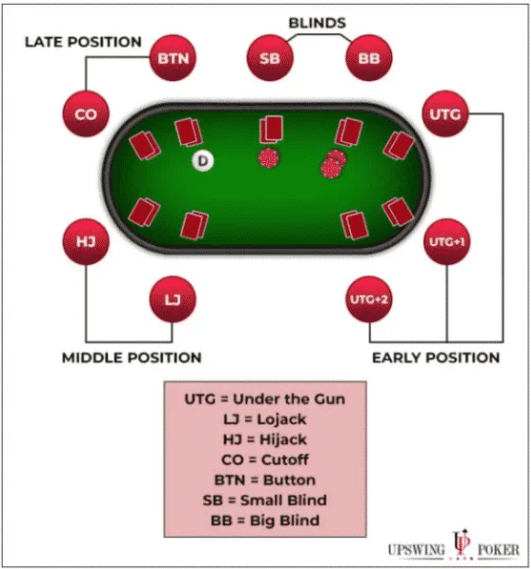
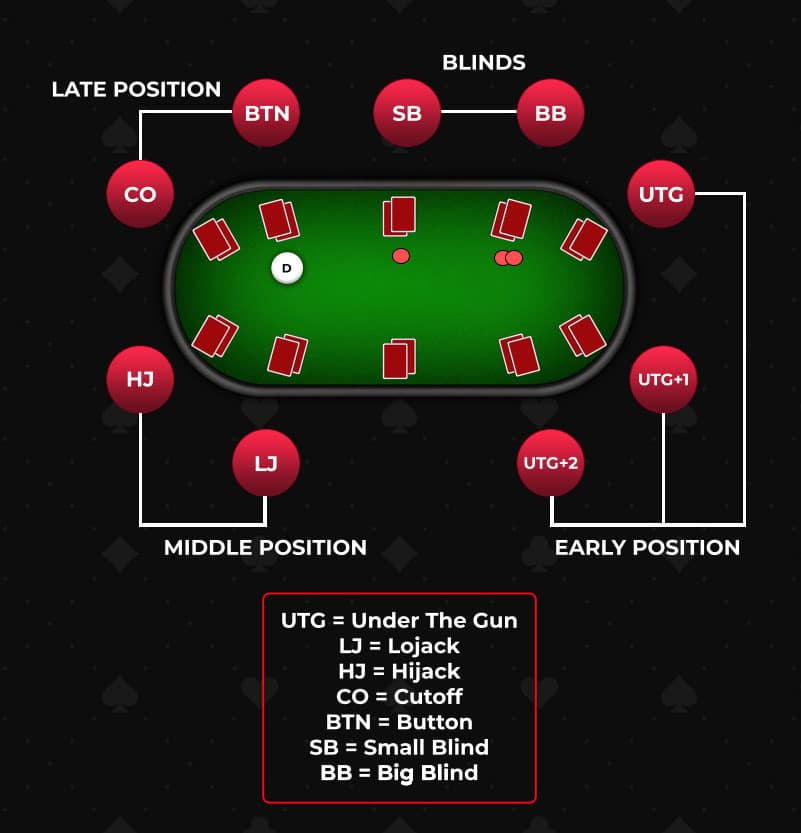
Once the small and big blinds have been posted, the action continues clockwise. The player immediately to the left of the big blind is the first player to have the option to voluntarily enter the pot. This player is known as the “under the gun” (UTG) player. They have the choice to:
- Fold: Discard their hand and forfeit any chance to win the pot.
- Call: Match the amount of the big blind.
- Raise: Increase the bet beyond the big blind.
This UTG position is considered the “earliest position” for voluntary betting. The players to their left then act in turn, moving closer to the button. Each subsequent player must at least call the highest bet made so far, or raise, or fold.
Post-Flop Betting Rounds
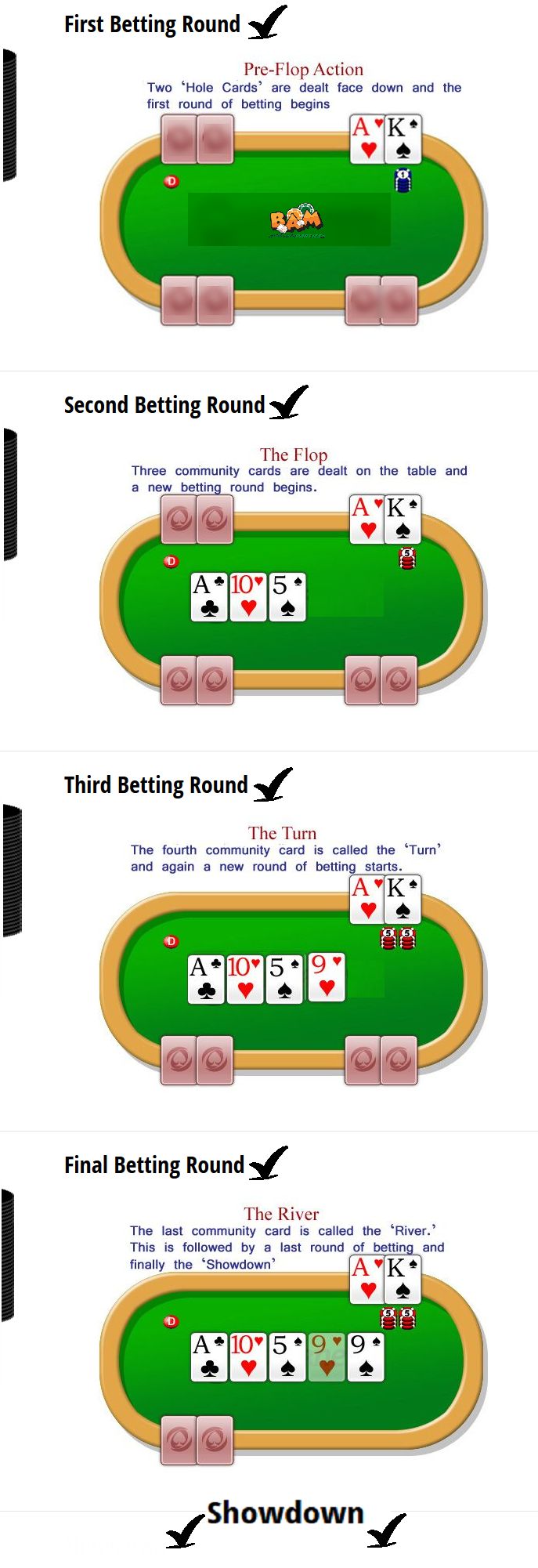
The betting order remains consistent throughout all subsequent betting rounds: the flop (the first three community cards), the turn (the fourth community card), and the river (the fifth and final community card). In each of these rounds, the player closest to the left of the dealer button who is still active in the hand will be the first to act.
If the dealer button is in play, and the betting round begins with the player to the left of the button (in the small blind, for example), that player will initiate the betting. The action then proceeds clockwise around the table. The critical distinction in post-flop betting is that the first player to act might not be the blinds anymore. Instead, it will be the player closest to the button in clockwise order who has not folded.
If all players to the left of the button fold before reaching the player on the button, the player on the button has the opportunity to check (if no bet has been made) or bet. The button player, being the last to act in any betting round, holds a significant strategic advantage due to the wealth of information they gather from the actions of all preceding players.
Strategic Implications of Betting Order
The sequence in which players bet is not merely a procedural formality; it is a fundamental element that profoundly shapes strategic decision-making in Texas Hold’em. Understanding the implications of acting early versus acting late is paramount for any player aiming to improve their game.
The Disadvantage of Early Position
Players acting in early positions, such as the small blind, big blind, and under the gun, face the greatest strategic challenges. They are forced to make decisions with the least information.
- Limited Information: When it’s your turn to act, you have no knowledge of how your opponents intend to play their hands. They could be strong, weak, bluffing, or waiting to trap you. This uncertainty makes it difficult to accurately assess the strength of your own hand relative to potential opponent holdings.
- Vulnerability to Raises: An early position player who chooses to raise often signals a strong hand. This can deter later position players from continuing in the hand. Conversely, if an early position player calls, it can be difficult to interpret their hand strength, as they could be playing a wide range of hands.
- Post-flop Challenges: Playing in early position post-flop is particularly difficult. If you bet and are called, you still have multiple players to act behind you on subsequent streets, increasing the risk of encountering a stronger hand or a well-timed check-raise.
The Advantage of Late Position
Conversely, players acting in late positions, especially the button, enjoy significant strategic advantages.
- Information is Power: As the betting progresses around the table, players in late positions have the opportunity to observe the actions of all players who acted before them. They can see who folded, who called, and who raised, providing valuable clues about their opponents’ hand strengths and intentions.
- Pot Control: With more information, late position players can more effectively control the size of the pot. They can choose to bet aggressively to build a pot when they have a strong hand or to bluff, or they can play more passively to keep the pot small when their hand is marginal.
- Bluffing Opportunities: The ability to act last in a betting round makes bluffing more effective. A late position player can observe the actions of others and decide to bet, knowing that no one can re-raise them unless they are the absolute last active player and choose to check. This allows for more daring bluffs that can win pots without the best hand.
- Strategic Flexibility: Late position players have more flexibility in their play. They can be more selective with their starting hands, knowing they have a better chance to play them profitably post-flop. They can also exploit the tendencies of players in earlier positions.
Middle Position Play
Players in middle positions find themselves in a transitional zone. They have some positional advantage over the early players but are still at a disadvantage compared to the players on the button. Their strategy often involves a balance between playing aggressively with strong hands and cautiously with marginal hands. They must be keenly aware of how many players are still to act behind them and adjust their play accordingly.
Beyond the Button: Advanced Considerations
While the dealer button is the ultimate arbiter of betting order, other factors and nuances can influence who bets first or how the betting unfolds. These considerations add further layers of strategy and complexity to the game.
Limping and Overlimping
A “limp” occurs when a player, instead of raising, simply calls the big blind. “Overlimping” is when a player calls the big blind after one or more players have already limped. This strategy is often employed by players in later positions who have a moderately strong hand and want to see the flop cheaply, or by players hoping to trap opponents. While it doesn’t change the fundamental betting order, it can influence the size of the pot and the number of players who see the flop, indirectly affecting subsequent betting rounds.
Check-Raising
The check-raise is a powerful tactic that is made possible by the structure of betting rounds. A player in an early position might choose to “check” (declare no bet) when it’s their turn, even if they have a strong hand. This is often done to induce a bet from an opponent. When an opponent then bets, the original checker can then “raise,” significantly increasing the bet. This move is most effective when performed by players in later positions who have observed the actions of earlier players.
The Dynamics of Multi-Way Pots
When multiple players enter a pot (a “multi-way pot”), the betting dynamics can become more complex. In such scenarios, the strength of a hand can change significantly, and the information gained from observing opponents becomes even more critical. A hand that might be a clear winner in a heads-up pot (against a single opponent) could be vulnerable in a multi-way pot where several players are likely to have connected with the board in some way. The betting order remains the same, but the interpretation of bets and raises needs to be adjusted for the increased number of active players.
Aggression and Initiative
The player who makes the first voluntary bet in a betting round (or the last player to raise) is said to have the “initiative.” This initiative often carries psychological weight and can allow that player to dictate the pace of the hand. In late position, players can often seize initiative by betting aggressively, even with a hand that might not be statistically the strongest, knowing they can bluff opponents out of the pot. Conversely, players in early position often find themselves reacting to the aggression of others, making it harder to maintain initiative.
Ultimately, the question of “Who bets first in Texas Hold’em?” is answered by the immutable rules of position and the dealer button. However, the strategic implications of this order are vast, providing a fertile ground for skilled players to exploit advantages, mitigate disadvantages, and navigate the intricate dance of betting, raising, and folding. Mastering the art of playing within and against the betting order is a hallmark of successful Texas Hold’em play.
LifeOutOfTheBox is a participant in the Amazon Services LLC Associates Program, an affiliate advertising program designed to provide a means for sites to earn advertising fees by advertising and linking to Amazon.com. Amazon, the Amazon logo, AmazonSupply, and the AmazonSupply logo are trademarks of Amazon.com, Inc. or its affiliates. As an Amazon Associate we earn affiliate commissions from qualifying purchases.