
The iconic Solomon R. Guggenheim Museum stands as a beacon of modern architecture and a testament to visionary design, gracing the prestigious Fifth Avenue in New York City. Its distinctive, spiraling form is instantly recognizable, drawing art lovers and architecture enthusiasts from around the globe. But the question of who conceived this masterpiece is central to understanding its enduring legacy. The answer, surprisingly, is not as straightforward as one might initially assume, involving a renowned architect whose original vision underwent significant evolution.
The Visionary Architect: Frank Lloyd Wright’s Genesis
The primary architect credited with the design of the Guggenheim Museum is the legendary Frank Lloyd Wright. His appointment to the project in the late 1940s marked the beginning of a challenging yet ultimately triumphant creative journey. Solomon R. Guggenheim, the wealthy industrialist and art collector, had a clear ambition: to create a building that would serve as a unique showcase for his burgeoning collection of Impressionist, Post-Impressionist, and early Modern art. He envisioned a space unlike any other museum, one that would allow visitors to experience art in a continuous, flowing environment, fostering a deeper engagement with the works on display.
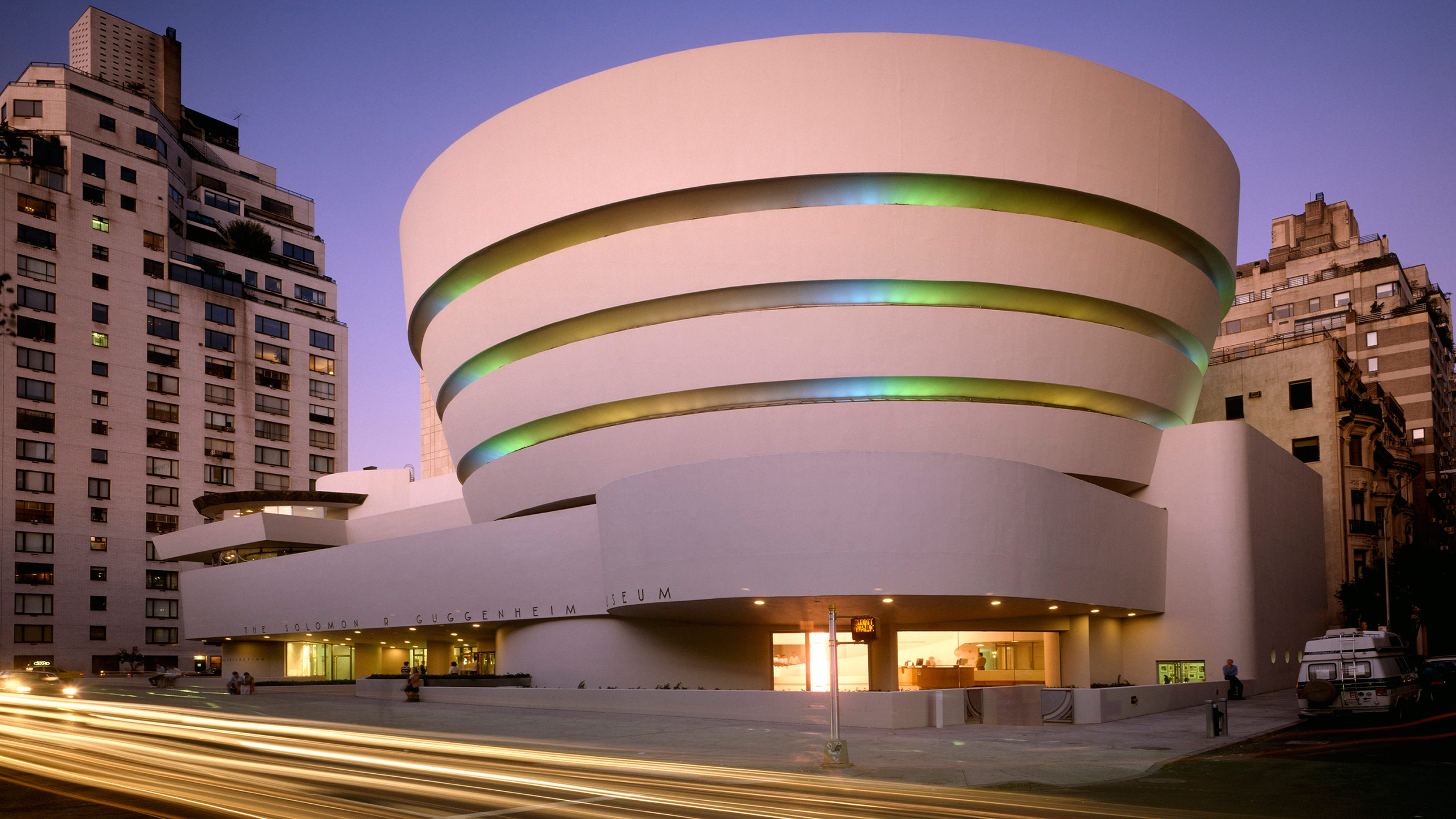
Wright, already a towering figure in architectural history with a philosophy deeply rooted in organic architecture and harmony with nature, was immediately captivated by Guggenheim‘s ambitious brief. His design concept was radical for its time, and even today, it stands apart from traditional museum structures. Instead of a series of discrete rooms, Wright proposed a continuous ramp that would spiral upwards from the ground floor to the very top of the building. This iconic ramp, or “great chain of being” as some have described it, was intended to guide visitors on a journey through art, with the artwork displayed on the exterior walls of the spiral.
A Revolutionary Design Concept
Wright‘s original sketches and models revealed a building that was not merely a container for art but an active participant in the viewing experience. He famously envisioned visitors arriving by automobile, entering a grand rotunda, and then ascending via an elevator to the top of the spiral. From there, they would leisurely descend the gently sloping ramp, encountering artworks on the curved walls as they made their way down. The central void of the rotunda was designed to be illuminated by natural light filtering down from a vast, illuminated dome, creating a serene and uplifting atmosphere.
The interior was conceived as a fluid, uninterrupted space, allowing the architecture itself to guide the viewer’s perception of the art. This departure from the conventional box-like galleries of other museums was a hallmark of Wright‘s innovative approach. He believed that the building and its contents should be in dialogue, each enhancing the other. The smooth, continuous curves of the exterior were meant to echo the organic forms found in nature, a philosophy that permeated much of Wright‘s work. He sought to create a building that felt alive, a sculpture in itself that would complement the artistic treasures it housed.

The Long and Complex Construction Process
The path from Wright‘s initial sketches to the completed museum was far from smooth. The project, commissioned in 1943, faced numerous delays and significant challenges. Solomon R. Guggenheim died in 1949, before construction could begin, and the project was then taken over by his niece, Hilla Rebay, who continued to champion Wright‘s vision. However, securing the necessary permits and funding proved to be a protracted and arduous process. The site on Fifth Avenue, overlooking Central Park, presented its own set of architectural and urban planning hurdles.
The design itself was met with both admiration and skepticism. Some praised its daring originality, while others questioned its practicality as a museum space. The continuous ramp, for instance, meant that artworks were displayed on a sloping surface, which some curators and art handlers found problematic for optimal viewing and preservation. The challenges of lighting and climate control within such an open, unconventional structure also required innovative solutions.
Construction finally began in 1953, but the building was not completed until shortly after Wright‘s death in 1959. His son, David Wright, and architect William Wesley Peters, who worked closely with Wright on the project, oversaw the final stages of construction, ensuring that the museum adhered as closely as possible to the original design. The dedication of the Guggenheim Museum on October 21, 1959, was a momentous occasion, solidifying Frank Lloyd Wright‘s place in architectural history and providing New York City with one of its most beloved and enduring landmarks.
Evolution and Additions: Beyond Wright’s Original Vision
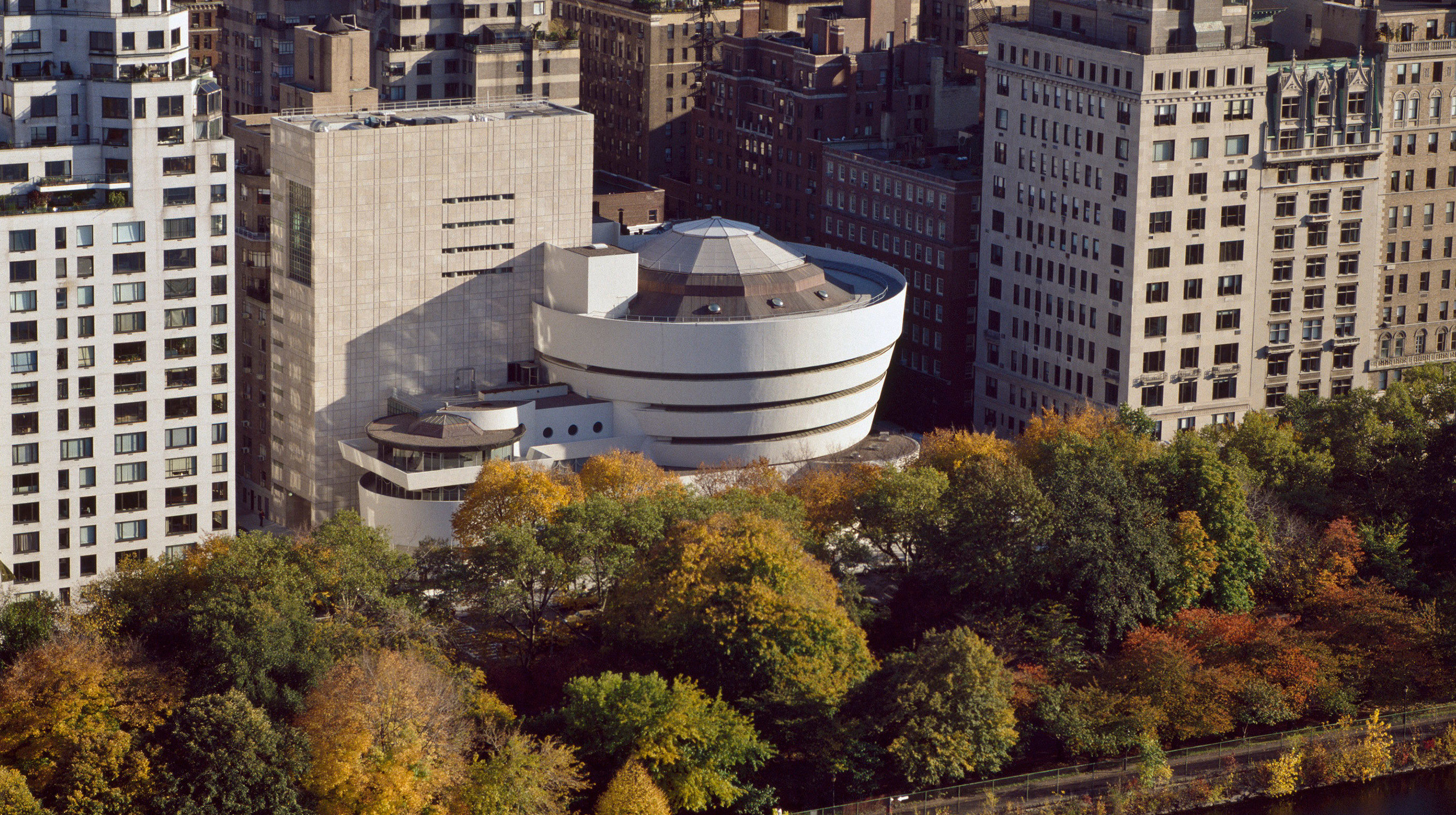
While Frank Lloyd Wright is unequivocally the principal designer, the Guggenheim Museum has seen modifications and additions over the decades that have shaped its current form and functionality. The most significant of these is the Guggenheim‘s Annex, designed by Gwathmey Siegel & Associates Architects and completed in 1992. This addition, located behind the original building, was designed to address some of the functional limitations of Wright‘s original structure, providing much-needed gallery space, administrative offices, and educational facilities.
The Gwathmey Siegel addition, while a departure from Wright‘s iconic rotunda, was designed to be sympathetic to the original building’s aesthetic. It features a rectangular tower clad in a pale limestone, intended to complement the creamy concrete of Wright‘s rotunda. The integration of the new and old structures aimed to expand the museum’s capacity and improve its operational efficiency without detracting from the impact of Wright‘s masterpiece.
The Guggenheim Museum continues to evolve, adapting to the changing needs of a major art institution while striving to preserve the integrity of Frank Lloyd Wright‘s groundbreaking design. Its unique architecture, coupled with its world-class art collection, makes it an indispensable destination for anyone visiting New York City, offering an experience that is as much about the art of building as it is about the art of viewing. It stands as a powerful symbol of innovation, artistic expression, and the enduring impact of a singular architectural vision.
LifeOutOfTheBox is a participant in the Amazon Services LLC Associates Program, an affiliate advertising program designed to provide a means for sites to earn advertising fees by advertising and linking to Amazon.com. Amazon, the Amazon logo, AmazonSupply, and the AmazonSupply logo are trademarks of Amazon.com, Inc. or its affiliates. As an Amazon Associate we earn affiliate commissions from qualifying purchases.