
The establishment of Colonial Connecticut represents a pivotal chapter in early American history, a story rich with religious dissent, political innovation, and the relentless pursuit of new opportunities. Unlike some of its sister colonies founded primarily for economic gain or as havens for specific religious groups, Connecticut’s origins are multifaceted, born from a unique confluence of these motivations. Understanding its founding principles provides invaluable insight into the character of the early American settlers and the lasting legacy evident in the state’s historical landmarks today. From its distinct governance to its strategic location, Connecticut emerged as a beacon of self-determination and structured liberty, shaping the future of the nation.

The Quest for Religious and Political Freedom
One of the primary drivers for the founding of Colonial Connecticut stemmed from a desire for greater religious and political autonomy, particularly among Puritan settlers who felt stifled even within the nascent Massachusetts Bay Colony. While the Pilgrims of Plymouth sought complete separation from the Church of England, the Puritans aimed to “purify” it from within. However, even within their new settlement, disagreements arose, pushing some to seek new frontiers.
Dissatisfaction with Massachusetts Bay’s Theocracy
The Massachusetts Bay Colony, established in 1630, rapidly grew into a thriving Puritan commonwealth. However, its leaders, particularly Governor John Winthrop, envisioned a “city upon a hill” – a strict theocracy where religious doctrine heavily influenced civil law. This centralized authority and limited suffrage, which often restricted voting rights to male church members, created friction. Many within the Massachusetts Bay Colony felt that their spiritual leaders had become too authoritarian, mirroring the very rigidities they had sought to escape in England.
Prominent among those who sought a new path was Reverend Thomas Hooker, a charismatic Puritan minister from Newtown (modern-day Cambridge, Massachusetts). Hooker argued for a more democratic system, believing that government should be based on the consent of the governed, not merely the elite few. He famously preached in 1638 that “the foundation of authority is laid in the free consent of the people.” This radical idea for its time laid the ideological groundwork for the future Connecticut Colony and set it apart from its more autocratic neighbors.
The Great Migration to the Connecticut River Valley
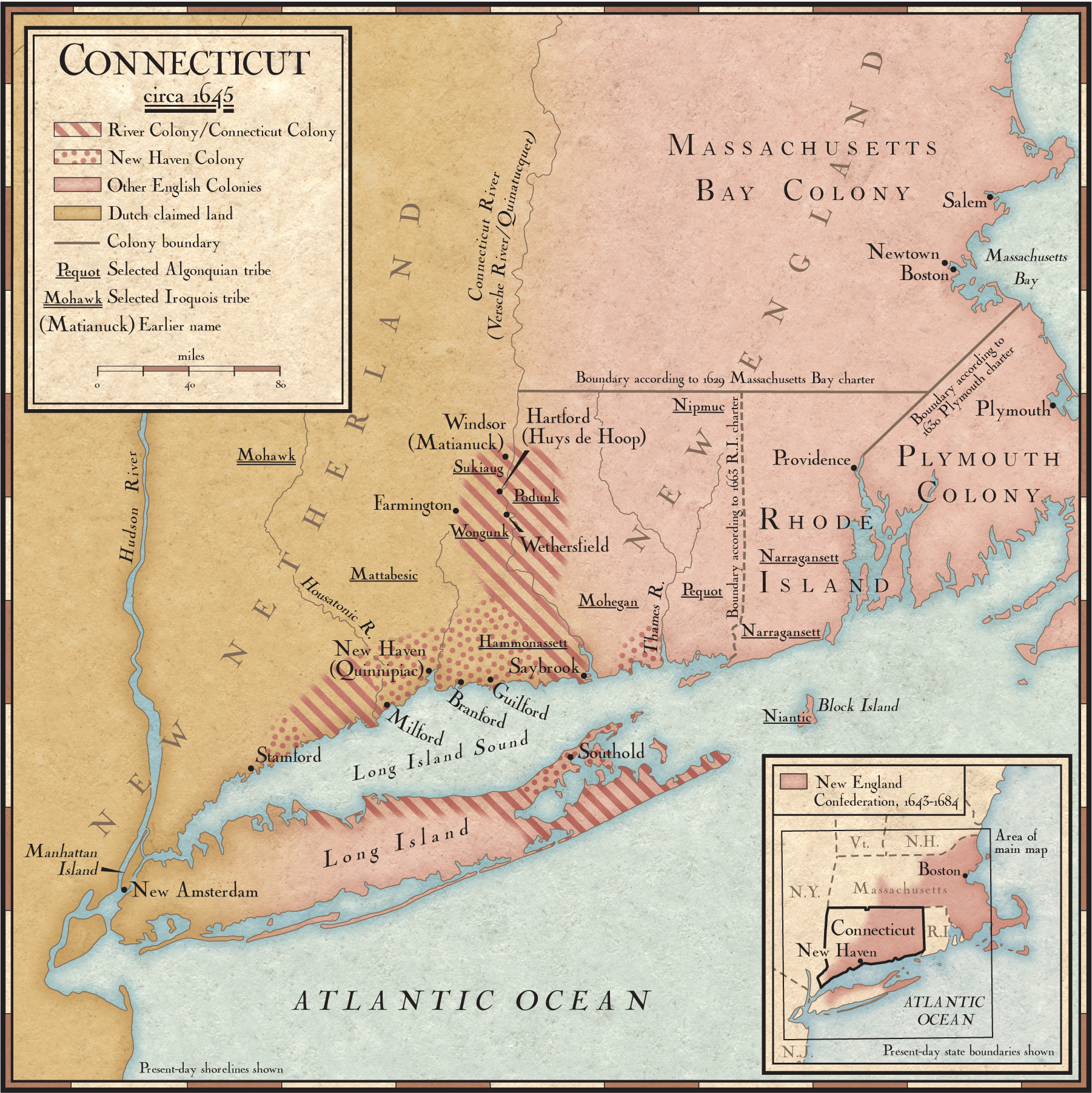
Beginning in 1636, Reverend Thomas Hooker led his congregation, numbering about 100 people and 160 cattle, on an arduous overland journey from Newtown southwest to the fertile Connecticut River Valley. They settled in an area they named Hartford. This migration was not an isolated event; other groups, under leaders like John Warham and Roger Ludlow, had already established towns such as Windsor (1633) and Wethersfield (1634) in the same region, primarily driven by the promise of rich agricultural land and access to trade routes. These independent settlements eventually coalesced to form the core of the Connecticut Colony.
Economic Prosperity and Strategic Advantage
Beyond ideological motivations, the allure of economic opportunity played a significant role in drawing settlers to the Connecticut River Valley. The region presented a compelling combination of fertile soil, navigable waterways, and a strategic location that promised both agricultural abundance and robust trade.
The Fertile Connecticut River Valley
The Connecticut River itself was a natural highway, facilitating transportation and communication. The valley’s rich alluvial soil, deposited over millennia by the river’s floods, was vastly superior to the rockier terrain found in many parts of Massachusetts. This fertility promised bountiful harvests of staple crops such as corn, wheat, and tobacco, critical for sustaining growing communities and generating surplus for trade. Farmers could envision a more prosperous future, less reliant on the vagaries of the land.
The river also provided a direct route to the sea, offering convenient access for trade with other colonies and England. This access was crucial for importing manufactured goods and exporting raw materials, positioning Connecticut as a vital commercial hub in the burgeoning colonial economy.

Defense and Expansion in a Contested Territory
The Connecticut River Valley was not uninhabited when the English arrived. Various Native American tribes, including the Pequot, Mohegan, and Narragansett, had lived there for centuries. The Dutch also claimed parts of the territory, having established a trading post, Fort Goed Hoop, near present-day Hartford. The English settlers viewed the land as strategically important, both for its resources and for establishing a buffer against French, Dutch, and even rival Native American expansion.
The early years of settlement were marked by complex and often violent interactions with indigenous populations, culminating in the Pequot War of 1637. This brutal conflict, which saw the near annihilation of the Pequot tribe by combined forces of English colonists and their Mohegan and Narragansett allies, secured English dominance in the region and paved the way for further colonial expansion. The war, a grim testament to the challenges of colonial expansion, solidified the English hold on the Connecticut River Valley, establishing a secure frontier for their growing settlements.
The Birth of Self-Governance: The Fundamental Orders
Perhaps the most enduring legacy of Colonial Connecticut’s founding is its pioneering spirit of self-governance, enshrined in what is considered the first written constitution in North America: the Fundamental Orders of Connecticut.
Crafting a Government “of the People”
In 1639, the towns of Hartford, Windsor, and Wethersfield united to adopt the Fundamental Orders. Influenced heavily by Reverend Thomas Hooker’s democratic ideals, this document established a framework for a representative government that significantly broadened suffrage beyond what was permitted in Massachusetts. It did not require church membership for voting, making it remarkably progressive for its era. The Fundamental Orders created a government based on the consent of freemen (male landowners), establishing annual elections for a governor and a General Court (legislature).
This document served as the foundational law for the Connecticut Colony for over a century and a half and profoundly influenced later constitutional developments in the United States. It earned Connecticut the moniker “The Constitution State,” a testament to its pivotal role in developing democratic principles.
The Absorption of the New Haven Colony
In 1638, another distinct colony, New Haven Colony, was founded on the shores of Long Island Sound by strict Puritans led by John Davenport and Theophilus Eaton. Unlike Connecticut, New Haven was a much more rigid theocracy, restricting political participation strictly to church members. However, its small size, financial struggles, and lack of a royal charter eventually made it vulnerable.
In 1662, King Charles II granted the Connecticut Colony a remarkably liberal royal charter, which essentially ratified the Fundamental Orders and greatly expanded its territorial claims, including the lands of the New Haven Colony. After some resistance, New Haven was formally absorbed by Connecticut in 1665, consolidating the territory and strengthening the democratic principles first established by Hooker and his followers. This merger further underscored Connecticut’s growing influence and stability among the New England colonies.
Enduring Legacy and Modern Echoes
The motivations and principles behind the founding of Colonial Connecticut have left an indelible mark on the landscape and character of the state. Today, visitors can explore numerous historical landmarks that stand as testaments to this rich past, offering tangible connections to the early settlers and their groundbreaking contributions to American democracy.
Towns like Hartford, Windsor, and Wethersfield still retain their colonial charm, with historic homes, churches, and town greens that transport visitors back to the 17th century. The Old State House in Hartford, designed by Charles Bulfinch and completed in 1796, stands on the site of the original meeting house where the Fundamental Orders were likely drafted, serving as a powerful symbol of Connecticut’s democratic heritage. The Butler-McCook House & Garden in Hartford, dating back to 1782, offers a glimpse into the daily lives of prominent families over generations, reflecting the enduring stability that the colony’s founding principles fostered.
Furthermore, sites related to the Pequot War, such as the Pequot Museum & Research Center in Mashantucket, provide crucial historical context and tell the story from indigenous perspectives, reminding us of the complex and often brutal realities of colonial expansion. These landmarks are not just static relics; they are living reminders of the bold vision, fervent beliefs, and profound struggles that shaped Connecticut and, by extension, the foundational principles of the United States. The pursuit of religious freedom, economic opportunity, and especially self-governance laid the bedrock for a colony that would significantly influence the American experiment, a legacy celebrated and preserved in its historic places.
LifeOutOfTheBox is a participant in the Amazon Services LLC Associates Program, an affiliate advertising program designed to provide a means for sites to earn advertising fees by advertising and linking to Amazon.com. Amazon, the Amazon logo, AmazonSupply, and the AmazonSupply logo are trademarks of Amazon.com, Inc. or its affiliates. As an Amazon Associate we earn affiliate commissions from qualifying purchases.