
The very idea of snow falling on the sun-drenched beaches and vibrant theme parks of Florida often conjures up images of a whimsical, almost surreal, fantasy. For many, Florida is synonymous with perpetual sunshine, palm trees swaying in a gentle breeze, and the warm embrace of the Atlantic Ocean or the Gulf of Mexico. It’s a destination that draws millions seeking an escape from colder climates, a place where the prevailing weather is a welcome contrast to frost and ice. Yet, the question lingers, a curious itch for those who wonder about the extremes of our planet’s climate and the unique geographical peculiarities of the Sunshine State.

While the image of a snowman on Miami Beach or snowflakes dusting the iconic Walt Disney World castle might seem utterly improbable, the answer to “Will it ever snow in Florida?” is not a straightforward “never.” It’s a nuanced exploration of meteorology, history, and the sheer unpredictability of weather patterns, even in a region as reliably warm as Florida.
The Science Behind Snowfall and Florida’s Climate
To understand why snow is such a rarity in Florida, we must first delve into the fundamental requirements for snowfall. Snow forms when the atmospheric temperature is at or below freezing (0° Celsius or 32° Fahrenheit) from the cloud level all the way down to the ground. This involves two key conditions: moisture in the atmosphere to form precipitation, and sufficiently cold temperatures throughout the atmospheric column.
Florida‘s unique geographical position plays a significant role. Situated in the southeastern United States, it’s a peninsula surrounded by warm ocean waters. These waters have a moderating effect on the climate, preventing temperatures from plummeting to extreme lows that are common in more northerly or inland locations during winter. The prevailing air masses that influence Florida are often tropical or subtropical, bringing warm, moist air. Even during the cooler months, from roughly November to March, the average temperatures, especially in the southern half of the state, remain well above freezing.
Winter Weather in the Sunshine State
While Florida is celebrated for its mild winters, it’s not entirely immune to cold fronts. The state does experience periods of cooler weather, particularly when a strong cold air mass originating from Canada or the northern United States pushes southward. These cold fronts can bring significantly lower temperatures, dropping the mercury into the 30s and 40s Fahrenheit across much of the state, especially in the northern and central regions.
However, for snow to actually fall and accumulate, the cold air needs to be accompanied by sufficient moisture. Often, when these cold fronts move through Florida, the air is too dry for precipitation to form, or any precipitation that does occur falls as rain or sleet. Sleet, which is frozen raindrops, can sometimes be mistaken for snow, but it’s a distinct phenomenon.
A Glimpse into Florida’s Snowy Past
While infrequent, there are documented instances of snow in Florida. These events are not widespread occurrences like those experienced in more northern states, but rather isolated, often historic, moments that have become part of the state’s meteorological lore.
The Great Blizzard of ’93
Perhaps the most significant and widely remembered snowfall event in Florida occurred during the Great Blizzard of 1993, also known as the Storm of the Century. This massive winter storm system impacted a vast portion of the eastern United States, and Florida was not spared. On March 12-14, 1993, snow fell across many parts of the state, including areas as far south as Tampa and even parts of the Florida Panhandle.
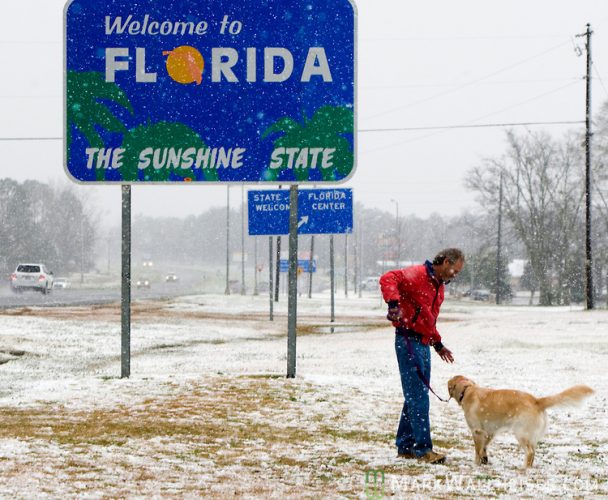
The Great Blizzard of 1993 brought varying amounts of snow, with some areas experiencing several inches. This was a truly exceptional event, a once-in-a-generation occurrence that surprised residents and made national headlines. Roads were slick, travel was disrupted, and many Floridians experienced snow for the first time in their lives. The impact was significant, causing school closures, flight cancellations, and a general sense of disbelief. The snow melted relatively quickly due to the underlying warm ground and the eventual return of warmer air, but the memory of this extraordinary winter event remains vivid for those who lived through it.
Other Sporadic Snowfall Events
Beyond the Great Blizzard of 1993, there have been other, less significant, snowfall events in Florida‘s history. For example, in January 1977, light snow flurries were reported in parts of northern Florida. In December 2017, a rare dusting of snow was observed in the western Florida Panhandle, near the border with Alabama. These instances are often characterized by very light accumulations, sometimes just a trace, and are confined to the northernmost regions of the state.
These sporadic events highlight the complex interplay of atmospheric conditions. They occur when a potent cold air mass collides with a source of moisture at precisely the right time and temperature. These precise conditions are rare, making each instance of snowfall in Florida a notable meteorological anomaly.
The Unlikely Future: Snow in Modern Florida?
Given the planet’s changing climate, discussions about weather patterns inevitably turn to the future. Will the chances of snow in Florida increase, decrease, or remain about the same?
Climate Change and its Potential Impact
The impact of climate change on regional weather patterns is a complex and actively researched area. While global temperatures are rising, this doesn’t necessarily translate to a simple increase in warmth everywhere all the time. Climate change can lead to more extreme weather events, which can manifest in various ways.
In the context of Florida, a warming climate might, paradoxically, lead to slightly more frequent or intense cold fronts capable of reaching the state, as these are part of larger-scale atmospheric shifts. However, the overall trend is towards warmer average temperatures. This means that even if cold fronts occur, the likelihood of temperatures dropping low enough for snow to form and reach the ground across a significant portion of the state is likely to decrease over the long term.
The warming of the Atlantic Ocean and the Gulf of Mexico also plays a role. Warmer waters contribute to more moisture in the atmosphere, which could, in theory, provide more fuel for storms. However, the crucial factor remains the temperature of the air reaching the ground.

The Improbability of Widespread Snow
Ultimately, widespread snowfall in Florida remains highly improbable, even in a changing climate. The state’s geography and its position within subtropical latitudes are fundamentally resistant to the conditions required for significant snow accumulation. The warm ocean currents, the prevailing air masses, and the relatively low elevation all contribute to a climate that favors warmth.
While a freak weather event, a perfect storm of atmospheric conditions, could theoretically bring snow to Florida again, especially to its northernmost regions, it’s unlikely to become a regular occurrence. The iconic image of Florida as a tropical paradise, a land of sun, sand, and citrus, is unlikely to be replaced by visions of snow-covered landscapes anytime soon.
For travelers planning a visit to Florida, whether for a luxurious stay at a resort like the Ritz-Carlton or a family adventure to Universal Studios Florida, the expectation of snow is not something to pack for. Instead, they can anticipate the warmth, the vibrant attractions, the unique local culture, and the countless outdoor activities that the Sunshine State is renowned for. The allure of Florida lies in its consistent warmth and its dedication to providing a tropical escape, a promise that even the most unusual of weather phenomena are unlikely to disrupt. The occasional, historical snowfall events serve as fascinating footnotes in the state’s otherwise sunny meteorological narrative, reinforcing its identity as a premier destination for sun-seekers.
LifeOutOfTheBox is a participant in the Amazon Services LLC Associates Program, an affiliate advertising program designed to provide a means for sites to earn advertising fees by advertising and linking to Amazon.com. Amazon, the Amazon logo, AmazonSupply, and the AmazonSupply logo are trademarks of Amazon.com, Inc. or its affiliates. As an Amazon Associate we earn affiliate commissions from qualifying purchases.