
Navigating the complexities of a divorce can be an emotionally and financially challenging period. For many individuals in California, the “Do It Yourself” (DIY) approach to divorce offers a path toward greater autonomy and cost savings. This choice reflects a proactive lifestyle decision, empowering individuals to manage their legal journey with careful planning and utilization of available resources. While not suitable for every situation, especially those involving significant conflict or intricate financial portfolios, a DIY divorce can be a viable and empowering option for couples seeking an amicable separation.
Navigating the Landscape of Self-Represented Divorce in California
The decision to pursue a DIY divorce is a significant one, often driven by a desire for efficiency, privacy, and control over the process. Understanding the fundamental requirements and assessing personal suitability are the first critical steps.
Is DIY Divorce Right for You?
A DIY divorce is generally most appropriate for uncontested cases. This means both spouses agree on all key aspects of their separation, including the division of assets and debts, spousal support (if any), and, crucially, all matters pertaining to child custody and visitation. If there’s substantial disagreement or a history of domestic violence, a DIY approach may prove challenging or even detrimental, necessitating professional legal representation. Factors that make a DIY divorce more feasible include:
- Mutual Agreement: Both parties are in full agreement on property division, debt allocation, and child-related issues.
- Simple Finances: Minimal complex assets (e.g., no businesses, numerous properties, or intricate investment portfolios).
- No High Conflict: A willingness to communicate respectfully and cooperate throughout the process.
- Time and Diligence: The self-represented litigant is prepared to dedicate time to research, form completion, and court procedures.
Understanding Key Legal Terms and Requirements
Before embarking on a DIY divorce, familiarizing oneself with fundamental California family law terminology is essential. The process officially begins with the filing of a “Petition for Dissolution of Marriage.” The spouse who files is the “Petitioner,” and the other is the “Respondent.” Key terms to grasp include:
- Community Property: Assets and debts acquired during the marriage, subject to 50/50 division.
- Separate Property: Assets and debts acquired before marriage, after separation, or by gift/inheritance, which are not subject to division.
- Spousal Support (Alimony): Financial payments from one spouse to the other, potentially temporary or permanent.
- Child Custody: Legal custody (who makes decisions for the child) and physical custody (where the child lives).
- Child Support: Financial payments to cover a child’s needs, calculated using statewide guidelines.
- Judgment: The final court order that officially dissolves the marriage and outlines all terms of the divorce.
California is a “no-fault” divorce state, meaning neither party needs to prove fault for the marriage’s breakdown. The only requirement is “irreconcilable differences” that have led to the irremediable breakdown of the marriage. There is also a mandatory six-month waiting period from the date the Respondent is served with the divorce papers until the earliest date the divorce can be finalized.
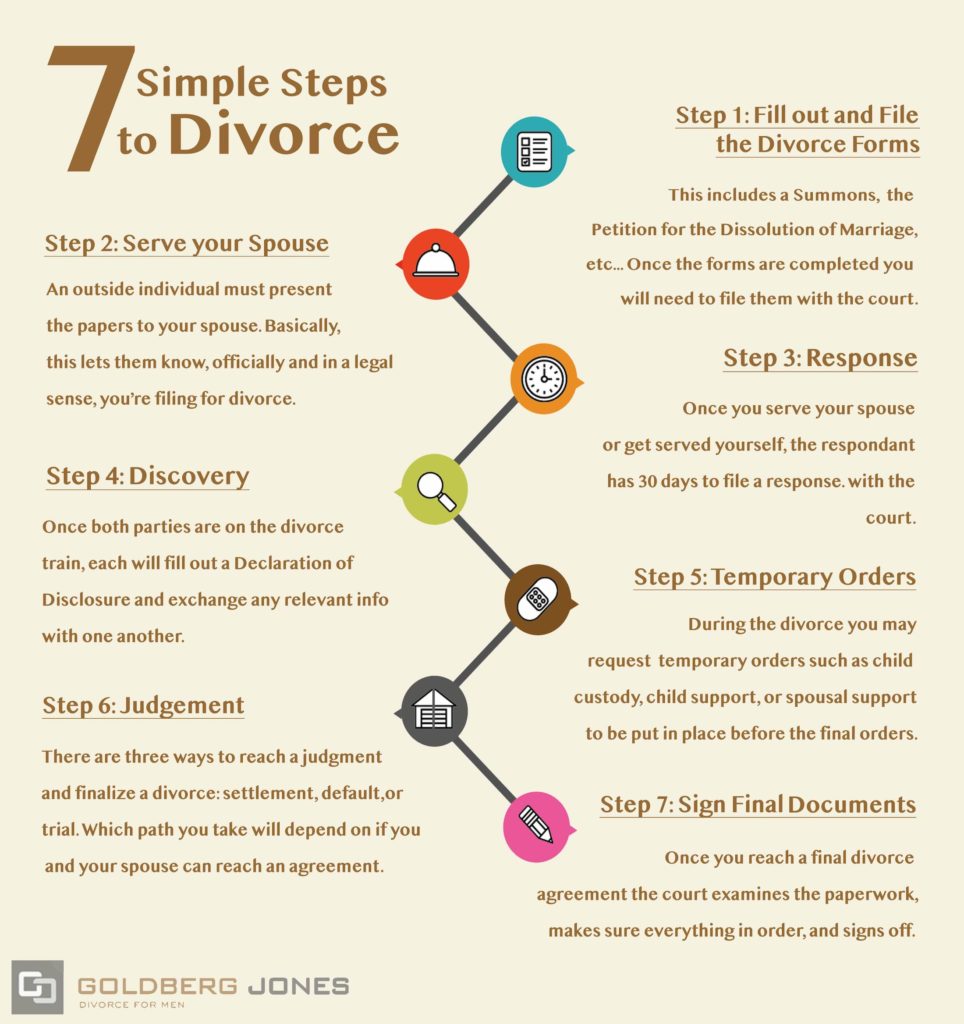
The Step-by-Step Guide to Filing Your Divorce Petition
Successfully navigating a DIY divorce involves a structured, sequential process. Each step requires meticulous attention to detail and adherence to court rules.
Initial Filings: Petition and Summons
The journey begins at the local Superior Court. The Petitioner must complete and file the initial forms:
- Petition – Marriage/Domestic Partnership (Form FL-100): This form formally requests the dissolution of marriage and states initial requests regarding property, debts, custody, and support.
- Summons (Form FL-110): This form notifies the Respondent that a divorce action has been filed and includes important legal warnings and response deadlines.
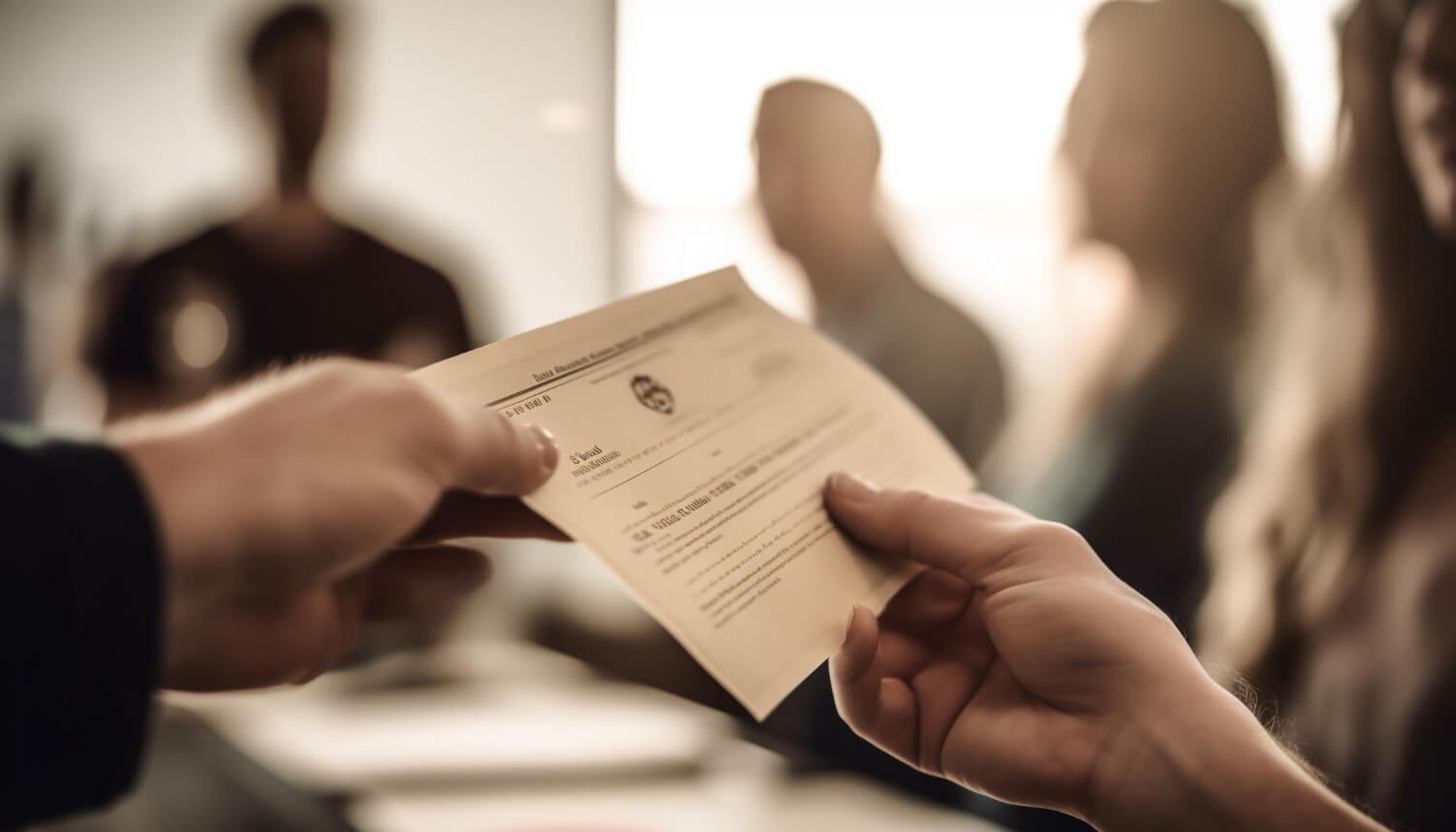
These forms are filed with the court clerk, and a filing fee is typically required, though fee waivers are available for eligible individuals. After filing, the Summons and Petition must be formally “served” on the Respondent. Service ensures the Respondent has legal notice of the proceedings. This cannot be done by the Petitioner; it must be completed by someone 18 or older who is not a party to the case, such as a friend, family member, process server, or sheriff. Once served, a Proof of Service form (FL-115) must be filed with the court. The Respondent then has 30 days to file a Response (Form FL-120) with the court.
Financial Disclosures: Transparency and Accuracy
Both parties are legally required to exchange complete and accurate financial information. This critical step ensures fairness and transparency in dividing assets and debts and determining support. Key forms include:
- Declaration of Disclosure (Form FL-140): A cover sheet for other financial documents.
- Schedule of Assets and Debts (Form FL-142): A detailed list of all community and separate property assets and debts.
- Income and Expense Declaration (Form FL-150): A comprehensive statement of income, expenses, and asset/debt summaries.
These disclosures are exchanged between the parties, but typically only the Declaration of Disclosure (FL-140) and Proof of Service of Declaration of Disclosure (FL-141) are filed with the court, confirming that the full disclosures have been exchanged.
Addressing Property, Debts, and Spousal Support
With financial information exchanged, couples can then negotiate the division of their community property and debts. In a DIY divorce, this is usually handled through a Marital Settlement Agreement (MSA) or Stipulated Judgment, where both parties agree on how everything will be divided.
- Property and Debt Division: California law mandates an equal division of community property and debts. This involves itemizing all assets (e.g., real estate, bank accounts, retirement funds, vehicles) and debts (e.g., mortgages, credit cards, loans) and agreeing on how they will be distributed.
- Spousal Support: If spousal support is an issue, the parties must agree on the amount, duration, and termination conditions. The court considers various factors, including the length of the marriage, standard of living during the marriage, earning capacities of each spouse, and the age and health of the parties.
Child Custody and Support Considerations
When children are involved, agreements on custody, visitation, and child support are paramount.
- Child Custody and Visitation: Parents must create a parenting plan outlining legal custody (who makes decisions) and physical custody (where the children live and the visitation schedule). The court’s primary concern is always the child’s best interest.
- Child Support: This is calculated using a statewide guideline formula, taking into account parents’ incomes, time spent with each parent, and certain expenses (e.g., health insurance, daycare). Even if parents agree on a different amount, the court must ensure it meets or exceeds the guideline, or provide a valid reason for deviation. The Family Law Facilitator at the court can assist with child support calculations.
Finalizing the Divorce
Once all agreements are reached regarding property, debts, spousal support, and children, these terms are formalized into a written agreement, often called a “Stipulated Judgment” or “Marital Settlement Agreement.” This document, along with a “Judgment” (Form FL-180), is submitted to the court for review and approval. The court will ensure all forms are correctly completed and that the agreements are fair and comply with California law, especially concerning child-related matters. After the judge signs the Judgment, the divorce becomes final after the statutory six-month waiting period has passed.
Leveraging Resources for a Smooth Process
The landscape of DIY divorce is supported by various resources designed to assist self-represented litigants. These tools are invaluable for maintaining accuracy and navigating procedural requirements.
Court Self-Help Centers and Legal Aid Services
Most California Superior Court branches offer self-help centers or Family Law Facilitators. These services provide free information, workshops, and assistance with completing forms. While they cannot provide legal advice or represent you, they can offer crucial guidance on court procedures and form requirements. Legal aid organizations may also offer free or low-cost legal services to those who qualify, providing limited scope representation or direct assistance with specific parts of the divorce process.
Online Tools and Form Assistance
The Judicial Council of California provides all mandatory divorce forms online, accessible through the California Courts website. Many reputable legal technology companies also offer online platforms that guide users through the divorce process, helping them prepare and generate the necessary forms based on their specific situation. These platforms often come with subscription fees but can significantly streamline the paperwork.
Professional Guidance: When to Seek Limited Scope Representation
Even when pursuing a DIY divorce, there are instances where consulting with an attorney for “limited scope representation” can be highly beneficial. This involves hiring an attorney for specific tasks, such as reviewing your completed forms, strategizing for negotiations, or representing you at a single court hearing. This approach allows you to maintain control over most of the process while receiving expert guidance where it’s most needed, often at a lower cost than full representation.
Common Challenges and Strategies for Success
While empowering, a DIY divorce is not without its hurdles. Anticipating common pitfalls and developing strategies to overcome them is key to a successful outcome.
Incomplete Paperwork and Procedural Errors
The most frequent challenge for self-represented litigants is ensuring all forms are correctly filled out and filed according to court rules. Errors or omissions can lead to delays, require re-filing, or even risk the case being dismissed.
- Strategy: Utilize court self-help resources, double-check all forms against court instructions, and consider having a Family Law Facilitator or a limited scope attorney review your documents before filing. Maintain meticulous records of all filed documents and correspondence.
Overlooking Complexities
What appears to be a straightforward divorce can sometimes harbor hidden complexities, especially concerning property division (e.g., tracing separate property contributions to community assets, valuing retirement accounts, or stock options) or determining spousal support in long-term marriages.
- Strategy: Be realistic about the simplicity of your case. If complex financial or legal issues arise, do not hesitate to seek professional legal advice. A small investment in expert consultation early on can prevent significant problems and costs down the line.
Managing Emotional Stress and Conflict
Divorce is inherently emotional. Even in amicable separations, stress, anger, and sadness can cloud judgment and impede cooperative communication, particularly in cities like Los Angeles or San Francisco where daily life can already be demanding.
- Strategy: Prioritize self-care throughout the process. Consider counseling or mediation to manage emotions and facilitate constructive communication. Focusing on the future and the shared goal of an amicable separation can help keep discussions productive.
Embracing a New Chapter: Lifestyle Post-Divorce
Successfully navigating a DIY divorce in California is not just a legal achievement; it’s a profound personal transformation, marking the beginning of a new chapter in one’s lifestyle.
Financial Independence and Rebuilding
A DIY divorce allows individuals to gain intimate knowledge of their financial situation, fostering a sense of control and empowerment. Post-divorce, this understanding is crucial for establishing financial independence. This might involve creating new budgets, opening separate accounts, or developing long-term financial plans for retirement and investments. The ability to manage your legal process often translates into greater confidence in managing your financial future, whether in Sacramento or San Diego.
Personal Growth and Empowerment
Undertaking a DIY divorce is a testament to resilience and self-reliance. The process of understanding legal requirements, completing complex forms, and advocating for oneself cultivates significant personal growth. Many individuals emerge from the process with a renewed sense of empowerment, ready to make independent life choices and pursue new personal and professional goals, often leading to a richer, more self-directed lifestyle.
Redefining Travel and Life Experiences
With the legal process concluded, individuals often find new freedom to explore passions and redefine their personal lifestyle, including how they approach leisure and travel. A post-divorce lifestyle might involve newfound flexibility for solo travel, adventurous road trips along the Pacific Coast Highway, or luxurious getaways to destinations like Napa Valley. This shift reflects a personal re-prioritization, embracing experiences that align with individual desires and financial autonomy, signifying a true “life out of the box.”
LifeOutOfTheBox is a participant in the Amazon Services LLC Associates Program, an affiliate advertising program designed to provide a means for sites to earn advertising fees by advertising and linking to Amazon.com. Amazon, the Amazon logo, AmazonSupply, and the AmazonSupply logo are trademarks of Amazon.com, Inc. or its affiliates. As an Amazon Associate we earn affiliate commissions from qualifying purchases.