
Navigating the legal landscape of firearm ownership and carrying in any state can be complex, and for those traveling to or residing in Alabama, understanding the requirements for concealed carry is paramount. This guide delves into the specifics of Alabama’s laws regarding concealed carry permits, offering clarity for both residents and visitors seeking to exercise their Second Amendment rights responsibly. Whether you are planning a vacation in Montgomery or considering a longer stay in a charming beach town along the Gulf Coast, familiarizing yourself with these regulations is an essential part of your preparation.

Understanding Alabama’s Concealed Carry Laws
Alabama operates under a “shall-issue” concealed carry permit system. This means that if an applicant meets the established legal criteria, the issuing authority is obligated to grant the permit. This contrasts with “may-issue” states, where discretion plays a larger role in permit approval. The primary legislative framework governing concealed carry in Alabama is found within the Alabama Code, particularly sections pertaining to pistol permits.
Constitutional Carry and Its Implications
In recent years, Alabama has moved towards a system that is often referred to as “constitutional carry” for eligible individuals. This development means that as of January 1, 2023, eligible Alabamians are permitted to carry a pistol, openly or concealed, without a permit. However, it is crucial to understand who is considered “eligible” under this law.
Eligibility for Constitutional Carry:
- Age: Applicants must be 19 years of age or older.
- Criminal History: Individuals must not have been convicted of a disqualifying felony offense. This includes a broad range of serious crimes.
- Domestic Violence: Those convicted of domestic violence misdemeanors are also prohibited.
- Mental Health: Individuals legally deemed mentally incompetent are not eligible.
- Other Prohibitions: Other federal and state prohibitions related to firearm possession, such as being subject to a domestic violence restraining order, also apply.
While constitutional carry simplifies the process for many, obtaining a concealed carry permit still offers significant advantages and is advisable for certain individuals and circumstances.
The Value of a Concealed Carry Permit
Despite the advent of constitutional carry, a concealed carry permit remains a valuable document for many individuals in Alabama. These permits not only signify a level of training and vetting but also provide reciprocity with other states, facilitating easier travel with a firearm.
Benefits of Obtaining a Permit:
- Interstate Reciprocity: Alabama has reciprocity agreements with numerous other states. This means that if you have an Alabama concealed carry permit, you can legally carry a concealed handgun in many other states that honor it. Without a permit, your ability to carry in other states, even those with constitutional carry, may be restricted or non-existent. This is particularly important for travelers planning trips that extend beyond Alabama’s borders. For instance, if you’re driving from Birmingham to Florida for a beach vacation, an Alabama permit can ensure you remain compliant with carry laws in Florida and any states in between.
- Easier Firearm Purchases: While not universally true, some argue that having a permit can streamline the process of purchasing firearms, as it may satisfy certain background check requirements or expedite the process.
- Proof of Training and Competency: Obtaining a permit often involves demonstrating proficiency with a firearm and understanding of relevant laws, providing a clear indication of responsible gun ownership.
- Access to Certain Restricted Areas: In some specific instances, permit holders may have access to areas that are otherwise restricted for firearms, though this is highly dependent on the specific location and its regulations.
Applying for a Concealed Carry Permit in Alabama
The process for applying for a concealed carry permit in Alabama is administered at the county level. The Sheriff’s Department in the county of your primary residence is typically the issuing authority.
Eligibility Requirements for a Permit
To be eligible for a concealed carry permit in Alabama, an applicant must generally meet the following criteria:
- Age: Be at least 21 years of age. While constitutional carry allows for 19-year-olds, permit requirements are typically set at 21.
- Residency: Be a bona fide resident of Alabama and of the county in which you are applying.
- Criminal Record: Not have been convicted of a felony or any crime involving moral turpitude, nor be charged with any such crime. A thorough background check will be conducted.
- Mental Competency: Not be deemed mentally incompetent by a court of law.
- Domestic Violence History: Not have a conviction for misdemeanor domestic violence.
- Other Disqualifications: Not be prohibited from possessing firearms under federal law, nor be subject to a protective order.
- Honorable Discharge: If a former member of the armed forces, you must have been honorably discharged.
The Application Process
The application process involves several steps designed to ensure the applicant meets all legal requirements.
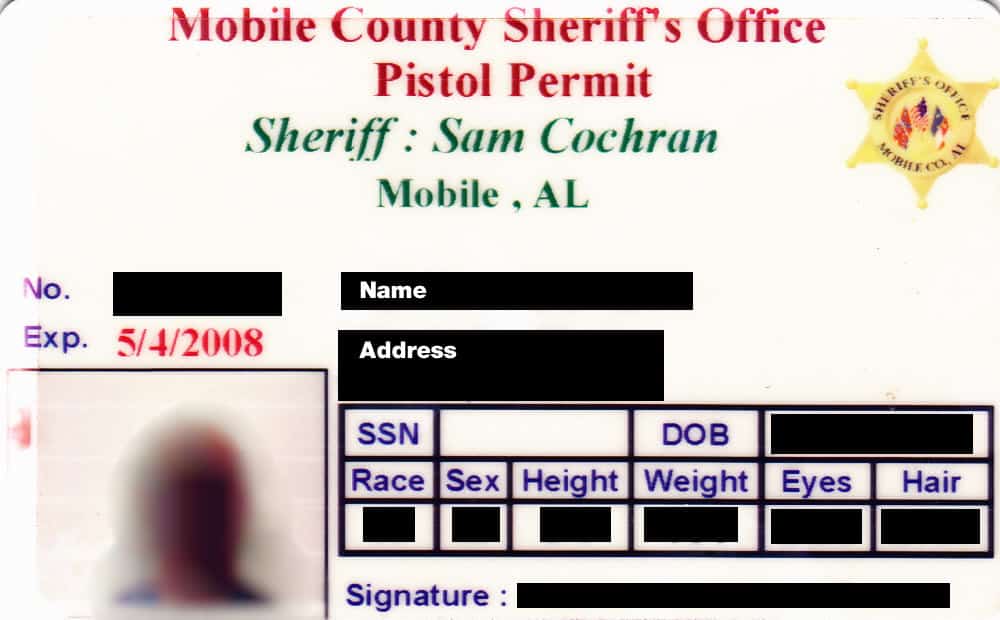
Steps to Obtain a Permit:
- Obtain an Application Form: Application forms are available from the Sheriff’s Department in your county of residence. Some departments may have these available online.
- Complete the Application: Fill out the application form completely and accurately. Any misinformation can lead to denial.
- Provide Required Documentation: This typically includes proof of residency (e.g., a driver’s license, utility bills), proof of identity, and potentially proof of firearm training or a firearms safety course certificate.
- Fingerprinting: You will be fingerprinted as part of the background check process.
- Background Check: The Sheriff’s Department will conduct a thorough background check, including state and federal databases.
- Interview (Potentially): In some cases, an interview with a law enforcement officer may be required.
- Pay the Fee: There is a fee associated with the permit application, which varies by county.
- Permit Issuance: If approved, the permit will be issued. The validity period for an Alabama concealed carry permit is typically five years.
Firearm Training Requirements
While constitutional carry does not explicitly mandate training, obtaining a concealed carry permit in Alabama may benefit from or, in some county-specific processes, require documented proof of firearms training. Many applicants opt to complete a certified firearms safety course, which can provide valuable knowledge about safe gun handling, marksmanship, and the legal aspects of carrying a firearm. Such courses are widely available from certified instructors across the state, including in major cities like Huntsville and Mobile.
Where Can You Legally Carry in Alabama?
Understanding where firearms can and cannot be carried is as crucial as knowing the permit requirements. Even with constitutional carry or a permit, there are numerous locations where firearms are prohibited.
Prohibited Locations
It is essential to be aware of the places where carrying a firearm, concealed or openly, is illegal. These restrictions are in place to ensure public safety in sensitive areas.
Common Prohibited Locations:
- Federal Buildings: This includes courthouses, post offices, and federal government facilities.
- Law Enforcement Facilities: Police stations and sheriff’s offices are generally off-limits.
- Correctional Facilities: Prisons and jails.
- Courthouses: While some exceptions may exist for judges or court officials, the general public is prohibited.
- Polling Places on Election Day: Carrying firearms at or near a polling place on election day is strictly forbidden.
- Schools and Universities: Carrying firearms on public or private school property (K-12) is prohibited, with limited exceptions for authorized personnel. Carrying on college and university campuses has specific regulations that permit holders should carefully review.
- Courtrooms: While inside a courtroom.
- Certain Private Establishments: Businesses that post signage prohibiting firearms, such as establishments that serve alcohol for consumption on the premises, are also off-limits. It is the responsibility of the carrier to recognize and adhere to such signage.
- K-12 School Zones: This prohibition is particularly strict and applies to the grounds and parking lots of K-12 schools.
Understanding “No Gun” Signs
Alabama law generally recognizes signage as a means for private property owners to prohibit firearms. If a business or establishment clearly posts a sign indicating that firearms are not permitted, you are legally obligated to comply. These signs are typically posted at entrances and should be visible to individuals entering the premises. Ignoring such signage can result in trespass charges or other legal penalties.
Traveling to or Through Alabama with a Firearm
For those planning a visit to Alabama from out of state, understanding the nuances of interstate firearm laws is critical.
Reciprocity with Other States
As mentioned earlier, Alabama honors concealed carry permits from states with which it has reciprocity agreements. If you hold a valid concealed carry permit from another state that Alabama recognizes, you can legally carry a concealed firearm in Alabama according to your home state’s permit provisions and Alabama’s laws regarding prohibited locations.
However, if you are traveling from a state that does not have reciprocity with Alabama, or if you are traveling from a state that does not issue permits, you may be subject to Alabama’s constitutional carry provisions if you meet the eligibility requirements. It is always advisable to verify the most current reciprocity agreements with the Alabama Law Enforcement Agency or the Sheriff’s Department of the county you will be visiting.

Federal Law and Transportation of Firearms
When transporting firearms across state lines, federal law also plays a role. The Gun Control Act of 1968 and the Firearm Owners’ Protection Act of 1986 provide certain protections for interstate transport. Generally, a firearm is considered unloaded and cased if it is not readily accessible from the passenger compartment of a vehicle and is not loaded with ammunition. However, state and local laws regarding prohibited areas still apply, even when transporting a firearm. It is crucial to ensure your firearm is unloaded, secured, and that ammunition is stored separately when in transit, adhering to the strictest interpretation of the law for the states you are traveling through.
In conclusion, while Alabama has adopted constitutional carry for eligible residents, the decision to obtain a concealed carry permit remains a personal one with distinct advantages, particularly for those who travel frequently or wish to have a clear, universally recognized credential. Understanding the legal requirements, prohibited locations, and interstate reciprocity is essential for responsible firearm ownership and carrying in the Heart of Dixie.
LifeOutOfTheBox is a participant in the Amazon Services LLC Associates Program, an affiliate advertising program designed to provide a means for sites to earn advertising fees by advertising and linking to Amazon.com. Amazon, the Amazon logo, AmazonSupply, and the AmazonSupply logo are trademarks of Amazon.com, Inc. or its affiliates. As an Amazon Associate we earn affiliate commissions from qualifying purchases.