
The passing of a loved one is an inherently difficult time, often compounded by the necessity of managing various administrative and legal complexities. Among these crucial tasks is obtaining a death certificate, a document indispensable for settling an individual’s affairs. In California, understanding the specific procedures for acquiring this vital record is not merely a bureaucratic chore but a fundamental step in navigating the practical aspects of loss, ensuring legal compliance, and managing the ongoing lifestyle implications for surviving family members. This guide provides an insightful overview of the process, designed to empower individuals with the knowledge needed during such sensitive periods.

Understanding the Importance of a Death Certificate in California
A death certificate is more than just a piece of paper; it’s a cornerstone document for numerous legal, financial, and personal affairs following a death. Its significance extends across various facets of life, impacting beneficiaries, estate matters, and overall family stability.
Legal and Administrative Necessities
At its core, a death certificate serves as official proof of death. This certification is legally required for a multitude of post-mortem actions. Without it, processes such as probating a will, distributing an estate, or transferring property cannot proceed. It is the primary document needed to formally close accounts, cancel subscriptions, and notify government agencies of the individual’s passing. For instance, insurance companies require a certified copy to process life insurance claims, enabling beneficiaries to access crucial funds that may be essential for their financial future and daily living. Similarly, pension plans, Social Security benefits, and veteran’s benefits all necessitate this certificate to initiate or cease payments, ensuring that surviving family members receive appropriate support or that improper payments are avoided. Legal processes like changing titles on real estate or vehicles, closing bank accounts, and settling debts also hinge on the presentation of a certified death certificate.
Impact on Personal and Family Lifestyle
Beyond the purely legal framework, the death certificate has profound implications for the personal and family lifestyle of those left behind. It allows families to move forward with critical decisions and adjustments. For individuals who may have been financially dependent on the deceased, accessing life insurance or pension benefits promptly can prevent significant disruption to their standard of living. For the executor or administrator of an estate, obtaining this document efficiently helps them fulfill their fiduciary duties, alleviating prolonged stress during a period of grief. Furthermore, for international citizens or those managing affairs across state lines, the certificate facilitates official communication and recognition of death in different jurisdictions, which can be critical for cross-border estate planning or inheritance matters, directly affecting their lifestyle and future plans. It grants the authority to make funeral arrangements and obtain burial permits, providing the closure necessary for the grieving process to begin in earnest.
Navigating the Application Process: Key Steps for Residents and Non-Residents
The process for obtaining a death certificate in California is standardized, yet it requires careful attention to detail regarding who can apply and what documentation is necessary.
Who Can Request a Certified Copy?
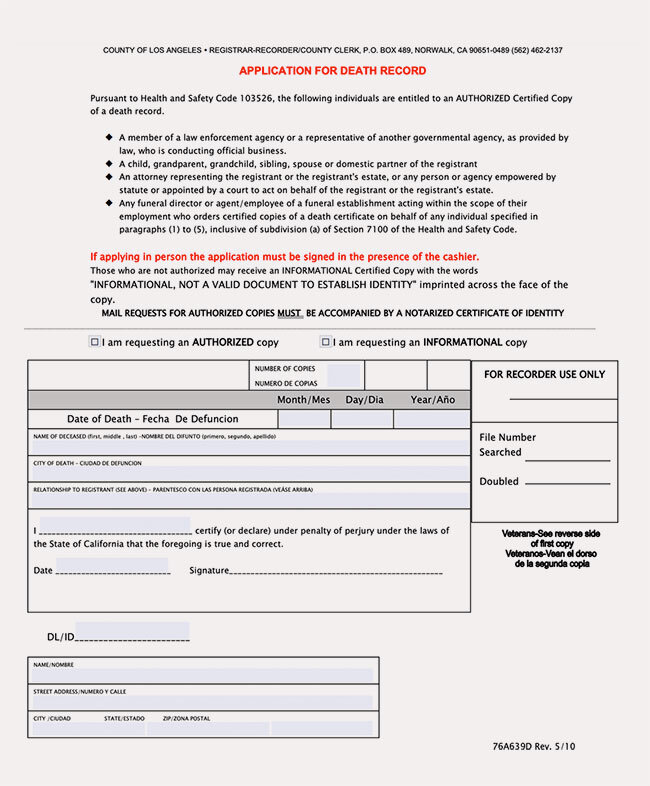
In California, access to certified copies of death certificates is restricted to authorized individuals to protect privacy. Those generally authorized to receive a certified copy include:
- A parent or legal guardian of the deceased.
- A child, grandparent, grandchild, sibling, spouse, or domestic partner of the deceased.
- A member of a law enforcement agency or a representative of another governmental agency, as provided by law, who is conducting official business.
- An attorney representing the deceased person or the deceased person’s estate, or any person or agency empowered by statute or appointed by a court to act on behalf of the deceased person or the deceased person’s estate.
- A funeral director (or an agent or employee of a funeral establishment) acting within the scope of their employment, when specifically authorized by family.
- An authorized representative of the deceased.
- A person who has a court order granting them access.
If you do not meet these criteria, you may still obtain an “informational” copy, which contains the same information as a certified copy but cannot be used for legal purposes. It will bear a legend stating, “INFORMATIONAL, NOT A VALID DOCUMENT TO ESTABLISH IDENTITY.”
Required Information and Documentation
When applying for a certified copy, applicants must provide specific information about the deceased and themselves. This typically includes:
- Full name of the deceased.
- Date and place of death.
- Parent’s names (if known).
- Your relationship to the deceased.
- Your full name and mailing address.
- A valid government-issued photo identification (e.g., driver’s license, passport) for verification.
- A signed statement under penalty of perjury asserting your relationship to the deceased, often included on the application form itself. This sworn statement is critical for receiving a certified copy, ensuring the integrity of vital records.
For non-residents whose loved ones passed away in California, the process is identical. The key is to provide proof of relationship and identity, irrespective of your current residence. The administrative burden can be significant for those managing affairs from afar, underscoring the importance of clear instructions and reliable application methods.

Methods of Application: Online, Mail, In-Person
California offers several convenient ways to apply for a death certificate:
- Online: Many county vital records offices, and the state office, provide online application portals. This method often involves uploading scanned copies of your ID and signed application, and paying fees electronically.
- By Mail: This is a common method, especially for those who cannot apply in person or online. You’ll need to print the application form, complete it, have your signature notarized (for certified copies), include a copy of your ID, and mail it with the appropriate fee to the vital records office.
- In-Person: For expedited service or if you prefer direct interaction, you can visit the local county vital records office where the death occurred, or the state office. Be sure to bring all required documentation, including your valid ID and payment.
Where to Apply: California Vital Records Offices
Knowing the correct office to contact is crucial for an efficient application process. In California, death certificates are recorded at both the state and county levels.
State vs. Local Health Departments
The primary state agency responsible for vital records is the California Department of Public Health – Vital Records (CDPH-VR). This office maintains records for the entire state. However, it is often more expedient to apply through the local county health department or registrar where the death occurred, especially if the event was recent. County offices typically have quicker processing times for recent deaths as the records are first filed locally before being sent to the state archive. For older records, or if you are unsure of the exact county, the CDPH-VR is a reliable option.
Specific County Offices
Each of California’s 58 counties has a local vital records office, usually within their public health department. For example:
- In Los Angeles County, applications are processed by the Los Angeles County Registrar-Recorder/County Clerk.
- For deaths occurring in San Francisco County, the San Francisco Department of Public Health handles requests.
- Residents and applicants for deaths in Alameda County would typically contact the Alameda County Public Health Department.
It is always advisable to check the specific county’s official website for their exact application procedures, fees, and current processing times. Many counties, like Sacramento, offer detailed instructions and downloadable forms directly on their registrar’s pages, facilitating a smoother experience for applicants.
Timelines, Fees, and Common Challenges
Understanding the logistical aspects of obtaining a death certificate, including wait times and costs, can help manage expectations during an already stressful time.
Processing Times and Expedited Services
Processing times can vary significantly depending on whether you apply through the state or county office, the method of application, and the volume of requests. County offices often process requests for recent deaths faster, sometimes within a few business days for in-person applications. Mail requests can take several weeks, while online applications may fall somewhere in between. The California Department of Public Health – Vital Records (CDPH-VR) typically has longer processing times, especially for mail requests, which can extend to several months. Some offices offer expedited services for an additional fee, which can be invaluable for individuals who need the document urgently for critical lifestyle-related decisions, such as closing an estate or making immediate financial arrangements.
Associated Costs
There is a fee for each certified copy of a death certificate. These fees are set by the state and counties and are subject to change. As of recent updates, the fee for a certified copy of a death certificate in California is typically around $21 per copy, though it’s prudent to verify the current fee with the specific office you are applying to. Payment methods usually include check, money order, credit card (for online/in-person), or cash (for in-person). Always confirm acceptable payment types before submitting your application. The cost, while modest, can add up if multiple copies are needed for various institutions and purposes, impacting personal budgets during an already financially strenuous period.
Addressing Common Issues and Denials
Applicants may encounter several challenges. One common issue is incomplete information on the application form or insufficient proof of identity/relationship. It is crucial to double-check all entries and ensure all required supporting documents are included. If your application for a certified copy is denied because you don’t meet the authorized requester criteria, you will typically receive an informational copy instead. Another challenge can be delays due to high volume or backlogs, especially during public health crises. In such cases, checking the office’s website for updates or calling their inquiry line can provide clarity. For issues related to discrepancies on the certificate itself, a formal amendment process may be required, which involves additional forms and potentially legal guidance. Proactive engagement and meticulous attention to detail can significantly streamline this administrative task, allowing individuals to focus more on their personal well-being and managing their altered lifestyle post-loss.
LifeOutOfTheBox is a participant in the Amazon Services LLC Associates Program, an affiliate advertising program designed to provide a means for sites to earn advertising fees by advertising and linking to Amazon.com. Amazon, the Amazon logo, AmazonSupply, and the AmazonSupply logo are trademarks of Amazon.com, Inc. or its affiliates. As an Amazon Associate we earn affiliate commissions from qualifying purchases.