
Navigating the landscape of construction and home improvement in the Sunshine State requires more than just skill and experience; it demands proper legal authorization. Obtaining a contractor’s license in Florida is a critical step for anyone looking to offer contracting services legally and professionally. This process ensures that individuals and businesses meet specific standards of competence, financial stability, and ethical conduct, thereby protecting consumers and upholding the integrity of the industry. Whether you’re a seasoned professional aiming to expand your operations or a newcomer eager to establish your presence, understanding the intricacies of the Florida contractor licensing system is paramount.
The primary regulatory body overseeing contractor licensing in Florida is the Florida Department of Business and Professional Regulation (DBPR), specifically through its Construction Industry Licensing Board (CILB). The DBPR establishes the rules, administers the examinations, and issues licenses to qualified individuals and businesses across various contracting classifications. This comprehensive framework aims to ensure that only competent and qualified individuals are permitted to undertake construction projects, safeguarding public safety and property.
Understanding Contractor Classifications and License Types
Before embarking on the licensing journey, it’s essential to understand the different types of contractor licenses available in Florida and the specific classifications that align with your intended services. The state categorizes contractors into two primary license types: registered and certified. The distinction is crucial as it dictates the scope of work you can legally perform and the areas in which you can operate.
Registered Contractors
A registered contractor license allows an individual to perform contracting work within a specific local jurisdiction (city or county) that has adopted an equivalency or registration program. This means that if you hold a registered license in Miami-Dade County, your license is only valid for contracting work within Miami-Dade County. To obtain a registered license, you typically need to meet the requirements set by the local building department, which may include examination, experience verification, and proof of financial responsibility. The advantage of a registered license is that it can be a stepping stone for some to gain experience within a specific locality before pursuing a statewide certified license. However, it limits your operational reach significantly.
Certified Contractors
A certified contractor license is a statewide license, meaning it is recognized and valid anywhere in Florida. This type of license is generally more difficult to obtain as it requires meeting higher standards of experience, knowledge, and financial stability. Certified contractors are recognized as having a comprehensive understanding of their trade and the ability to manage complex construction projects. There are numerous classifications within the certified contractor category, each pertaining to a specific area of expertise. Some of the most common include:
- General Contractor (GC): This is the broadest classification. A certified General Contractor is qualified to engage in the construction, repair, remodeling, or improvement of any structure, building, or project that does not require special engineering or architectural design. They can oversee all phases of a construction project, including managing subcontractors.
- Building Contractor (BC): A certified Building Contractor is qualified to engage in the construction, repair, remodeling, or improvement of any structure or building that is not more than two stories in height, or any other type of building or structure that does not require special engineering or architectural design. This license is also limited to projects with a cost of less than $1 million.
- Residential Contractor (RC): A certified Residential Contractor is qualified to engage in the construction, repair, remodeling, or improvement of any structure or building that is intended for use as a single-family dwelling or duplex. This is a more specialized license focusing on residential projects.
- Specialty Contractors: This broad category encompasses a wide range of specialized trades. Examples include:
- Air Conditioning Contractor: For the installation, servicing, and repair of air conditioning systems.
- Electrical Contractor: For the installation and maintenance of electrical systems.
- Plumbing Contractor: For the installation and repair of plumbing systems.
- Roofing Contractor: For the installation and repair of roofing systems.
- Swimming Pool Specialty Contractor: For the construction and repair of swimming pools.
- Glass, Storefront, and Stucco Specialty Contractor: For specific trade work related to these areas.
The choice between a registered and certified license, and which specific classification to pursue, depends entirely on your career goals, the services you intend to offer, and the geographic areas in which you plan to operate.
Eligibility Requirements for a Contractor’s License
Meeting the eligibility criteria is the first major hurdle in the Florida contractor licensing process. These requirements are designed to ensure that applicants possess the necessary knowledge, skills, experience, and financial responsibility to operate as contractors. The DBPR has detailed stipulations for each license type and classification, but some common elements apply across the board.
Experience and Education
A significant component of the licensing requirements is demonstrating relevant experience in the construction industry. The amount and type of experience required vary depending on the license classification. Generally, applicants need to prove a minimum number of years of practical experience working in the specific trade they are seeking a license for. This experience must be verifiable, often requiring references from former employers, clients, or a supervising licensed contractor.
In some cases, a certain amount of college education in construction-related fields may be substituted for a portion of the required experience. For instance, a degree in construction management or engineering from an accredited institution might reduce the number of years of practical experience needed. However, a substantial period of hands-on experience is almost always a prerequisite.
Financial Stability and Responsibility
Florida places a strong emphasis on financial responsibility for contractors. This is to protect consumers from situations where a contractor may be unable to complete a project due to financial difficulties or may abscond with funds. Applicants are typically required to provide evidence of financial stability, which can include:
- Credit Reports: A personal credit report is often required to assess an applicant’s financial history. A satisfactory credit score is usually necessary.
- Financial Statements: For businesses, audited or reviewed financial statements may be needed to demonstrate solvency.
- Surety Bonds: Many license classifications require the applicant to obtain a surety bond. A surety bond is a guarantee from a surety company that the contractor will complete projects according to contract and pay subcontractors and suppliers. The bond amount varies based on the license type and the contractor’s financial standing.
- Proof of Assets/Liabilities: In some instances, applicants may need to provide documentation detailing their assets and liabilities.
Competency Examinations
To ensure a baseline level of knowledge and competency, applicants for certified contractor licenses must pass comprehensive examinations. These exams are administered by the DBPR and cover both the technical aspects of the specific trade and the legal and business principles governing contracting in Florida.
The examinations typically consist of two parts:
- The Business and Finance Examination: This section tests the applicant’s understanding of business management, financial principles, contract law, lien law, and other regulatory aspects relevant to operating a contracting business in Florida.
- The Trade Knowledge Examination: This section assesses the applicant’s expertise in the specific trade for which they are applying. It covers technical knowledge, safety practices, building codes, and construction methods relevant to that classification.
For registered contractors, the examination requirements are usually determined by the local jurisdiction but often mirror aspects of the certified exam or focus on local building codes and regulations.
Insurance and Workers’ Compensation
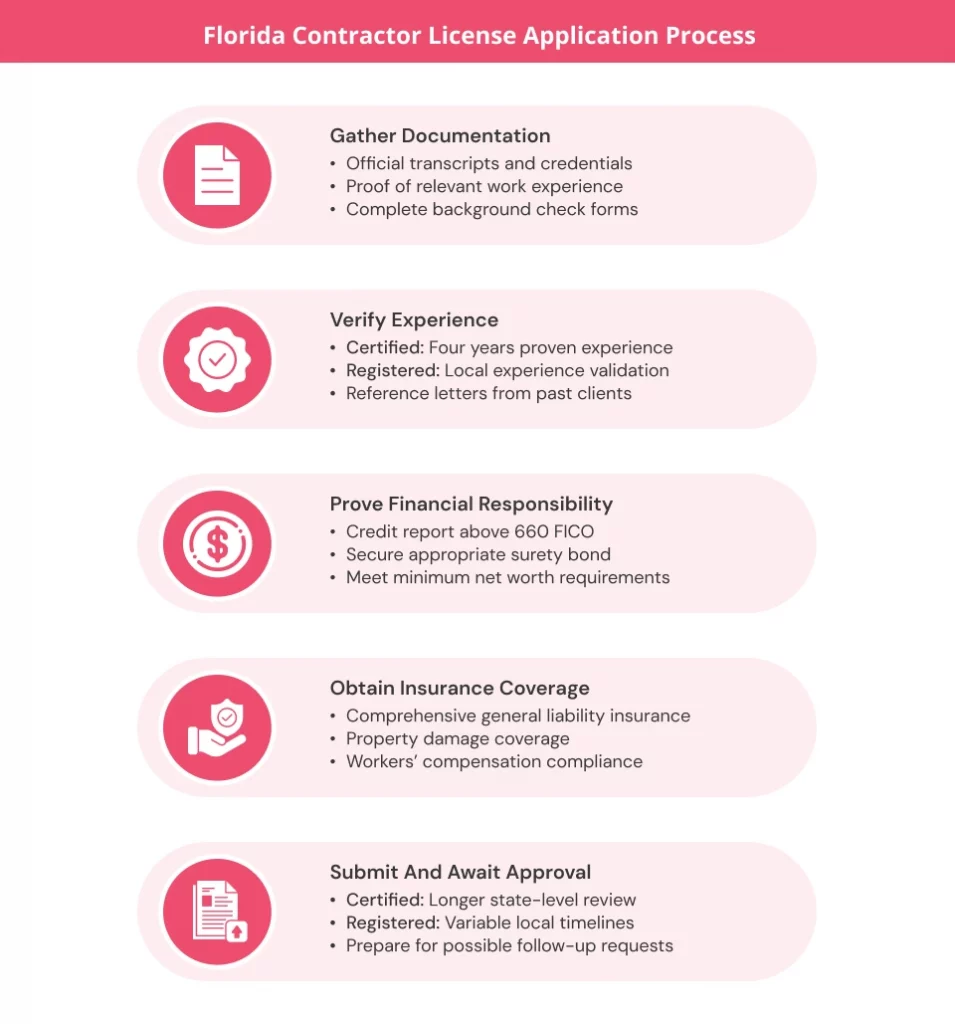
Holding appropriate insurance coverage is a non-negotiable requirement for licensed contractors in Florida. This protects both the contractor and their clients from liability arising from accidents or damages during a project. Required insurance typically includes:
- General Liability Insurance: This covers property damage or bodily injury that may occur as a result of your contracting operations.
- Workers’ Compensation Insurance: If you have employees, Florida law mandates that you carry workers’ compensation insurance. This provides benefits to employees who suffer work-related injuries or illnesses.
The specific coverage limits and requirements for insurance and workers’ compensation will be detailed by the DBPR and may also be influenced by local ordinances.
The Application Process: Step-by-Step
Once you have determined your eligibility and gathered the necessary documentation, you can begin the formal application process. This is a structured procedure designed to ensure all requirements are met systematically.
Step 1: Application Submission
The first step is to obtain the correct application form from the Florida Department of Business and Professional Regulation website. Applications are specific to the license type (registered or certified) and classification you are pursuing. It is crucial to fill out the application completely and accurately, providing all required supporting documents. Incomplete applications are a common cause of delay, so meticulous attention to detail is essential.
Supporting documents typically include:
- Proof of experience (employment verification letters, reference statements).
- Credit reports.
- Financial statements or other proof of financial stability.
- Proof of workers’ compensation insurance and general liability insurance (if already obtained).
- Proof of educational qualifications, if applicable.
- Application fees.
Step 2: Application Review and Approval
After submitting your application and fees, the DBPR will review your submission to verify that all requirements have been met. This review process can take several weeks. If any information is missing or unclear, the DBPR will contact you to request clarification or additional documentation. It is advisable to keep copies of all submitted documents for your records.
Step 3: Examination Scheduling and Taking
Once your application is approved, you will be notified that you are eligible to take the required examinations. The DBPR will provide information on how to schedule your exam, typically through a designated testing service. You will then need to arrange a time and location to take both the Business and Finance and the Trade Knowledge exams. It is recommended to study diligently using the official study guides and practice materials provided by the DBPR. Passing these exams is a significant milestone in the licensing process.
Step 4: Final Licensing and Issuance
After successfully passing all required examinations and fulfilling any remaining requirements (such as obtaining a surety bond if not already secured, or providing final proof of insurance), your application will move to the final stage of approval. Upon final approval, the DBPR will issue your contractor’s license. You will receive an official license certificate that you must display as required by law.
Congratulations! You are now a licensed contractor in Florida. However, the journey doesn’t end here. Maintaining your license requires ongoing compliance with Florida laws and regulations, including license renewal, continuing education requirements, and adherence to ethical business practices.
Maintaining Your License and Compliance
Obtaining a contractor’s license is a significant achievement, but it comes with the responsibility of ongoing compliance. To keep your license active and in good standing, you must adhere to several key requirements.
License Renewal
Contractor licenses in Florida are typically valid for a specific period, usually two years, after which they must be renewed. The DBPR will send renewal notices to your last known address, but it is your responsibility to ensure that your license is renewed on time. Failure to renew your license before it expires can result in penalties, additional fees, or even the need to reapply for a new license. The renewal process involves submitting a renewal application, paying renewal fees, and demonstrating compliance with continuing education requirements.
Continuing Education (CE) Requirements
To ensure that licensed contractors stay up-to-date with the latest building codes, industry best practices, safety standards, and legal requirements, Florida mandates continuing education. The number of hours and specific topics required for CE can vary based on your license classification. Typically, you will need to complete a certain number of hours of approved CE courses during each licensing renewal cycle. These courses are offered by various accredited providers throughout the state. Keeping records of your completed CE courses is essential for the renewal process.

Adhering to Laws and Ethics
As a licensed contractor, you are bound by the laws and regulations governing the construction industry in Florida. This includes adhering to building codes, permit requirements, labor laws, and consumer protection statutes. Engaging in unethical practices, fraud, negligence, or gross incompetence can lead to disciplinary actions by the DBPR. These actions can range from reprimands and fines to license suspension or revocation. It is crucial to maintain a high standard of professionalism and integrity in all your business dealings.
By understanding and diligently fulfilling these ongoing requirements, you can ensure that your contractor’s license remains a valuable asset, enabling you to build a successful and reputable contracting business in Florida.
LifeOutOfTheBox is a participant in the Amazon Services LLC Associates Program, an affiliate advertising program designed to provide a means for sites to earn advertising fees by advertising and linking to Amazon.com. Amazon, the Amazon logo, AmazonSupply, and the AmazonSupply logo are trademarks of Amazon.com, Inc. or its affiliates. As an Amazon Associate we earn affiliate commissions from qualifying purchases.