
Embarking on a journey from the sun-drenched coast of California to the towering skyscrapers of Manhattan is a quintessential American experience. Whether you are planning a rapid cross-country flight or a soul-searching road trip, understanding the distance between Los Angeles and New York City is the first step in mastering this transcontinental traverse. This journey spans nearly the entire width of the United States, crossing multiple time zones, diverse climates, and an array of cultural landscapes that define the North American continent.
Measuring the Miles: Distance by Land and Air
When asking how far it is from the Pacific Ocean to the Atlantic Ocean, the answer depends entirely on your mode of transport. The physical geography of the United States dictates varied paths, each offering a different perspective on the sheer scale of the country.

The Great Circle Route: Flight Distance
If you were to travel in a “straight line”—known in aviation as the great circle route—the distance between Los Angeles and New York City is approximately 2,450 miles (3,940 kilometers). A non-stop flight typically takes between five and six hours depending on the jet stream. Traveling eastward is generally faster due to tailwinds, while the return trip to the West Coast often takes slightly longer. Major hubs like Los Angeles International Airport and John F Kennedy International Airport serve as the primary gateways for this busy aerial corridor.
The Transcontinental Highway: Driving Distance
For those choosing the open road, the distance increases significantly. The most direct driving route covers roughly 2,800 miles (4,500 kilometers). If you were to drive non-stop, it would take about 41 to 45 hours of pure driving time. However, most travelers distribute this over five to seven days to account for rest, fuel, and the inevitable desire to explore the landmarks scattered across the Midwest and the Great Plains.
Transcontinental Road Trip Routes: Exploring the American Landscape
Choosing a route is about more than just mileage; it is about the experience you wish to have. Three primary interstate systems dominate the trek from Los Angeles to the East Coast, each offering distinct scenery and regional flavors.
The Northern Path via Interstate 80
Interstate 80 is the workhorse of American cross-country travel. While it technically begins in San Francisco, travelers from Los Angeles can head north to join it. This route takes you through the heart of the Rocky Mountains, across the vast plains of Nebraska, and through the industrial powerhouse of Chicago. It is a route of dramatic contrasts, shifting from high-altitude peaks to the urban sprawl of the Great Lakes region before descending into Pennsylvania and New Jersey.
The Historic Heartland via Interstate 40
For many, the dream of a cross-country trip is synonymous with Historic Route 66. While the old highway has been largely replaced by Interstate 40, the spirit remains. Starting in California, this route cuts through Arizona and New Mexico, offering a look at the stunning high desert and Southwestern culture. You will pass through Oklahoma and Arkansas before heading northeast toward Tennessee and Virginia. It is a culturally rich path that showcases the musical heritage of the American South.
The Southern Sun via Interstate 10
If you are traveling during the winter months, Interstate 10 is the preferred choice to avoid snow. This route takes you through the southernmost part of the United States, passing through Phoenix, El Paso, and Houston. To reach New York City from here, you would eventually turn north through Atlanta and follow the I-95 corridor through Washington DC and Philadelphia.
Must-Visit Landmarks Along the Way
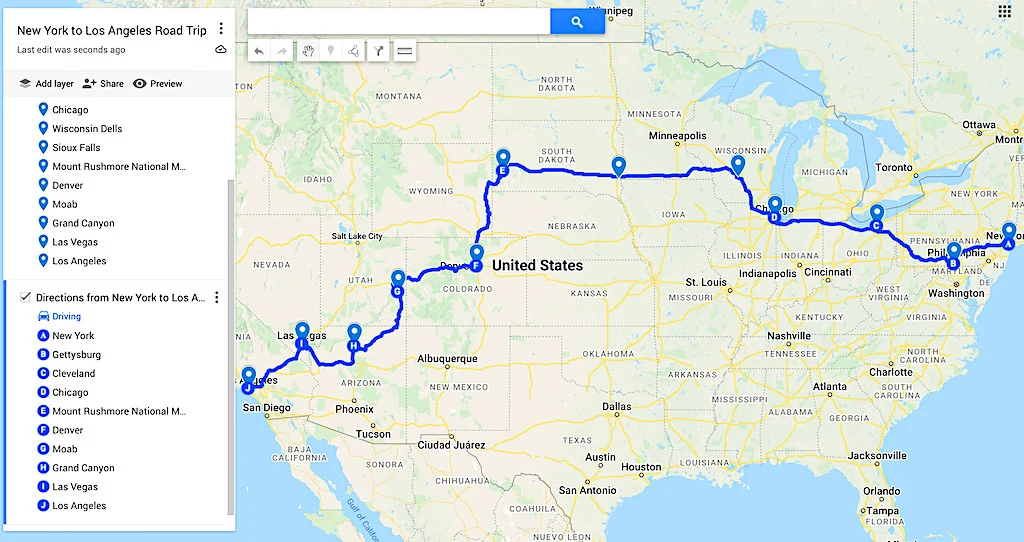
The distance between these two mega-cities is punctuated by some of the most famous landmarks in the world. Integrating these stops into your itinerary transforms a simple relocation into a grand adventure.
Natural Wonders and National Parks
Leaving Los Angeles, one of the first major stops for many is Joshua Tree National Park, known for its otherworldly rock formations. Further east in Arizona, the Grand Canyon offers a scale of natural beauty that is difficult to comprehend. If you take a slightly more northern detour, Zion National Park in Utah provides stunning red cliffs and unique hiking opportunities like The Narrows.
Urban Icons and Historical Sites
As you move into the Midwest, the Gateway Arch in St Louis serves as a symbolic marker of the “Gateway to the West.” In Chicago, travelers can admire the architecture of the Willis Tower or enjoy the lakefront. Approaching the East Coast, a stop in Philadelphia allows for a visit to Independence Hall and the Liberty Bell, providing a deep dive into the revolutionary history of the United States.
Logistics: Choosing Your Mode of Transport
Deciding how to bridge the 2,800-mile gap involves balancing time, budget, and the type of experience you desire. Each method of travel offers a different lens through which to view the country.
The Speed of Commercial Aviation
For most business travelers and vacationers with limited time, flying is the only logical choice. Dozens of flights depart daily from Los Angeles to the various New York City area airports, including LaGuardia Airport and Newark Liberty International Airport. This is the most efficient way to travel, allowing you to have breakfast near the Santa Monica Pier and dinner in Times Square.
The Romance of the Rail
For a slower, more scenic approach, Amtrak offers several transcontinental routes. While there is no single direct train from Los Angeles to New York City, travelers can take the Southwest Chief to Chicago and then transfer to the Lake Shore Limited or the Cardinal. This journey takes approximately three days and offers comfortable sleeper cars and dining services, allowing you to watch the Mississippi River and the Appalachian Mountains roll by from your window.
The Ultimate Road Trip
Driving remains the most flexible option. It allows for spontaneous detours to places like Sedona or Nashville. However, one must consider the costs of fuel, vehicle maintenance, and overnight stays in hotels or motels. It is a logistical challenge that requires careful planning, especially regarding weather conditions in the Sierra Nevada or the snowy plains of the Midwest.
Seasonal Travel: When to Make the Cross-Country Trek
The “when” is just as important as the “how” when traveling such a massive distance. The climate of the United States varies wildly, and your timing can significantly impact your safety and enjoyment.
Summer: The Peak Season
Summer is the most popular time for a cross-country trip, particularly for families. The days are long, and all mountain passes are open. However, travelers should be prepared for intense heat in the Mojave Desert and Texas. Additionally, major attractions like Yellowstone National Park (a common northern detour) and Central Park will be at their most crowded.
Winter: The Southern Route Necessity
Winter travel between Los Angeles and New York City requires caution. Heavy snowfall can close sections of Interstate 80 in Wyoming and Colorado. If you must drive during these months, sticking to the southern tier via New Mexico and the Gulf Coast is much safer. Conversely, seeing New York City decorated for the holidays is a magical experience that many find worth the cold.

Spring and Autumn: The Golden Windows
Many experienced travelers argue that late spring (May and June) or early autumn (September and October) are the best times to travel. The weather is generally mild across the entire country, and the foliage in regions like the Hudson Valley or the Blue Ridge Mountains is spectacular. During these shoulder seasons, the distance feels shorter as the comfortable climate makes every stop more enjoyable.
The journey from Los Angeles to New York City is more than just a measurement of 2,800 miles. It is a transition from the laid-back, “Golden State” energy of the West Coast to the relentless, “City That Never Sleeps” vibrance of the East Coast. Whether you are looking at the Hollywood Sign in your rearview mirror or the Empire State Building through your windshield, the distance between these two icons remains one of the greatest travel adventures in the world.
LifeOutOfTheBox is a participant in the Amazon Services LLC Associates Program, an affiliate advertising program designed to provide a means for sites to earn advertising fees by advertising and linking to Amazon.com. Amazon, the Amazon logo, AmazonSupply, and the AmazonSupply logo are trademarks of Amazon.com, Inc. or its affiliates. As an Amazon Associate we earn affiliate commissions from qualifying purchases.