
The allure of Hawaii is undeniable: pristine beaches, lush volcanic landscapes, a vibrant culture, and the promise of a true tropical escape. For many aspiring visitors, the primary hurdle isn’t choosing between Maui and Kauai, or deciding which Honolulu eatery to try first, but rather understanding the journey itself. The question of “How long is a plane ride to Hawaii?” is often the first logistical consideration, shaping travel plans, budgeting for time off, and setting expectations for the trans-Pacific adventure. This article delves into the realities of flying to the Aloha State, covering typical durations from various departure points, the factors that influence flight times, and essential tips for preparing for this significant journey.
The Geographic Reality: Why Flights to Hawaii Are Long-Haul
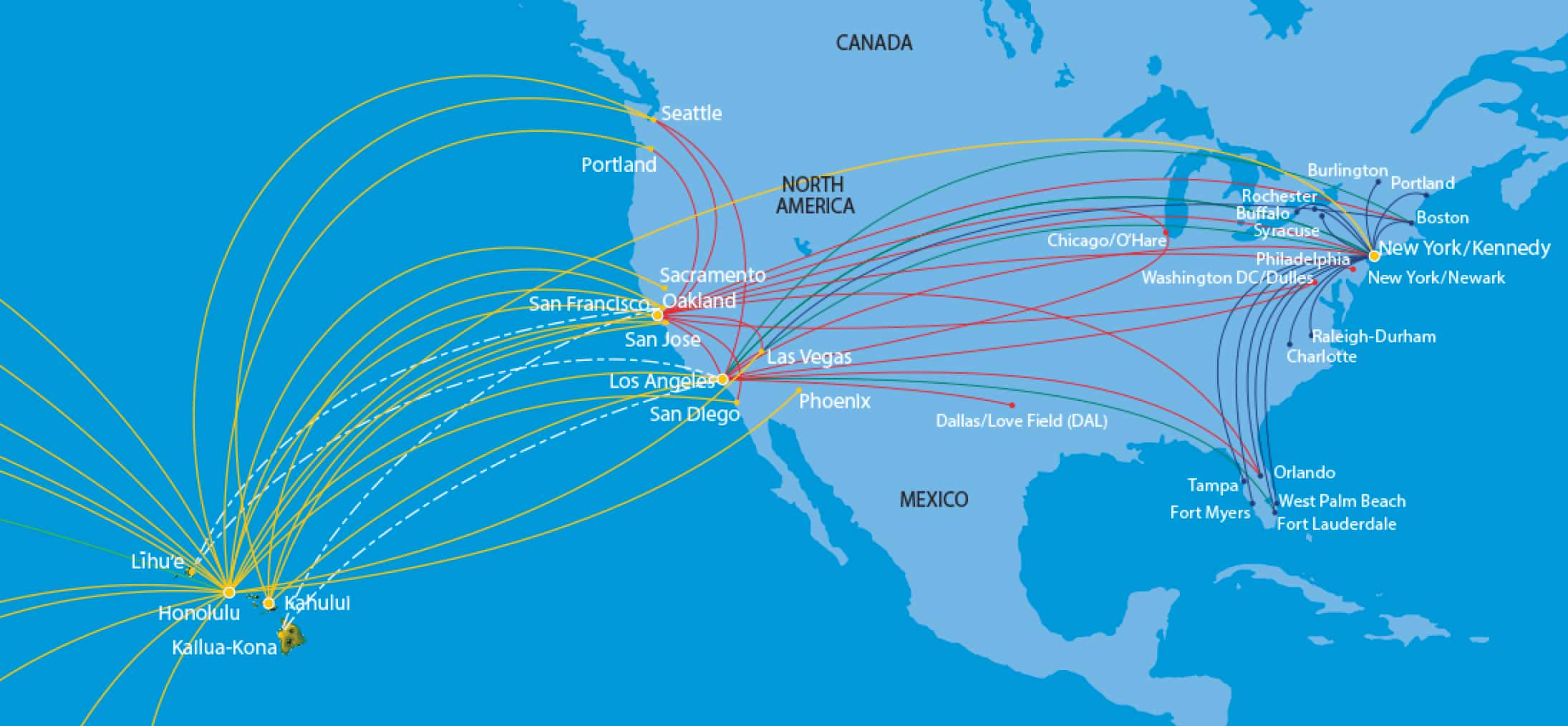
Hawaii’s appeal is intrinsically linked to its remote location. As the most isolated major population center on Earth, situated roughly in the middle of the Pacific Ocean, it’s a destination that demands a significant time commitment to reach by air. Understanding this geographic reality is crucial for setting realistic expectations for your travel duration.
The Isolated Jewel: Hawaii’s Unique Location
The Hawaiian Islands are approximately 2,400 miles (3,860 km) southwest of the U.S. mainland, 3,850 miles (6,200 km) southeast of Japan, and 4,900 miles (7,900 km) northeast of Australia. This vast expanse of ocean means that virtually all flights to the state are long-haul, requiring several hours in the air, regardless of your departure point. For travelers from the Continental United States, this translates into a journey across open water, a stark contrast to shorter domestic flights. This isolation is precisely what has preserved much of Hawaii’s unique ecosystem and cultural heritage, but it also dictates the nature of the travel experience.
Trans-Pacific Journeys: Understanding the Airspace
Flights across the Pacific Ocean are regulated by specific protocols designed to ensure safety and efficiency over vast stretches of water where diversion airports are few and far between. Modern twin-engine aircraft, such as the Boeing 787 Dreamliner or the Airbus A330, are ETOPS (Extended-range Twin-engine Operational Performance Standards) certified, meaning they can safely operate at a certain distance from a suitable airport. This allows airlines to fly more direct routes over the ocean, optimizing fuel efficiency and reducing flight times. However, the sheer distance remains the primary factor, and pilots must meticulously plan their routes to account for weather patterns, especially the powerful jet stream, which can significantly alter flight duration.
Typical Flight Durations from Major Departure Points
The duration of your flight to Hawaii largely depends on your starting location. Generally, the further east you are on the U.S. mainland, the longer your flight will be. International flights can vary even more dramatically.
West Coast Departures: The Quickest Routes
Travelers departing from the U.S. West Coast enjoy the shortest flight times to Hawaii. These flights are predominantly direct and offer the most convenient access to the islands.
- From Los Angeles (LAX) or San Francisco (SFO): Expect non-stop flights to take approximately 5 hours and 30 minutes to 6 hours.
- From Seattle (SEA) or Portland (PDX): Flights typically range from 5 hours and 45 minutes to 6 hours and 30 minutes.
These durations reflect the closest proximity of these major hubs to the Hawaiian Islands.
Central and Mountain States: Adding Hours
Moving eastward, flights from the Central United States and Mountain West will naturally take longer, often necessitating a layover, although direct flights are becoming more common from major cities.
- From Denver (DEN), Phoenix (PHX), Dallas (DFW), or Houston (IAH): Direct flights can range from 7 hours to 8 hours and 30 minutes. If a layover is involved, especially on the West Coast, the total travel time can easily extend to 10-12 hours or more, depending on the connection.
East Coast Departures: The Marathon Flights
For those originating on the U.S. East Coast, a trip to Hawaii is a true long-haul journey. While direct flights are available from some major hubs, they are less common and tend to be significantly longer.
- From New York (JFK/EWR), Boston (BOS), Miami (MIA), or Orlando (MCO): Non-stop flights, when available, can take between 9 hours and 11 hours. More commonly, travelers from these regions will have at least one layover, usually on the West Coast, pushing total travel time (including connections) to 12-18 hours or even more. This makes careful itinerary planning essential.
International Gateways: A Global Perspective
Hawaii also serves as a popular destination for international travelers. Flight durations from global cities vary widely:
- From Tokyo (NRT/HND), Japan: Approximately 7 hours to 7 hours and 30 minutes.
- From Sydney (SYD), Australia: Around 9 hours to 10 hours.
- From Vancouver (YVR), Canada: Typically 5 hours and 30 minutes to 6 hours.
These international routes highlight Hawaii’s strategic position as a trans-Pacific hub and tourist magnet.
Factors Influencing Your Flight Time
While average durations provide a good baseline, several variables can affect the actual time you spend in the air. Understanding these can help you anticipate potential adjustments to your travel schedule.
Direct vs. Connecting Flights: The Layovers Impact
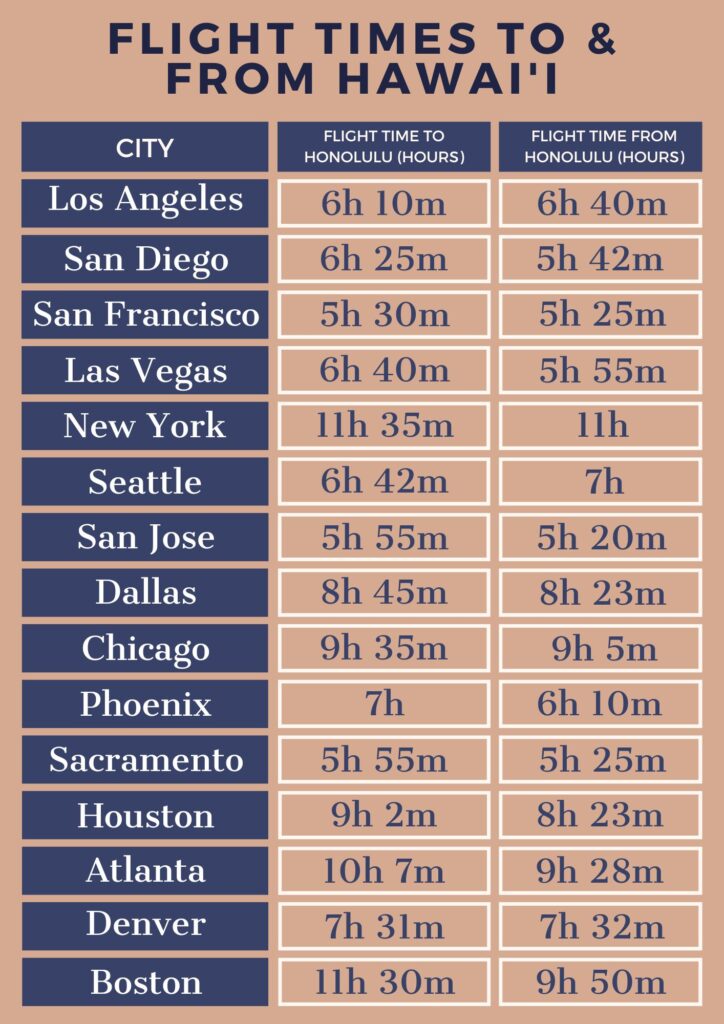
The most significant factor influencing total travel time is whether your flight is direct or involves one or more layovers. A direct flight takes you from your origin to your destination without any changes in aircraft or significant stops. A connecting flight, on the other hand, involves disembarking one plane, potentially changing terminals, and boarding another. While a direct flight from the East Coast might be 10 hours, a connecting flight could easily add 2-6 hours (or more) for the layover itself, extending the total journey significantly. For many travelers, especially from central or eastern North America, a connecting flight through a major West Coast hub like Los Angeles or San Francisco is the most common and often most economical option.
Aircraft Type and Airspeed: Modern Aviation’s Role
The type of aircraft used can also play a minor role in flight duration. Newer, more fuel-efficient planes like the Boeing 787 or Airbus A350 are designed for long-haul routes and can sometimes maintain slightly higher cruising speeds or more direct routes due to their operational capabilities. While the difference might only be 15-30 minutes on a multi-hour flight, it contributes to the overall efficiency of the journey. Older models might fly at slightly slower speeds or less optimal altitudes, marginally affecting flight time.
Jet Stream and Headwinds/Tailwinds: Nature’s Influence
Weather patterns, particularly the powerful jet stream, exert a considerable influence on trans-Pacific flight times. The jet stream is a fast-flowing, narrow air current found in the atmosphere.
- Tailwinds: When flying westward towards Hawaii from the U.S. mainland, flights often contend with headwinds, which can slow the aircraft down and add 30 minutes to an hour (or more) to the flight duration.
- Headwinds: Conversely, flights returning eastward from Hawaii frequently benefit from tailwinds, potentially shaving 30 minutes to an hour off the return journey.
Airlines factor these atmospheric conditions into their flight planning, but actual conditions on the day of travel can still lead to variations.
Air Traffic Control and Gate Delays: Unforeseen Variables
Beyond the actual flight time, various operational factors can add to your total travel duration. Air traffic control (ATC) restrictions, which manage the flow of aircraft in congested airspace, can lead to holding patterns or delayed departures. Similarly, gate availability at busy airports, ground crew issues, or unexpected maintenance can cause delays on the tarmac before takeoff or after landing. While not technically “flight time,” these elements are part of the overall journey and should be considered when planning connections or ground transportation upon arrival.
Navigating the Journey: Preparing for Your Hawaiian Flight
Given the significant flight durations, preparing adequately for your journey to Hawaii is essential for a comfortable and enjoyable travel experience.
Time Zone Differences and Jet Lag Management
Hawaii observes Hawaii Standard Time (HST) year-round and does not practice daylight saving time. This means significant time zone differences, especially for travelers from the East Coast, who will experience a 5-6 hour time change.
- Westward Travel: Flying westward often makes jet lag less severe upon arrival, as your day is extended. However, adjusting to an earlier bedtime can be challenging.
- Eastward Return: The return journey eastward can be tougher, as you lose hours, potentially causing more pronounced jet lag.
To combat jet lag, try to adjust your sleep schedule gradually before departure, stay hydrated on the flight, avoid excessive caffeine and alcohol, and expose yourself to natural light upon arrival to help reset your circadian rhythm.
Choosing Your Arrival Airport in Hawaii
Hawaii is served by several international and regional airports. Most long-haul flights from the U.S. mainland and international destinations arrive at Daniel K. Inouye International Airport (HNL) in Honolulu on Oahu. However, direct flights are increasingly available to other islands as well:
- Kahului Airport (OGG) on Maui
- Kona International Airport (KOA) on Hawaii Island (Big Island)
- Lihue Airport (LIH) on Kauai
- Ellison Onizuka Kona International Airport at Keahole (KOA) on the Big Island
If your final destination is not Oahu, consider a direct flight to your island of choice to avoid the additional time and hassle of an inter-island connection, which can add another 1-3 hours to your total journey.
In-Flight Comfort and Entertainment Tips
For flights lasting 5 hours or more, comfort is paramount.
- Clothing: Wear loose, comfortable clothing and layers, as cabin temperatures can fluctuate.
- Hydration: Drink plenty of water and avoid dehydrating beverages.
- Movement: Get up and walk around the cabin periodically, and perform simple stretches to prevent stiffness and reduce the risk of deep vein thrombosis.
- Entertainment: Most airlines offer extensive in-flight entertainment systems, but bringing your own loaded tablet, books, or puzzles can provide additional options. Noise-canceling headphones are a game-changer for long flights.
- Sleep Aids: An eye mask, neck pillow, and earplugs can significantly improve the quality of rest you get.
The Anticipation: Why the Journey is Worth It
While the duration of a plane ride to Hawaii is undeniably long, the rewards waiting at the destination far outweigh the time spent in transit.
Arrival in Paradise: The Reward
Touching down in Hawaii is an experience unlike any other. The moment you step off the plane, you’re greeted by warm, fragrant air, the sounds of distant crashing waves, and the vibrant colors of tropical foliage. The beauty of the islands, from the iconic shores of Waikiki Beach to the dramatic cliffs of the Na Pali Coast, quickly makes the journey a distant memory. This journey isn’t just a trip; it’s an immersion into a unique culture and breathtaking natural beauty that only Hawaii’s isolated location has preserved.
Planning Your Hawaiian Adventure
Knowing the flight duration allows you to plan your Hawaiian adventure more effectively. Factor in the travel day as a transition period, especially upon arrival, to allow for rest and adjustment to the new time zone. Give yourself a day or two to settle in before embarking on strenuous activities. Whether you’re planning to hike Diamond Head, surf at Maui’s famous breaks, explore the Volcanoes National Park on the Big Island, or simply relax on a black sand beach, proper planning around your flight schedule will ensure you arrive refreshed and ready to embrace the magic of the islands.
In conclusion, a plane ride to Hawaii is a significant commitment of time, typically ranging from 5.5 hours from the West Coast to 10+ hours from the East Coast (excluding layovers). However, with careful planning and an understanding of the factors involved, this journey across the Pacific becomes an integral part of the unforgettable experience of visiting one of the world’s most cherished travel destinations. Aloha!
LifeOutOfTheBox is a participant in the Amazon Services LLC Associates Program, an affiliate advertising program designed to provide a means for sites to earn advertising fees by advertising and linking to Amazon.com. Amazon, the Amazon logo, AmazonSupply, and the AmazonSupply logo are trademarks of Amazon.com, Inc. or its affiliates. As an Amazon Associate we earn affiliate commissions from qualifying purchases.