
Embarking on a journey from the sun-kissed beaches of Florida to the tropical paradise of Hawaii is an adventure that many dream of. However, given the vast geographical distance separating these two iconic American states, one of the most pressing questions for prospective travelers is often, “How long will the flight take?” The answer, while seemingly straightforward, is actually multi-faceted, involving complex logistics, several factors influencing travel time, and a significant commitment of hours in transit. Unlike shorter cross-country hops, a flight from [Florida] to [Hawaii] is a genuine long-haul expedition that demands preparation and an understanding of the journey ahead.

This article delves into the intricacies of this extensive air travel, providing a comprehensive guide to what you can expect in terms of flight duration, common routes, influential variables, and practical tips to make your journey as smooth as possible. Prepare to cross nearly the entire breadth of North America and a significant portion of the Pacific Ocean to reach the Aloha State.
Understanding the Great Distance and Time Zones
The sheer magnitude of the journey from [Florida] to [Hawaii] is often underestimated. These two states represent nearly opposite ends of the United States map, separated by thousands of miles of continental landmass and open ocean.
Geographical Perspective
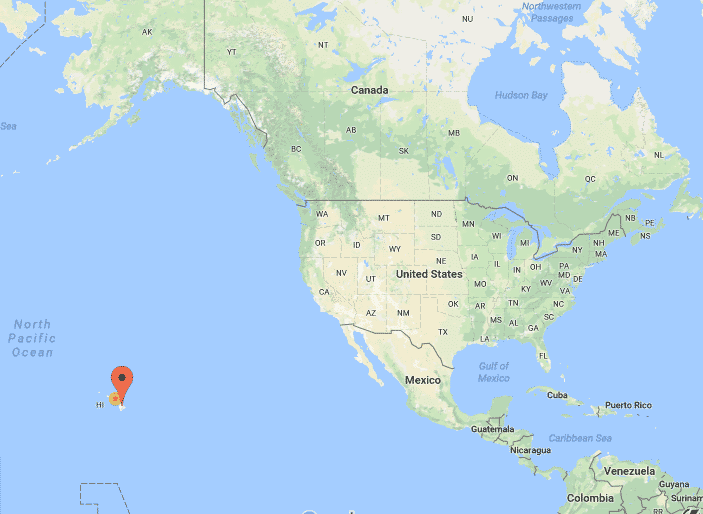
[Florida], situated on the southeastern tip of the contiguous United States, is about as far east as you can get within the country. [Hawaii], on the other hand, is an archipelago located deep in the central [Pacific Ocean], making it the westernmost state and the only one not located in [North America]. The direct “as the crow flies” distance between, for example, Miami and Honolulu is approximately 4,900 to 5,000 miles (around 7,900-8,050 kilometers). This vast expanse necessitates either an extremely long, rare direct flight or, more commonly, a journey involving at least one significant layover on the continental West Coast. No commercial airline currently offers a non-stop service from [Florida] to [Hawaii] due to this extreme distance and operational considerations.The Time Zone Challenge
Beyond the physical distance, travelers must contend with a substantial time zone difference. Most of [Florida] operates on the Eastern Time Zone (ET), while [Hawaii] observes Hawaii Standard Time (HST). There is a six-hour difference during Eastern Standard Time and a five-hour difference during Eastern Daylight Time (because [Hawaii] does not observe daylight saving). This means that if it’s noon in [Florida], it’s only 6 or 7 AM in [Hawaii]. This significant shift contributes to jet lag, making the “feeling” of the journey even longer upon arrival and requiring strategic planning for recovery.
Average Flight Durations and Common Routes
Since a direct commercial flight from [Florida] to [Hawaii] is not available, the journey invariably involves at least one stop, usually on the West Coast of the United States. This two-segment travel structure dictates the overall duration.
Typical Connecting Hubs
The vast majority of flights from [Florida] to [Hawaii] will route through a major hub city in the western or central United States. Common layover points include:
- West Coast: Los Angeles (LAX), San Francisco (SFO), Seattle (SEA), Phoenix (PHX). These are the most direct gateways to [Hawaii] once you’ve crossed the continental U.S.
- Central U.S.: Dallas/Fort Worth (DFW), Houston (IAH), Denver (DEN). These hubs serve as excellent intermediate stops, particularly for travelers starting from central [Florida] or the panhandle.
- Southeastern U.S.: Occasionally, flights might route through a major hub like Atlanta (ATL) first, then proceed to a West Coast hub. While efficient for connections, this often adds to the overall travel time due to the slightly indirect path.
Illustrative Flight Times
To give a realistic expectation, let’s break down the journey into typical segments and total travel times.
Segment 1: From Florida to the West Coast Hub
- Flights from major [Florida] cities such as [Miami], Orlando, or Tampa to a West Coast hub ([Los Angeles], [San Francisco], [Seattle]) typically range from 4.5 to 6.5 hours of actual flight time.
- Flights to central hubs ([Dallas/Fort Worth], [Houston], [Denver]) would be slightly shorter, around 3 to 4.5 hours.
Segment 2: From West Coast Hub to Hawaii
- Flights from West Coast hubs ([Los Angeles], [San Francisco], [Seattle]) to major Hawaiian airports like Honolulu International Airport (HNL) on Oahu, Kahului Airport (OGG) on Maui, or Kona International Airport (KOA) on Big Island generally take 5.5 to 6.5 hours.
Total In-Air Flight Time:
Adding these segments together, the pure flight time (wheels up to wheels down) from [Florida] to [Hawaii] will generally fall between 10 to 13 hours.
Total Travel Time (Including Layovers):
This is where the overall duration significantly expands. Factoring in layover times, which can range from 1.5 hours to several hours, the complete door-to-door travel time from [Florida] to [Hawaii] usually ranges from 14 to 20+ hours. For example:
- An efficient journey with a short layover might be 14-16 hours.
- A more common journey with a moderate layover (2-4 hours) could be 16-18 hours.
- Journeys with longer layovers or multiple stops could easily exceed 20 hours.
Factors Influencing Your Travel Time
Several variables can influence the precise duration of your flight to [Hawaii], making each journey unique. Understanding these can help in planning and setting expectations.
Departure and Arrival Cities
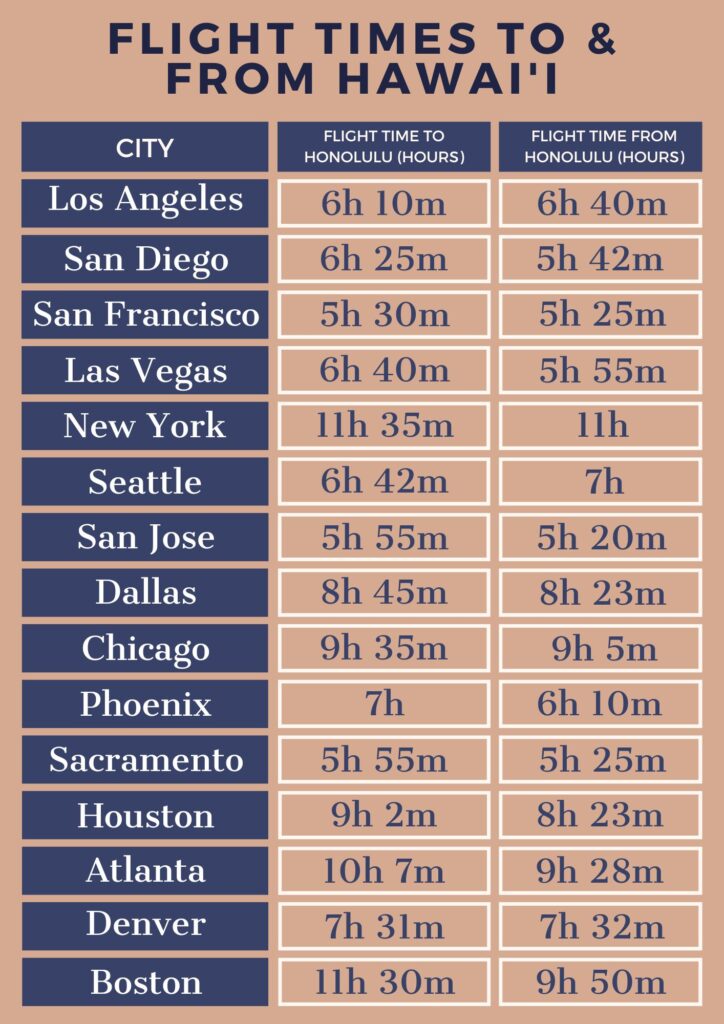
The specific starting point in [Florida] matters. Flying from [Miami] or [Orlando] will often have more direct route options to central or west coast hubs than, say, originating from Pensacola or [Jacksonville]. Similarly, your final destination in [Hawaii] also plays a role. While most international flights land at Honolulu International Airport on [Oahu], flying directly to Maui or Big Island might involve slightly different routing or add an inter-island flight (which will further extend total travel time) if your initial international flight cannot connect you directly to your island of choice. The smallest island airports, like Lihue (LIH) on Kauai, typically require a stop in [Honolulu] first.
Layover Duration and Efficiency
The length of your layover is arguably the most significant variable impacting total travel time. A meticulously planned itinerary with a short, efficient layover (e.g., 1.5-2 hours) can shave hours off the overall journey. However, a layover that is too short runs the risk of missing a connection due to delays. Conversely, choosing a flight with a longer layover (4+ hours) can provide a much-needed break to stretch, eat a proper meal, or even briefly exit the airport for some fresh air, but it inherently extends your travel day.
Airline and Aircraft Type
While less impactful than distance or layovers, the airline and the specific aircraft type can subtly affect flight times. Airlines flying the [Florida] to West Coast routes and then to [Hawaii] often include major carriers like United Airlines, American Airlines, Delta Air Lines, Southwest Airlines, Alaska Airlines, and Hawaiian Airlines. Newer, more fuel-efficient aircraft like the Boeing 787 Dreamliner or Airbus A350 might maintain slightly faster cruise speeds or take more direct routes, but these differences are usually marginal in the grand scheme of a multi-segment journey.
Weather and Air Traffic Control
Unforeseen circumstances like adverse weather conditions at your origin, destination, or en route can lead to delays, extending flight times. Strong headwinds over the [Pacific Ocean] can add 30-60 minutes to the West Coast to [Hawaii] segment. Air traffic control restrictions or unexpected mechanical issues can also contribute to longer travel durations. While these are usually beyond a traveler’s control, they are factors to be aware of.
Navigating the Journey: Tips for a Long-Haul Flight
A long-haul flight to [Hawaii] requires more than just booking a ticket; it demands thoughtful preparation to ensure comfort and minimize stress.
Preparation is Key
- Book Wisely: When choosing flights, pay close attention not just to the price but also to the total travel time and layover durations. Consider flying on weekdays, which are often less busy.
- Seat Selection: If possible, select your seats in advance. A window seat offers views and a wall to lean on, while an aisle seat provides easier access to stretch and use restrooms. For such a long journey, extra legroom seats (if available and within budget) are a worthy investment.
- Pack Essentials: Keep a well-stocked carry-on. This should include entertainment (books, loaded devices), necessary medications, a neck pillow, an eye mask, earplugs/noise-canceling headphones, and a light jacket or blanket.
- Check-in Online: Expedite your airport experience by checking in online 24 hours prior to departure. This also confirms your flight details and allows you to catch any last-minute gate changes.
Staying Comfortable
- Hydrate: Air cabin environments are notoriously dry. Drink plenty of water throughout your journey and avoid excessive alcohol and caffeine, which can contribute to dehydration.
- Move Regularly: Combat stiffness and the risk of deep vein thrombosis (DVT) by getting up and walking around the cabin every couple of hours. Perform simple stretches in your seat.
- Wear Comfortable Clothing: Opt for loose-fitting, breathable layers. Compression socks can also be beneficial for circulation on long flights.
- Eat Sensibly: While airline food is provided, consider bringing healthy snacks. Avoid heavy, greasy meals that can leave you feeling sluggish.
Conquering Jet Lag
The significant time difference to [Hawaii] means jet lag is almost inevitable.
- Pre-Adjust: A few days before your trip, try to gradually shift your sleep schedule closer to [Hawaii Standard Time]. Go to bed an hour earlier or later each night.
- Upon Arrival: Once you land, try to expose yourself to natural light, stay hydrated, and try to adopt the local time zone immediately for meals and sleep. Avoid napping for too long if it’s daytime in [Hawaii].
- Melatonin: Some travelers find melatonin helpful in resetting their sleep cycles, but consult a doctor first.
Layovers as Opportunities
Instead of viewing layovers solely as an inconvenience, consider them a break in the journey.
- Stretch and Refuel: Use the time to walk, stretch, and find healthier food options than what’s available on the plane.
- Freshen Up: Many larger airports have lounges with shower facilities, or simply use the restroom to freshen up.
- Stay Informed: Keep an eye on flight monitors for any gate changes or delays to your connecting flight.
Choosing Your Hawaiian Arrival Point
While Honolulu International Airport on [Oahu] is the primary gateway to [Hawaii] for most travelers, you have options for your final destination, which can affect your total travel time.
Oahu and Honolulu: The Main Hub
Most flights from the continental U.S., especially long-haul connections, will land at HNL. If your final destination is [Oahu], your journey effectively ends here, barring a short taxi or shuttle ride to your accommodation. This is generally the most straightforward and time-efficient way to arrive in [Hawaii].
Maui, Big Island, and Kauai: Beyond the First Stop
If your ultimate destination is another island like [Maui], [Big Island], or [Kauai], you will likely need to take an additional inter-island flight.
- These flights are typically short, ranging from 30 to 50 minutes.
- However, they add another segment to your journey, including additional check-in, security, and boarding times.
- Factor in an extra 3-5 hours for the entire inter-island transfer process when calculating your total door-to-door travel time. Some airlines offer direct flights from West Coast hubs to Maui or Kona, potentially bypassing [Honolulu] for those specific islands, but these are less frequent than flights to HNL.
In conclusion, flying from [Florida] to [Hawaii] is an undertaking that requires patience and preparation. While the “how long” question has a variable answer, expect a journey that spans at least 14 hours and can extend beyond 20, punctuated by a necessary layover on the U.S. West Coast. By understanding the logistics, preparing for the long hours, and managing the time zone change, you can transform this extensive travel day into the exciting gateway to your unforgettable Hawaiian escape.
LifeOutOfTheBox is a participant in the Amazon Services LLC Associates Program, an affiliate advertising program designed to provide a means for sites to earn advertising fees by advertising and linking to Amazon.com. Amazon, the Amazon logo, AmazonSupply, and the AmazonSupply logo are trademarks of Amazon.com, Inc. or its affiliates. As an Amazon Associate we earn affiliate commissions from qualifying purchases.