
The dream of a Hawaiian escape conjures images of sun-drenched beaches, lush volcanic landscapes, and the gentle rhythm of aloha. For many, the iconic archipelago represents the ultimate paradise, a serene haven far removed from the everyday. But before you can dip your toes into the warm waters off Maui or hike the breathtaking trails of Kauai, a fundamental question arises: how long will it actually take to get to Hawaii? The answer, while seemingly straightforward, depends on a fascinating array of factors, from your departure city to your chosen mode of transport and even the layovers you encounter along the way. This comprehensive guide will illuminate the various travel durations, ensuring you can plan your journey to the Aloha State with precision and anticipation.
The Allure of the Aloha State and Your Journey There
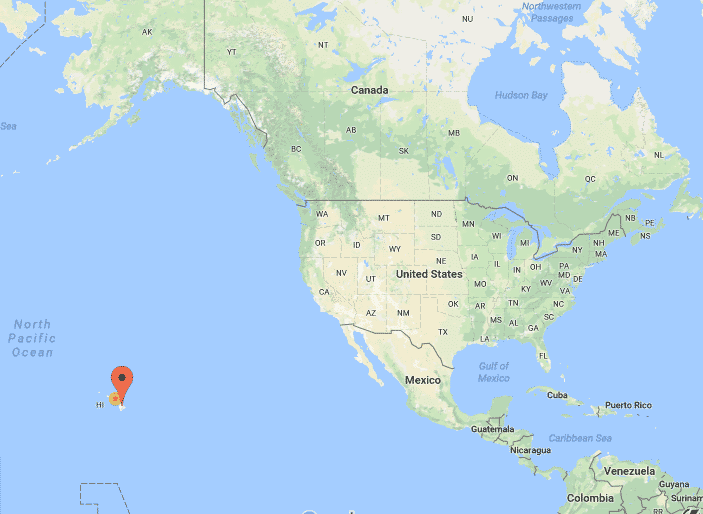
Hawaii, the only island state in the United States, is geographically isolated in the heart of the Pacific Ocean. This isolation is precisely what gives it its unique charm and mystique but also dictates the practicalities of travel. Unlike mainland destinations reachable by car or train, reaching Hawaii inherently involves a significant journey over water, making air travel the most common and efficient method for most visitors.
Understanding the duration of your trip is paramount for several reasons. Firstly, it impacts your overall itinerary, helping you allocate sufficient time for travel days without cutting into your precious vacation. Secondly, it plays a role in managing expectations, especially regarding potential jet lag given the significant time zone differences. Finally, knowing the travel time helps you pack appropriately and prepare for the journey itself, whether it’s a quick hop or a multi-leg international flight.
The primary factors influencing how long it takes to reach Hawaii are:
- Starting Location: The further you are from the mid-Pacific Ocean, the longer the journey.
- Mode of Transport: Flying is fastest; cruising is a leisurely alternative.
- Direct vs. Connecting Flights: Layovers significantly extend total travel time.
- Airport Procedures: Check-in, security, and boarding contribute to the overall experience.
Air Travel: The Swiftest Path Across the Pacific
For the vast majority of travelers, flying is the chosen method to reach Hawaii. It offers the fastest transit, transforming an oceanic expanse into a matter of hours rather than days. However, “fastest” is relative, and flight durations vary wildly depending on your origin.
From Mainland United States and Canada
Being part of North America, the United States and Canada enjoy the most frequent and shortest flight paths to Hawaii.
-
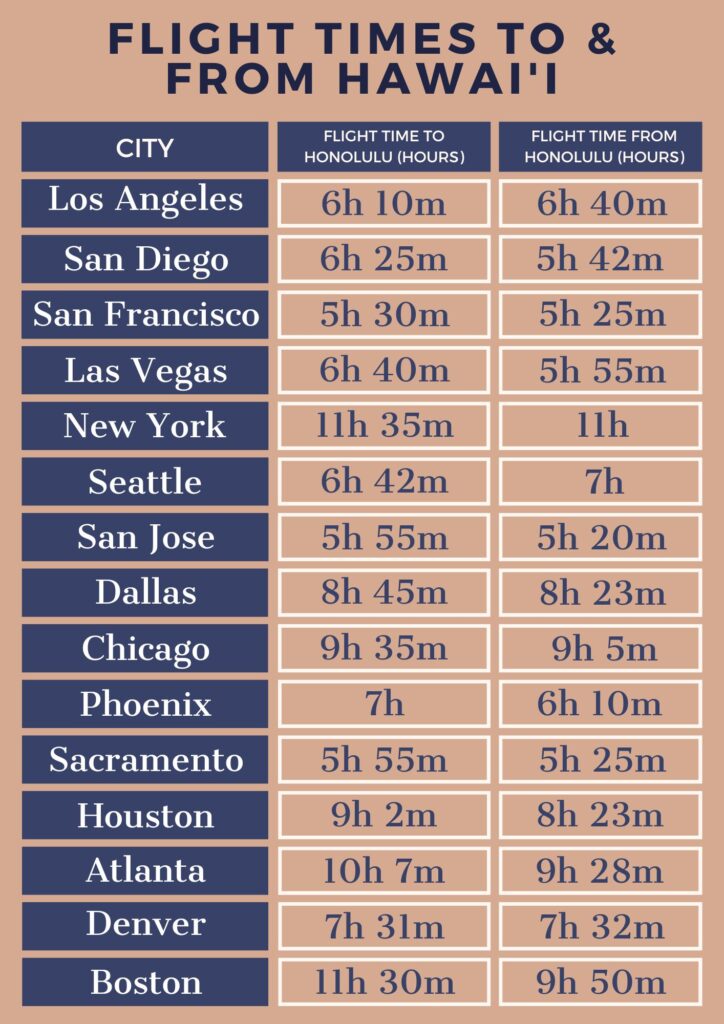
West Coast Departures: This is where the journey is shortest and most direct. Major hubs like Los Angeles, San Francisco, and Seattle in the United States, as well as Vancouver in Canada, offer numerous direct flights daily. A typical direct flight from these cities to Honolulu, Oahu, or Maui generally takes 5 to 6 hours. This makes Hawaii a relatively quick hop for residents of the West Coast.
-
Central and East Coast Departures: Traveling from the heartland or eastern seaboard of North America entails a more substantial journey. Direct flights are available from major hubs like Chicago, Dallas, Houston, Atlanta, New York, and Miami. These direct flights are significantly longer, typically ranging from 9 to 11 hours. Many travelers, however, opt for connecting flights, usually through a West Coast city such as Los Angeles or San Francisco. When factoring in a layover, the total travel time can easily stretch to 12 to 16 hours, sometimes even more, depending on the length of the connection.
Upon arrival, most international and mainland United States flights land at Daniel K. Inouye International Airport (HNL) in Honolulu on Oahu. However, direct flights are also increasingly available to other major Hawaiian airports, including Kahului Airport (OGG) on Maui, Kona International Airport (KOA) on the Big Island, and Lihue Airport (LIH) on Kauai. For travelers heading to a different island than their arrival point, inter-island flights, typically 30-45 minutes in duration, will add a little extra time to the total journey.
International Air Travel: Crossing Vast Oceans
For those traveling from further afield, reaching Hawaii involves an even more epic journey.
-
Asia and Oceania: Given Hawaii’s central Pacific location, it serves as a popular destination and stopover for travelers from Asia and Oceania.
- From Tokyo or Osaka, Japan, direct flights typically take 7 to 8 hours.
- From Seoul, South Korea, expect flights around 8 to 9 hours.
- From Sydney or Melbourne, Australia, or Auckland, New Zealand, direct flights generally take 9 to 10 hours.
These routes often have direct options, minimizing layover times.
-
Europe: Traveling from Europe to Hawaii is the longest air journey for most. There are no direct flights from Europe to Hawaii due to the immense distance. Travelers typically fly to a major hub on the West Coast of the United States or Canada (e.g., Los Angeles, San Francisco, Vancouver) before catching a connecting flight to Honolulu.
- From cities like London, Paris, or Frankfurt, the total travel time, including at least one layover, usually ranges from 15 to 20 hours or even more. This journey often spans across two calendar days due to time zone changes and long flight durations.
The Leisurely Voyage: Getting to Hawaii by Cruise Ship
While air travel is about speed, cruising to Hawaii offers a different kind of experience: the journey itself becomes part of the vacation. This mode of transport is ideal for those who prefer a more relaxed pace, enjoy the amenities of a ship, and want to unpack only once. However, it’s a significantly longer commitment.
Typical Cruise Durations and Departure Points
Cruises to Hawaii predominantly depart from West Coast ports in North America.
- Departure Ports: The most common embarkation points are Los Angeles, San Francisco, and San Diego in California, as well as Seattle in Washington and Vancouver in British Columbia, Canada.
- Duration: A one-way cruise from these West Coast cities to the first Hawaiian island typically takes 4 to 6 days at sea. A full round-trip cruise, which often includes several days sailing between islands and the return journey, can last anywhere from 10 to 18 days, with some extended itineraries even longer.
It’s important to note that these durations are purely for the sea travel segment. You would also need to factor in travel time to reach your departure port and any pre- or post-cruise stays. While slower, cruising offers the unique advantage of arriving in Hawaii fully relaxed, having enjoyed days of ocean views, onboard entertainment, and gourmet dining. Some cruise lines also offer inter-island cruises that start and end in Honolulu, allowing you to fly directly to Hawaii and then explore the islands by sea.
Factors That Add Time to Your Hawaiian Journey
While flight times and cruise durations provide a core estimate, several other factors can significantly impact your total travel time to Hawaii. Ignoring these can lead to rushed connections, stress, or simply an inaccurate perception of how long the journey will actually feel.
-
Layovers and Connections: This is perhaps the biggest variable in air travel. A seemingly short 8-hour flight from the East Coast that includes a 4-hour layover in Denver or Phoenix suddenly becomes a 12-hour journey. Longer layovers, while sometimes cheaper, extend travel significantly. When booking, always scrutinize the total elapsed time, not just the flight segments.
-
Airport Procedures: From arriving at the airport 2-3 hours before an international flight, navigating security checkpoints, waiting for boarding, and taxiing on the runway, these procedures add substantial time. Factor in at least 2-4 hours on top of your scheduled flight time for the airport experience alone, especially if you’re traveling during peak season or from a busy airport.
-
Time Zones: Crossing the Pacific Ocean means crossing multiple time zones. Hawaii Standard Time (HST) is 2-3 hours behind the West Coast of the United States and 5-6 hours behind the East Coast, with even larger differences for international travelers. While this doesn’t add to physical travel time, it can make the journey feel longer due to the “lost” hours, often resulting in jet lag upon arrival.
-
Ground Transportation: Once your plane touches down at Daniel K. Inouye International Airport in Honolulu or another Hawaiian airport, your journey isn’t quite over. You still need to collect your luggage, pass through customs (if applicable), and arrange transportation to your hotel or resort. This final leg, whether by taxi, shuttle, or rental car, can add anywhere from 30 minutes to 2 hours depending on traffic and your destination on Oahu, Maui, the Big Island, or Kauai.
Planning Your Perfect Hawaiian Arrival
With a clearer understanding of the various durations and influencing factors, you can effectively plan your journey to Hawaii.
-
Prioritize Direct Flights When Possible: If budget allows and direct flights are available from your region, they will almost always offer the most efficient and least stressful travel experience, minimizing the chance of missed connections and reducing overall travel time.
-
Book in Advance: Especially for peak travel seasons, securing your preferred flight times and connections well in advance can help avoid less desirable long layovers or inconvenient schedules.
-
Consider Time of Arrival: For long-haul flights, arriving in Hawaii in the afternoon or early evening can be beneficial. This allows you to check into your accommodation, have dinner, and then go to bed at a reasonable local time, helping to mitigate the effects of jet lag. Arriving too early in the morning might mean a very long day with little rest.
-
Prepare for the Journey: For longer flights, pack essentials in your carry-on, including entertainment, snacks, a travel pillow, and any medications. Staying hydrated and moving around the cabin when possible can also make a significant difference in your comfort upon arrival.
In conclusion, while the average flight from the West Coast of the United States to Hawaii might be a swift 5-6 hours, the true “how long” question encompasses much more. From the 12-16 hour odyssey from the East Coast (including layovers) to the 15-20+ hour transcontinental journey from Europe, or the multi-day cruise across the Pacific, getting to Hawaii is an integral part of the adventure. By understanding these durations and planning accordingly, you can ensure your arrival in the Aloha State is as smooth and enjoyable as the paradise that awaits. The journey may be long, but the reward of Hawaii’s unparalleled beauty and culture makes every minute worthwhile.
LifeOutOfTheBox is a participant in the Amazon Services LLC Associates Program, an affiliate advertising program designed to provide a means for sites to earn advertising fees by advertising and linking to Amazon.com. Amazon, the Amazon logo, AmazonSupply, and the AmazonSupply logo are trademarks of Amazon.com, Inc. or its affiliates. As an Amazon Associate we earn affiliate commissions from qualifying purchases.