
The question of the distance between Alaska and Russia captivates the imagination, hinting at ancient migrations, geopolitical boundaries, and the allure of extreme travel. While these two vast landmasses appear separated by the immense Pacific Ocean on a global map, their northernmost points share a remarkably close proximity, offering a unique geographical fascination for travelers and explorers alike. The answer isn’t a single number but rather a fascinating exploration of geography, history, and the potential for incredible journeys across one of the world’s most unique maritime borders.
The Astonishing Proximity: A Geographic Overview
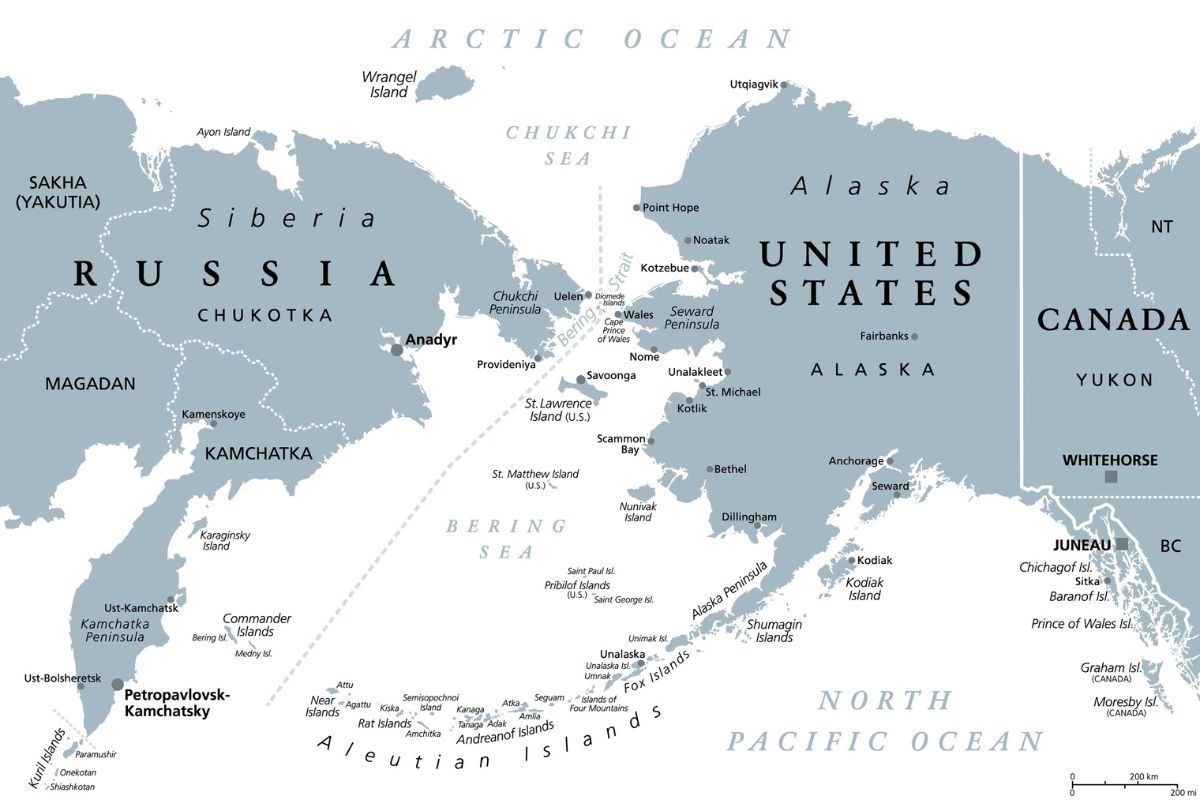
At its narrowest point, the stretch of water separating Alaska and Russia is astonishingly small. This critical waterway is known as the Bering Strait, a maritime passage that connects the Arctic Ocean to the Bering Sea and, by extension, the wider Pacific Ocean. Its significance extends far beyond mere geography, playing a pivotal role in global climate, ocean currents, and the history of human migration.

The Bering Strait and Its Islands
The true bottleneck of the distance lies between a pair of small islands nestled within the Bering Strait, known collectively as the Diomede Islands. These two islands act as stepping stones across the watery divide:
- Little Diomede Island: Belonging to the United States and part of Alaska, this island is home to an Iñupiat community.
- Big Diomede Island: Belonging to Russia, this island is uninhabited but hosts a Russian weather station and border guard post.
These two islands are separated by a mere 2.4 miles (approximately 3.8 kilometers) of water. This is the shortest distance between Alaska and Russia, making it possible to see one country from the other on a clear day. The international border, which also doubles as the International Date Line, runs directly between them. This means that Little Diomede Island is almost a full day behind Big Diomede Island in terms of calendar time, a truly unique temporal border.
Defining “Between”: Closest Points and Average Distances
While the Diomede Islands represent the absolute minimum separation, the distance between the mainlands of Alaska and Russia is slightly greater but still remarkably close.
- The closest point on the Alaskan mainland is Cape Prince of Wales.
- The closest point on the Russian mainland is Cape Dezhnev, the easternmost point of mainland Asia.
The distance between these two capes is approximately 55 miles (about 88 kilometers). This is still a relatively short distance in geological terms, especially when considering the vastness of the two nations involved. The average width of the entire Bering Strait itself is around 53 miles (85 kilometers), with an average depth of 100 to 165 feet (30 to 50 meters). These figures underscore the incredible geographical compression at this northern latitude, making it a critical point of interest for scientific research, historical understanding, and future travel considerations.
Historical Connections and Ancient Journeys
The proximity of Alaska and Russia has not always been a watery divide. For tens of thousands of years, this region served as a vital bridge, facilitating one of the most significant human migrations in history. Understanding this ancient connection provides profound insight into the region’s cultural and historical fabric.
The Bering Land Bridge: A Pathway to Continents
During the Pleistocene Epoch (the last Ice Age), massive glaciers locked up vast quantities of the Earth’s water, causing global sea levels to drop significantly. This dramatic change exposed a massive landmass that stretched across what is now the Bering Strait. This submerged landmass, often referred to as the Bering Land Bridge or Beringia, connected Asia and North America for thousands of years.
This exposed land, a vast, treeless plain, was rich in grasses and supported megafauna such as woolly mammoths, saber-toothed cats, and ancient bison. Crucially, it provided a pathway for early humans from Siberia to migrate into Alaska and, subsequently, spread throughout the Americas. This epic journey, undertaken by nomadic hunter-gatherers, represents the foundational migration that populated two continents. The Bering Land Bridge National Preserve in Alaska stands as a testament to this incredible chapter in human history, preserving a landscape that once hosted a vibrant ecosystem and the dawn of human presence in the New World.

Modern Day Remnants: Indigenous Communities
Even after the land bridge submerged around 11,000 years ago as the glaciers receded and sea levels rose, the proximity across the Bering Strait continued to foster connections. Indigenous communities on both sides—such as the Yupik and Inupiat peoples—share common cultural, linguistic, and familial ties, illustrating the deep historical bonds that transcend modern national borders. For centuries, these communities maintained contact, trading and hunting across the ice and open water. The “ice curtain” of the Cold War severely curtailed these interactions, but the shared heritage remains a powerful cultural link. Today, the people of Little Diomede Island in Alaska and those in coastal villages of Chukotka in Russia are living testaments to this enduring connection, facing similar challenges and opportunities in the harsh but beautiful Arctic environment.
Modern Travel Realities Across the Divide
Despite the close geographical proximity, crossing the Bering Strait between Alaska and Russia remains a formidable travel challenge. It is not a routine tourist route, largely due to political restrictions, extreme weather conditions, and the absence of established infrastructure. Yet, for adventurers and specialized expeditions, it represents one of the world’s most epic frontiers.
Navigating the Bering Strait: Expeditions and Cruises
Direct crossings between Alaska and Russia for leisure travelers are extremely rare and highly regulated.
- Expedition Cruises: The primary way for tourists to experience the Bering Strait region is through specialized expedition cruises. These typically depart from Nome, Alaska, or occasionally from Anadyr or Uelen in Chukotka, Russia. These voyages often explore the remote coastlines, Diomede Islands, St. Lawrence Island, and sometimes even Wrangel Island, offering unparalleled wildlife viewing (walruses, polar bears, seabirds) and cultural encounters with indigenous communities. Due to visa requirements and sensitive border areas, passengers typically remain on board or follow strict guided itineraries when visiting shorelines.
- Extreme Expeditions: Very occasionally, hardy adventurers undertake unique crossings, such as swimming, kayaking, or traversing the ice (when conditions permit and with proper permits). These are high-risk, logistically complex undertakings requiring extensive preparation, government permissions from both the United States and Russia, and often supported by experienced teams. Famous crossings include Lynne Cox‘s swim in 1987 and a successful overland vehicle expedition across the frozen strait in 2008. These remain highly exceptional feats, not accessible to the general public.
- “Ice Curtain”: During the Cold War, the border became known as the “ice curtain” due to the complete lack of contact between the United States and the Soviet Union across the strait. While some restrictions eased after the Cold War, travel across this border remains among the most tightly controlled in the world, requiring extensive permits and strict adherence to regulations.
The Dream of a Bering Strait Bridge or Tunnel
For over a century, the idea of a fixed link—either a bridge or a tunnel—across the Bering Strait has captured the imagination of engineers and politicians. Such a monumental project, sometimes called the “Intercontinental Peace Bridge” or the “Trans-Eurasian Belt Development,” would connect the railway networks of North America and Eurasia, creating a true global land route.
The primary proposed routes would generally follow the path of the Diomede Islands, utilizing them as mid-points. While technically feasible, the immense engineering challenges (permafrost, seismic activity, extreme weather, depth of water in some sections), astronomical costs (estimated in the hundreds of billions of dollars), and geopolitical complexities have prevented any concrete plans from moving forward. Nevertheless, the dream of a physical connection across this historically significant divide continues to symbolize humanity’s enduring ambition to conquer geographical barriers and foster global unity.
Unique Travel Experiences in the Bering Sea Region
For those who are drawn to the allure of extreme remoteness and untouched wilderness, the regions bordering the Bering Strait offer unparalleled travel experiences, albeit demanding careful planning and a spirit of adventure.
Exploring Remote Alaskan Wilderness
The Alaskan side of the Bering Strait is characterized by vast, unspoiled tundra, rugged coastlines, and a rich indigenous culture.
- Nome, Alaska: A historic gold rush town, Nome serves as the primary gateway to the Bering Strait region. It’s the finish line of the famous Iditarod Trail Sled Dog Race and offers unique opportunities for gold panning, wildlife viewing (muskoxen, reindeer), and experiencing Iñupiat culture. From Nome, small aircraft can take visitors to even more remote villages or for scenic flights over the strait towards the Diomede Islands.
- Bering Land Bridge National Preserve: Accessible primarily by bush plane or boat, this preserve offers a glimpse into prehistoric landscapes. It’s a land of volcanic fields, hot springs, and diverse wildlife, ideal for intrepid hikers and those interested in archaeology and paleontology.
- Wildlife Viewing: The Bering Sea is one of the most productive marine ecosystems in the world. Visitors to coastal Alaska can witness massive migrations of seabirds, observe walruses hauling out on beaches, and potentially spot whales and seals.
Discovering Chukotka: Russia’s Far East Frontier
On the Russian side, Chukotka is an equally wild and even more remote frontier. It is Russia’s easternmost region, a vast expanse of tundra, mountains, and Arctic coastline.
- Limited Access: Chukotka is a border zone, and access for foreign travelers is highly restricted, requiring special permits in addition to a Russian visa. Independent travel is virtually impossible, and most visits are facilitated by specialized tour operators or expedition cruises.
- Indigenous Cultures: The region is home to several indigenous peoples, including the Chukchi, Yupik, and Even, who maintain traditional lifestyles centered around reindeer herding, whaling, and sealing. Cultural immersion experiences, often featuring traditional dances, crafts, and food, are highlights of visits here.
- Anadyr: The capital of Chukotka, Anadyr is a colorful town on the Bering Sea coast, serving as the main transport hub. It offers a glimpse into modern Arctic life and Soviet-era architecture.
- Arctic Wildlife: Chukotka is a prime location for viewing polar bears, walruses, various seal species, and migratory birds. Wrangel Island, a UNESCO World Heritage Site north of Chukotka, is renowned as a polar bear denning ground and the last refuge of the woolly mammoth.
The short distance between Alaska and Russia across the Bering Strait is a geographical marvel. While crossing it remains an endeavor for the adventurous and well-prepared, the surrounding regions offer some of the most profound and untouched travel experiences on Earth, connecting travelers to ancient history, vibrant indigenous cultures, and unparalleled natural beauty at the very edge of the world.
LifeOutOfTheBox is a participant in the Amazon Services LLC Associates Program, an affiliate advertising program designed to provide a means for sites to earn advertising fees by advertising and linking to Amazon.com. Amazon, the Amazon logo, AmazonSupply, and the AmazonSupply logo are trademarks of Amazon.com, Inc. or its affiliates. As an Amazon Associate we earn affiliate commissions from qualifying purchases.