
Navigating the complexities of wage and hour laws, particularly in a jurisdiction as dynamic as California, is crucial for both employers and employees. Understanding how overtime pay is calculated is not merely a matter of compliance; it’s fundamental to ensuring fair compensation and fostering a productive work environment. This guide will delve into the intricacies of California’s overtime regulations, providing a clear framework for accurate calculation.
Understanding California’s Overtime Framework
California has specific rules that dictate when overtime pay is due. These rules are generally more generous to employees than federal standards, reflecting the state’s commitment to worker protections. The core principle is that employees who work beyond a standard workday or workweek are entitled to a higher rate of pay for those extra hours.
Daily Overtime
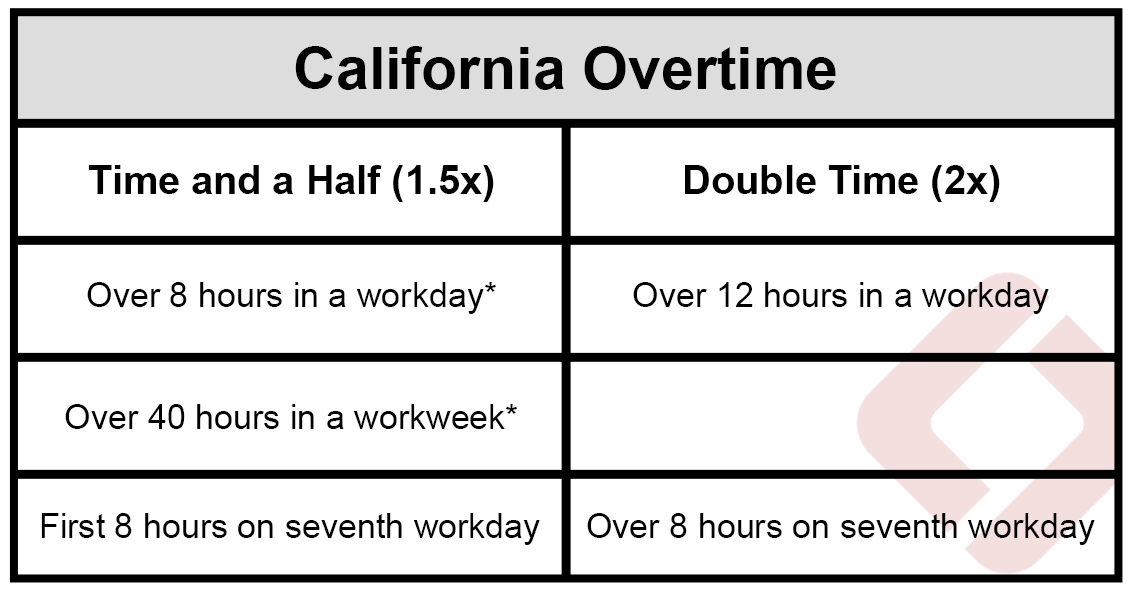
In California, daily overtime applies when an employee works more than eight hours in any single workday. A workday is defined as any consecutive 24-hour period beginning at the same time each calendar day. It does not necessarily align with a calendar day.
- The Standard Workday: A standard workday is typically considered eight hours.
- Overtime Trigger: Any hour worked beyond the eighth hour in a single workday is considered overtime.
- Rate of Pay: For daily overtime, employees must be paid at a rate of one and one-half (1.5) times their regular rate of pay.
Example: If an employee earns $20 per hour and works 10 hours in a single workday, the first eight hours are paid at their regular rate of $20/hour. The remaining two hours are overtime hours. The overtime pay for these two hours would be calculated as $20/hour * 1.5 = $30/hour. Thus, the total pay for that day would be (8 hours * $20/hour) + (2 hours * $30/hour) = $160 + $60 = $220.
Weekly Overtime
In addition to daily overtime, California also mandates weekly overtime. This applies when an employee works more than 40 hours in a single workweek. A workweek is defined as any consecutive seven-day period, starting on the same day and at the same hour each week.
- The Standard Workweek: A standard workweek is considered 40 hours.
- Overtime Trigger: Any hour worked beyond the 40th hour in a single workweek is considered overtime, regardless of whether daily overtime has already been paid for some of those hours.
- Rate of Pay: For weekly overtime, employees must be paid at a rate of one and one-half (1.5) times their regular rate of pay.
Example: If an employee works 12 hours on Monday, 10 hours on Tuesday, 8 hours on Wednesday, 10 hours on Thursday, and 10 hours on Friday, their total hours for the week are 50.
- Monday: 8 hours regular + 4 hours daily overtime (paid at 1.5x)
- Tuesday: 8 hours regular + 2 hours daily overtime (paid at 1.5x)
- Wednesday: 8 hours regular
- Thursday: 8 hours regular + 2 hours daily overtime (paid at 1.5x)
- Friday: 8 hours regular + 2 hours daily overtime (paid at 1.5x)
In this scenario, the employee has already earned daily overtime for 10 hours (4+2+2+2). When calculating weekly overtime, we look at the total 50 hours. The first 40 hours are accounted for. The remaining 10 hours are where weekly overtime is considered. Since daily overtime has already been paid for these hours at 1.5x, the employer must ensure that the total compensation for these hours meets the requirements. In this specific example, all hours worked beyond 8 in a day have already been paid at the 1.5x rate, effectively covering the weekly overtime requirement for those hours. However, if an employee worked, for instance, 6 hours each day Monday through Friday, and then an additional 10 hours on Saturday, they would have 30 regular hours and 10 overtime hours for the week, all paid at 1.5x their regular rate.
Double Time
California also has a provision for double time pay, which is an even higher rate for hours worked under specific circumstances.
- Trigger for Double Time: Double time pay (twice the regular rate) is required for all hours worked in excess of 12 hours in a single workday, or in excess of 8 hours on the seventh consecutive day of work in a workweek.
- Rate of Pay: Double time pay means employees must be paid at a rate of two (2) times their regular rate of pay.
Example: If an employee works 13 hours in a single workday, the first 8 hours are paid at the regular rate, hours 9 through 12 are paid at the daily overtime rate (1.5x), and the 13th hour is paid at the double time rate (2x).
Example of Double Time on the Seventh Consecutive Day: Consider an employee who works 8 hours each day for six consecutive days. On the seventh consecutive day, if they work for 9 hours, the first 8 hours of that seventh day are paid at 1.5 times their regular rate (as they exceed 8 hours on the seventh consecutive day), and the 9th hour is paid at 2 times their regular rate (as it exceeds 8 hours on the seventh consecutive day).
Calculating the Regular Rate of Pay
The “regular rate of pay” is the foundation for calculating overtime. It’s not always as simple as the hourly wage. For non-exempt employees, the regular rate includes all remuneration for employment paid to the employee, with a few specific statutory exclusions. This means bonuses, commissions, and other forms of compensation must be factored into the regular rate calculation.
Components of the Regular Rate
- Hourly Wage: The most straightforward component.
- Commissions: If an employee earns commissions, these generally must be included in the regular rate.
- Bonuses: Most discretionary and non-discretionary bonuses need to be included.
- Shift Differentials: Additional pay for working certain shifts.
- On-Call Pay: Compensation for being available to work.
- Other Forms of Remuneration: Any payment made as a condition of employment.
Statutory Exclusions
There are limited statutory exclusions, such as:
- Sums paid as gifts or as a result of special occasion.
- Payments made for periods when the employee is not reporting to work (e.g., vacation pay, sick pay, holiday pay, holiday premium pay).
- Discretionary bonuses.
- Payments for periods of absence from work for which the employee is paid for less than a full workday, or for which the employee is paid pursuant to a sick leave, or to a retirement, or other plan.

The Calculation Process
To calculate the regular rate when a non-hourly component is involved, you typically follow these steps:
- Determine the Pay Period: Identify the period for which overtime is being calculated (e.g., weekly).
- Sum Total Compensation: Add up all compensation paid to the employee during that pay period, including hourly wages and any applicable non-wage compensation (like commissions or non-discretionary bonuses earned during that period).
- Sum Total Hours Worked: Add up all the hours the employee worked during that pay period.
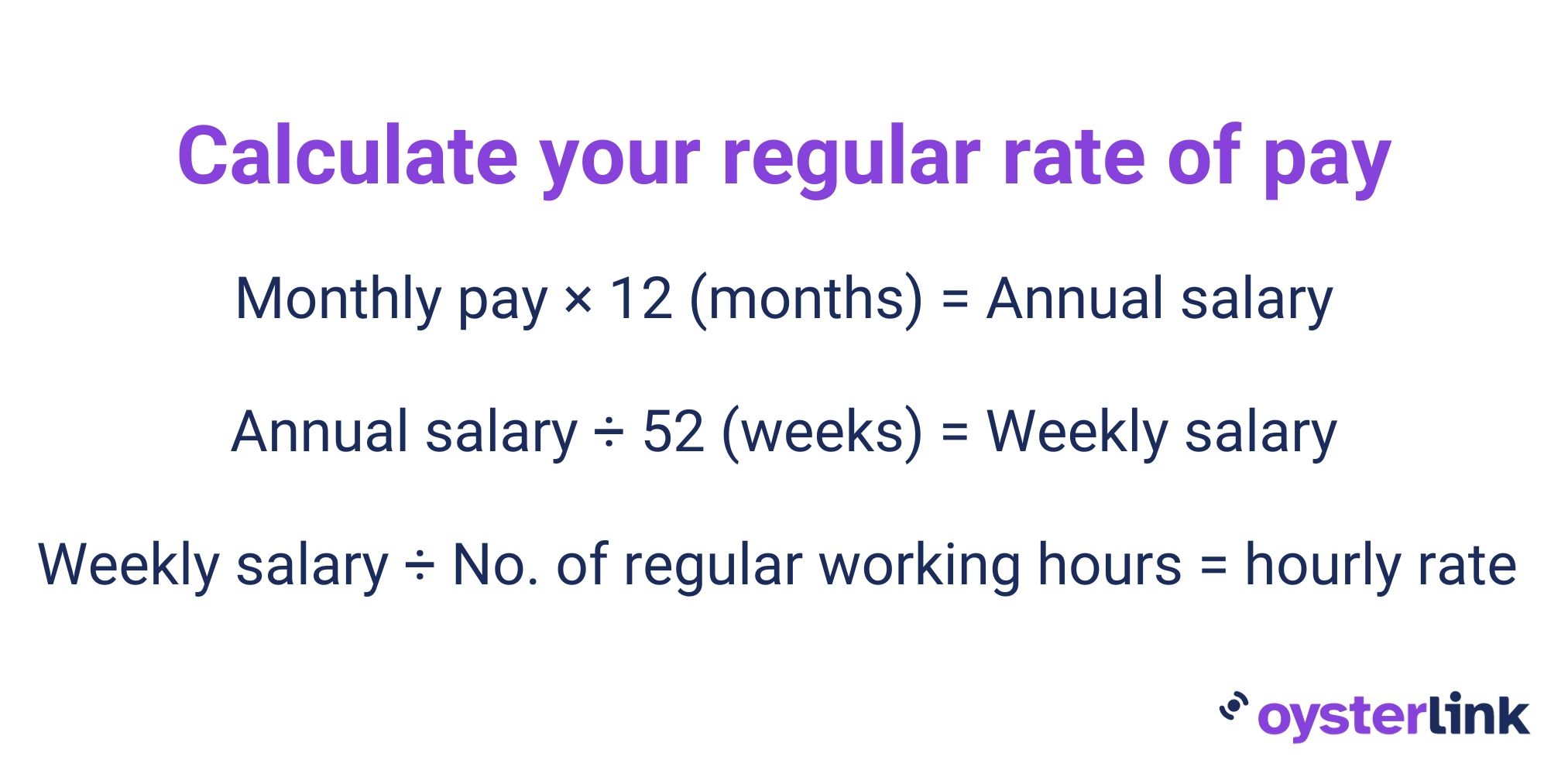
- Calculate the Regular Rate: Divide the total compensation by the total hours worked. This gives you the regular rate of pay for that period.
Example: An employee earns $20 per hour and also earned a $200 commission during a particular week. They worked 45 hours that week.
- Hourly Pay: 45 hours * $20/hour = $900
- Total Compensation: $900 + $200 (commission) = $1100
- Total Hours Worked: 45 hours
- Regular Rate of Pay: $1100 / 45 hours = $24.44 per hour (approximately)
Now, overtime can be calculated based on this regular rate. In this example, 5 hours are overtime hours (45 total hours – 40 standard hours).
- Overtime Pay: 5 hours * ($24.44/hour * 1.5) = 5 hours * $36.66/hour = $183.30
The employee’s total pay for the week would be their regular hourly pay for 40 hours plus the overtime pay, plus the commission: (40 hours * $20/hour) + $183.30 = $800 + $183.30 = $983.30. Correction: The commission was already included in the calculation of the regular rate of pay, so the total pay is simply the total compensation for the period. The hourly portion of the pay for the 45 hours, adjusted for overtime premium, plus the commission.
A more accurate way to think about it is:
The employee earned $1100 for 45 hours of work. The regular rate is $24.44/hour.
For the first 40 hours, the employee is due $24.44/hour * 40 hours = $977.60.
For the 5 overtime hours, the employee is due an overtime premium. The overtime premium is 0.5 times the regular rate ($24.44 * 0.5 = $12.22).
So, the overtime premium is 5 hours * $12.22/hour = $61.10.
The total pay is the sum of the base pay for all hours (at the regular rate) plus the overtime premium: $977.60 (base pay for 45 hours) + $61.10 (overtime premium) = $1038.70. This represents the total compensation that would be due if we were to strictly separate base pay and overtime premium.
However, a simpler and legally compliant method is to calculate the total compensation for the period and then calculate the overtime premium separately.
Total Compensation = $1100.
Regular Rate = $24.44/hour.
Overtime Hours = 5.
Overtime Premium Rate = $24.44 * 0.5 = $12.22/hour.
Total Overtime Premium = 5 hours * $12.22/hour = $61.10.
Total Pay = Total Compensation + Total Overtime Premium = $1100 + $61.10 = $1161.10.
This second method ensures that the employee receives their full regular rate for all hours worked, plus the additional premium for overtime hours.
Exemptions and Special Cases
Not all employees are entitled to overtime pay in California. The most common reason for exemption is the employee’s job duties and salary.
Executive, Administrative, and Professional Exemptions
To qualify for these exemptions, employees must meet both a salary threshold and specific duties tests.
- Salary Basis: The employee must be paid a fixed salary that is at least twice the state minimum wage for a full-time employee, and this salary must be paid regardless of the quantity or quality of work performed.
- Duties Test: The employee’s primary duties must fall within the recognized definitions of executive, administrative, or professional roles. This often involves exercising discretion and independent judgment in significant matters.
Other Exemptions
Other less common exemptions include outside sales employees, certain computer professionals (though this exemption has specific requirements), and those working in specific industries with unique regulations.
Industries with Special Rules
Certain industries, such as healthcare, transportation, and agriculture, may have specific overtime rules that differ from the general provisions. It is crucial to consult the relevant industry-specific regulations. For instance, healthcare facilities often have regulations regarding consecutive workdays and mandatory rest periods.
Record-Keeping and Compliance
Accurate record-keeping is paramount for businesses operating under California’s overtime laws. Employers are legally required to maintain detailed records of hours worked and wages paid.
Essential Records to Maintain
- Employee Information: Name, address, social security number, occupation, date of birth (if under 19).
- Hours Worked: Daily and weekly records of total hours worked by each non-exempt employee. This includes start and end times, meal breaks, and any time spent on call.
- Wage Rate: Regular rate of pay, including all compensation elements.
- Pay Deductions: Details of any deductions made from wages.
- Total Wages Paid: Records of gross and net wages paid for each pay period.
Consequences of Non-Compliance
Failure to comply with California’s overtime laws can lead to significant penalties, including back wages, liquidated damages, attorney’s fees, and civil penalties. The California Labor Commissioner’s Office actively enforces these regulations.
Staying Updated
Labor laws are subject to change. Employers and HR professionals should make it a priority to stay informed about updates to minimum wage, overtime rules, and other wage and hour regulations in California. Consulting with legal counsel specializing in employment law is highly recommended to ensure ongoing compliance and best practices. By diligently understanding and applying these principles, businesses can ensure fair treatment of their employees and operate within the legal framework of California.
LifeOutOfTheBox is a participant in the Amazon Services LLC Associates Program, an affiliate advertising program designed to provide a means for sites to earn advertising fees by advertising and linking to Amazon.com. Amazon, the Amazon logo, AmazonSupply, and the AmazonSupply logo are trademarks of Amazon.com, Inc. or its affiliates. As an Amazon Associate we earn affiliate commissions from qualifying purchases.