
New York City, a vibrant tapestry woven from towering skyscrapers, bustling streets, and iconic landmarks, offers an inexhaustible wellspring of inspiration for artists. Capturing its essence on paper, however, requires more than just a cursory glance. It demands an understanding of its unique character, its architectural rhythms, and the dynamic energy that pulsates through its five boroughs. This guide will delve into the art of drawing New York, transforming the cityscape into compelling visual narratives, and exploring how to translate its dynamism and grandeur onto the page.
Capturing the Iconic Skyline: From Foundation to Flair
The quintessential image of New York is undeniably its skyline. This collection of architectural marvels, from historic structures to modern behemoths, defines the city’s profile against the horizon. To effectively draw it, one must consider the foundational elements that create its distinctive silhouette.

Understanding Architectural Silhouettes and Forms
Before adding intricate details, it’s crucial to grasp the basic shapes and volumes of New York’s most recognizable buildings. Think of the geometric simplicity of the Empire State Building – a series of receding rectangular prisms culminating in a pointed spire. Contrast this with the stepped Art Deco elegance of the Chrysler Building, or the sheer, monolithic presence of One World Trade Center.
Begin by sketching the dominant forms. Use simple geometric shapes – rectangles, squares, triangles – to block out the overall mass of each building. Pay attention to their relative heights and widths. Don’t be afraid to exaggerate certain proportions to emphasize their impact. The angle of your viewpoint will significantly alter these forms; a low angle will make buildings appear taller and more imposing, while a high angle will reveal more of their tops and create a sense of looking down upon the city.
Delineating Iconic Structures: Key Buildings and Their Details
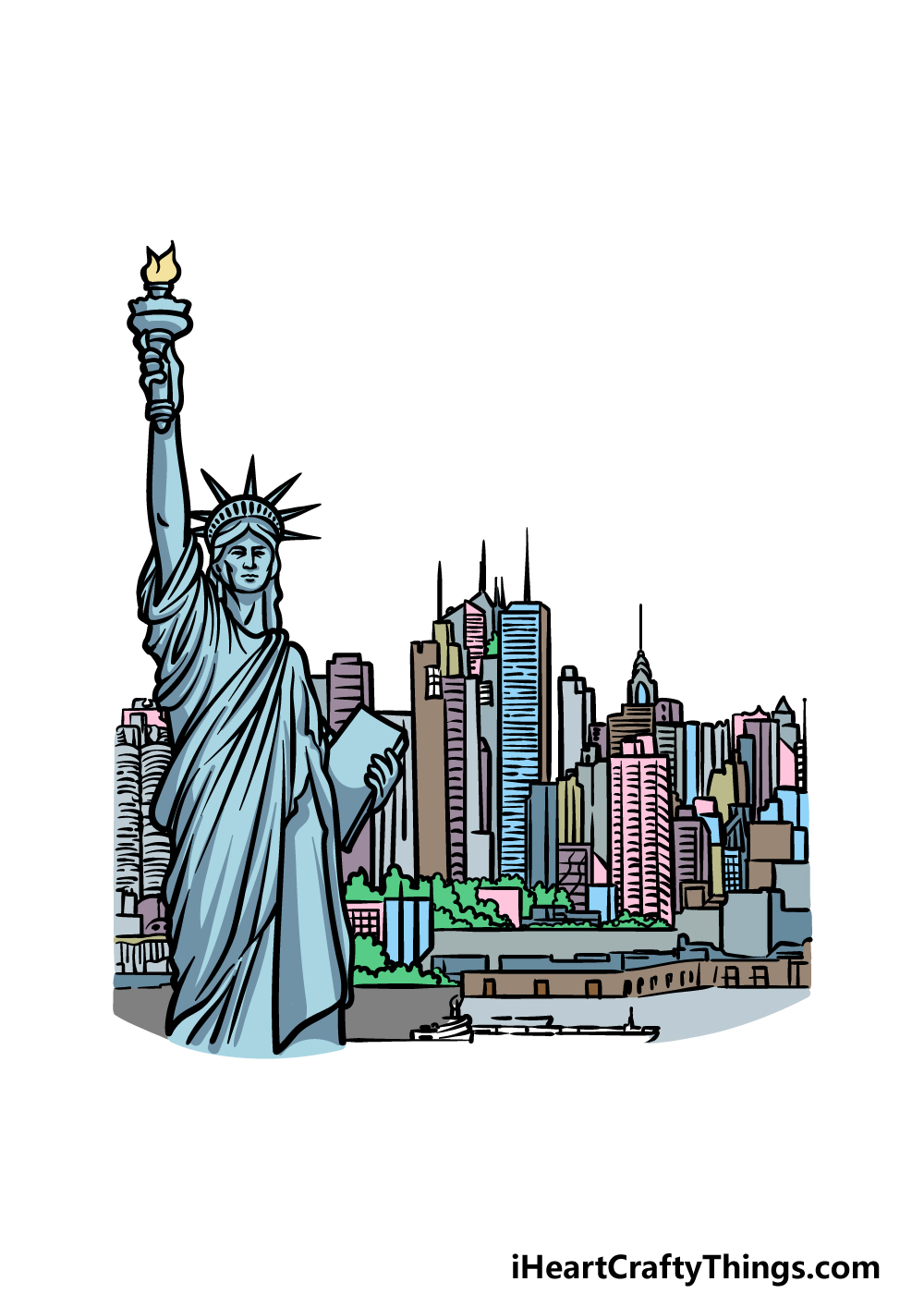
Once the foundational shapes are established, begin to refine them with key architectural features. The Empire State Building, for instance, is characterized by its setbacks, its distinctive spire, and the vertical lines of its windows. The Chrysler Building is famous for its gargoyles and its radiant, sunburst-like crown. The Statue of Liberty, though not a skyscraper, is an essential element of many New York views, with its flowing robes and torch needing careful observation.
Focus on capturing the essence of these details without getting bogged down in excessive minutiae. For older buildings, consider the ornamentation, the window styles, and the materials suggested by texture. For modern structures, emphasize clean lines, glass facades, and innovative shapes. The interplay of light and shadow on these forms is also paramount. Use shading to define edges, create depth, and suggest the materials from which the buildings are constructed. A sharp, defined shadow can convey the harshness of sunlight on steel and glass, while softer shadows might suggest older brickwork.
Creating Depth and Perspective: The Illusion of Immensity
Drawing a skyline effectively is an exercise in perspective. New York’s urban landscape is characterized by its density and the way buildings recede into the distance. Understanding one-point and two-point perspective is essential for creating a believable sense of depth.
When drawing buildings that are angled away from you, use two-point perspective, where vertical lines remain vertical, but horizontal lines converge to vanishing points on the horizon. For buildings viewed directly head-on, one-point perspective is sufficient, with all parallel receding lines meeting at a single vanishing point. The further buildings are from your viewpoint, the smaller they should appear, and their details will become less distinct. Employ atmospheric perspective by using lighter values and less contrast for objects in the distance, mimicking how haze and distance soften colors and edges. This technique is crucial for conveying the vastness of the city.
Infusing Life into the Streets: The Human Element and Urban Dynamics
A New York drawing is incomplete without the energy of its streets. The city is defined not only by its architecture but by the millions of people who inhabit it and the constant motion that characterizes its public spaces.
Capturing Movement and Activity: People, Vehicles, and Energy
The streets of New York are a constant stream of activity. To bring your drawings to life, consider incorporating figures, vehicles, and elements that suggest motion. Even a few well-placed silhouettes of pedestrians can imbue a scene with life. Think about their posture, their direction of travel, and their interactions. Are they rushing to work, strolling through Central Park, or pausing to admire a street performer?

Vehicles, from iconic yellow cabs to bustling subway entrances, are also integral to the urban fabric. Suggest the blur of motion of passing cars with quick, directional strokes. The rumble of a subway train can be implied through subtle distortions or the suggestion of movement around a station entrance. The overall goal is to convey a sense of dynamism, a feeling that the city is alive and in perpetual motion. This can be achieved through line weight variations, energetic marks, and the careful placement of elements that suggest activity.
Depicting the Iconic Streetscape: From Avenues to Alleyways
New York’s streetscape is incredibly diverse. The wide, grand avenues of Manhattan offer a different character than the charming brownstones of Brooklyn or the bustling commercial hubs of Queens. Each area has its own visual language.
When drawing an avenue, consider the repetition of building facades, the patterns of streetlights, and the signs that adorn storefronts. The sense of scale can be enhanced by depicting figures walking on the sidewalks, appearing small against the towering buildings. In contrast, drawing a quieter street might focus on the architectural details of brownstones, the ironwork of fire escapes, and the leafy canopies of trees. Don’t overlook the details that make New York unique: the ubiquitous fire escapes, the intricate street signs, the steam rising from manhole covers, and the diverse array of shops and businesses.
Adding Sensory Details: Light, Weather, and Atmosphere
The atmosphere of New York can be just as important as its physical form. Consider how light interacts with the urban environment throughout the day and in different weather conditions. A bright, sunny day will cast sharp shadows and create vibrant colors. A foggy morning might soften edges and create a more mysterious mood. Rain can create reflections on wet streets, adding a layer of visual interest.
Think about the quality of light. Is it the harsh glare of midday sun reflecting off glass towers, or the warm, golden light of sunset bathing the city in a soft glow? The way you render light and shadow will significantly impact the mood and realism of your drawing. Consider adding elements like steam rising from vents, rain puddles, or gusts of wind to further enhance the sense of atmosphere and bring your drawing to life.
The Art of Observation: Finding Your New York
Ultimately, drawing New York is a deeply personal experience. It’s about observing the city, understanding its rhythms, and translating your unique perspective onto paper.
Choosing Your Subject: From Grand Views to Intimate Details
New York offers an infinite number of subjects. You might be drawn to the sweeping panorama of the Manhattan skyline viewed from across the East River, or the intimate details of a quaint cafe in Greenwich Village. Perhaps the energy of Times Square, with its dazzling billboards, or the quiet contemplation offered by the Metropolitan Museum of Art will capture your imagination.
Don’t feel compelled to draw the most famous landmarks. Sometimes, the most compelling drawings come from observing the less obvious. A study of the intricate patterns of a fire escape, the play of light on a row of brownstones, or the candid expression of a street vendor can be just as powerful as a grand vista. Allow your curiosity to guide you.
Developing Your Style: Techniques and Mediums
The medium and techniques you choose will greatly influence the final outcome of your drawing. Charcoal can create bold, dramatic effects, ideal for capturing the grittiness of the urban environment. Pencils offer a range of tones and can be used for detailed renderings. Ink can produce crisp lines and strong contrasts, perfect for architectural subjects. Experiment with different approaches to find what best suits your vision.
Consider the texture you want to achieve. Do you want to convey the smoothness of glass, the roughness of brick, or the worn surface of cobblestone? The way you apply your medium – whether through cross-hatching, stippling, smudging, or bold brushstrokes – will contribute to the overall texture and feel of your drawing. Don’t be afraid to blend techniques to create unique effects.
Practicing and Refining: The Journey of a New York Artist
Like any skill, drawing New York improves with practice. The more you observe and sketch, the better you will become at capturing its essence. Dedicate time to regular drawing sessions, whether it’s sketching in a park, observing from a cafe window, or working from photographs.
Analyze your drawings. What worked well? What could be improved? Seek feedback from other artists. The process of drawing New York is a continuous journey of learning and refinement. By approaching it with patience, keen observation, and a willingness to experiment, you can create drawings that not only depict the city but also evoke its spirit and tell its unique story.
LifeOutOfTheBox is a participant in the Amazon Services LLC Associates Program, an affiliate advertising program designed to provide a means for sites to earn advertising fees by advertising and linking to Amazon.com. Amazon, the Amazon logo, AmazonSupply, and the AmazonSupply logo are trademarks of Amazon.com, Inc. or its affiliates. As an Amazon Associate we earn affiliate commissions from qualifying purchases.