
The Sunshine State is renowned for its abundant sunshine and vibrant outdoor lifestyle, but like many jurisdictions, Florida has specific regulations regarding vehicle window tinting. Understanding these laws is crucial for drivers to avoid citations and ensure their vehicles comply with state mandates. While personal preference plays a role in tinting choices, the legal framework is designed to balance driver comfort, privacy, and importantly, safety. This article delves into the specifics of Florida‘s tint laws, focusing on the commonly asked question about the legality of 15% tint.
Florida’s Window Tint Regulations: A Comprehensive Overview
Florida‘s window tint laws are primarily governed by Florida Statute § 316.295. These statutes aim to set clear guidelines for the reflectivity and darkness of window tint, ensuring that law enforcement officers can see occupants and that drivers have adequate visibility. The percentage of light transmission, often referred to as VLT (Visible Light Transmission), is the key metric used to determine legality. A lower VLT percentage means a darker tint, blocking more light from entering the vehicle.
Understanding Visible Light Transmission (VLT)
Visible Light Transmission (VLT) is the percentage of visible light that passes through a window. For example, a tint with a 70% VLT allows 70% of the light to pass through, making it a very light tint. Conversely, a 15% VLT allows only 15% of the light to pass through, resulting in a significantly darker appearance. Florida law specifies the minimum VLT allowed for different windows of a vehicle.
Front Windshield Regulations
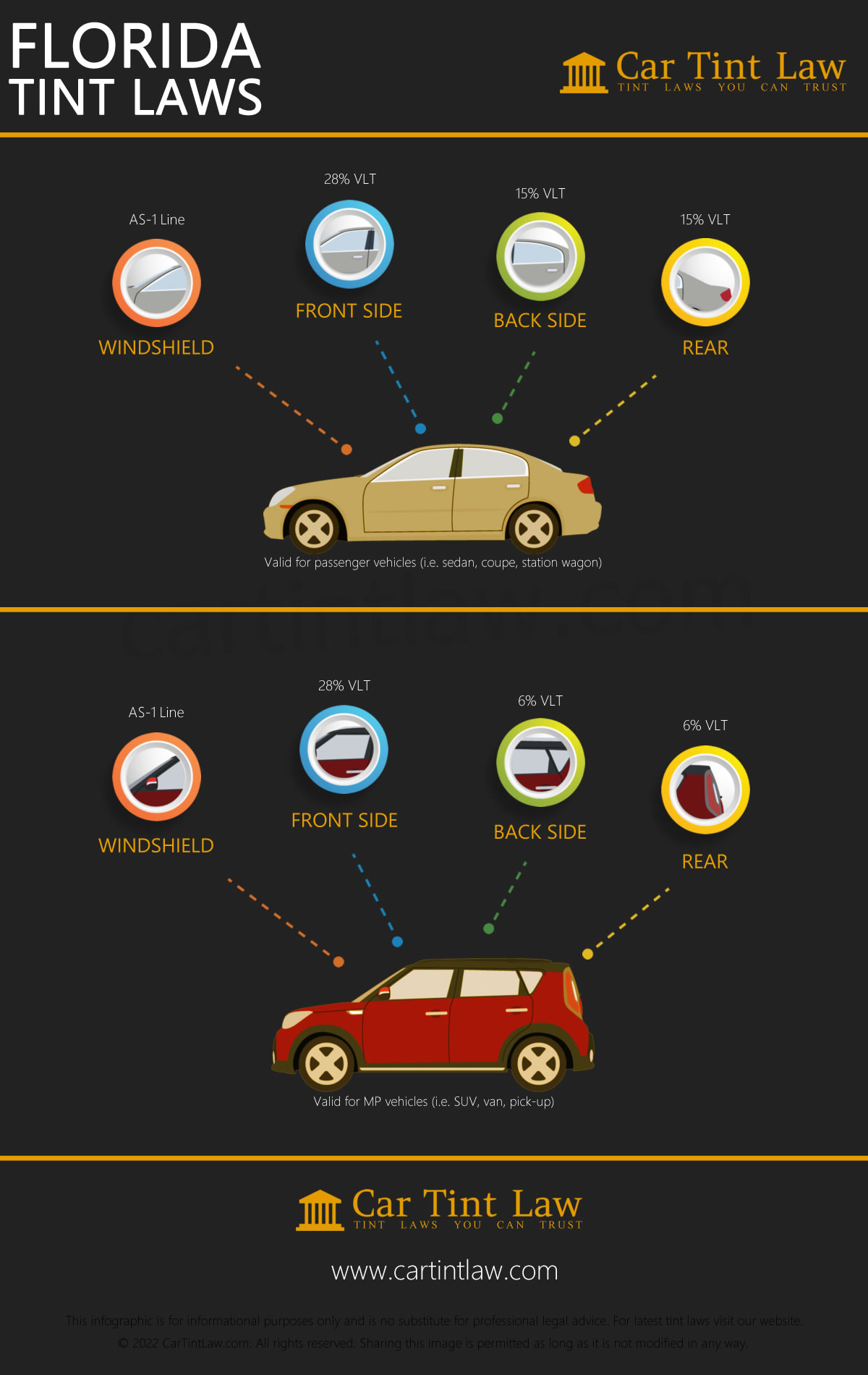
The front windshield is subject to strict regulations to ensure unimpeded visibility for the driver. Florida law permits tinting on the top portion of the windshield, commonly referred to as the “brow.” This is typically limited to a strip of 5 inches or the manufacturer’s AS-1 line, whichever is lower. The purpose of this limited tint is to reduce glare from the sun without compromising the driver’s forward vision. Any tinting below this AS-1 line on the front windshield is illegal.
Driver and Passenger Side Windows
For the front driver’s side and front passenger’s side windows, Florida law mandates a minimum VLT of 28%. This means that at least 28% of light must be able to pass through these windows. This regulation is in place to ensure that law enforcement officers can easily see into the vehicle’s cabin from the outside and to maintain a reasonable level of visibility for the driver and passengers.
Rear Window and Rear Windshield Regulations
The regulations for the rear window and rear passenger windows are generally more lenient than those for the front. In Florida, these windows can be tinted to a darker level. The law permits any tint darkness on the rear window and rear passenger windows, provided the vehicle is equipped with dual side mirrors. Dual side mirrors are essential for maintaining adequate visibility of the road and traffic behind the vehicle when the rear window is heavily tinted.
Is 15% Tint Legal in Florida?
Now, let’s address the specific question: Is 15% tint legal in Florida?
Based on Florida Statute § 316.295, the minimum VLT allowed for the front driver’s side and front passenger’s side windows is 28%. Therefore, 15% tint is illegal for the front driver’s and passenger’s side windows in Florida.
However, as mentioned, the regulations for the rear window and rear passenger windows are more permissive. 15% tint is legal for the rear window and rear passenger windows in Florida, provided the vehicle has dual side mirrors. This means that while you cannot apply 15% tint to the front windows, you can legally apply it to the back of your vehicle, enhancing privacy and heat reduction for those areas.
Medical Exemptions
It is important to note that Florida law does include provisions for medical exemptions. Individuals with certain medical conditions that are aggravated by sunlight may be eligible for a medical exemption to tint their front windows darker than the standard 28% VLT. These exemptions typically require a written certification from a licensed physician, outlining the medical necessity. The specific requirements and documentation for medical exemptions should be verified with the Florida Department of Highway Safety and Motor Vehicles or local law enforcement.

Reflectivity Limits
In addition to VLT restrictions, Florida law also imposes limits on the reflectivity of window tint. The maximum allowed reflectivity for all windows is 25%. This means that the tint should not be so reflective that it causes excessive glare to other drivers. This measure is primarily a safety concern, aiming to prevent situations where a highly reflective tint could temporarily blind another motorist.
Consequences of Non-Compliance
Driving a vehicle with window tint that does not comply with Florida‘s regulations can result in citations and fines. Law enforcement officers are authorized to enforce these tint laws. A common consequence is a traffic ticket, which can carry a fine and potentially impact your driving record. In some cases, officers may issue a warning, allowing you time to correct the tint violation. However, repeat offenses or a deliberate disregard for the law can lead to more significant penalties.
Avoiding Tint Violations
To ensure compliance and avoid potential penalties, it is highly recommended to:
- Consult with Reputable Tint Shops: Professional window tinting businesses are well-versed in Florida‘s laws and can advise you on the darkest legal tint percentages for your specific vehicle. They will use certified films that meet state requirements.
- Understand the VLT Percentages: Be clear about what VLT percentages mean and how they apply to different parts of your vehicle.
- Check for Updates: While laws are generally stable, it’s always wise to be aware of any potential changes or updates to Florida‘s vehicle tint regulations.
- Seek Legal Advice if Unsure: If you have specific concerns or are considering an exemption, consulting with a legal professional or the relevant state agencies is advisable.
Popular Tinting Choices and Their Legality in Florida
When considering window tinting in Florida, many drivers are interested in specific darkness levels. Understanding the legality of these popular choices can be helpful.
20% Tint
Often referred to as “the legal limit” in many states, 20% tint is a popular choice for its balance of privacy and heat rejection. However, in Florida, 20% tint is illegal for the front driver’s and passenger’s side windows, as the minimum VLT required is 28%. It is legal for the rear windows and rear windshield, provided dual side mirrors are present.
35% Tint
This VLT percentage is a common choice for those seeking a moderate level of tint. 35% tint is legal in Florida for all windows, including the front driver’s and passenger’s side windows. It offers a noticeable improvement in heat reduction and privacy without being overly dark, ensuring visibility for drivers and compliance with the law.
50% Tint
A lighter tint, 50% VLT, is often chosen for a subtle enhancement of privacy and a slight reduction in glare and heat. 50% tint is legal in Florida for all windows. It is a safe bet for those who want a minimal tint that is guaranteed to be compliant across the entire vehicle.
Limo Tint (5% VLT)
“Limo tint” refers to extremely dark window tint, typically around 5% VLT. This level of darkness is primarily used for privacy in limousines and other specialized vehicles. In Florida, 5% tint is illegal for the front driver’s and passenger’s side windows. It is legal for the rear windows and rear windshield, provided the vehicle has dual side mirrors, as it offers significant privacy and heat rejection.

Conclusion: Balancing Style, Comfort, and Legality
Window tinting offers numerous benefits, from reducing interior heat and protecting upholstery from UV damage to enhancing privacy and improving vehicle aesthetics. However, it is essential to navigate Florida‘s specific legal landscape to enjoy these advantages without incurring penalties. For the front driver’s and passenger’s side windows, a minimum of 28% VLT is required. For the rear windows and rear windshield, 15% tint is permissible, as long as dual side mirrors are installed. By understanding these regulations and consulting with professional tint installers, Florida drivers can achieve their desired look and functionality while remaining fully compliant with state law.
LifeOutOfTheBox is a participant in the Amazon Services LLC Associates Program, an affiliate advertising program designed to provide a means for sites to earn advertising fees by advertising and linking to Amazon.com. Amazon, the Amazon logo, AmazonSupply, and the AmazonSupply logo are trademarks of Amazon.com, Inc. or its affiliates. As an Amazon Associate we earn affiliate commissions from qualifying purchases.