
For countless teenagers across the United States, obtaining a driver’s license marks a pivotal rite of passage, symbolizing newfound freedom, independence, and the exciting prospect of exploring the world beyond their immediate neighborhoods. In the vast and diverse state of Texas, this milestone carries particular significance, opening up avenues for travel, adventure, and the practicalities of daily life in a region known for its expansive landscapes and sprawling cities. Whether you’re dreaming of road-tripping through the scenic Hill Country, cruising along the Gulf Coast, or simply navigating the vibrant urban centers of Dallas or Houston, understanding the age requirements and the process for getting your driver’s license in Texas is the essential first step.

The path to obtaining a full, unrestricted driver’s license in Texas is a graduated one, designed to ensure that new drivers gain experience incrementally, under supervision, before being granted full driving privileges. This multi-stage system, managed by the Texas Department of Public Safety (DPS), begins earlier than many might expect, allowing aspiring drivers to start their journey towards independence long before their eighteenth birthday.
Understanding Texas Driver’s License Requirements
The Texas Department of Public Safety outlines a clear, step-by-step process for young drivers. This process is structured to build confidence and competence gradually, moving from a learner’s permit with significant restrictions to a provisional license with fewer limitations, and finally to an unrestricted license. Each stage has specific age requirements, training mandates, and supervised driving hour stipulations.
The Learner’s Permit (Instruction Permit) at 15
The journey begins with the Instruction Permit, often referred to as a learner’s permit. In Texas, individuals can apply for an Instruction Permit as early as 15 years of age. To be eligible, applicants must:
- Be at least 15 years old: This is the absolute minimum age to begin the process.
- Complete the classroom portion of a Driver Education course: This course, typically 32 hours, can be taken through a certified driving school, a parent-taught program, or an approved online provider. The applicant must have completed at least the first six hours of the course to apply for the permit.
- Provide proof of identity, U.S. citizenship or lawful presence, and Texas residency: This usually includes a birth certificate, social security card, and two documents proving Texas residency (e.g., utility bill, school records).
- Provide a Verification of Enrollment and Attendance (VOE) form: This form, obtained from the applicant’s school, confirms satisfactory academic performance. If home-schooled, specific alternative documentation is required.
- Pass a written knowledge test: This test covers traffic laws and road signs.
- Pass a vision test: Ensuring adequate eyesight for driving.
Once issued, the Instruction Permit allows the holder to drive a motor vehicle only when accompanied by a licensed driver who is at least 21 years old, has a valid Texas driver’s license, and is seated in the front passenger seat. This supervised driving period is crucial for gaining real-world experience and familiarity with various driving conditions, from city streets in Austin to rural roads leading to Big Bend National Park.
The Provisional License at 16
The next significant milestone occurs at 16 years of age, when permit holders become eligible to apply for a Provisional License (Class C). This license comes with fewer restrictions than the Instruction Permit but is not yet fully unrestricted. To qualify for a Provisional License, applicants must:
- Be at least 16 years old: The minimum age for this stage.
- Have held an Instruction Permit for at least six months: This minimum holding period ensures a sufficient amount of supervised practice.
- Complete the full Driver Education course: Both the classroom (32 hours) and the behind-the-wheel instruction (14 hours) must be finished.
- Complete 30 hours of supervised behind-the-wheel driving practice: This practice must be documented on a specific form, including at least 10 hours driven at night. The supervising driver must be at least 21 years old and hold a valid Texas driver’s license.
- Pass the driving skills test (road test): This practical test assesses the applicant’s ability to operate a vehicle safely and in compliance with traffic laws.
The Provisional License comes with certain restrictions aimed at minimizing risks for new drivers:
- No more than one passenger under 21 years old who is not a family member, unless accompanied by a licensed driver 21 years or older.
- Prohibition from driving between midnight and 5:00 a.m. unless for school-related activities, employment, or medical emergencies.
These restrictions are designed to limit driving in situations statistically associated with higher accident rates for young drivers, such as late-night driving and driving with multiple young passengers. This period allows young drivers to continue gaining experience in a slightly less restricted environment, preparing them for full independence.
Obtaining a Full (Unrestricted) License
Finally, the path culminates in obtaining a full, unrestricted Class C driver’s license. This typically occurs at 18 years of age. Once a driver turns 18, the restrictions associated with the Provisional License are automatically lifted. There’s no additional test required; the Provisional License essentially converts to a full license once the age requirement is met.
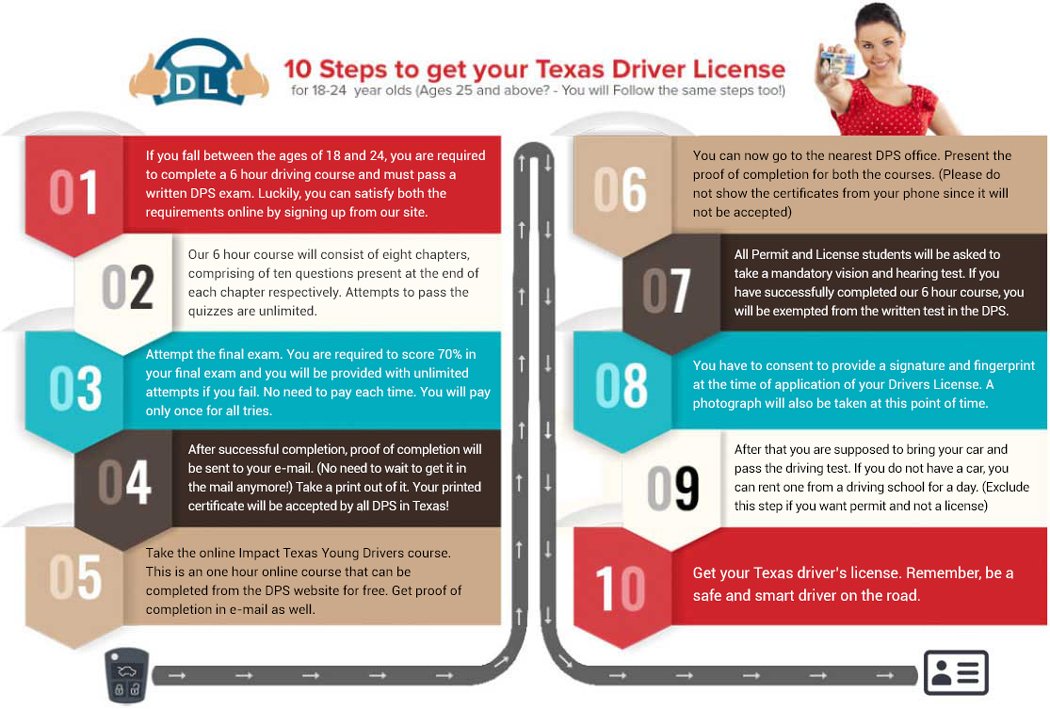
For individuals who begin their driving journey at 18 years of age or older, the process is slightly different and often expedited. They are not required to hold an Instruction Permit for six months or complete the 30 hours of supervised behind-the-wheel practice. They must still complete a 6-hour adult driver education course, pass the written knowledge test, and pass the driving skills test. However, the graduated licensing system with its provisional stages is primarily for drivers under 18.
Navigating the Texas Licensing Process
Understanding the age requirements is just one part of the equation; navigating the actual process of applying, learning, and testing is where the real work begins. The system is designed to be thorough, ensuring that all new drivers in Texas are adequately prepared for the responsibilities of the road.
Driver Education: The Cornerstone

Driver Education is arguably the most critical component of the entire licensing process for young drivers. The 32-hour classroom component covers essential topics such as traffic laws, defensive driving techniques, the dangers of impaired driving, and risk assessment. Whether chosen through a traditional driving school, an online program, or the parent-taught option, this foundational knowledge is indispensable. For those opting for the parent-taught course, the Texas Department of Public Safety provides comprehensive guides and required forms to ensure the curriculum’s integrity. It’s a significant commitment, but one that lays the groundwork for safe driving habits.
Practical Driving: Behind-the-Wheel Training
Beyond the classroom, the practical behind-the-wheel training is where theoretical knowledge translates into real-world skills. The 14 hours of in-car instruction with a certified instructor for traditional courses, or the more extensive 30 hours of supervised practice for the parent-taught method, are crucial. This is where drivers learn to maneuver a vehicle, understand road dynamics, and react to various traffic situations.
Imagine the thrill of your first time merging onto a highway, navigating the intricate intersections of San Antonio, or even practicing parallel parking near the bustling Riverwalk. These experiences, under the watchful eye of an instructor or experienced family member, build the muscle memory and decision-making skills vital for safe driving. This supervised practice period is not just a requirement; it’s an opportunity to build confidence and develop a keen awareness of your surroundings, whether you’re heading to a local attraction or preparing for a longer trip across the state.
Required Documentation for Your Application
When it comes time to visit the Texas Department of Public Safety (DPS) office, having all your documentation in order is paramount to avoid delays. Generally, you’ll need:
- Proof of Identity: Original or certified birth certificate, U.S. passport, or unexpired foreign passport with a visa.
- Proof of U.S. Citizenship or Lawful Presence: If not covered by identity document, e.g., Green Card.
- Proof of Texas Residency: Two documents like a utility bill, bank statement, or medical card showing your current Texas address.
- Social Security Card: The physical card itself is usually required.
- Verification of Enrollment and Attendance (VOE) form: For applicants under 18, confirming school enrollment or graduation.
- Proof of Driver Education Completion: DE-964 certificate from a driving school or PTDE Packet (Parent Taught Driver Education) forms.
- Impact Texas Teen Drivers (ITTD) Program Certificate: A mandatory two-hour video course to raise awareness about distracted driving, which must be completed within 90 days of the driving test.
- Application Fee.
A meticulous approach to gathering these documents will ensure a smoother application process at the DPS office, getting you one step closer to your driving independence.
The Freedom of the Open Road: Exploring Texas with Your New License
Once you’ve navigated the licensing process and successfully obtained your driver’s license, a world of exploration opens up, especially in a state as expansive and diverse as Texas. For a website focused on travel, hotels, and tourism, the driver’s license isn’t just a piece of plastic; it’s a passport to unparalleled experiences and unforgettable journeys.
Iconic Texas Destinations Awaiting Your Drive
Texas boasts an incredible array of destinations, from bustling metropolitan hubs to serene natural wonders, many of which are best accessed by car. With your new license, you can plan road trips to:
- Major Cities: Drive to Houston to visit the Space Center Houston or explore its diverse culinary scene. Head to Dallas for world-class shopping, museums like the Sixth Floor Museum, and a vibrant nightlife. Discover Austin’s “Live Music Capital of the World” charm, its burgeoning food truck culture, and outdoor activities around Lady Bird Lake. Or immerse yourself in San Antonio’s rich history, from the historic Alamo to the picturesque Riverwalk.
- Natural Wonders: Embark on an epic journey to Big Bend National Park in West Texas, where dramatic desert landscapes, mountain ranges, and the Rio Grande await hikers and stargazers. Explore the pristine beaches and diverse wildlife of Padre Island National Seashore or South Padre Island, perfect for a coastal escape. Head further west to Guadalupe Mountains National Park for breathtaking peaks and canyons.
- Charming Towns and Cultural Hotspots: Discover the German heritage of Fredericksburg in the Hill Country, known for its wineries and peach orchards. Visit Galveston for its historic architecture, beaches, and Moody Gardens. Or explore Fort Worth’s cowboy culture at the Stockyards National Historic District.
Many of these destinations, particularly the natural parks and smaller towns, are not easily accessible via public transport, making a driver’s license indispensable for a true Texas experience.
Road Trips and Beyond: Unlocking Texas Travel
The driver’s license transforms travel planning, making spontaneous day trips and meticulously planned multi-day adventures equally feasible. Imagine booking a stay at a luxurious resort nestled deep within the Hill Country, like the JW Marriott San Antonio Hill Country Resort & Spa, or a boutique hotel in downtown Austin, such as The Driskill Hotel. Your driver’s license provides the freedom to reach these accommodations, explore surrounding attractions like the Natural Bridge Caverns, and dine at local eateries far from the typical tourist routes.
For those planning longer trips, having a driver allows for flexibility in accommodation choices. You might opt for a charming Airbnb in a remote location one night, and a five-star hotel like the Grand Hyatt San Antonio or the Marriott Marquis Houston the next. The ability to drive also facilitates family trips, business stays where personal transport is often convenient, and budget travel, as you can choose accommodations slightly outside city centers where prices might be more favorable.
Beyond the Wheel: The Broader Lifestyle Impact in Texas
While the immediate benefit of a driver’s license is the ability to drive, its impact on lifestyle, particularly in a state like Texas, is profound. It’s about more than just getting from point A to point B; it’s about empowerment, convenience, and becoming an active participant in a broader world.
For young adults, a driver’s license significantly enhances independence. It means not relying on parents or public transportation for school, work, or social activities. This newfound autonomy is a key aspect of transitioning into adulthood, fostering responsibility and self-reliance. It enables participation in extracurricular activities, part-time jobs, and social gatherings across town, contributing to a more active and engaged lifestyle.
Furthermore, in a state where distances between cities and attractions can be vast, a driver’s license is often a necessity rather than a luxury. Public transportation in many parts of Texas, particularly outside of Dallas, Houston, Austin, and San Antonio, is limited. Having a car and the license to drive it simplifies daily errands, makes commuting to college or work feasible, and opens up opportunities for exploring the state’s rich culture, food scene, and natural beauty. From attending a concert in Austin, visiting a family ranch in rural Texas, or simply grabbing groceries, the ease of independent transportation significantly elevates quality of life.
The driver’s license truly embodies the spirit of freedom associated with the vast landscapes of Texas and indeed, North America. It’s an invitation to explore, to connect, and to experience all that this incredible state has to offer, from its bustling metropolises to its quiet corners bordering Mexico. The journey to getting your driver’s license in Texas might seem rigorous, but the doors it opens to travel, independence, and a richer lifestyle are immeasurable.
LifeOutOfTheBox is a participant in the Amazon Services LLC Associates Program, an affiliate advertising program designed to provide a means for sites to earn advertising fees by advertising and linking to Amazon.com. Amazon, the Amazon logo, AmazonSupply, and the AmazonSupply logo are trademarks of Amazon.com, Inc. or its affiliates. As an Amazon Associate we earn affiliate commissions from qualifying purchases.