
The Boston Marathon stands as a beacon of athletic excellence and a pinnacle achievement for distance runners worldwide. Held annually on Patriots’ Day in April, it is one of the world’s oldest and most prestigious marathons, tracing its roots back to 1897. For many, simply completing a marathon is a significant accomplishment; running Boston elevates that experience to an entirely different realm, largely due to its unique and rigorous qualification standards. Unlike most mass participation marathons that welcome runners through lottery systems or charity entries as their primary means of entry, the Boston Marathon is primarily a time-qualifier race. This requirement not only preserves the event’s competitive integrity but also ensures that the field comprises dedicated and accomplished athletes, making the journey to the start line in Hopkinton, Massachusetts, a testament to years of training and unwavering determination.

For those immersed in the running lifestyle, the pursuit of a Boston Qualifying Time (BQT) often becomes a multi-year quest, involving strategic race selection, meticulous training plans, and sometimes, several attempts at various marathons. It’s a goal that transcends mere finish lines, embodying a commitment to personal bests and a deep respect for the sport’s traditions. This quest also intertwines with the broader themes of travel and tourism, as runners often journey to different cities and countries in search of fast, flat courses conducive to achieving their coveted BQT, transforming race weekends into comprehensive travel experiences. Beyond the qualification itself, participating in the Boston Marathon becomes a destination event, drawing thousands of runners and spectators to the historic city, fueling the local economy and creating an unparalleled atmosphere. Understanding the specific qualifying times, the process, and how to plan for this monumental event is crucial for any aspiring Boston runner.
Understanding the Boston Marathon Qualification Process
The Boston Marathon’s commitment to maintaining a high-caliber race field is exemplified by its stringent qualification standards. These standards are reviewed and adjusted periodically by the Boston Athletic Association (BAA), the race organizers, to manage the ever-increasing demand for entry. The core principle remains constant: runners must achieve a specific time in a certified marathon within a designated qualification window, which typically spans approximately 18 months prior to the race date. This process ensures that every participant has earned their spot through athletic merit, fostering a highly competitive yet profoundly inspiring environment on race day.
A Brief History of Qualification and Its Evolution
From its inception in 1897, the Boston Marathon initially did not have strict qualifying times. Early races were smaller, primarily drawing local runners. As the marathon grew in popularity in the mid-20th century, especially during the running boom of the 1970s, the need to manage the burgeoning field size became apparent. The first official qualifying standard was introduced in 1970, requiring male runners to complete a marathon in under 4 hours. This initial step marked the beginning of Boston’s unique identity as a performance-based event. Over the decades, as athletic training improved and more people embraced long-distance running, the standards progressively tightened to reflect the growing competitiveness and the event’s capacity limits. The Boston Athletic Association (BAA) continuously balances the desire to include as many deserving runners as possible with the logistical realities of hosting such a massive event on a linear course, which dictates field size and course management. This continuous evolution means that aspiring Boston runners must always stay informed about the latest BQT requirements published by the BAA.
The Core Requirements: Age and Gender Categories
The qualifying times for the Boston Marathon are not universal; they are stratified by both age and gender, acknowledging physiological differences and the natural progression of athletic performance through a runner’s lifespan. This categorization makes the goal achievable for a broader range of dedicated athletes. A runner’s age on the date of the Boston Marathon they wish to enter determines their age group for qualification purposes. For example, if a runner turns 40 the week before the Boston Marathon, they would qualify based on the 40-44 age group standard, even if they were 39 when they ran their qualifying race.
The categories typically begin at 18-34 years old and then progress in five-year increments (e.g., 35-39, 40-44, 45-49, and so forth), extending to the oldest age groups. Generally, the qualifying times become more lenient as the age groups increase. Additionally, women are given more time than men within the same age group, reflecting average physiological differences in marathon performance. All qualifying races must be run on courses certified by national governing bodies like USATF (USA Track & Field) in the United States, or AIMS (Association of International Marathons and Distance Races) internationally. This certification ensures that the course distance is accurate and fair, preventing runners from qualifying on short courses.
The Specific Qualifying Standards (General Reference)
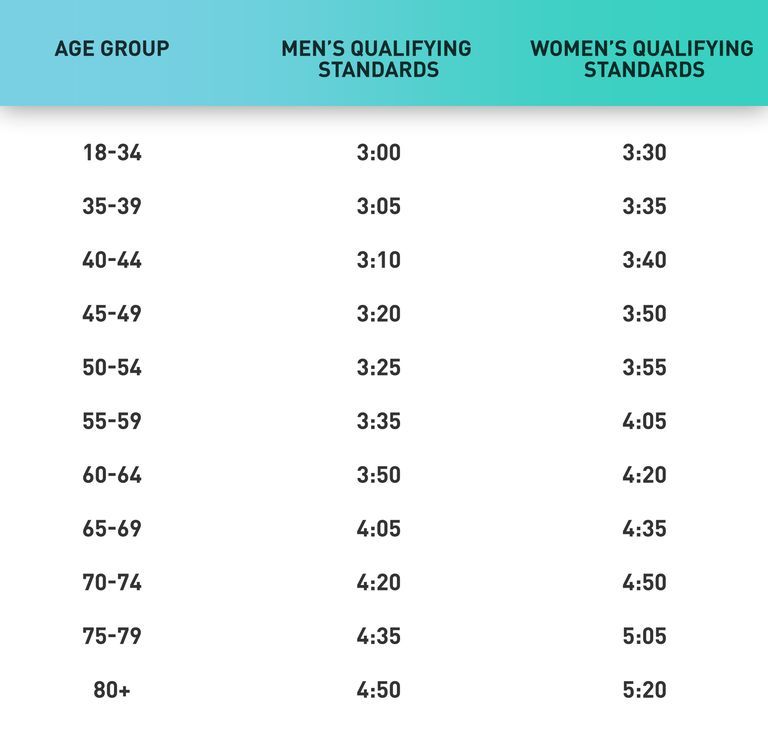
While these times are subject to change and should always be verified on the official Boston Marathon website, here is a general reference for qualifying standards (as of recent years, always check the current year’s standards):
-
Men:
- 18-34: 3 hours 00 minutes 00 seconds
- 35-39: 3 hours 05 minutes 00 seconds
- 40-44: 3 hours 10 minutes 00 seconds
- 45-49: 3 hours 20 minutes 00 seconds
- 50-54: 3 hours 25 minutes 00 seconds
- 55-59: 3 hours 35 minutes 00 seconds
- 60-64: 3 hours 50 minutes 00 seconds
- 65-69: 4 hours 05 minutes 00 seconds
- 70-74: 4 hours 20 minutes 00 seconds
- 75-79: 4 hours 35 minutes 00 seconds
- 80 and over: 4 hours 50 minutes 00 seconds
-
Women:
- 18-34: 3 hours 30 minutes 00 seconds
- 35-39: 3 hours 35 minutes 00 seconds
- 40-44: 3 hours 40 minutes 00 seconds
- 45-49: 3 hours 50 minutes 00 seconds
- 50-54: 3 hours 55 minutes 00 seconds
- 55-59: 4 hours 05 minutes 00 seconds
- 60-64: 4 hours 20 minutes 00 seconds
- 65-69: 4 hours 35 minutes 00 seconds
- 70-74: 4 hours 50 minutes 00 seconds
- 75-79: 5 hours 05 minutes 00 seconds
- 80 and over: 5 hours 20 minutes 00 seconds
It’s important to note that merely achieving these times does not guarantee entry. Due to the overwhelming number of qualifiers each year, the Boston Athletic Association often implements a “cut-off” time, meaning applicants must have run faster than their age-group standard to be accepted. For instance, in some years, runners have needed to be 5 minutes or even more under their standard to secure a spot. This adds another layer of challenge and prestige to the qualification process, underscoring the fierce competition to participate in this legendary race.
Beyond the Clock: The Journey to Hopkinton
Achieving a Boston Marathon qualifying time is an arduous journey that extends far beyond a single race result. It encapsulates months, if not years, of dedicated training, strategic planning, and a deep immersion into the running lifestyle. The path to Hopkinton is a testament to perseverance, resilience, and the runner’s spirit, often involving significant travel and a nuanced understanding of race logistics.
Certified Races and Time Submission
The first critical step is selecting and completing a qualifying marathon. The Boston Athletic Association (BAA) strictly mandates that qualifying times must be achieved in a marathon certified by a national federation associated with World Athletics. For runners in the United States, this means a USATF certified course. Internationally, courses certified by the Association of International Marathons and Distance Races (AIMS) are accepted. This ensures uniformity and fairness in race measurement. Runners often travel to specific marathons known for their fast courses, sometimes referred to as “Boston Qualifiers,” such as the California International Marathon or the Grandma’s Marathon. The selection of a qualifying race often involves researching course profiles, average weather conditions, and travel logistics, turning the pursuit of a BQT into a mini-travel adventure in itself. Once a qualifying time is achieved, runners must submit their application during a specific registration window, usually in September, ensuring all details are accurate and that their qualifying race details can be verified. The aforementioned “cut-off” phenomenon further emphasizes the need for a strong performance, often pushing runners to aim significantly faster than the published standard.
Training and Preparation: A Lifestyle Commitment
The pursuit of a BQT is not just about race day; it’s a profound commitment to a disciplined lifestyle. This involves a meticulously structured training plan, often lasting 16-20 weeks, designed to build endurance, speed, and mental fortitude. It encompasses thousands of miles logged, grueling long runs, demanding speed work, and vital recovery sessions. Nutrition becomes a paramount consideration, with runners carefully fueling their bodies to support intense training and optimize performance. Adequate rest and injury prevention strategies are equally crucial, requiring a holistic approach to physical and mental well-being. Many runners integrate cross-training, strength work, and even sports psychology into their routines. This rigorous preparation often dictates daily schedules, social plans, and dietary choices, turning the runner into a dedicated athlete whose life revolves, in part, around the singular goal of reaching Boston. For some, this commitment might even involve training trips to higher altitudes or warmer climates, combining fitness goals with unique travel experiences.
The Allure of Boston: A Runner’s Tourism Mecca
Once qualified, the dream transitions from a time on the clock to an immersive experience in one of America‘s most historic cities. Boston itself becomes a central character in the marathon story. For runners and their families, the race transforms into a unique travel and tourism opportunity. The city buzzes with an undeniable energy during marathon week, as thousands of athletes from over 100 countries descend upon its streets. Iconic landmarks like the Freedom Trail, Fenway Park, and the historic neighborhoods of Beacon Hill and the North End become backdrops to pre-race jitters and post-race celebrations.
The Boston Marathon Expo, typically held at the Hynes Convention Center, is a massive gathering where runners collect their bibs, browse the latest running gear, and soak in the electric atmosphere. It’s a key part of the experience, a vibrant hub of excitement and anticipation that kicks off the race weekend. This blend of athletic achievement and cultural exploration makes the Boston Marathon not just a race, but a comprehensive travel destination event, drawing visitors eager to experience both the athletic spectacle and the charm of Boston.
Planning Your Boston Marathon Experience: Travel and Accommodation
Securing a qualifying time is just the first hurdle; meticulously planning your trip to Boston is equally crucial for a stress-free and enjoyable marathon experience. Given the event’s popularity and the influx of tens of thousands of participants, spectators, and media, travel and accommodation require careful, often early, consideration. This planning becomes an integral part of the overall lifestyle commitment to the Boston Marathon dream.
Strategic Travel Planning for Race Weekend
Booking flights to Boston Logan International Airport (BOS) should be a priority once your entry is confirmed. Airfares typically escalate as the race date approaches, so securing them well in advance can lead to significant savings. Consider arriving a few days before the race to allow for acclimatization, bib pickup at the Hynes Convention Center, and participation in pre-race activities without feeling rushed. This extra time also allows for a relaxed exploration of the city, transitioning from race prep to tourism.
Transportation within Boston is generally excellent, with a comprehensive public transport system (the “T”). However, understanding race-day logistics, particularly getting to the start line in Hopkinton, is vital. The Boston Athletic Association (BAA) provides shuttle buses from Boston Common and other designated locations, underscoring the importance of knowing your departure point and time. Planning your return trip after the race is equally important, especially if you anticipate being tired or sore. Opting for public transport or pre-arranged rides over trying to navigate heavy traffic post-race is advisable.
Accommodation Choices in Boston
Finding the right accommodation can significantly enhance your race weekend experience. Boston offers a diverse range of options, from luxurious hotels to boutique inns and apartments via services like Airbnb. Key factors for runners are proximity to the finish line on Boylston Street, ease of access to the start line buses, and amenities that support pre-race relaxation and post-race recovery.
Many runners prefer to stay in neighborhoods like Back Bay, Downtown Boston, or near Copley Square, as these areas put you right in the heart of the action and close to the finish line. Popular choices might include The Fairmont Copley Plaza, The Lenox Hotel, or The Omni Parker House, which offer excellent service and amenities tailored to guests. For those seeking slightly more affordable options or self-catering facilities, areas across the Charles River in Cambridge (e.g., Hyatt Regency Cambridge) or closer to the Seaport District might be considered, though factor in travel time. Regardless of your budget, booking your stay months in advance is imperative, as prices surge and availability dwindles rapidly. Look for places offering late checkout options or baggage storage for convenience after the race.
Exploring Boston: Pre and Post-Race Activities
The Boston Marathon provides a perfect opportunity to blend athletic achievement with vibrant urban exploration. Beyond the race itself, Boston is rich in history, culture, and culinary delights, making it an ideal destination for pre- and post-race tourism. Before the race, a gentle stroll along the Freedom Trail, visiting historic sites like Faneuil Hall Marketplace and Quincy Market, can be a relaxing way to manage pre-race jitters and soak in the city’s atmosphere. You might visit the New England Aquarium, explore the prestigious campuses of Harvard University or Massachusetts Institute of Technology (MIT) in Cambridge, or enjoy a meal in the historic North End.
After the marathon, when you’re recovering and celebrating, the city offers even more. Consider catching a Boston Red Sox game at Fenway Park, visiting world-class institutions like the Museum of Fine Arts or the Isabella Stewart Gardner Museum, or simply enjoying a leisurely walk through Boston Common and the Public Garden. The city’s diverse culinary scene provides endless options for celebrating your achievement, from indulging in fresh seafood in the Seaport District to enjoying Italian fare in the North End. This combination of athletic rigor and cultural immersion makes the Boston Marathon a truly unforgettable travel experience.
The Boston Marathon: More Than Just a Race
The Boston Marathon transcends its status as a mere athletic competition; it is a cultural phenomenon, a historical pilgrimage, and a powerful demonstration of human spirit. For those who earn their coveted entry through demanding qualifying times, it represents the culmination of a dedicated lifestyle and a profound connection to the global running community. The 26.2 miles from Hopkinton to Boston’s Boylston Street are not just a test of physical endurance, but an emotional journey fueled by history, community, and personal triumph.
The Spectator Experience and Community Spirit
One of the most defining characteristics of the Boston Marathon is the unparalleled support from the spectators. The entire course, particularly through towns like Framingham, Natick, Wellesley, and Newton, is lined with millions of cheering fans. The “Scream Tunnel” at Wellesley College, where students famously offer kisses and high-fives, is legendary, providing an incredible surge of energy for runners around mile 12. The challenging Newton Hills, culminating in the infamous Heartbreak Hill around mile 20, are met with equally fervent encouragement, helping weary runners push through their limits.
This communal spirit extends beyond race day. The week leading up to the marathon transforms Boston into a festival of running, attracting visitors from around the globe who contribute significantly to the local economy and cultural fabric. Restaurants, hotels, and local businesses thrive, reflecting the deep integration of the marathon into the city’s identity. Families, friends, and local residents create an atmosphere of warmth and resilience, making the marathon a powerful demonstration of unity and human connection that resonates deeply with the spirit of tourism and shared experiences.

Legacy and Inspiration
The Boston Marathon’s legacy is etched into the annals of sports history. From its early days, inspired by the success of the first modern Olympic Marathon, to its pivotal role in the fight for women’s inclusion in long-distance running (epitomized by Kathrine Switzer’s groundbreaking run in 1967), the race has consistently pushed boundaries and inspired generations. The sheer effort required to achieve a BQT imbues the event with an aura of exclusivity and profound respect, setting it apart in the crowded world of mass participation events.
Every year, the stories of thousands of qualifiers, from seasoned veterans to first-time Boston runners, serve as powerful inspiration. These narratives highlight the power of dedication, the pursuit of personal excellence, and the transformative impact of setting and achieving ambitious goals. The marathon’s history, combined with its ongoing commitment to challenging standards, ensures its enduring status as a dream race for runners worldwide. It’s a vivid reminder that some experiences, particularly those requiring immense dedication and grit, are genuinely earned, offering rewards that extend far beyond a finisher’s medal.
In conclusion, the qualifying time for the Boston Marathon is more than just a number; it is an invitation to a unique club of dedicated athletes and a gateway to an unparalleled travel and cultural experience. Achieving it requires unwavering commitment, meticulous planning, and a deep love for the sport, transforming the journey itself into a significant part of the accomplishment. From the countless training miles to the strategic race selection, from booking accommodation in Back Bay to exploring Boston’s historic landmarks, every step of the Boston Marathon journey is infused with purpose and excitement. For those who meet the challenge, race day on Boylston Street is not merely the end of a race, but the triumphant culmination of a dream, celebrated in one of the world’s most iconic and vibrant cities.
LifeOutOfTheBox is a participant in the Amazon Services LLC Associates Program, an affiliate advertising program designed to provide a means for sites to earn advertising fees by advertising and linking to Amazon.com. Amazon, the Amazon logo, AmazonSupply, and the AmazonSupply logo are trademarks of Amazon.com, Inc. or its affiliates. As an Amazon Associate we earn affiliate commissions from qualifying purchases.