
Understanding the nuances of workers’ compensation insurance in California is crucial for businesses operating within the Golden State. While the general rule mandates coverage for most employers, there are specific exemptions that can significantly impact operational costs and legal compliance. Navigating these exemptions requires careful attention to detail, as misinterpretations can lead to costly penalties and legal entanglements. This guide delves into the categories of individuals and entities that may be exempt from the mandatory workers’ compensation insurance requirements in California, offering clarity for business owners, independent contractors, and those managing payroll.

Understanding Workers’ Compensation in California
Workers’ compensation is a no-fault insurance system designed to provide medical benefits and wage replacement to employees who suffer work-related injuries or illnesses. In California, the law is quite stringent, and most employers are legally obligated to secure workers’ compensation insurance. This coverage protects both the employee by providing essential support during recovery and the employer by shielding them from potential lawsuits arising from workplace injuries. The primary goal is to ensure that employees receive prompt care and compensation without the need for lengthy litigation. The system is administered by the California Department of Industrial Relations, Division of Workers’ Compensation.
The General Mandate for Employers
The overwhelming majority of employers in California must provide workers’ compensation insurance. This includes businesses of all sizes, from sole proprietorships with a single employee to large corporations. The type of business, whether it’s a retail store, a tech startup, a restaurant, or a construction company, generally does not exempt an employer from this requirement. The focus is on the employer-employee relationship. If an individual is classified as an employee, they are typically covered under the employer’s workers’ compensation policy. Failure to comply can result in severe penalties, including significant fines, stop-work orders, and even criminal charges in some cases. The employer remains liable for all medical and indemnity benefits even if they fail to secure insurance.
What Constitutes an Employee?
The definition of an “employee” for workers’ compensation purposes is broad. It generally includes anyone who performs services for another person or entity and is under the control and direction of that person or entity. This includes full-time, part-time, temporary, and even seasonal workers. The key factor is the employer’s right to control what work is done and how it is done. This distinction is crucial, as misclassifying an employee as an independent contractor to avoid workers’ compensation premiums is a serious offense in California. The California Supreme Court’s ruling in Dynamex Operations West, Inc. v. Superior Court established the “ABC test” for determining employee status, making it more challenging for businesses to classify workers as independent contractors.
Specific Exemptions from Workers’ Compensation Insurance
While the mandate is broad, certain specific situations and categories of individuals are legally exempt from the requirement to be covered by workers’ compensation insurance. These exemptions are often narrowly defined and apply under specific conditions. Understanding these can be critical for businesses that utilize independent contractors or operate in niche industries.
Independent Contractors
One of the most common categories considered for exemption is independent contractors. However, California has a rigorous test to determine if a worker is truly an independent contractor. Simply having an independent contractor agreement does not automatically exempt an employer from providing workers’ compensation. The worker must meet the strict criteria of the “ABC test”:
- A: The person is free from the control and direction of the hiring entity in connection with the performance of the work, both under the contract for the performance of the work and in fact.
- B: The person performs work that is outside the usual course of the hiring entity’s business.
- C: The person is customarily engaged in an independently established trade, occupation, or business of the same nature as the work performed.
If a worker fails to meet any one of these conditions, they are presumed to be an employee and must be covered by workers’ compensation insurance. This means that if a painter, for example, is hired by a general contractor for a construction project (which is within the usual course of the general contractor’s business), the painter will likely be considered an employee unless they can also satisfy the other two prongs of the test. The burden of proof lies with the hiring entity to demonstrate that the worker is indeed an independent contractor.
Certain Sole Proprietors and Partners
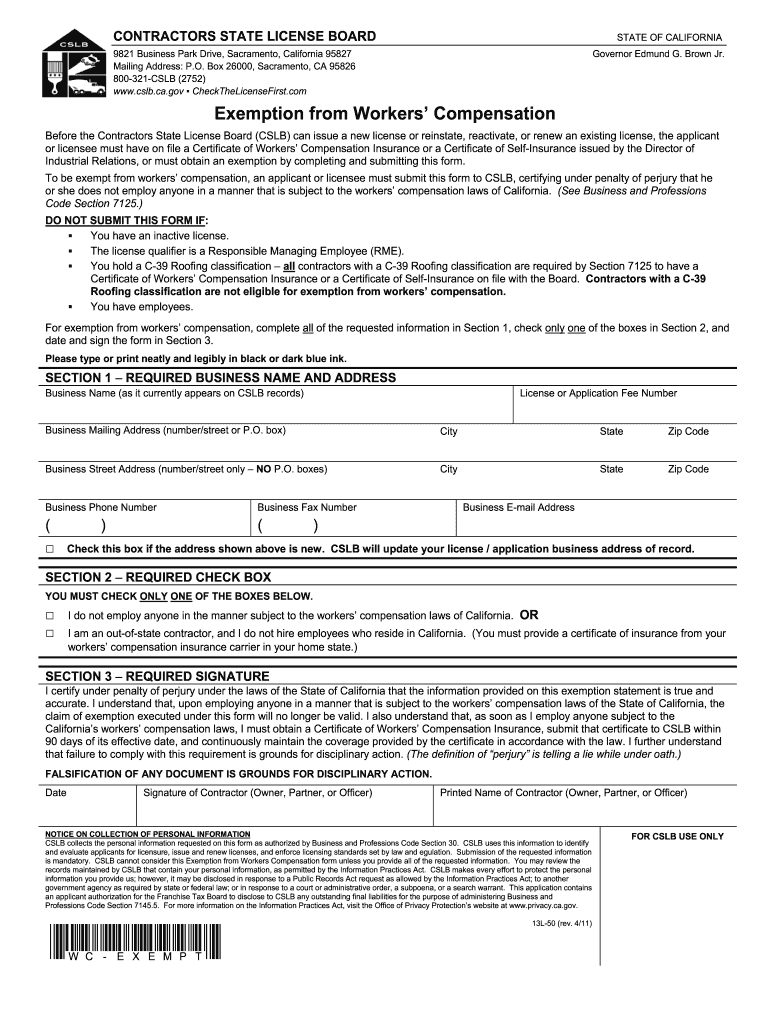
In some very specific circumstances, sole proprietors and general partners in a partnership may be exempt, but this is often by choice and requires formal action. A sole proprietor or a general partner can elect to be excluded from workers’ compensation coverage. This election must be made in writing and filed with the insurer or the administrative director of the Division of Workers’ Compensation. It is important to note that this exclusion typically applies only to the sole proprietor or general partner themselves, not to any employees they might have. If a sole proprietor has employees, they are still legally required to provide workers’ compensation insurance for those employees.
Corporate Officers
Corporate officers can also be exempt under certain conditions. A director or an officer of a corporation who is also a shareholder may be excluded from workers’ compensation coverage if they meet specific criteria. These criteria typically involve holding a substantial ownership interest in the corporation and formally electing to be excluded. The exclusion must be in writing and filed with the insurer or the Division of Workers’ Compensation. Similar to sole proprietors and partners, this exemption applies only to the corporate officer themselves and does not extend to any other employees of the corporation.
Agricultural Employees Under Specific Conditions
While most agricultural workers are covered, there are limited exemptions. For instance, individuals employed by a farmer to whom the farmer has paid less than $100 in cash wages in the preceding calendar year may be exempt. However, this exemption is very narrow and does not apply if the employer has had more than one employee to whom they paid $100 or more in cash wages during the preceding calendar year. Additionally, certain family members of a farm employer may also be exempt under specific conditions, often related to their familial relationship and the extent of their work.
Domestic Workers
Domestic workers, such as housekeepers, nannies, or caregivers, are generally considered employees and must be covered by workers’ compensation insurance. However, there is a notable exception: if a homeowner hires a domestic worker to perform services in their private residence, and the total cash wages paid to that worker do not exceed $7,500 in the 12 months preceding the start of the work, the homeowner is not required to carry workers’ compensation insurance for that specific worker. This threshold is reviewed periodically and may change. Once the threshold is met, coverage becomes mandatory.
Casual Employees
The definition of a “casual employee” is critical and often misunderstood. In California, the exemption for casual employees is very narrow. Generally, an employee is considered casual if their employment is both:
- Casual in nature: Not in the usual course of the employer’s trade, business, profession, or occupation.
- Intermittent: Not to exceed six months in duration, and not to exceed 100 work days or 1000 hours in the 12 months preceding the injury.
It is extremely difficult to meet both of these conditions simultaneously. Most work performed for a business, even if infrequent, is likely to be considered within the usual course of that business, thus disqualifying it from being “casual.” For example, a freelance graphic designer hired by a marketing agency to create social media content would likely not be considered a casual employee because graphic design is within the usual course of a marketing agency’s business.
Volunteers and Unpaid Interns
The status of volunteers and unpaid interns can be complex. Generally, if a volunteer or intern is performing services for a for-profit entity and is not truly volunteering or gaining a clear educational benefit under a formal program, they may be considered an employee and require coverage. However, bona fide volunteers working for non-profit organizations or governmental entities are typically not covered by workers’ compensation requirements, as they are not considered employees. The key is the lack of compensation and the voluntary nature of the work. For unpaid internships, the rules are particularly strict, and if the intern is providing a benefit to the employer without a clear educational purpose, they may be deemed an employee.
Employer Responsibilities and Due Diligence
Even with the existence of these exemptions, employers bear the responsibility of correctly classifying their workers and understanding their obligations. Failure to do so can lead to severe consequences. It is highly recommended for businesses to consult with legal counsel or a qualified insurance broker specializing in California workers’ compensation to ensure compliance.
The Importance of Accurate Worker Classification
The most significant pitfall for employers is misclassifying employees as independent contractors or failing to recognize that certain workers do not meet the criteria for an exemption. The Division of Workers’ Compensation and the Employment Development Department (EDD) actively scrutinize worker classifications. Penalties for misclassification can include back premiums, interest, fines, and liability for any unpaid medical and indemnity benefits. The “ABC test” is the benchmark, and employers must be able to prove that all three conditions are met for a worker to be considered an independent contractor.
Consequences of Non-Compliance
The penalties for failing to secure required workers’ compensation insurance in California are substantial. The Administrative Penalties Schedule can impose fines of up to $10,000 for each uncontested violation. If a serious injury occurs to an uninsured worker, the penalties can escalate to $5,000 or 10 times the amount the employer would have paid for premiums, whichever is greater. Furthermore, the employer can be personally liable for all medical and indemnity costs associated with a workplace injury, which can run into hundreds of thousands of dollars. The Division of Labor Standards Enforcement can also issue stop-work orders, halting all business operations until compliance is achieved.
Seeking Professional Guidance
Given the complexity of California labor laws and workers’ compensation regulations, seeking expert advice is not merely recommended; it is essential for safeguarding a business. Insurance brokers who specialize in workers’ compensation can help assess a business’s specific needs and ensure they obtain the correct coverage. Legal professionals experienced in employment law can provide guidance on worker classification, contract drafting, and compliance strategies. Staying informed about legislative changes and regulatory updates is also crucial, as exemptions and requirements can evolve over time.
Conclusion
While California law mandates workers’ compensation insurance for most employers, a clear understanding of the specific exemptions is vital for businesses to operate compliantly and efficiently. From the strict criteria for independent contractors to the specific conditions for corporate officers and domestic workers, each exemption requires careful scrutiny. The overarching principle remains: when in doubt, err on the side of caution and secure coverage. The financial and legal repercussions of non-compliance far outweigh the cost of obtaining the necessary insurance, ensuring a safer and more secure environment for both employers and their workforce.
LifeOutOfTheBox is a participant in the Amazon Services LLC Associates Program, an affiliate advertising program designed to provide a means for sites to earn advertising fees by advertising and linking to Amazon.com. Amazon, the Amazon logo, AmazonSupply, and the AmazonSupply logo are trademarks of Amazon.com, Inc. or its affiliates. As an Amazon Associate we earn affiliate commissions from qualifying purchases.