
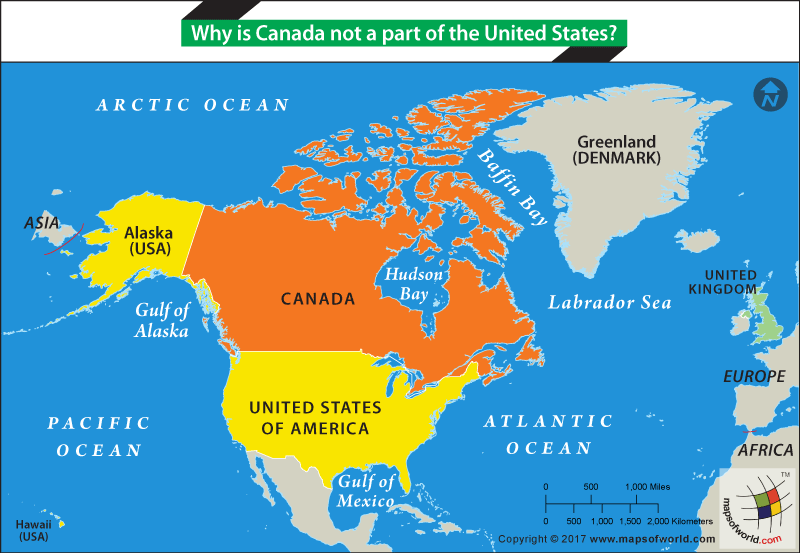
The vast, wild expanse of Alaska, the 49th state of the United States, sits majestically at the northwestern tip of North America. Bordered by Canada to its east, the Pacific Ocean to its south, and the Arctic Ocean to its north, its unique geographical position often sparks a natural question: why isn’t this immense territory part of its immediate neighbor, Canada? The answer lies not in a simple modern geopolitical decision, but in a rich, complex tapestry of historical exploration, imperial ambition, economic pragmatism, and diplomatic maneuvering that dates back centuries. Understanding Alaska’s journey from a remote wilderness to a strategic American landmark involves delving into the legacies of powerful empires, the ambitions of pioneering individuals, and a pivotal transaction that forever altered the map of North America. This historical narrative not only defines Alaska’s political status but also underscores its enduring significance as a frontier of both natural beauty and strategic importance.

A Legacy of Imperial Claims and Early Exploration
The story of Alaska’s ownership begins long before the modern nations of the United States or Canada existed in their current forms. It’s a tale woven with the threads of European expansion and the relentless pursuit of new territories and resources.
Russian Presence and Pioneering Ventures
The first European power to lay a definitive claim to Alaska was the Russian Empire. Driven by a desire for furs, particularly sea otter pelts which were highly prized in China, Russian explorers and traders gradually pushed eastward across Siberia throughout the 17th and 18th centuries. The defining moment came in 1741, when Vitus Bering, a Danish navigator in Russian service, led an expedition that sighted the Alaskan mainland. This voyage confirmed the geographical separation of Asia and North America via the Bering Strait and solidified Russia’s claim to the territory, which they then referred to as “Russian America.”
Over the subsequent decades, Russian trappers, known as “promyshlenniki,” established settlements and trading posts along the Alaskan coast and the Aleutian Islands. The most significant of these was the establishment of Sitka (originally known as New Archangel) as the capital of Russian America. The Russian-American Company, a state-sponsored commercial enterprise, was chartered in 1799 to manage and exploit the fur trade, extending Russian influence as far south as California at one point. This enterprise brought immense wealth to the Russian crown but also led to significant exploitation of indigenous populations and overhunting of fur-bearing animals. By the mid-19th century, the profitability of the fur trade began to decline, and maintaining a distant, sparsely populated colony became an increasing burden for the Russian Empire.
British Ambitions and Unclaimed Territories
While Russia was busy establishing its foothold in Alaska, the British Empire, through its powerful Hudson’s Bay Company, was expanding its influence across much of what is now Canada. British explorers like Captain James Cook also charted parts of the Alaskan coast in the late 18th century, but they did not establish permanent settlements or assert a strong territorial claim in the way the Russians did. The focus for Britain in North America was primarily on the vast Canadian interior, particularly the lucrative fur trade routes and the expansion westward towards the Pacific.
Although British Columbia eventually bordered Alaska, at the time of Russian control, the concept of a unified “Canada” as a sovereign nation did not yet exist. The territories that would eventually form Canada were a collection of British colonies and vast, largely unexplored lands. Therefore, when Russia began to consider divesting its Alaskan holdings, it was the United States, rather than the patchwork of British North American colonies, that emerged as the more viable and strategically aligned buyer. The British Empire had its hands full with its existing colonial empire and saw less immediate value in acquiring the remote, resource-depleted Alaskan territory compared to the nascent, expansionist United States.
The Pivotal Alaskan Purchase of 1867
The decision to sell Alaska was a complex one for the Russian Empire, driven by a combination of economic distress, strategic vulnerability, and a pragmatic assessment of future geopolitical realities. The sale marked a defining moment in American history and secured Alaska’s destiny outside of Canada.
Russia’s Motivations for Selling
By the mid-19th century, the Russian Empire found itself in a precarious position regarding its American colony. The Crimean War (1853-1856) had severely depleted Russia’s coffers and exposed its military weaknesses. Defending such a distant and sparsely populated territory as Alaska from potential British encroachment, especially given Britain’s naval superiority, seemed increasingly untenable. Czar Alexander II and his advisors feared that if war broke out again, Alaska could easily be seized by Britain without any compensation.
Furthermore, the Russian-American Company was no longer turning a significant profit, its fur resources largely depleted. The logistical challenges and costs of maintaining a colonial administration across thousands of miles of ocean were enormous. Selling Alaska to the United States offered a twofold advantage: it would provide much-needed funds for the imperial treasury and create a friendly buffer state against Britain in North America, a strategic move to undermine a rival’s influence. The idea of selling the territory to Canada was simply not on the table, as Canada was not yet an independent nation capable of such a transaction, and its colonial master, Britain, was Russia’s primary geopolitical rival.
American Ambition and “Seward’s Folly”
The United States, despite having just emerged from its devastating Civil War, was firmly in an expansionist phase. Secretary of State William H. Seward was a staunch proponent of American expansion and vision of a continental republic. He saw immense strategic and economic potential in Alaska, even if its immediate value wasn’t apparent to all. The concept of “Manifest Destiny” – the belief in America’s divinely ordained right to expand westward – provided a powerful ideological backdrop.
Negotiations between Seward and Russian Minister to the United States, Eduard de Stoeckl, proceeded swiftly and secretly. On March 30, 1867, a treaty was signed in Washington D.C., agreeing to the sale of Alaska for $7.2 million. This amounted to approximately two cents per acre for an immense territory roughly twice the size of Texas.
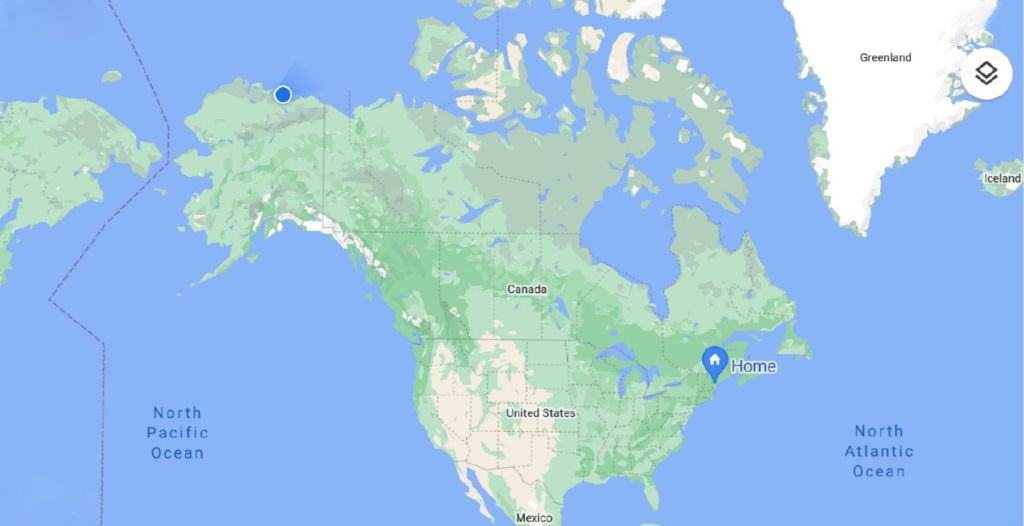
The purchase was initially met with widespread skepticism and ridicule in the American press, earning it epithets like “Seward’s Folly,” “Seward’s Icebox,” and “President Andrew Johnson’s Polar Bear Garden.” Many questioned the wisdom of buying a frozen, desolate wasteland when the nation was still reeling from the Civil War. However, Seward and his supporters argued for its strategic importance in the Pacific and its potential for natural resources, arguments that would be resoundingly validated in the years to come. The purchase officially transferred sovereignty of Alaska from Russia to the United States, cementing its future outside of any potential Canadian federation.
Defining the Border and Resource Riches
The 1867 purchase solidified Alaska’s status as an American territory, but its precise borders with Canada – particularly the intricate Panhandle region – became a source of contention for decades, especially with the discovery of gold.
The Alaskan-Canadian Border Dispute
The initial treaty of 1867 defined the boundary based on an earlier Anglo-Russian Treaty of 1825. This treaty stipulated a boundary line that followed the mountain range nearest the coast up to the 141st meridian west longitude and then along that meridian to the Arctic Ocean. However, the wording “coast” and “mountain range” in the Panhandle region was vague and open to interpretation. For decades, this ambiguity didn’t pose a major problem due to the remote nature of the territory.
The situation changed dramatically with the Klondike Gold Rush of 1896. Thousands of prospectors flocked to the Yukon Territory of Canada, and the most accessible routes often required passing through the Alaskan Panhandle. The control of key ports like Skagway became crucial. Canada argued for a boundary that would give it access to the sea through some of these inlets, while the United States maintained a more expansive interpretation of its coastal strip. The dispute created significant diplomatic tension between the United States and Great Britain (which still represented Canada’s foreign policy interests at the time).
The Boundary Settlement and Enduring Relations
The Alaska boundary dispute was finally resolved in 1903 by an international tribunal composed of three Americans, two Canadians, and one Briton. The tribunal ultimately sided mostly with the American interpretation, granting the United States control over the valuable coastal ports and inlets. While the decision was deeply unpopular in Canada and contributed to a growing sense of Canadian national identity separate from Britain, it definitively settled the physical boundary, reaffirming Alaska’s territorial integrity as part of the United States.
Despite this historical dispute, the relationship between Alaska and its Canadian neighbors, particularly British Columbia and the Yukon Territory, has generally been one of cooperation and shared interests. From shared wilderness management to cross-border tourism and trade, the practicalities of living side-by-side in such a rugged environment have fostered strong regional ties.
Alaska’s Journey to Statehood and Modern Significance
From a distant Russian outpost to an American territory, Alaska’s path to becoming a full-fledged state of the United States was a prolonged one, culminating in 1959. This final step cemented its identity and highlighted its crucial role in the American nation.
From District to Territory to State
Following the purchase, Alaska initially existed as a military district, then a civil district, and finally, in 1912, it was formally organized as an incorporated territory of the United States. This period saw slow but steady development, driven by resource extraction (gold, copper, fishing, and later oil) and a growing population. The strategic importance of Alaska became undeniable during World War II, when the Aleutian Islands became a battleground against Japan and Alaska served as a vital staging point for lend-lease supplies to the Soviet Union. The construction of the Alaska Highway during this period, linking Alaska to the contiguous United States through Canada, underscored its logistical importance.
After the war, the momentum for statehood grew, fueled by a desire for greater political representation and control over its own destiny. Despite opposition from some who felt Alaska was too remote and sparsely populated, statehood was finally granted on January 3, 1959. This marked a profound transformation, integrating Alaska fully into the American federal system.
A Landmark of Strategic and Natural Importance
Today, Alaska stands as a testament to its dramatic history and its unparalleled natural environment. It is a land of superlatives: the largest state by area, home to the highest peak in North America, Denali (formerly Mount McKinley), and possessing an incredible diversity of wildlife and landscapes, from vast boreal forests and tundra to glaciated mountains and active volcanoes.
Economically, Alaska is a major producer of oil and natural gas, fishing, and minerals. Strategically, its location continues to be of paramount importance. During the Cold War, it served as a critical front line against the Soviet Union, with numerous military installations and radar sites. Even today, its proximity to Russia across the Bering Strait and its access to the Arctic Ocean make it a vital component of American defense and a key player in emerging Arctic geopolitics.
In essence, Alaska is not part of Canada because it was acquired by the United States from the Russian Empire at a time when Canada was not yet an independent nation capable of such a transaction, and the geopolitical chessboard favored an American acquisition. This historical landmark decision, often initially dismissed as “Seward’s Folly,” proved to be one of the most astute real estate deals in history, shaping the modern map of North America and bestowing upon the United States an invaluable frontier of natural wonder and strategic significance.
LifeOutOfTheBox is a participant in the Amazon Services LLC Associates Program, an affiliate advertising program designed to provide a means for sites to earn advertising fees by advertising and linking to Amazon.com. Amazon, the Amazon logo, AmazonSupply, and the AmazonSupply logo are trademarks of Amazon.com, Inc. or its affiliates. As an Amazon Associate we earn affiliate commissions from qualifying purchases.