
The story of how the United States acquired California is a captivating saga woven with threads of exploration, imperial ambition, armed conflict, and the powerful allure of the American frontier. Far from a simple transaction, California’s journey into the American union was a complex process stretching over decades, involving multiple cultures, shifting allegiances, and pivotal historical events. Today, California stands as a beacon of innovation, culture, and natural beauty, but its past as a contested territory shaped its very identity. Understanding this historical arc is crucial to appreciating the dynamic forces that forged one of the most significant states in the nation. This exploration delves into the key phases that transformed California from a distant colonial outpost into a cornerstone of the American West.
Early Explorations and Shifting Allegiances
Before becoming a territory of the United States, California had a rich and often tumultuous history under two different colonial powers. Its vast landscapes and strategic Pacific coastline made it a valuable, albeit distant, prize for imperial powers.
Spanish Colonial Era
The first European claim on California was made by Spain. In 1542, Portuguese explorer Juan Rodríguez Cabrillo, sailing under the Spanish flag, was the first European to navigate the coast of what is now California. He claimed the land for Spain, though significant colonization wouldn’t begin for over two centuries. The Spanish presence intensified in the late 18th century, driven by concerns over Russian and British expansion in the North Pacific. Father Junípero Serra established the first of 21 missions in San Diego in 1769, initiating a system that aimed to convert indigenous populations to Christianity and solidify Spanish control. These missions, along with presidios (forts) and pueblos (civilian towns), formed the backbone of Spanish colonial society in New Spain, which California was a part of. However, Spanish control was tenuous; the region was sparsely populated by Europeans and geographically isolated from the centers of Spanish power in Mexico City. The Spanish legacy, including place names, architecture, and agricultural practices, remains deeply embedded in California’s identity.
Mexican Rule and Growing US Interest
The early 19th century brought a seismic shift in California’s governance. In 1821, Mexico gained independence from Spain, and California, along with vast territories across the American Southwest, became a province of the new Mexican Republic. This period saw significant changes, notably the secularization of the missions in the 1830s. Their lands were largely redistributed to Mexican citizens, creating a system of vast ranchos where a wealthy class of Californios (people of Spanish or Mexican descent born in California) thrived. These ranchos formed the dominant economic and social structure, based primarily on cattle raising for hides and tallow.
Simultaneously, American interest in California began to grow. Trappers, traders, and explorers, such as Jedediah Smith and Kit Carson, ventured into the region, initially drawn by the fur trade. Soon, reports of California’s fertile lands and strategic ports, particularly San Francisco Bay, began filtering back East. American merchants established trade routes, exchanging manufactured goods for California’s hides and tallow. These early interactions were generally peaceful, but they laid the groundwork for future tensions as American settlers began to eye the land not just for trade, but for permanent residency. The Mexican government, wary of foreign encroachment but often too weak or distant to effectively govern the northern frontier, struggled to control the increasing flow of American immigrants.
Manifest Destiny and Westward Expansion
The concept of Manifest Destiny, which gained significant traction in the United States during the 1840s, played a pivotal role in shaping American ambitions towards California. This powerful ideology provided a moral and political justification for westward expansion, framing it as a divinely ordained mission to spread democracy and American institutions across the continent.
The Concept of Manifest Destiny
Coined by journalist John O’Sullivan in 1845, “Manifest Destiny” articulated the belief that the United States was destined, by God, to expand its dominion and spread democracy and capitalism across the entire North American continent. This idea resonated deeply with a young, rapidly growing nation eager to fulfill its perceived destiny as a continental power. Proponents of Manifest Destiny saw the acquisition of vast territories, including Oregon, Texas, and crucially, California, as both a natural progression and a national imperative. They envisioned a United States stretching from the Atlantic to the Pacific, securing vital ports for trade with Asia and establishing itself as a global economic force.
California, with its prime location on the Pacific coast, was seen as the jewel in the crown of this expansionist vision. Its deep-water harbors, fertile valleys, and temperate climate made it an incredibly attractive prospect for agricultural development and international trade. The notion that a relatively underdeveloped Mexico was “holding back” these lands from their potential further fueled American expansionist sentiments. This ideological framework provided the political and popular will necessary to pursue a policy of aggressive territorial acquisition, even if it meant conflict.
American Settlers and Increasing Tensions
As the idea of Manifest Destiny took hold, the trickle of American settlers into California grew into a steady stream. These pioneers, often encouraged by land speculators and tales of fertile lands, migrated over the arduous overland trails, establishing communities in areas like the Sacramento Valley. While some integrated into Californio society, many maintained a distinct American identity and harbored annexationist sentiments. They often viewed Mexican laws and governance as arbitrary or inefficient, leading to friction with local authorities.
The Mexican government, for its part, was increasingly alarmed by the influx of these foreign settlers. Laws were passed to limit immigration and restrict land ownership for non-citizens, but enforcement was difficult due to the vastness of the territory and the limited military presence. Figures like John C. Frémont, an American explorer and military officer, played a controversial role during this period. Officially on mapping expeditions, Frémont’s actions were often perceived by Mexican authorities as thinly veiled attempts to stir up rebellion among American settlers. His presence, along with the growing number of American immigrants, significantly heightened tensions and set the stage for direct confrontation. The stage was thus set for a decisive clash between Mexican sovereignty and American expansionist ambitions.
The Bear Flag Revolt and the Mexican-American War

The simmering tensions in California eventually boiled over, coinciding with and becoming an integral part of a larger conflict between the United States and Mexico. These events directly accelerated California’s path to becoming an American territory.
The Spark of Rebellion
In the spring of 1846, with rumors of war between the United States and Mexico circulating, a group of American settlers in Sonoma decided to take matters into their own hands. Encouraged by the presence and implied support of John C. Frémont, who was then leading a government exploring expedition in the region, these settlers launched a pre-emptive strike against Mexican authorities. On June 14, 1846, they captured the Mexican garrison at Sonoma, taking General Mariano Guadalupe Vallejo prisoner. They then declared the establishment of the independent California Republic.
To symbolize their new nation, they hoisted a crude flag featuring a grizzly bear and a star—the iconic “Bear Flag.” The revolt was short-lived and somewhat chaotic, lacking widespread support among all American settlers and certainly among the Californios. However, it served as a significant catalyst, drawing American attention to the region and providing a convenient pretext for military intervention. The Bear Flag Revolt effectively severed Mexican administrative control over a portion of Northern California just as the larger conflict was about to erupt.
War with Mexico
The Bear Flag Revolt quickly merged with the broader Mexican-American War, which officially began in May 1846 following a border dispute in Texas. News of the war reached California in July 1846, prompting decisive action from the United States Navy. Commodore John D. Sloat, commanding the Pacific Squadron, sailed into Monterey Bay and formally raised the American flag, proclaiming California as part of the United States. Other naval forces quickly followed suit, seizing key ports like San Francisco and Los Angeles.
The military campaign to secure California was not without resistance. Californio forces, under the leadership of figures like General José Castro and Andrés Pico, mounted spirited but ultimately outmatched resistance. Notable engagements included the Battle of San Pasqual and the Battle of the Rio San Gabriel. American forces, including naval landing parties, Frémont’s irregulars (who formed the “California Battalion”), and later arriving U.S. Army troops, systematically consolidated control. By early 1847, with the signing of the Treaty of Cahuenga, organized Mexican resistance in California effectively ceased. The war continued elsewhere, but California was firmly under American military occupation, paving the way for its formal transfer.
The Treaty of Guadalupe Hidalgo and Statehood
The conclusion of the Mexican-American War formalized California’s place within the United States, and a subsequent, unexpected event propelled it rapidly towards statehood. This final phase cemented California’s future.
Ceding California
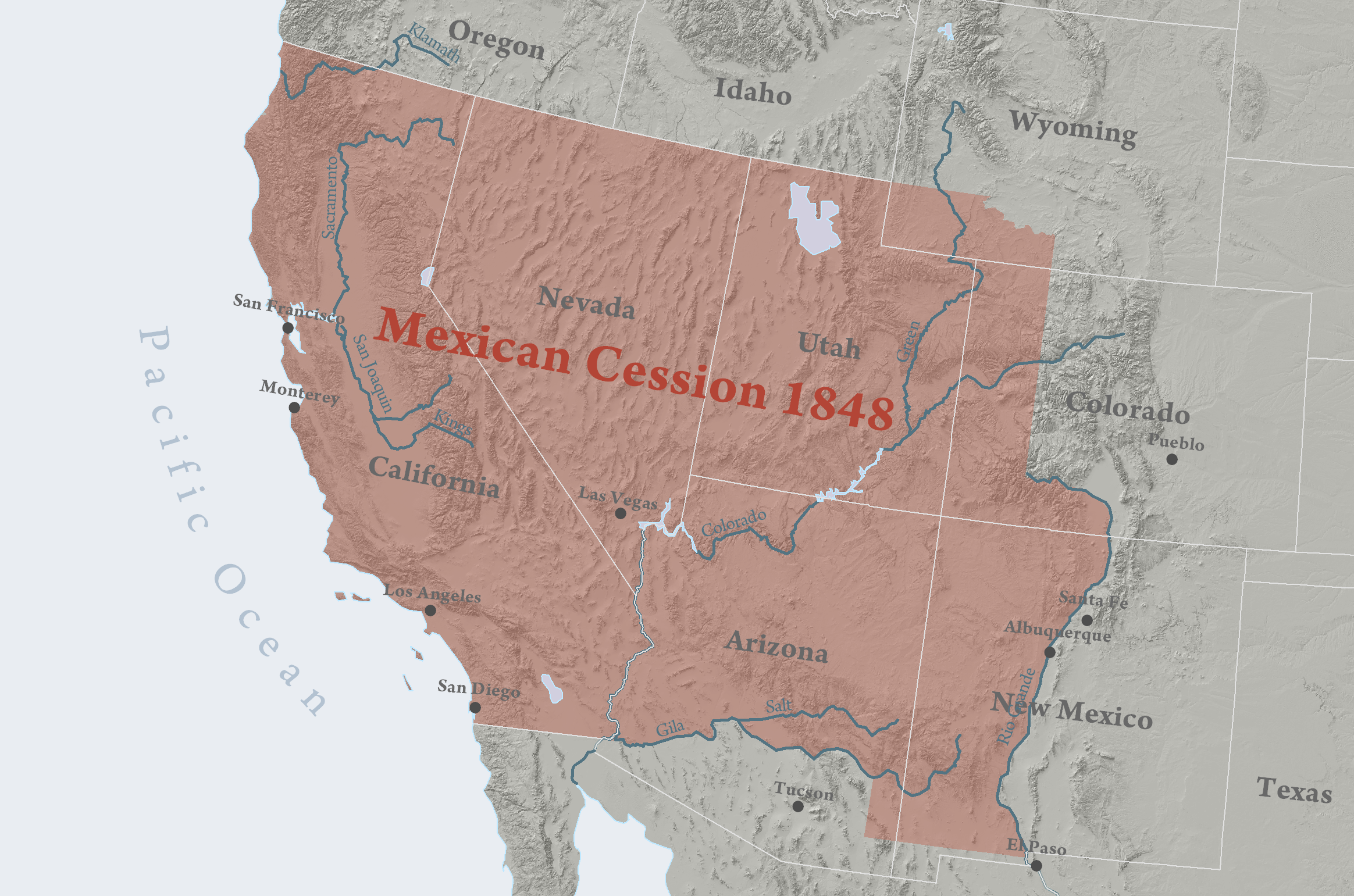
The Mexican-American War concluded with the signing of the Treaty of Guadalupe Hidalgo on February 2, 1848. This momentous treaty officially ended hostilities and fundamentally reshaped the map of North America. Under its terms, Mexico ceded vast territories to the United States, encompassing what would become the states of California, Nevada, Utah, Arizona, and parts of Colorado, New Mexico, and Wyoming. In return, the United States agreed to pay Mexico $15 million and assume about $3.25 million in claims by U.S. citizens against Mexico.
For California, the treaty was a formal declaration of its new allegiance. It transformed the former Mexican province into an American territory, bringing with it American laws, institutions, and a new framework for governance. The treaty also stipulated that Mexicans residing in the ceded territories could choose to retain Mexican citizenship or become U.S. citizens, with guarantees for their property and civil rights—though these guarantees were often poorly enforced in practice, leading to significant land loss for many Californios. The formal transfer of sovereignty marked a definitive end to California’s colonial and Mexican eras and heralded its future as a burgeoning American state.
The Gold Rush and Rapid Development
Just days before the Treaty of Guadalupe Hidalgo was signed, an event occurred that would irrevocably alter California’s trajectory and accelerate its development at an unimaginable pace: the discovery of gold. On January 24, 1848, James W. Marshall found flakes of gold at Sutter’s Mill near Coloma. Initially kept quiet, news of the discovery exploded by late 1848 and throughout 1849, triggering the legendary California Gold Rush.
Hundreds of thousands of “Forty-Niners” from across the United States and around the world descended upon California, transforming a sparsely populated territory into a bustling, chaotic, and rapidly growing frontier. Mining camps sprang up overnight, cities like San Francisco swelled from sleepy towns into major ports, and the demand for goods and services fueled an unprecedented economic boom. The Gold Rush created immense wealth, albeit for a minority, and attracted a diverse population, laying the groundwork for California’s multicultural identity. This sudden explosion of population and economic activity made stable governance under a territorial system increasingly untenable and created an urgent need for more formal political structures.
California Achieves Statehood
The immense population growth and economic upheaval brought by the Gold Rush created an immediate imperative for California to transition from a military-governed territory to a formal state. The existing legal and administrative framework was insufficient to manage the influx of people, the rampant crime, and the complex land claims. In 1849, a constitutional convention was held in Monterey, where delegates drafted a state constitution that prohibited slavery, despite the South’s strong opposition to another free state joining the Union.
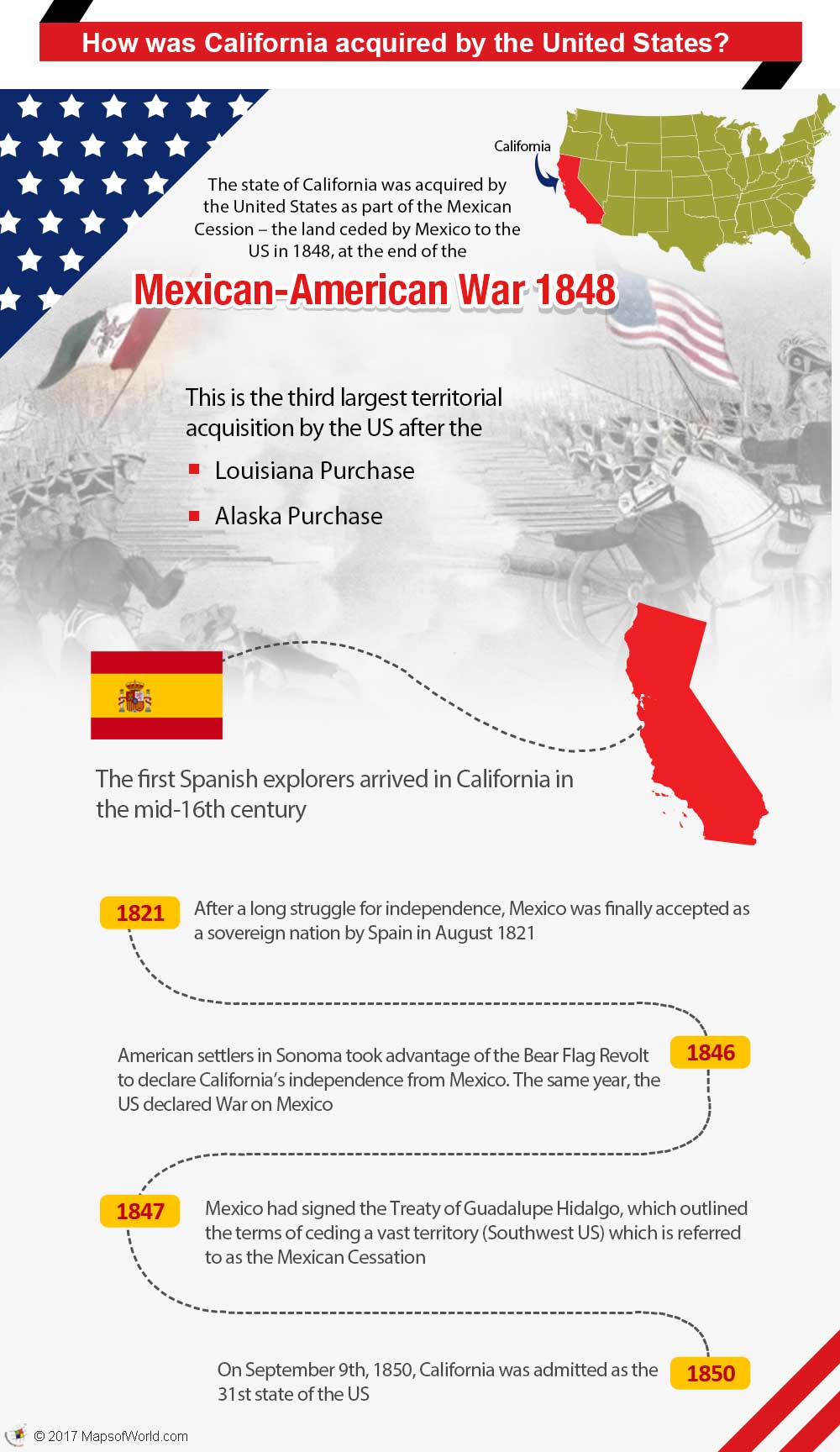
California’s application for statehood quickly became a flashpoint in the national debate over slavery, threatening to upset the delicate balance between free and slave states. However, the urgency of its unique situation, combined with political maneuvering in Washington D.C., led to a solution. California was admitted to the Union as the 31st state on September 9, 1850, as part of the Compromise of 1850. This series of legislative acts addressed several slavery-related issues, allowing California to enter as a free state while making concessions to the South elsewhere. Thus, in a remarkably short span of just over two years after the Treaty of Guadalupe Hidalgo, California transitioned from a foreign territory to a full-fledged American state, forever altering the geopolitical landscape of the United States.
The acquisition of California by the United States was a multi-faceted process driven by a potent mix of exploration, ideological conviction, military conquest, and sheer economic opportunity. From its initial claims by Spain and subsequent Mexican rule, to the aggressive expansionism of Manifest Destiny and the sudden catalyst of the Gold Rush, California’s journey into the Union is a testament to the dynamic forces that shaped the American nation. It stands as a profound historical landmark, reflecting the ambitions, conflicts, and transformative events that forged one of the most vibrant and influential states in the modern world.
LifeOutOfTheBox is a participant in the Amazon Services LLC Associates Program, an affiliate advertising program designed to provide a means for sites to earn advertising fees by advertising and linking to Amazon.com. Amazon, the Amazon logo, AmazonSupply, and the AmazonSupply logo are trademarks of Amazon.com, Inc. or its affiliates. As an Amazon Associate we earn affiliate commissions from qualifying purchases.