
Receiving a ticket, whether it’s for a parking violation, a speeding infraction, or any other misdemeanor, can be a frustrating experience. Beyond the initial annoyance, the real challenge often begins when you need to navigate the administrative process of addressing it. In the state of California, understanding where to locate the crucial citation number on your ticket is the very first step toward resolving the issue efficiently. This seemingly simple piece of information is the key to paying your fine, requesting traffic school, or challenging the citation in court. For residents and visitors alike, knowing how to quickly identify this number can save valuable time and prevent further complications. This guide will walk you through the nuances of California tickets, ensuring you can confidently locate your citation number and proceed with the necessary actions.
Understanding the Importance of Your Citation Number
The citation number isn’t just a random string of characters; it’s a unique identifier for your specific violation. Think of it as the social security number for your ticket. Without it, most online portals, phone systems, and even in-person inquiries at the courthouse will be unable to retrieve your record. Its importance extends beyond mere identification, serving as the primary reference point for all subsequent actions you might take.
Why the Citation Number is Crucial
The citation number is the cornerstone of the entire process for several critical reasons:
- Online Access: Most California counties offer online portals for viewing ticket details, paying fines, and requesting extensions. The citation number is almost always the primary, if not sole, method of accessing your record. Without it, you’re locked out of these convenient digital services.
- Court Correspondence: When you communicate with the Superior Court (or the specific traffic division), whether by phone, mail, or in person, referencing your citation number ensures that court staff can quickly pull up your case. This prevents delays and miscommunications.
- Legal Representation: If you decide to hire a traffic attorney, the citation number will be the first piece of information they request. It allows them to research your case, understand the charges, and properly represent you.
- Proof of Payment/Resolution: Should any dispute arise regarding whether you’ve paid your fine or completed traffic school, the citation number is your definitive proof of the transaction or action taken. Always keep a record of it.
- Tracking Deadlines: Your citation number is linked to specific deadlines for payment, court appearances, and traffic school completion. Missing these deadlines can lead to increased fines, a suspended driver’s license, or even a warrant for your arrest.
Common Scenarios Leading to a Citation
Citations in California can arise from a multitude of situations, impacting both local residents and tourists exploring the Golden State. Understanding the context can sometimes help in recalling where specific details might have been provided.
- Traffic Violations: These are perhaps the most common, including speeding, running red lights, illegal turns, improper lane changes, or driving under the influence (DUI). These are typically issued by police officers (e.g., California Highway Patrol, city police departments like Los Angeles Police Department or San Francisco Police Department, or county sheriffs).
- Parking Violations: Parking illegally, expired meters, parking in restricted zones, or blocking driveways fall under this category. These tickets are often placed directly on your vehicle.
- Mechanical Violations: Issues like expired registration tags, broken headlights/taillights, tinted windows that violate regulations, or missing license plates can also result in citations.
- Other Infractions: Less common but still possible are citations for littering, minor public disturbances, or other local ordinance violations. While not strictly traffic-related, they often follow a similar administrative process.
Regardless of the scenario, the need to locate that elusive citation number remains paramount.
Decoding a California Traffic Ticket
California tickets, while generally following a standard format, can vary slightly depending on the issuing agency (e.g., city police, county sheriff, California Highway Patrol). However, the critical information, including the citation number, is usually presented in a prominent and consistent manner.
Front and Back: Where to Look First
When you receive a ticket, whether handwritten by an officer or printed from an electronic device, your first instinct should be to examine both sides.
- Front Side (The Original Document): This is where the officer records most of the details of the infraction. You’ll find information about the violation itself, the date and time, location, your vehicle information, and your personal details. Crucially, this is the most common place for the citation number to appear.
- Back Side (Instructions and Information): The back of the ticket typically contains important instructions regarding how to pay the fine, options for traffic school, court appearance details, and contact information for the relevant court or agency. Sometimes, a smaller, secondary reference number might be here, but the primary citation number is almost always on the front.
Different Types of California Tickets (Parking, Moving, Infraction)
The appearance of the citation number can also slightly differ based on the type of ticket:
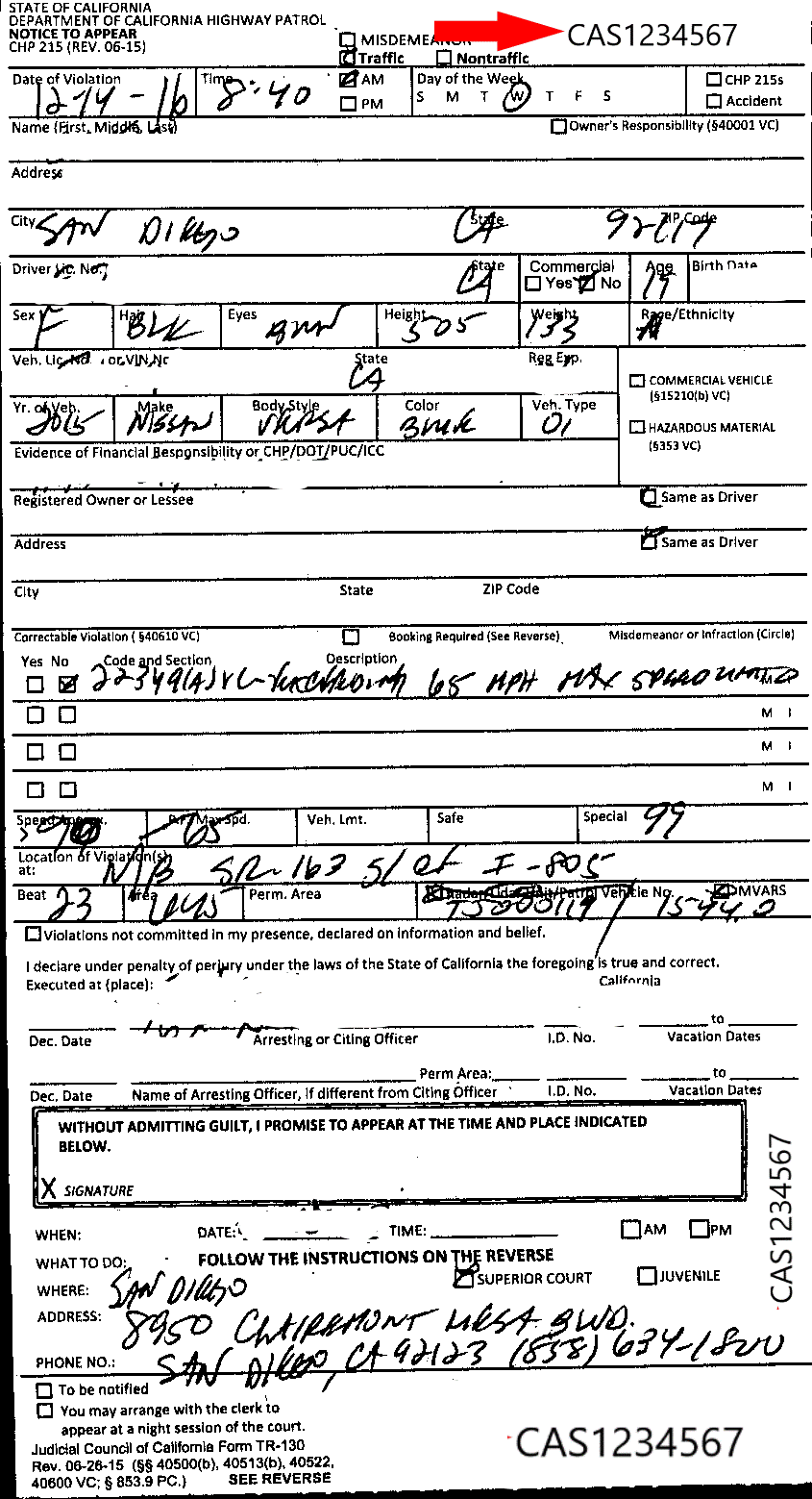
- Moving Violation Tickets: These are often handed directly to you by a law enforcement officer. They are typically larger, multi-part forms. The citation number is almost always a prominent, bolded number at the very top or bottom of the ticket’s front page. It might be labeled as “Citation No.”, “Ticket No.”, “Case No.”, or “Docket No.” and is usually an alphanumeric string.
- Parking Tickets: These are usually smaller, often single-sheet documents, and are affixed to your vehicle. The citation number (often called “Violation Number” or “Ticket Number”) is typically found at the very top or bottom of the ticket, often in a distinct box or highlighted section.
- Infraction (Non-Traffic) Tickets: For minor infractions not related to traffic (e.g., littering), the format might resemble a standard traffic ticket or be a simpler form. Again, look for a clearly labeled “Citation Number” or “Case Number.”
Key Sections of a Standard Citation
Familiarizing yourself with the general layout of a California ticket can help you quickly hone in on the citation number:
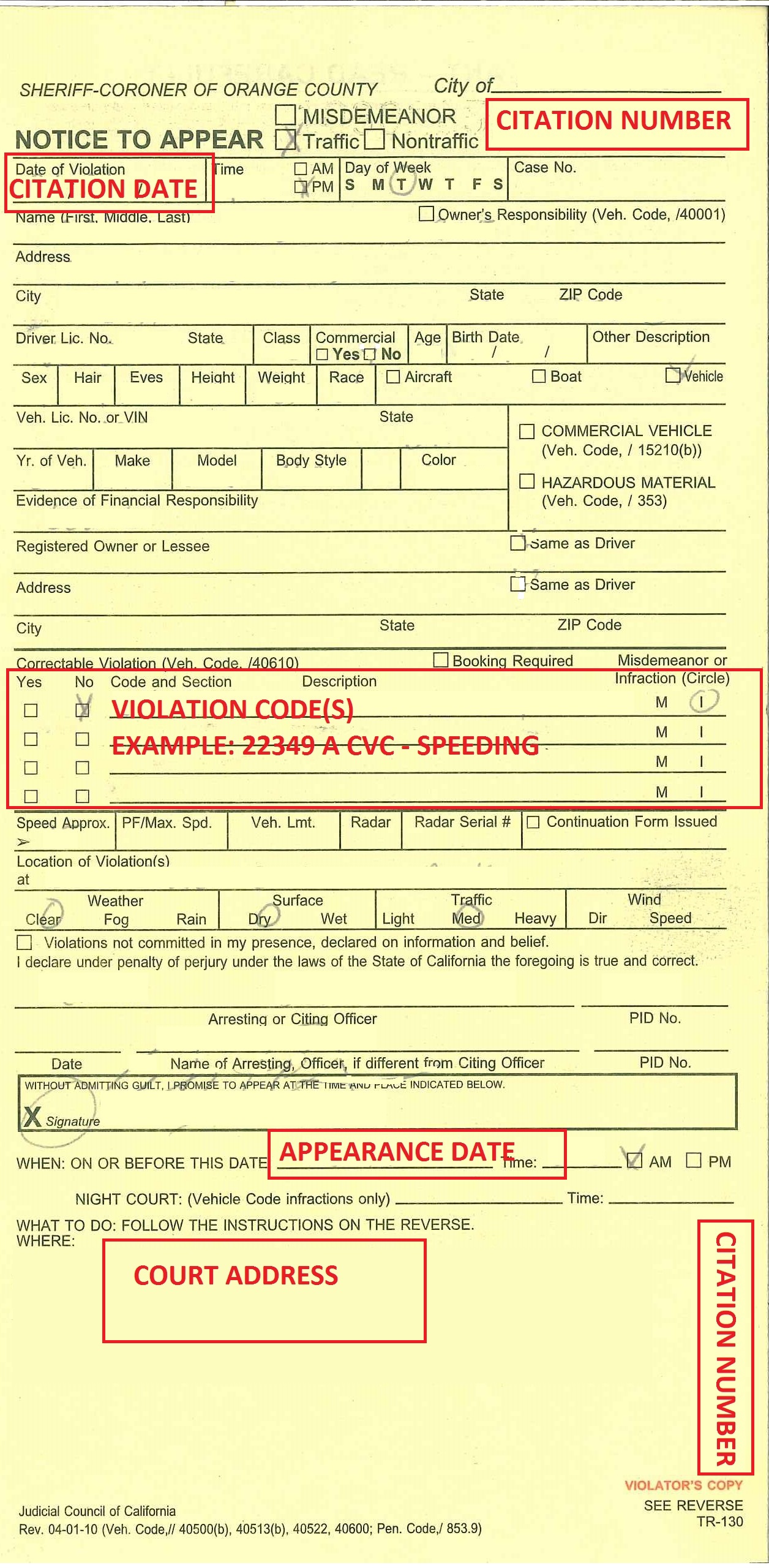
- Header Information: This usually includes the issuing agency (e.g., California Highway Patrol, Sacramento Police Department), date of issue, and sometimes the court name.
- Your Information: Your name, address, driver’s license number, and vehicle information.
- Violation Details: Specific Vehicle Code section violated, a description of the offense, and the location.
- Court Information: The name and address of the court you need to contact or appear at, often with a due date.
- Signature Line: Your signature acknowledging receipt (for moving violations).
- The Citation Number: This is the critical piece of information you’re looking for. It’s often found near the top right or top left, or sometimes prominently centered at the bottom, usually in a larger font or a dedicated box. It can be a combination of letters and numbers, typically 7-10 characters long.
Pinpointing the Citation Number: A Step-by-Step Guide
Even with varying formats, there are reliable places to search for your citation number. Consistency, for the most part, is key across California’s diverse law enforcement agencies.
The Standard Location on a Handwritten Ticket
For tickets handwritten by an officer, the citation number is almost always at the top of the form.
- Look for a Bolded or Boxed Number: Scan the upper portion of the ticket for a number that stands out. It might be in a shaded box, bolded, or printed in a larger font than the surrounding text.
- Keywords to Spot: Common labels accompanying the number include: “CITATION NO.”, “TICKET NO.”, “CASE NUMBER”, “VIOLATION NO.”, or “NOTICE TO APPEAR.”
- Check Both Corners: It’s often in the top right or top left corner. Sometimes, it might be printed vertically along one of the sides.
- Multi-Part Forms: If you received a multi-part carbon copy form, the citation number will be printed on all copies. Ensure you’re looking at your copy, which usually has the instructions on the back.
Electronic Tickets and Their Nuances
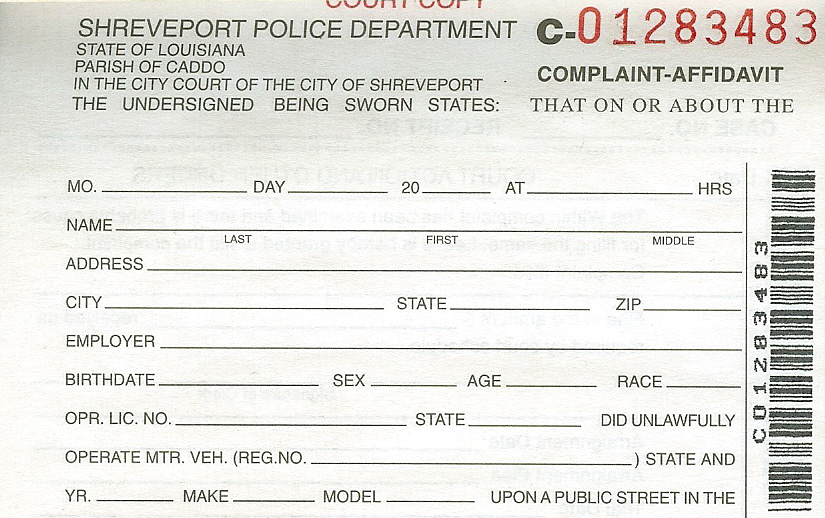
As law enforcement agencies increasingly adopt electronic ticketing systems, the appearance of the citation number on printed electronic tickets can be slightly different, though often clearer.
- Printed Receipts: Electronic tickets are usually printed on a thermal receipt printer. The information is typically very clear and well-organized.
- Header Prominence: The citation number (or “Notice to Appear” number) will almost always be prominently displayed in the header section of the receipt, often as the first or second line of printed text.
- Digital Format Consistency: Because these are generated by software, the placement tends to be highly consistent across tickets issued by the same agency, making them easier to locate once you’ve seen one.
- DMV Records: If an electronic ticket was issued, and you’ve misplaced your copy, sometimes you can find record of it by checking your driving record through the Department of Motor Vehicles (DMV) or directly contacting the court using your driver’s license number, though this is less direct than having the citation number.
What to Do If You Cannot Find It
If, after thoroughly checking both sides of your ticket, you still cannot locate the citation number, don’t panic. There are still avenues to pursue:
- Contact the Issuing Agency: If you remember which law enforcement agency issued the ticket (e.g., California Highway Patrol, Los Angeles County Sheriff’s Department, San Diego Police Department), contact their non-emergency line. Provide them with your name, date of birth, driver’s license number, and the approximate date and location of the incident. They may be able to retrieve the number for you.
- Contact the Relevant Court: Based on the location where you received the ticket, you can usually infer which Superior Court district handles the case. Visit or call the traffic division of that court. With your driver’s license number and date of birth, they might be able to search for outstanding citations under your name. Be prepared for potentially longer wait times.
- Check Online Court Portals (with caution): Some county court websites allow you to search for citations using your driver’s license number or even just your name. However, these systems are not always comprehensive or perfectly up-to-date, and privacy concerns limit the information displayed.
- Wait for a Courtesy Notice: In some cases, the court may mail a “courtesy notice” with additional information, including the citation number, to the address on your driver’s license. However, relying on this is risky, as it might not arrive before your payment or appearance deadline.
Next Steps After Locating Your Citation Number
Once you have successfully identified your citation number, you’re ready to take action. Ignoring a ticket in California is not an option, as it can lead to severe penalties.
Online Payments and Court Information
The most common next step for many is to resolve the ticket online.
- County Superior Court Websites: Each county in California has its own Superior Court website. Navigate to the traffic division section. You will typically find a link for “online payments” or “case search.”
- Enter Your Citation Number: Input your citation number into the designated field. This will pull up your case details, including the fine amount, options for traffic school, and your due date.
- Payment Options: Most sites offer credit/debit card payments. Be aware that convenience fees may apply.
- Traffic School Eligibility: The system will often indicate if you are eligible for traffic school, which, upon completion, can prevent points from being added to your driving record for minor infractions.
Seeking Legal Counsel in California
For more serious violations, or if you believe you were unjustly cited, seeking legal counsel is a prudent step.
- Traffic Attorneys: California has many attorneys specializing in traffic law. Provide them with your citation number, and they can advise you on the best course of action, which might include contesting the ticket in court.
- Public Defenders: If you are facing a misdemeanor or felony traffic offense and cannot afford an attorney, you may be eligible for a public defender.
- Understanding Your Rights: An attorney can help you understand your rights, the potential consequences of a conviction (points, insurance increases, license suspension), and build a defense strategy.
Deadlines and Consequences of Inaction
California courts operate on strict deadlines. It is crucial to mark your calendar and act promptly.
- Initial Appearance/Payment Date: This is typically listed on the ticket itself or on the courtesy notice.
- Failure to Appear (FTA): If you fail to appear in court or pay your fine by the due date, a “Failure to Appear” can be entered on your record. This can result in significantly increased fines, a hold on your driver’s license, and potentially a warrant for your arrest.
- DMV Consequences: Unresolved tickets are often reported to the Department of Motor Vehicles (DMV). This can lead to a hold on your vehicle registration renewal or a suspension of your driver’s license until the matter is resolved.
Preventing Future Citations in the Golden State
While knowing how to handle a ticket is essential, preventing them in the first place is always the best approach. California’s roads are beautiful but can also be complex, with specific regulations in different areas.
Familiarizing Yourself with California Traffic Laws
Laws vary from state to state, and California has its own unique regulations.
- Vehicle Code: The California Vehicle Code is extensive. While you don’t need to memorize it, being aware of common violations, speed limits, lane usage rules, and signage can significantly reduce your risk.
- Specific City Ordinances: Some cities like San Francisco or Los Angeles have specific local ordinances, especially regarding parking, that differ slightly from state law. Pay attention to local signage.
- Hands-Free Devices: Be mindful of California’s strict hands-free device laws. Using a cell phone without a hands-free device is a primary offense.
Defensive Driving Practices
Beyond knowing the rules, adopting safe driving habits is paramount.
- Maintain Awareness: Always be aware of your surroundings, other vehicles, pedestrians, and road conditions.
- Adhere to Speed Limits: Speeding is one of the most common reasons for citations. Pay attention to posted speed limits and adjust for traffic and weather.
- Signal Properly: Always signal your turns and lane changes well in advance.
- Avoid Distractions: Put away your phone, avoid eating messy foods, and keep your focus solely on driving.
Staying Informed About Road Rules
Laws and regulations can change, and staying updated ensures you’re always compliant.
- DMV Website: The California Department of Motor Vehicles (DMV) website is an excellent resource for current traffic laws, driver handbooks, and updates.
- Traffic Apps and GPS: Many navigation apps provide real-time traffic updates and can alert you to speed cameras or traffic enforcement zones.
- Driving Courses: Periodically refreshing your driving knowledge with an online or in-person defensive driving course can reinforce good habits and make you aware of new laws.
By understanding where to find your citation number and proactively managing the associated process, you can transform a potentially stressful situation into a manageable task. Armed with this knowledge and a commitment to safe driving, navigating the roads and administrative nuances of the Golden State becomes a much smoother experience.
LifeOutOfTheBox is a participant in the Amazon Services LLC Associates Program, an affiliate advertising program designed to provide a means for sites to earn advertising fees by advertising and linking to Amazon.com. Amazon, the Amazon logo, AmazonSupply, and the AmazonSupply logo are trademarks of Amazon.com, Inc. or its affiliates. As an Amazon Associate we earn affiliate commissions from qualifying purchases.